

What Happens on the Day of a Hair Operation: Check-In, Hairline Drawing and Graft Placement
Key Takeaways
- A hair operation is usually performed under local anesthetic while you are awake, and the NHS describes it as a day procedure without an overnight stay.
- Cleveland Clinic puts a typical session at about four to eight hours, with the slow part being graft placement rather than harvesting.
- The hairline is drawn and agreed in a mirror before any anesthetic is given, because placed grafts cannot be undone later.
- Grafts are generally anchored by around ten to fourteen days, and shedding of transplanted hairs between two and four weeks is a normal resting phase, not graft loss.
- The NHS advises about three days before returning to work, roughly a month away from sport and sun, and new visible growth from around six months.
- Transplanted hair is relocated, not created, so the size of the permanent donor zone sets the ceiling for what any session can achieve.
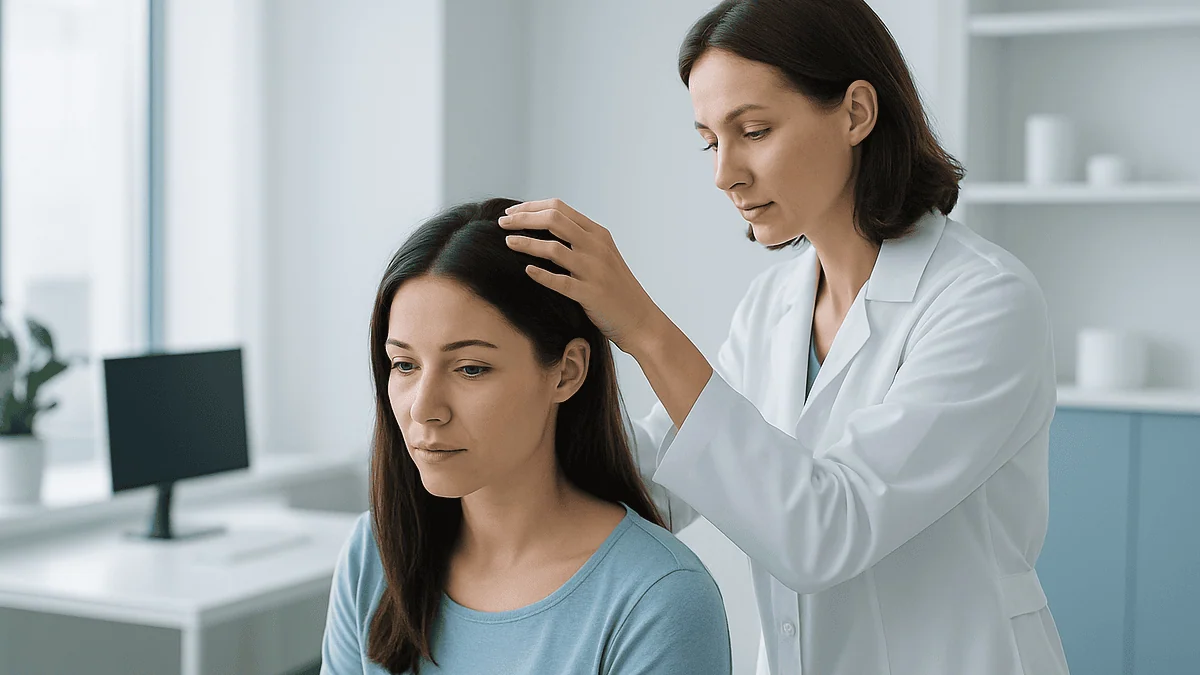
On the day of a hair operation, you check in, confirm consent and your medical history, and the surgeon draws and agrees the new hairline with you while you sit upright. The scalp is numbed with local anesthetic, sometimes with light sedation. Follicles are harvested from the back or sides of the head and placed one graft at a time into tiny incisions. Most sessions last several hours, and you usually go home the same day.
The night before, most people do the same small thing: they stand at the bathroom mirror, push their fringe back with two fingers, and try to picture where the new line will sit. Then they set two alarms, lay out a button-up shirt because a T-shirt has to go over the head, and wonder whether they will feel the needle.
Those are reasonable worries, and the honest answers are more ordinary than the internet suggests. If you have been searching for what happens on hair operation day, this is the long version: the check-in paperwork, the marker pen and the mirror, the numbing, the hours of quiet work in a reclining chair, and the drive home with a headband of gauze.
Nothing here is a promise about results. It is a description of a typical day, drawn from mainstream medical sources, so that the unfamiliar parts feel a little less strange when they arrive.
Hair operation day: what happens, step by step?
A hair transplant moves hair follicles from a part of the scalp that keeps its hair for life, usually the back and sides, to an area that has thinned. The follicles carry their own genetic instructions with them, which is why transplanted hair tends to keep growing where it lands. The day is built around that single idea: take healthy follicles out without damaging them, and put them back in at the right angle, depth and direction.
The sequence is remarkably consistent across surgeons. You arrive, check in, and go through consent and a short medical review. The surgeon photographs your scalp, draws the planned hairline and donor zone, and confirms it with you in a mirror. The donor area is trimmed or shaved as needed. Local anesthetic is injected to numb the scalp, and some people are offered mild sedation on top. Follicular units, the natural bundles of one to four hairs the scalp grows in, are removed either individually or as a narrow strip. Technicians sort them under magnification while the surgeon makes tiny recipient incisions in the thinning area. Grafts are then placed, one by one, into those incisions. A dressing goes on, aftercare is explained, and you go home.
The NHS describes the procedure as normally carried out under local anesthetic and usually taking a day, without an overnight stay. That matches what most people experience: a long, slow, oddly calm day in a chair, punctuated by bathroom breaks, a sandwich, and a great deal of counting by the team around you.
Everything that follows expands on each of those steps, in the order you will meet them.
What happens at check-in before a hair operation?
Check-in feels administrative, and it is, but it exists for safety rather than paperwork’s sake. Expect to confirm your identity, sign or re-read the consent form, and walk through your medical history one more time. The team will ask about allergies, past reactions to local anesthetic, bleeding problems, blood pressure, diabetes, and any medicines or supplements you take. Some of these, including common blood-thinning agents and certain herbal products, affect bleeding during surgery; whether anything should be paused, and for how long, is a decision for your prescribing clinician and the surgical team, never something to change on your own.

A nurse usually records your blood pressure and pulse. If either is unusually high on the day, the team may wait, recheck, or in some cases postpone. That is not a rejection; it is a judgment about whether the scalp will bleed more than it should while the grafts are being placed.
You will be asked to wash your hair that morning with plain shampoo and to arrive without styling products, hats that press on the crown, or caffeine excess, since stimulants can raise heart rate and bleeding. Most services also ask you to eat a normal breakfast unless sedation instructions say otherwise. Wear something that opens at the front. Pulling a tight collar over freshly placed grafts at the end of the day is exactly what you want to avoid.
Photographs come next: front, top, sides and back, under standard lighting. They are your baseline and the team’s, and they become the only fair way to judge change later, because memory of one’s own hairline is notoriously unreliable.
Finally, someone will confirm how you are getting home. Even without sedation, a scalp full of anesthetic, a dressing and eight hours in a chair are good reasons not to drive yourself.
Why does the hairline drawing take so long?
The marker pen stage often surprises people. It can take twenty or thirty minutes of drawing, wiping, stepping back and drawing again, and it is arguably the most important half hour of the day. Grafts, once placed, are permanent. A hairline drawn too low or too straight cannot be quietly undone later.
Surgeons think about three things while they draw. The first is the donor supply. Every person has a finite number of follicles in the permanent zone, and the Mayo Clinic notes that hair loss is usually progressive, so a plan has to leave enough donor hair for the years ahead rather than spending it all on a youthful line now. The second is anatomy: the hairline typically sits above the frontalis muscle, the sheet of muscle that raises your eyebrows, so that it does not move when you make a surprised face. The third is irregularity. Natural hairlines are not ruler-straight; they have small peaks and dips, single hairs scattered in front of denser rows, and a softer temple angle than most people expect. A slightly imperfect line reads as real. A perfect one reads as drawn.
You are part of this. You will be asked to sit upright, look straight ahead in a mirror, then tilt your chin down as you would when someone taller stands beside you. If the line looks wrong to you, this is the moment to say so, plainly. Good teams expect debate at this stage and would rather redraw four times than place a single graft in a spot you did not agree to.
Once settled, the donor zone is marked as well, and the drawing is photographed. Those two pen lines are the whole plan for the day.
Is hair surgery painful? How the scalp is numbed
Local anesthetic works by blocking the sodium channels that nerves use to send pain signals, so the scalp goes numb while you stay awake and able to talk. It is injected in a ring around the donor area and later around the recipient area. The honest part: those first injections sting, and many people describe them as the most uncomfortable minutes of the entire day. The sensation lasts seconds per injection and fades as the drug spreads. Some teams add a vibrating device or cold to distract the skin’s nerves, and some offer light sedation, a medicine given to make you drowsy and relaxed rather than unconscious. Whether sedation is used, and which agent, is a decision for the anesthesia and surgical team based on your health.
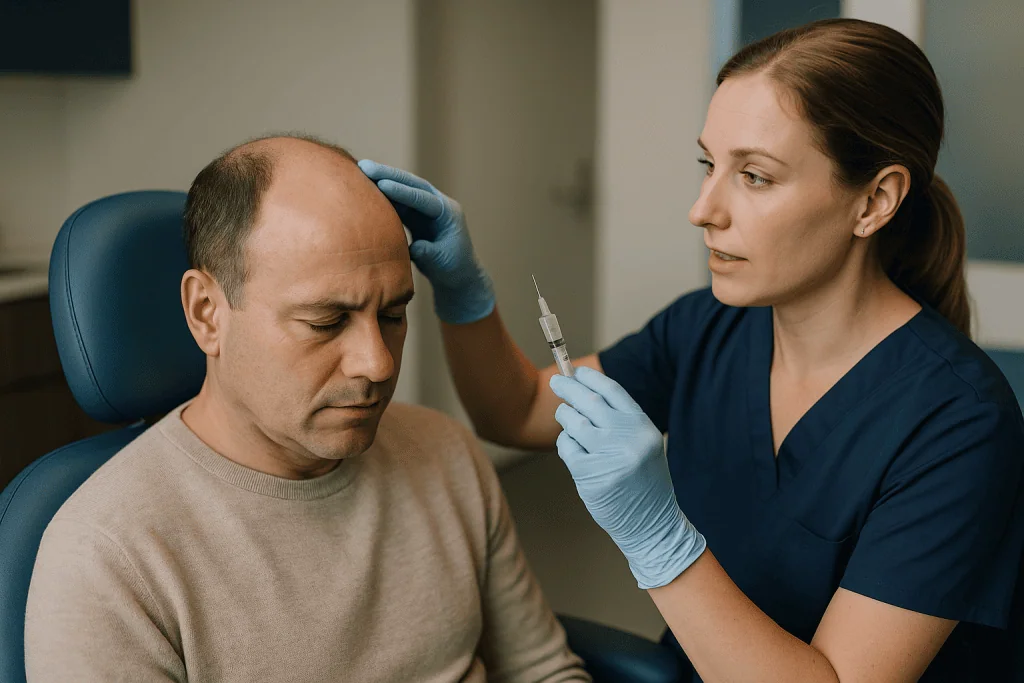
Once numb, the sensations change character. You may feel pressure, tugging, and the vibration of instruments against bone, but not sharp pain. If sharpness returns, say so; anesthetic wears off over hours and is simply topped up. Nobody is expected to tough it out.
Afterwards, when the anesthetic fades that evening, the scalp usually feels tight, tender and swollen rather than acutely painful. The donor area tends to be sorer than the recipient area, especially after a strip procedure. The NHS describes the scalp as likely to be tight and sore for a few days. Pain relief, if needed, is prescribed or advised by the team; some over-the-counter options increase bleeding, which is why they will tell you which ones to avoid rather than leaving it to guesswork.
People often ask whether the procedure being painless means it is minor. It is not minor; it is a lengthy surgical procedure that happens to be comfortable because of how it is anesthetized.
FUE vs FUT: what actually happens during graft harvesting
There are two ways to take follicles out, and both are in mainstream use. Follicular unit transplantation, usually shortened to FUT, removes a narrow horizontal strip of scalp from the back of the head; the wound is closed with stitches or staples, and technicians divide the strip into individual follicular units under microscopes. Follicular unit extraction, or FUE, removes each follicular unit directly with a tiny circular punch, leaving hundreds of dot-sized openings that heal on their own. The NHS lists both as standard approaches.
What you notice on the day differs. FUE usually requires the donor area to be shaved short so the punch can see each unit; FUT can often be done with a strip hidden under longer hair. FUE is slower per graft and involves the surgeon or a device working methodically across the whole donor zone while you lie face down or on your side. FUT harvest itself is quicker, but the closure adds a linear scar that is concealed by hair above it.
| Step on the day | FUT (strip) | FUE (punch) |
|---|---|---|
| Donor preparation | Strip area trimmed; surrounding hair can stay long | Donor zone usually shaved to a few millimeters |
| How grafts are removed | One strip of skin, then dissected under microscopes | Individual follicular units taken one at a time |
| Wound left behind | One line closed with stitches or staples | Many tiny circular openings, left open |
| Position during harvest | Face down for the strip, then upright | Face down or on the side for a longer stretch |
| Follow-up need | Stitches or staples removed at a later visit | No sutures to remove |
Neither method is universally better. The right choice depends on your hair characteristics, how you wear your hair, scalp laxity, how many grafts are planned, and your surgeon’s judgment. The recipient side of the operation, where the grafts are placed, is identical either way.
What happens during graft placement?
Placement is the long middle of the day, and it is quieter than most people imagine. Once the donor area is harvested, the grafts wait in a chilled holding solution, because follicles out of the body are living tissue and survive best kept cool and moist. Technicians sort them by the number of hairs each contains. Single-hair units are set aside for the very front edge, where they mimic the fine, sparse hairs of a natural hairline; two- and three-hair units go further back where density matters more.
The surgeon then makes the recipient sites: tiny slits or needle openings in the thinning skin, each angled to match how your existing hair leaves the scalp. Direction is the detail people rarely think about. Hair at the front points forward and slightly down, hair at the crown spirals, and hair at the temples flattens against the skull. Getting the angle wrong by even a few degrees produces hair that stands up or crosses its neighbors. Making sites is precise work, often done with magnifying loupes, and the surgeon controls the pattern and density personally.
Placement itself is done with fine forceps or an implanter pen, a hollow needle that loads a graft and releases it as it withdraws. Each graft is guided into a site so that the follicle sits at the correct depth: too deep and it can pit or become buried, too shallow and it can pop out or dry. Skilled placers handle grafts by the surrounding tissue rather than the follicle itself, because crushing the base is one of the main ways a graft fails to survive.
You will be asked to keep your head still but can talk, listen to something, or sleep. There is usually a proper lunch break, and the team will keep checking that you are numb and comfortable.
How long does a hair transplant take on the day?
Plan for a full day. The NHS states that a hair transplant usually takes a day and does not normally require an overnight stay. Cleveland Clinic gives a typical range of about four to eight hours in the chair, with larger sessions running longer or, occasionally, being divided over two consecutive days. Those figures are averages, not commitments; your own day depends on graft number, technique and how quickly your scalp cooperates.
Where does the time go? Check-in, photographs and hairline drawing commonly take the first hour. Numbing and harvesting follow, and FUE harvesting of a large number of grafts can occupy several hours on its own because each unit is removed individually. Sorting happens in parallel. Site creation is usually under an hour, and placement, the slowest part per graft, fills the afternoon. Dressings and the aftercare briefing close the day.
Two practical points follow from this. First, clear your calendar entirely; nobody should be squeezing a graft session between meetings. Second, ask for the expected finish time at check-in so the person collecting you is not waiting outside for two hours. Sessions frequently run over because a surgeon would rather place the final grafts carefully than quickly.
Some people ask whether a shorter session is a sign of a better team. It is not. Speed per graft has little to do with quality, and a technician racing to finish is more likely to damage follicles. What matters is that each graft spends as little time as possible outside the body and is handled gently once it is out. A careful, unhurried day is the goal, and it usually feels longer than it looks on paper.
Who is a hair operation usually for, and who is asked to wait?
The typical candidate has pattern hair loss, the inherited, hormone-driven thinning that affects most adults who lose hair, alongside a donor zone that is thick enough to supply grafts without looking obviously thinned itself. The Mayo Clinic notes that hair transplantation works by moving your own hair, so it is generally considered for people whose loss is stable and whose remaining hair is healthy. Men with receded temples or a thinning crown and women with a widened part but a strong occipital band are the common patterns.
Several groups are commonly asked to wait or to consider other routes first. People in their late teens or early twenties whose loss is still moving quickly may be advised to let the pattern reveal itself, because a hairline built for a twenty-two-year-old can look stranded if the surrounding hair keeps retreating. People with active inflammatory scalp conditions, including scarring forms of alopecia, are usually asked to have the disease controlled first, since transplanting into inflamed skin risks losing the grafts. Diffuse thinning that also involves the donor area, sudden shedding after illness or stress, and hair loss from chemotherapy are situations where the NHS notes a transplant is not usually suitable, at least until the cause is understood.
Medical factors count too. Uncontrolled blood pressure, poorly managed diabetes, bleeding disorders, and heavy smoking all affect healing and graft survival, and a surgeon may ask for these to be addressed with your regular clinician before booking. Expectations matter as much as anatomy. Someone hoping for the density of their teenage years from a single session is likely to be disappointed, and an ethical team will say so before the day rather than after.
None of this is a verdict on anyone. It is a set of conditions for the operation to be worth doing.
Hair transplant recovery week by week: the first days at home
The evening of surgery, expect a numb, tight scalp, a headband dressing over the donor area, and instructions to sleep with your head raised on several pillows to limit swelling. Small amounts of oozing from the donor site onto the pillow are common; large, soaking bleeds are not. Most people manage the first night with rest and whatever pain relief the team advised.
Days one to three bring swelling, which tends to travel forward and down with gravity, so puffiness across the forehead and sometimes around the eyes appears on day two or three and settles within a few days. The NHS suggests many people can return to work about three days after the procedure, though a desk job is very different from a warehouse. Fine crusts form around every graft; they are supposed to be there.
Days four to seven are about gentle washing. You will be shown a specific technique, usually pouring or dabbing rather than rubbing, to soften the crusts without disturbing the grafts. The donor area, whether dots or a stitched line, usually feels itchy as it heals; scratching it is the main temptation to resist.
Around ten to fourteen days, the crusts have generally fallen away and the recipient area looks like a close-cropped, slightly pink field. Stitches from a strip procedure are removed about now. The NHS advises avoiding sport and strenuous exercise for about a month, and protecting the scalp from direct sun during the same period.
Then comes the part that alarms everyone who was not warned: between roughly two and four weeks, the transplanted hairs shed. The follicles have not died. They have entered a resting phase after the shock of relocation and will restart. Visible new growth typically begins around six months, with the fuller picture between twelve and eighteen months, again per the NHS. Patience is not optional at this stage; it is the treatment.
Can you dislodge grafts after 10 days?
This is the most searched aftercare question, and the reassuring answer comes with a small caveat. In the first two to three days, grafts are held in place mainly by a clot and by the snug fit of the incision; they can be knocked out by a fingernail, a towel, a tight cap or a pillow. Over the following days, new blood vessels grow into each graft and skin cells bridge the gap, anchoring it. Cleveland Clinic describes grafts as generally secure by around ten to fourteen days, and most surgeons relax the strictest handling rules at that point.
So after ten days, the risk of physically dislodging a graft is low, and by two weeks it is very low. Normal washing, gentle combing around the area, and wearing a loose hat are usually fine by then, subject to your team’s specific timetable. What is not yet safe is anything that raises blood pressure sharply in the scalp or invites infection: heavy lifting, contact sports, saunas, swimming pools, and sunburn, which the NHS advises avoiding for about a month.
The caveat is about what you see. If a hair, or a hair with a tiny white bulb attached, comes away in the second or third week, people understandably assume a graft has been lost. Almost always it is the shaft shedding as the follicle enters its resting phase, exactly as described in the recovery timeline. A true dislodged graft in the first days typically shows as a pinpoint of fresh bleeding at the site, which is why you are told to leave the scabs alone during that window.
If in doubt, photograph the spot and send it to your team rather than guessing. They see this question constantly and can tell the difference in seconds.
Is hair surgery risky? Complications in plain language
Hair transplantation is elective surgery, and every surgery carries risk. The good news is that the serious risks are uncommon and the common ones are mostly temporary; the honest news is that neither category is zero.
The NHS lists the effects most people should expect: a tight, sore scalp for a few days, temporary swelling that can drift to the face, small scabs over each graft, and some numbness or reduced sensation that can last weeks to months as small scalp nerves regrow. Itching in the donor area is almost universal during healing.
Less common problems include bleeding that needs attention, infection of either site, and folliculitis, an inflammation of individual follicles that looks like small pimples in the grafted area and usually appears several weeks in. Some people develop cysts where a graft was placed too deep or a hair grows inward. Scarring is inevitable but varies: a fine line after FUT, scattered dots after FUE, and in a minority of people, wider or raised scars, particularly with a history of keloids.
The risks people fear most are aesthetic. Grafts can fail to survive in patches, leaving thinner areas than planned. An unnatural appearance can result from a hairline set too low, too straight, or angled poorly, or from a donor zone over-harvested until it looks moth-eaten. These are difficult to correct and are the reason the planning stage matters so much.
Alternatives exist and are worth discussing before booking. The Mayo Clinic describes medicines that slow loss or thicken existing hair, including a topical vasodilator and, for some men, an oral medicine that lowers the hormone driving follicle shrinkage; both act on existing follicles rather than adding new ones, and both require ongoing use under a prescriber’s guidance. Evidence for low-level light devices is mixed. Hairpieces, cosmetic fibers, scalp micropigmentation and simply keeping hair short are legitimate choices too. Weighing all of this is a conversation with your treating team, not a decision the internet should make for you.
What people often get wrong about what happens on hair operation day
Myths cluster around this procedure, partly because so much of what is written about it is written by people selling it. A few corrections, grounded in what mainstream sources actually say.
“You will be asleep.” Almost never. The NHS describes the procedure as done under local anesthetic. You may be sedated enough to doze, but you are expected to be awake enough to turn your head, sit up for the hairline check and eat lunch.
“The hair that grows is new hair.” It is your own hair, relocated. No follicles are created. That is why donor supply sets a ceiling on what is possible, and why a surgeon who talks about your donor zone as a savings account is being accurate rather than cautious.
“If the grafts fall out, the operation failed.” The shed at two to four weeks is part of the process, not a sign of failure. Grafts that have physically dislodged in the first days bleed visibly; hairs that shed later do not.
“More grafts is always better.” Density has limits set by blood supply. Pack sites too tightly and grafts compete for oxygen and survive worse. A sensible number for your skin and donor supply beats a headline figure.
“It is a one-off fix.” Transplanted hair usually persists, but the untreated hair around it may keep thinning. The Mayo Clinic notes that hair loss is generally progressive and that further sessions or ongoing medical treatment are sometimes discussed. A transplant is one part of a long-term plan for the scalp, not a full stop.
“Numb means minor.” The comfort is anesthetic, not triviality. You have had hundreds or thousands of small wounds made in your scalp, and healing behaves accordingly.
Questions to ask your care team before the day
The best time to ask is at the consultation, when there is no marker pen on your forehead and no pressure to agree. A short list, in the order most people find useful:
- Which harvesting method are you recommending for me, and why does it suit my hair, scalp and hairstyle rather than being your default?
- Roughly how many grafts are planned, and how much of my total donor supply does that use? What would be left for a second session if my loss progresses?
- Who will be making the recipient sites and who will be placing the grafts? How many people will be involved and what is each person’s role?
- What will you draw for the hairline, and can we agree it in a mirror before any anesthetic is given?
- Which of my current medicines or supplements need to be discussed with my prescribing doctor before the day, and who will coordinate that?
- Will sedation be offered, what kind, and what does that mean for eating, driving and having someone with me?
- How long should I expect to be in the chair, and what time should my lift arrive?
- What exactly does your aftercare timetable say about washing, sleeping position, hats, exercise and sun, day by day, for the first month?
- What are the specific signs you want me to contact you about, and how do I reach someone outside working hours?
- What is your plan if the result is patchier or less dense than expected? How and when would that be assessed?
- What are the realistic alternatives for someone with my pattern of loss, including doing nothing surgical for now?
Write the answers down. Consultation memory is as unreliable as hairline memory, and having the team’s own words on paper makes the day itself far less anxious.
When to call your doctor after a hair operation
Most of the first two weeks is dull in the best way: swelling that comes and goes, scabs that loosen, an itch you are not allowed to scratch. Some signs, though, are not part of normal healing and deserve a same-day call to the surgical team, or urgent care if you cannot reach them.
- Bleeding that does not stop with ten to fifteen minutes of firm, steady pressure, or a dressing that soaks through repeatedly.
- Spreading redness, warmth, or increasing rather than decreasing pain at either the donor or recipient site after the first few days, especially with pus or a foul smell.
- A fever, chills, or feeling generally unwell in the days after surgery.
- Swelling that is severe, closes the eyes, or is accompanied by difficulty breathing or swallowing, which may signal an allergic reaction and needs emergency care.
- Sudden loss of vision, severe headache, chest pain or a fast irregular heartbeat, which are not expected after this procedure and should be treated as emergencies.
- Numbness that is worsening, or new weakness in the face or forehead.
- A cluster of painful pimples or boils in the grafted area that keeps enlarging.
- Signs of a blood clot in the leg after a long day sitting still, such as a swollen, painful calf, or breathlessness.
- Any reaction you suspect is linked to a medicine you were given or prescribed.
The rule of thumb is that recovery should trend gently in one direction. Things that get better, then worse, or that arrive new after a quiet week, are what your team wants to hear about. Nobody on a surgical team minds an unnecessary call; they mind the necessary call that never came. Keep the after-hours number somewhere you can find it without your reading glasses.
Frequently asked questions
How long does it take to heal from hair surgery?
Surface healing takes about two weeks; the full result takes over a year. The NHS notes that scabs usually fall off within about ten days, many people return to work after around three days, and sport should wait about a month. Transplanted hairs shed between two and four weeks, new growth typically appears from around six months, and the fuller outcome is judged at twelve to eighteen months.
Can you dislodge grafts after 10 days?
It is unlikely. Grafts are most vulnerable in the first two to three days, and Cleveland Clinic describes them as generally secure by around ten to fourteen days once new blood vessels have anchored them. After that point, ordinary washing and a loose hat are usually fine. Hairs that come away in weeks two to four are almost always shedding shafts, not lost grafts. Follow your own team’s timetable.
Is hair transplant painful during the operation?
The injections of local anesthetic sting for a few seconds each and are usually the most uncomfortable part. Once the scalp is numb you feel pressure and tugging rather than pain, and the anesthetic is topped up if sharpness returns. That evening the scalp is typically tight, sore and swollen for a few days, more so at the donor site. Pain relief is guided by your surgical team.
Is hair surgery risky?
It carries the usual surgical risks in a mostly mild form. Common effects include swelling, scabbing, numbness, itching and a sore scalp for a few days. Less common problems are bleeding, infection, folliculitis, cysts, wider scars and patchy graft survival. Aesthetic risks such as an unnatural hairline are hard to reverse, which is why planning matters. Your surgeon should discuss these and the non-surgical alternatives before you decide.
How long does hair transplant take from check-in to going home?
Usually most of a day. The NHS describes it as a day procedure, and Cleveland Clinic gives a typical range of roughly four to eight hours in the chair, longer for large graft numbers. Add an hour or so for check-in, photographs and hairline drawing, plus the aftercare briefing at the end. Very large sessions are sometimes divided over two consecutive days rather than rushed into one.
Can grafts fall out during the first week?
Yes, in the first few days a graft can be knocked out by scratching, a rough towel, a tight cap or rubbing against a pillow, which is why teams give such strict handling rules early on. A truly dislodged graft usually shows a pinpoint of fresh bleeding at the site. Anchoring improves quickly, and by around two weeks the risk is very low. Photograph any worry and ask your team.
Will I be asleep for a hair operation?
Normally not. The NHS describes hair transplants as carried out under local anesthetic, which numbs the scalp while you stay awake. Some teams offer light sedation, a medicine that makes you drowsy and relaxed, but you are still expected to sit up for the hairline check, turn your head on request and eat lunch. Whether sedation is used is a decision for the anesthesia and surgical team.
Do I need to shave my head before a hair transplant?
It depends on the technique. Follicular unit extraction usually requires the donor area at the back and sides to be shaved short so each follicular unit can be seen and removed with a small punch. Strip surgery often leaves surrounding hair long enough to cover the harvested line. The recipient area may or may not be trimmed. Your surgeon will tell you what to do before the day.
Who is usually asked to wait before having a hair operation?
People whose hair loss is still progressing quickly, often in their late teens or early twenties, are frequently asked to wait so the final pattern is clearer. So are people with active inflammatory or scarring scalp conditions, sudden diffuse shedding, hair loss from chemotherapy, or uncontrolled medical problems such as high blood pressure or diabetes. Unrealistic expectations about density are also a reason to pause and discuss alternatives.
What happens to the transplanted hair in the weeks after surgery?
It usually falls out, and that is expected. Between about two and four weeks, most transplanted hairs shed as the relocated follicles enter a resting phase after the move; the follicles themselves remain. The NHS notes that new growth generally becomes visible from around six months, with the fuller result taking twelve to eighteen months. The gap in between is the hardest part psychologically, so plan for it.
References
This article is for general information only and is not a substitute for professional medical advice. Please consult a qualified doctor about your individual situation.

More from the Blog
How Long to Stay in Istanbul After a DHI Hair Transplant: Washing Visits and the Flight Home
There is no guideline-fixed number of days to stay in Istanbul after a DHI hair transplant. Most care teams ask patients to remain nearby…
Why Washing, Heat and Intense Exercise Wait After PRP for Hair Loss: The First-Day Rules
After PRP for hair loss, most care teams ask patients to keep the scalp dry and untouched for a period measured in hours to…
Beard Transplant Myths: Will Transplanted Scalp Hair Look Different on Your Face?
Transplanted scalp hair keeps the traits of its origin, a principle called donor dominance, so hair moved to the face may differ slightly in…

When Can Makeup, Threading and Tinting Restart After an Eyebrow Transplant?
Most surgeons ask patients to keep makeup off a freshly transplanted eyebrow until the grafts have anchored and the small crusts have shed, which…
Preparing for a Female Hair Transplant: Scalp Analysis, What to Pause and the Days Before
Preparing for a female hair transplant usually begins weeks ahead with a scalp analysis to confirm the cause of thinning and check the donor…
Preparing for Scalp Micropigmentation: Skin Type Review, Tanning, Alcohol and What to Pause
Scalp micropigmentation preparation usually starts with a skin type review covering tone, scarring tendency and any active scalp condition, followed by a few weeks…