

What to Expect After Endometriosis Surgery: Pain Relief, Follow-Up and Realistic Timelines

Key Takeaways
- Return to normal activity ranges from about 5 days after a diagnostic laparoscopy to up to 12 weeks after major laparoscopic surgery, according to NHS guidance.
- Shoulder-tip pain after keyhole surgery comes from carbon dioxide gas irritating the diaphragm and typically fades within days as the gas is absorbed.
- Endometriosis can return after any surgery, including hysterectomy when ovaries are kept, which is why hormonal treatment is often discussed for people not trying to conceive.
- Disease stage seen at surgery does not reliably predict pain severity, though fertility teams do use it in planning.
- Surgery that removes an endometrioma can take some healthy ovarian tissue with it, so ovarian reserve is worth discussing before trying to conceive.
- There is no evidence that Epsom salt baths treat endometriosis; warmth may relax muscles, but soaking should wait until incisions have sealed.
After endometriosis surgery, most people notice incision and gas-related discomfort for several days, with return to usual activities ranging from about a week after a diagnostic laparoscopy to up to 12 weeks after more extensive treatment. Endometriosis pain often eases over the following months, but symptoms can return, so follow-up, hormonal treatment and fertility planning are decided with your care team.
The discharge paperwork is on the kitchen counter, three small dressings are itching under a loose T-shirt, and the question that kept you awake before the operation has simply changed shape. Before, it was “will they find anything?” Now it is “did this work?”
Endometriosis surgery results are rarely a single yes or no. Relief can arrive in stages; some pain belongs to the healing abdomen rather than the disease; and the long game involves hormones, follow-up and, for many, a conversation about pregnancy. Knowing which sensations are expected and which deserve a phone call makes those first weeks far less unnerving.
This explainer walks through what surgeons actually do, what the days and months afterward usually look like, where the evidence is solid and where it is honestly thin, and the questions worth bringing to your next appointment.
What do endometriosis surgery results actually measure?
“Results” sounds like a single number, yet clinicians judge the outcome of endometriosis surgery on at least four separate fronts, and they do not always move together.
The first is what was found and removed. Endometriosis is tissue similar to the lining of the womb growing outside it, most often on the pelvic lining, ovaries, bowel or bladder. During surgery the team documents where lesions sat, how deep they went, and whether all visible disease could be treated. That operative report is the foundation of every later conversation.
The second is pain. Period pain, pain during sex, pelvic pain between periods and painful bowel movements are the symptoms that most often bring people to surgery, and the goal is a meaningful, lasting drop in them. The NHS is candid that surgery can relieve symptoms but does not guarantee they will stay away.
The third is fertility. For some people the operation is primarily about improving the chance of pregnancy, and the result is judged on that, not on pain scores.
The fourth is quality of life: sleep, work, exercise and relationships. Patients tend to notice this last one most, and it is the hardest to capture in a chart.
Keeping these four apart matters because a procedure can succeed on one front and disappoint on another. Visible disease may be cleared while pain persists for a while because nerves remain sensitized; conversely, fertility may improve even when some discomfort continues. When you ask your surgeon “did it go well?”, it helps to ask which of the four you both mean.
How laparoscopic endometriosis surgery works, step by step
Nearly all endometriosis surgery today is laparoscopic, meaning it is done through a few small cuts using a thin camera and slender instruments rather than one large incision. The NHS describes the procedure as keyhole surgery performed under general anesthetic, usually with a cut near the navel and one or two more lower on the abdomen.
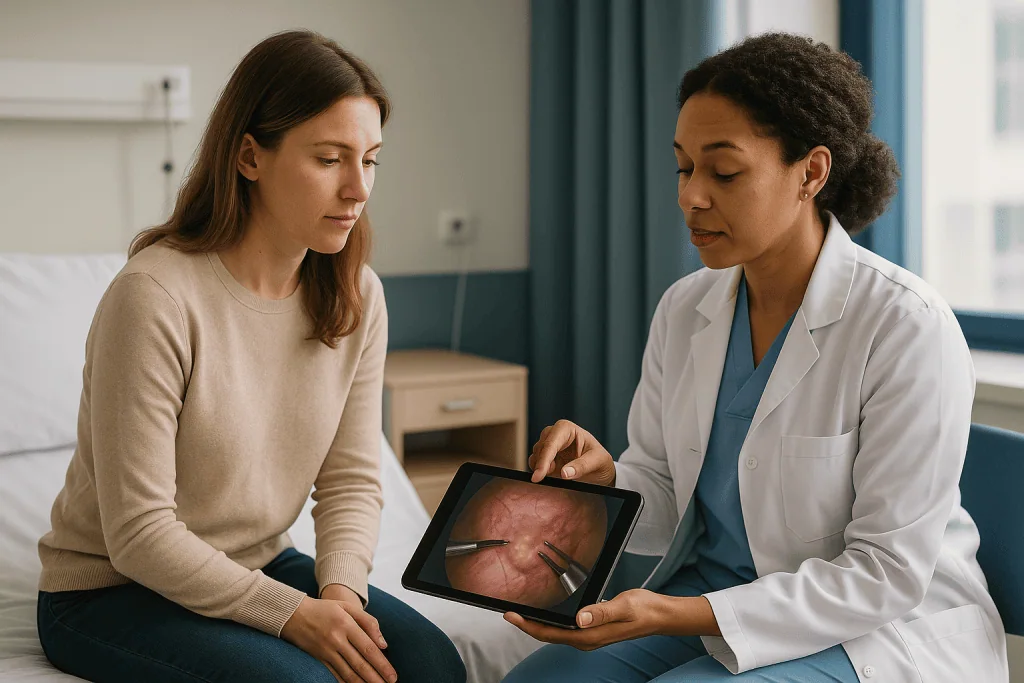
Carbon dioxide gas is first pumped into the abdomen to lift the wall away from the organs and create working space. That gas is why so many people wake with an odd ache under the shoulder blades: a little remaining gas irritates the diaphragm, and the nerve that supplies it also reports to the shoulder. The NHS notes this shoulder pain is common and settles as the gas is absorbed.
With the camera inside, the surgeon maps the pelvis. Lesions can look like dark spots, clear blisters, scar-like patches or nodules. Two techniques then treat them. Excision cuts the lesion out, including its base. Ablation destroys the surface of the lesion with heat or energy. Surgeons often combine them depending on depth and location; deep disease near the bowel or ureter is generally excised, because ablation cannot safely reach the base.
Ovarian cysts filled with old blood, called endometriomas, may be drained and their lining removed. Adhesions, which are bands of scar tissue gluing organs together, are divided to free them.
The incisions are closed with dissolvable stitches or glue. Most people go home the same day or after one night, according to the NHS, although a longer stay follows more complex bowel or bladder work. The operative photographs and report are what your follow-up will be built on, so ask whether you can have a copy.
Who is usually offered surgery, and who is usually asked to wait
Surgery is one tool among several, and guidance from the NHS and Mayo Clinic frames it as a choice made with the patient rather than an automatic step.
People are commonly offered surgery when pain has not responded adequately to simpler measures such as anti-inflammatory pain relievers and hormonal treatment; when imaging shows an endometrioma or deep disease affecting the bowel, bladder or ureters; when fertility is the priority and the team believes removing lesions could help; or when the diagnosis itself is uncertain and a look inside will settle it. Laparoscopy remains the only way to confirm endometriosis with certainty, although ultrasound and MRI can identify deep disease and cysts beforehand.
Others are usually asked to wait, at least for now. Someone whose symptoms are well controlled on hormonal therapy and who is not trying to conceive gains little from an operation and carries its risks. Those who have already had several pelvic surgeries face more adhesions and higher complication rates, so teams often try medical options first. Active pelvic infection, uncontrolled medical conditions and the weeks around a planned pregnancy are other reasons to pause.
Timing within reproductive life also shapes the decision. Because endometriosis is driven by estrogen, symptoms often ease after menopause, and a person close to that transition may reasonably choose to manage symptoms medically rather than operate.
None of these are rigid rules. A team weighs symptom severity, disease location, fertility plans, previous treatment and personal preference. If you are unsure which group you fall into, asking “what would change your advice?” is a fair and useful question.
Endometriosis surgery results by procedure type: a comparison table
Different operations ask different things of the body and deliver different things in return. The ranges below are typical, not promises, and are drawn from NHS guidance on laparoscopy and endometriosis treatment.
| Procedure | What it involves | Typical return to usual activities | What it can and cannot do |
|---|---|---|---|
| Diagnostic laparoscopy | Camera inspection, sometimes biopsy | Around 5 days (NHS) | Confirms diagnosis; no treatment of lesions unless done at the same time |
| Laparoscopic excision or ablation | Lesions cut out or destroyed; adhesions divided | Several days to a few weeks; up to 12 weeks after major work (NHS) | Can relieve pain and may improve fertility; disease can return |
| Endometrioma surgery | Cyst drained and lining removed | Similar to excision; depends on ovary involvement | Removes cyst; some healthy ovarian tissue may be lost, which matters for fertility planning |
| Hysterectomy with or without ovary removal | Womb removed; ovaries sometimes removed too | Up to 12 weeks (NHS) | Ends periods and pregnancy; does not guarantee an end to endometriosis pain, particularly if ovaries remain |
Two points in this table deserve emphasis. First, the recovery figures describe when people commonly feel able to work, drive and exercise, not when every internal tissue has healed; the NHS reminds patients that recovery from major laparoscopic surgery can take up to 12 weeks. Second, hysterectomy sits at the far end of the scale for a reason. It is irreversible, it ends fertility, and the NHS is clear that endometriosis can persist or come back afterward, especially when ovaries are left in place and continue producing estrogen. Removing the ovaries triggers surgical menopause, with its own long-term considerations for bone and heart health that the team should discuss before, not after, the operation.
Pain after endometriosis surgery: what the first 48 hours feel like
The immediate post-operative days are about surgical healing rather than endometriosis itself, and it helps to know the three distinct sensations most people describe.
Incision soreness is the obvious one. Small cuts still pass through skin, fat and muscle, and the navel incision in particular can feel bruised when you sit up, cough or laugh. Holding a folded towel against the abdomen when coughing takes the edge off.
Gas pain is the surprising one. The NHS lists shoulder-tip discomfort, bloating and cramping after laparoscopy as expected effects of the carbon dioxide used during surgery. Walking, even slowly around the house, helps the body reabsorb the gas faster than lying still does, and warmth over the shoulders or abdomen soothes it. This pain usually fades within a few days.
Deep pelvic ache is the one that worries people, because it can feel like the pain they came in with. Tissue that has been cut, cauterized or freed from adhesions swells and is tender; the first period after surgery is often heavier or more uncomfortable than usual as the pelvis recovers. This is not evidence that the operation failed.
Fatigue sits underneath all three. General anesthetic, reduced appetite and disrupted sleep leave most people tired for a week or more, and the Mayo Clinic advises planning rest even after minimally invasive procedures.
A simple way to track progress is to rate pain each morning and evening for two weeks. The numbers rarely fall in a straight line; a bad day after an active day is common. The trend over a week is what you and your team want to see heading downward.
Endometriosis surgery recovery time: a realistic week-by-week picture
Recovery is not a race, and bodies vary, but a rough map helps you judge whether you are broadly on track. The NHS laparoscopy guidance anchors the ranges below.
Days 1 to 3. Rest, short walks, light meals. Dressings usually stay on for a day or two unless told otherwise. The NHS advises against driving for at least 24 hours after a general anesthetic, and many teams suggest waiting until you can brake sharply without pain. Bowels may be sluggish from anesthetic and pain medicine; fluids, fiber and walking help.
Days 4 to 7. Gas pain has usually eased. Showers are fine once dressings are off; soaking in a bath generally waits until incisions are sealed, so ask your team. People who had a diagnostic laparoscopy often feel able to return to desk work around now, in line with the NHS estimate of about 5 days for minor procedures.
Weeks 2 to 4. Energy returns in uneven steps. Gentle exercise such as walking and stretching is encouraged; heavy lifting, abdominal workouts and high-impact sport usually wait for the surgeon’s go-ahead. Stitches dissolve; the navel scar may feel firm. The first period can be rough.
Weeks 4 to 12. After extensive excision, bowel or bladder surgery, or hysterectomy, the NHS places full recovery at up to 12 weeks. Internal healing lags behind how you feel from the outside, which is why teams ask for patience with strenuous activity and, after some procedures, with sexual intercourse.
Where you land in these ranges depends on how much was done, your general health and how well pain is controlled early on. Falling behind the map is a reason to check in, not a sign of failure.
Pain relief after surgery: how the usual options work and why some pain lingers
Post-operative pain relief typically layers two or three approaches, chosen by the anesthetic and surgical team, with every dose and duration set by them rather than by anything you read here.
Non-steroidal anti-inflammatory drugs reduce the production of prostaglandins, the chemical messengers behind both surgical inflammation and the uterine cramping of endometriosis. They are often paired with acetaminophen, which works through a different pathway, so the two together cover more ground than either alone. Short courses of stronger medicines may be used for the first day or two after larger operations, and the Mayo Clinic notes these are intended for brief use. Local anesthetic infiltrated into the incisions during surgery explains why the first hours at home can feel deceptively comfortable before the wounds wake up.
Non-drug measures carry real weight. Heat over the lower abdomen relaxes muscle and eases cramping. Walking disperses gas. Pacing activity so that good days do not become overdone days prevents the familiar crash.
Why, then, does endometriosis-type pain sometimes persist for weeks after a thorough operation? Nerves in the pelvis that have carried pain signals for years become sensitized; they do not reset the moment the lesion is gone. Pelvic floor muscles that have been guarding against pain stay tight and ache on their own. Both can be addressed, often with pelvic floor physiotherapy and time, and the Cleveland Clinic lists physiotherapy among supportive treatments. Many people describe the clearest improvement over the two or three cycles after surgery rather than in the first week. Persisting or worsening pain beyond that window is the signal to revisit the plan with your team, not to assume nothing more can be done.
Follow-up after endometriosis surgery: what your care team checks and why
The first follow-up visit, typically a few weeks after the operation, is less a formality than the moment the surgical findings turn into a long-term plan.
Your surgeon will go through the operative report: where disease was found, its depth, whether endometriomas were treated and whether anything had to be left behind, for instance tissue wrapped around a ureter or bowel wall that was judged safer to leave. The stage of disease may be mentioned. Staging describes the extent of lesions and adhesions seen at surgery, and the Johns Hopkins overview makes the point that stage does not reliably predict pain; minimal disease can hurt badly, extensive disease can be quiet. Fertility teams, however, do use stage in their planning.
Wounds are checked for healing and infection. You will be asked how pain compares with before, how your first period went, and whether bowel and bladder function feel normal. Any biopsy results, which confirm the tissue type under a microscope, are reviewed.
The central conversation is usually about what comes next. The NHS and Mayo Clinic both describe hormonal treatment after surgery as a common strategy to lower the chance of symptoms returning in people who are not trying to conceive. If pregnancy is the goal, the discussion turns to timing, whether referral to a fertility specialist is appropriate, and what tests might help.
Later follow-up is tailored. Some people are seen again at a few months, others only if symptoms return. Keeping a simple symptom diary between visits, noting pain, bleeding and bowel or bladder changes alongside your cycle, gives the team far better information than memory can.
Endometriosis recurrence after surgery: what the evidence actually shows
This is the question people most want a clean answer to, and honesty requires some nuance.
Endometriosis is a chronic, estrogen-driven condition, and surgery removes lesions rather than the underlying tendency to form them. The World Health Organization describes it as a disease that can require long-term management, and the NHS states plainly that symptoms may return after surgery and that surgery does not guarantee they will stay away. The Mayo Clinic says the same about conservative surgery, and that hormonal treatment afterward is often used to reduce that risk.
Published recurrence figures vary widely between studies because they measure different things: some count returning pain, some count lesions seen on imaging, and some count repeat surgery. Follow-up periods range from one to many years. Quoting a single percentage would be misleading, so this article does not. What the body of evidence does support is that recurrence is more likely over longer follow-up, after incomplete removal of deep disease, with endometriomas, and when no hormonal suppression follows surgery in someone who is not pregnant or trying to conceive. Pregnancy and breastfeeding often produce a temporary lull because they lower estrogen exposure.
Returning pain does not automatically mean returning lesions. Adhesions, pelvic floor tension, bladder pain syndrome and bowel sensitivity can all mimic endometriosis, and sorting these out is part of why follow-up matters.
Two practical implications follow. First, a plan for after surgery is as important as the surgery itself. Second, repeat operations carry diminishing returns and rising risk from scar tissue, so most teams reserve them for clear indications. The decision on whether, and when, to operate again rests with your team, informed by your symptoms and your goals.
Pregnancy after endometriosis surgery: timing and expectations
For many people, the real result they are hoping for is a positive test. Here the evidence offers encouragement with caveats.
Endometriosis can affect fertility in several ways: adhesions distort the fallopian tubes and ovaries, endometriomas occupy ovarian tissue, and inflammation in the pelvis is thought to affect egg quality and implantation. The NHS notes that surgery to remove endometriosis tissue can improve the chance of pregnancy, and the Mayo Clinic says the same for conservative surgery that preserves the womb and ovaries. Not everyone with endometriosis has trouble conceiving; the WHO points out that many people with the condition become pregnant without help.
On timing, people often ask how long after surgery they can try. There is no universal waiting period written into guidelines. Many teams suggest not delaying once incisions have healed and you feel physically ready, on the reasoning that any benefit from clearing lesions is thought to be greatest in the months after surgery, before disease has a chance to return. The exact advice depends on what was done, whether an ovary was operated on, and your age and overall fertility assessment, so it belongs in a conversation with your team.
A few specifics matter. Surgery for endometriomas can remove some healthy ovarian tissue along with the cyst, and the team may measure ovarian reserve afterward. Hormonal treatments used to control endometriosis prevent pregnancy while taken, so they are usually paused when conception is the goal. If pregnancy has not happened after a reasonable period, or if other factors are present, referral for assisted reproduction may be discussed; the Mayo Clinic lists in vitro fertilization among options for endometriosis-related infertility. None of this is a timetable, only a framework for the questions worth asking.
What medications treat endometriosis after surgery, and how they work
Medicines after surgery serve two jobs: controlling pain in the short term and suppressing the hormonal fuel for endometriosis in the longer term. What follows describes mechanisms and typical roles only; which, whether and for how long are decisions for your prescribing clinician.
Hormonal contraceptives, including the combined pill, patch or ring, steady hormone levels and thin the lining of the womb and of lesions, which the NHS describes as a way to make periods lighter and less painful. They may be used continuously to avoid periods altogether.
Progestogen-only options, available as tablets, injections, implants or a hormone-releasing intrauterine device, suppress the growth of endometriosis tissue directly. The Mayo Clinic lists these among first-line hormonal treatments.
Gonadotropin-releasing hormone analogues temporarily switch off the ovaries’ estrogen production, creating a reversible menopause-like state. Because that state brings hot flushes and bone density loss, they are usually prescribed with a small amount of “add-back” hormone and for limited periods, as the NHS explains. Newer oral forms of this class exist and work on the same principle.
Aromatase inhibitors block estrogen production in tissues outside the ovary and are reserved for specific situations under specialist care.
Pain relievers address symptoms rather than the disease. Non-steroidal anti-inflammatories reduce prostaglandin-driven cramping; for persistent nerve-related pain, clinicians sometimes use medicines originally developed for nerve pain or mood, chosen for their effect on pain pathways.
The practical point from the NHS and Mayo Clinic is that hormonal treatment after surgery is commonly recommended to delay recurrence for people not currently trying to conceive. Side effects, contraception needs and future pregnancy plans all shape the choice, so the conversation is worth having before you leave the hospital rather than months later.
What people often get wrong about endometriosis surgery results
Some beliefs about this surgery are sticky enough to deserve direct correction.
“Surgery fixes endometriosis for good.” It treats what is visible at the time. The NHS, Mayo Clinic and WHO all describe endometriosis as a condition that can return and often needs long-term management. Expecting a permanent reset sets people up for disappointment and sometimes for unnecessary repeat surgery.
“A hysterectomy ends the problem.” Removing the womb ends periods, but endometriosis lives outside the womb. The NHS states that symptoms can persist or recur after hysterectomy, particularly if ovaries are retained. It is a serious option for specific situations, not a universal solution.
“Pain right after surgery means it failed.” Early pain is mostly surgical healing and gas; disease-related relief tends to show over the following cycles.
“Epsom salt baths treat endometriosis.” There is no evidence that magnesium sulfate in bathwater affects endometriosis lesions or hormone activity, and major sources do not list it as a treatment. A warm bath can relax tense pelvic and back muscles, which is genuinely soothing, and that comfort is the honest extent of the claim. After surgery, soaking should wait until your team confirms incisions have sealed.
“Heavy bleeding has nothing to do with endometriosis.” The NHS lists heavy periods among endometriosis symptoms, and the condition frequently coexists with adenomyosis, where similar tissue grows into the muscle of the womb and drives heavy, painful bleeding. Surgery on pelvic lesions may not change bleeding caused by adenomyosis or fibroids, which is why ongoing heavy periods after surgery deserve their own assessment rather than being written off.
“More surgeries mean better results.” Each operation adds scar tissue and risk. Careful selection matters more than frequency.
Questions to ask your care team about your endometriosis surgery results
A follow-up appointment moves quickly. Bringing a written list turns it from a debrief into a planning session. These questions are drawn from what patients most often wish they had asked.
- Where exactly was the endometriosis, how deep was it, and was any disease left behind? Can I have a copy of the operative report and photographs?
- Was tissue sent for biopsy, and what did it show?
- Was excision, ablation or both used, and does that change how likely symptoms are to return?
- Were my ovaries or tubes involved, and does that affect my fertility or ovarian reserve?
- Based on what you found, how soon would you expect endometriosis-related pain to settle, and what would make you want to see me sooner?
- Do you recommend hormonal treatment now, and what are the trade-offs if I am planning a pregnancy in the next year or two?
- If I want to try to conceive, when do you suggest starting, and at what point would you refer me to a fertility specialist?
- Would pelvic floor physiotherapy help with the muscle pain I still feel?
- Which of my symptoms, such as heavy bleeding or bowel pain, might have a cause other than endometriosis?
- What activity, lifting and exercise limits apply to me specifically, and for how long?
- What is the plan if pain returns: imaging, medication, physiotherapy or another operation, and how would we decide?
- Who do I contact between appointments, and what counts as urgent?
It is reasonable to ask for a written summary of the answers. Partners or a trusted friend can take notes while you listen, which frees you to ask the follow-up question that matters most to you. If anything in the answers is unclear, say so during the visit; clinicians would far rather repeat themselves than have you leave uncertain.
When to call your doctor after endometriosis surgery
Most recoveries are uneventful, and knowing the genuine warning signs lets you relax about everything else. Contact your care team or seek urgent care if you notice any of the following, which the NHS and Mayo Clinic highlight as reasons for prompt review after laparoscopy and gynecological surgery.
- A fever, chills or feeling generally unwell in the days after surgery, which can point to infection inside the abdomen or in a wound.
- Redness, warmth, swelling, foul-smelling discharge or opening of an incision.
- Pain that steadily worsens rather than eases, or severe abdominal pain that is not relieved by your prescribed medicine.
- Persistent or repeated vomiting, inability to keep fluids down, or a swollen, hard abdomen.
- Heavy vaginal bleeding that soaks through a pad within an hour or passes large clots.
- Pain, burning or difficulty passing urine, blood in the urine, or not passing urine for many hours.
- No bowel movement for several days with cramping and bloating, or the opposite, severe diarrhea.
- Pain, swelling, warmth or redness in one calf or leg, which can signal a blood clot.
- Chest pain, sudden breathlessness or coughing up blood: call emergency services, as these may indicate a clot in the lung.
- Fainting, a racing heart or feeling lightheaded when standing.
Less dramatic concerns still warrant a call: a scar that keeps weeping, pain that plateaus without improving after a couple of weeks, a first period far heavier than expected, or new pain with sex when activity resumes. Teams would rather hear from you early. Your discharge paperwork should list a direct number; keep it somewhere you will find it at 2 a.m. Every decision about what to do next, including whether to come back in, sits with the clinicians who know your operation.
Frequently asked questions
How long does endometriosis surgery recovery time usually take?
It depends on how much was done. The NHS estimates about 5 days to resume normal activities after a diagnostic laparoscopy and up to 12 weeks after major laparoscopic treatment such as deep excision or hysterectomy. Most people are home within a day, walk from day one, and ease back into work and exercise over two to six weeks, with the surgeon setting lifting and sport limits.
Is pain after endometriosis surgery normal, and when should it ease?
Yes, some pain is expected. Incision soreness, bloating and gas-related shoulder pain usually settle within days, and deeper pelvic tenderness improves over a few weeks. Endometriosis-type pain often shows its clearest change over the two or three cycles after surgery. Pain that worsens, comes with fever or vomiting, or has not improved after a couple of weeks should be reported to your team.
How long after endo surgery can you get pregnant?
There is no fixed waiting period in guidelines. Many teams suggest trying once incisions have healed and you feel ready, because the benefit of clearing lesions is thought to be greatest in the months after surgery. Your specific advice depends on what was operated on, your age and ovarian reserve, and whether hormonal treatment is planned, so timing is best agreed with your surgeon or a fertility specialist.
What is the chance of endometriosis recurrence after surgery?
Recurrence is common enough that the NHS, Mayo Clinic and WHO all describe endometriosis as a long-term condition that may return after surgery. Published rates vary widely because studies measure different things over different time spans, so no single figure applies to everyone. Risk is higher with incomplete removal of deep disease, endometriomas and no hormonal treatment afterward; your team can estimate your own likelihood.
What medications are used to treat endometriosis after surgery?
Hormonal treatments are the main group: combined hormonal contraceptives, progestogen-only options including the hormonal intrauterine device, and gonadotropin-releasing hormone analogues that temporarily switch off ovarian estrogen. Pain relievers such as non-steroidal anti-inflammatories manage symptoms rather than the disease. Which, if any, suits you depends on side effects and pregnancy plans and is decided by your prescribing clinician.
Does Epsom salt help with endometriosis?
No reliable evidence shows that Epsom salt, which is magnesium sulfate, affects endometriosis lesions or symptoms, and major medical sources do not list it as a treatment. A warm bath can relax tense pelvic and back muscles, which may feel soothing, but that comfort is the extent of the benefit. After surgery, avoid soaking until your team confirms the incisions have sealed.
Can endometriosis cause heavy bleeding?
It can. The NHS lists heavy periods among endometriosis symptoms, and the condition often coexists with adenomyosis, where similar tissue grows into the womb muscle and drives heavy, painful bleeding. Surgery on pelvic lesions may not change bleeding caused by adenomyosis or fibroids, so persistent heavy periods after an operation deserve separate assessment and possibly different treatment.
Does a hysterectomy end endometriosis pain?
Not always. Endometriosis grows outside the womb, so removing the womb alone does not remove all disease, and the NHS notes symptoms can persist or return, particularly when ovaries are kept and continue producing estrogen. Hysterectomy is irreversible and ends fertility, and removing the ovaries causes surgical menopause, so it is reserved for specific situations after careful discussion.
Why do I have shoulder pain after laparoscopic endometriosis surgery?
The carbon dioxide gas used to create working space during keyhole surgery can linger and irritate the diaphragm. The nerve supplying the diaphragm shares a pathway with the shoulder, so the brain reads the irritation as shoulder-tip pain. The NHS describes this as a common, temporary effect; walking, warmth and time help it fade over a few days.
When can I exercise and have sex again after endometriosis surgery?
Gentle walking is encouraged from the first day. Heavy lifting, core workouts and high-impact sport usually wait several weeks, longer after extensive or hysterectomy surgery, where the NHS places full recovery at up to 12 weeks. Sexual activity can typically resume once incisions and any internal wounds have healed and it feels comfortable; your surgeon will give limits specific to what was done.
References
- NHS: Endometriosis, treatment
- NHS: Laparoscopy (keyhole surgery)
- World Health Organization: Endometriosis fact sheet
- Cleveland Clinic: Endometriosis
This article is for general information only and is not a substitute for professional medical advice. Please consult a qualified doctor about your individual situation.

More from the Blog

How Do Surgeons Choose Between Robotic and Laparoscopic Hysterectomy? The Keyhole Options
Surgeons choose between robotic and laparoscopic hysterectomy mainly on the complexity of the operation, the size and position of the uterus, scar tissue from…
Second Opinion for Fibroids: Questions to Ask Before Agreeing to Surgery
A second opinion before fibroid surgery is reasonable and common, because fibroids are rarely an emergency and several treatments can relieve the same symptoms.…
When Vaginal Infections Keep Returning: How Gynecologists Investigate and Plan Prevention
Recurrent vaginal infections usually mean one of three things: the original diagnosis was wrong, the infection was never fully cleared, or a specific trigger…

What to Expect After a Hysterectomy: Pathology Results, Symptom Relief and Follow-Up Visits
After a hysterectomy, the removed tissue is routinely examined by a pathologist, and the written report most often confirms a benign cause such as…

Life After Ovarian Cyst Surgery: Cycles, Fertility Follow-Up and Long-Term Ovary Health
Life after ovarian cyst surgery usually means a few weeks of recovery, then periods that return on roughly their previous schedule when at least…

After Endometriosis Surgery: What Is Normal, and Which Symptoms Mean a Call to Your Surgeon?
After endometriosis surgery, mild to moderate incision soreness, bloating, shoulder-tip pain from residual gas, fatigue and light vaginal bleeding are expected for several days…