

Who May Be a Candidate for SBRT for Early-Stage Lung Cancer When Surgery Is Not Planned
Key Takeaways
- SBRT is most established for stage I non-small cell lung cancer, which the National Cancer Institute defines as a tumor up to about 4 centimeters with no lymph node spread.
- The strongest candidates are people judged medically inoperable or who decline surgery after a full discussion, with a single peripheral tumor and no prior radiation to that part of the chest.
- Treatment is typically completed in one to five outpatient sessions according to the Mayo Clinic, with the number chosen mainly by how close the tumor lies to the airways, heart, and esophagus.
- Radiation pneumonitis, the side effect that most needs watching, usually appears weeks to a few months after treatment rather than during it.
- Post-treatment scans almost always show scarring that can look larger than the original tumor, so ask in advance how your team will tell scar from regrowth.
- Guideline evidence supports high control of the treated tumor, but survival comparisons with surgery come mostly from small or non-randomized studies and should be interpreted cautiously.
SBRT for early-stage lung cancer is usually considered for people with a small non-small cell lung cancer that has not spread to lymph nodes and who cannot safely have surgery, or who decline it after a full discussion. Candidacy depends on tumor size and position, lung and heart function, prior treatments, and review by a multidisciplinary team, which makes the final decision with the patient.
The scan result arrives on a Tuesday, and the sentence that stays with her is not the diagnosis. It is the surgeon’s careful phrasing: “I don’t think an operation is the right thing for your lungs.” She has lived with emphysema for years, climbs one flight of stairs and stops, and had quietly assumed that if cancer ever came, surgery would be the obvious answer. Now it isn’t, and a new acronym has entered the conversation.
SBRT for early stage lung cancer sits at exactly this fork in the road. For decades, people whose lungs or hearts could not tolerate an operation were offered conventional radiation over many weeks, or sometimes nothing at all. Stereotactic body radiotherapy changed that calculation, and the question of who qualifies has become one of the most searched topics in lung cancer care.
This explainer walks through how the treatment works, who is typically offered it, who is usually asked to wait or look elsewhere, and what honest evidence says about outcomes, without the hype that tends to surround anything called “precision.”
What is SBRT for early-stage lung cancer, and how does it actually work?
Stereotactic body radiotherapy, usually shortened to SBRT, is a way of delivering a high, tightly focused amount of radiation to a small tumor in a handful of sessions rather than the several weeks used in conventional radiotherapy. “Stereotactic” simply means the target is located in three-dimensional space with imaging so the beams can be aimed from many angles and meet at one point.
Picture a magnifying glass concentrating sunlight. Any single beam passing through healthy lung carries a modest amount of energy, but where dozens of beams converge on the tumor, the effect is intense enough to damage the DNA of cancer cells so they can no longer divide. Surrounding tissue, receiving only a fraction of that total, is spared far more than it would be with older techniques.
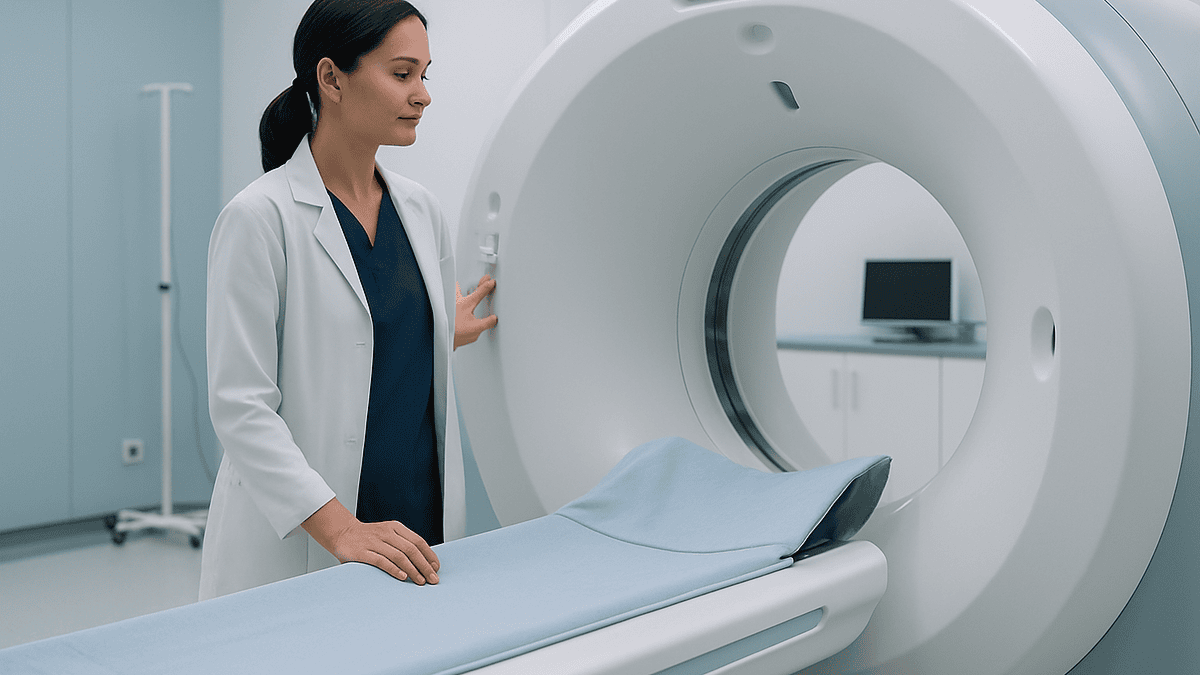
Lungs move with every breath, which is the central engineering problem. Planning typically begins with a CT scan taken across the breathing cycle, sometimes called a four-dimensional CT, so the team can see how far the tumor travels as you inhale and exhale. Some centers ask patients to hold their breath briefly, some use gentle abdominal compression to shallow the breathing, and some track the tumor in real time. The machine itself is a linear accelerator, a device that generates high-energy X-rays; no radioactive material is placed in the body.
According to the Mayo Clinic, treatments of this kind are usually completed in one to five sessions. Each session is painless, and you remain awake, lying still on a custom-molded cushion or frame that keeps your position identical from day to day. The radiation itself is invisible and silent, apart from the hum of the machine rotating around you.
Why might surgery not be planned in the first place?
Surgery remains the long-standing standard for early-stage non-small cell lung cancer, the most common type, which grows more slowly than small cell lung cancer and is staged and treated differently. So when a team steers away from an operation, there is always a reason, and understanding it helps make sense of everything that follows.
The commonest reason is what clinicians call being “medically inoperable,” a phrase meaning that the risks of anesthesia and removing part of a lung outweigh the likely benefit for that particular person. Chronic obstructive pulmonary disease, interstitial lung disease, significant heart disease, poor exercise tolerance, or a combination of several conditions can each tip that balance. Breathing tests measuring how much air the lungs move and how well they transfer oxygen are usually part of the assessment, and the results are weighed alongside age, frailty, and previous chest operations.
A second group is sometimes described as “high-risk operable.” These patients could technically undergo surgery, but recovery would be uncertain and the team may prefer a less invasive route or a smaller operation than a full lobectomy, the removal of one of the lung’s five lobes.
A third reason is choice. Some people, after a frank conversation about what an operation involves, decide they do not want it. Guidelines including the American Society for Radiation Oncology statement indexed on PubMed recognize this scenario and recommend a genuine shared decision rather than pressure in either direction.
Whatever the reason, the recommendation should come from a multidisciplinary team, a group that includes surgeons, radiation oncologists, medical oncologists, radiologists, and pathologists reviewing the case together. If you have only met one specialist, it is reasonable to ask whether that wider review has happened.
Who is usually a candidate for SBRT, and who is asked to wait?
The clearest candidates share a recognizable profile. Their tumor is small and confined to the lung. Imaging, and often a biopsy, shows no spread to the lymph nodes in the center of the chest or beyond. Surgery has been judged too risky or has been declined after discussion. And they are well enough to lie flat and still for the length of a session, which for many people is the most physically demanding part of the treatment.
Several factors tend to strengthen the case. A single lesion rather than several. A position in the outer part of the lung, away from the airways and heart. Reasonable overall fitness, sometimes measured by whether a person can manage daily activities independently. No previous radiation to the same region of the chest.
Others are usually asked to wait or are steered toward a different plan. If staging is incomplete, the team will generally want a PET-CT scan, which combines a sugar-based tracer that lights up metabolically active tissue with a CT image, before committing. If there is a suspicion of lymph node involvement, a sampling procedure may be needed first, because SBRT treats only what it is aimed at. Active lung infection, an unstable heart condition, or very poor lung function that makes even small amounts of radiation-related inflammation dangerous can all prompt a pause.
Implanted devices such as pacemakers rarely rule treatment out, but they do require planning and monitoring. Interstitial lung disease, a group of conditions causing scarring throughout the lungs, deserves special mention: radiation can worsen it, so the team weighs that risk carefully. None of these are automatic exclusions. They are prompts for a more detailed conversation, and the decision rests with the treating team.
Does the tumor's size and position change whether SBRT is an option?
Enormously, and this is where the word “early-stage” earns its keep. In the staging system described by the National Cancer Institute, stage I non-small cell lung cancer means a tumor up to about 4 centimeters across, roughly the size of a walnut, with no spread to lymph nodes or distant organs. SBRT is most established for tumors in this range, and larger tumors become progressively harder to treat safely because the volume of healthy lung receiving radiation grows with them.
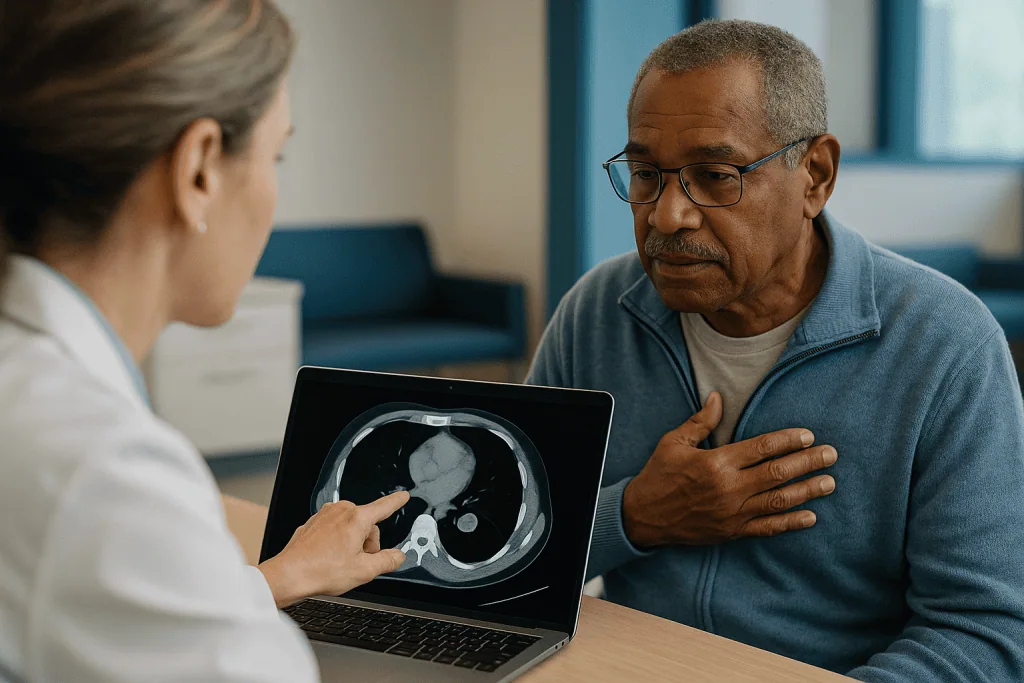
Position matters just as much as size. Radiation oncologists divide the lung into two broad zones:
- Peripheral tumors sit in the outer portion of the lung, surrounded mostly by spongy lung tissue. They are the textbook targets for SBRT because there is little nearby that can be harmed.
- Central tumors lie within a couple of centimeters of the main airways, the esophagus, the heart, or the large blood vessels. Here the team has to be far more cautious, and treatment is often spread over more sessions or a different approach is chosen. Tumors touching the main airway itself, sometimes called ultracentral, carry a higher risk of serious complications and are handled case by case.
A tumor high in the chest near the shoulder can sit close to the brachial plexus, the bundle of nerves running to the arm; one lying against the chest wall can leave soreness or, rarely, a rib fracture months later. None of these positions necessarily rules SBRT out, but each changes the plan, the number of sessions, and the conversation about side effects. Asking your team “where exactly is it, and what is next to it?” is one of the most useful questions you can put to them.
Is a biopsy always required before SBRT for lung cancer?
Usually, yes, and the reasons are worth understanding rather than simply accepting. A biopsy, the removal of a small tissue sample for examination under a microscope, confirms that a shadow on a scan is in fact cancer, identifies its type, and increasingly allows molecular testing that may matter for future treatment decisions. Radiation cannot distinguish a tumor from a scar, an old infection, or a benign growth; it treats whatever it is pointed at.
For lung nodules, the sample is typically taken either through a thin needle passed through the chest wall under CT guidance, or through a flexible camera passed down the airway, a bronchoscopy. Both are day procedures. The needle route carries a known risk of a small air leak causing partial lung collapse, which is more troublesome in people with already fragile lungs, and this is precisely the group most often considered for SBRT.
That tension creates a genuine gray area. When a nodule is growing on repeated scans, lights up strongly on PET-CT, looks typical of cancer, and the person has a high background risk from smoking, some multidisciplinary teams will proceed without a tissue diagnosis if a biopsy is judged too dangerous. Guideline language on PubMed from the American Society for Radiation Oncology acknowledges this as a considered exception rather than a routine shortcut, and it should be a documented team decision explained clearly to the patient.
If you are told a biopsy is not being done, ask why, what the team’s confidence level is, and what evidence they are relying on. If you are told one is essential, ask which route is safest for your lungs. Either answer is legitimate; what matters is that it has been thought through for you specifically.
SBRT vs surgery for lung cancer: how do the two paths compare?
People naturally want to know which option is “better.” The honest answer is that the two are compared on different terms, because they are usually offered to different groups of patients. Surgeons operate on people fit enough for surgery; SBRT has been studied mostly in those who are not. Direct head-to-head trials in fit patients have been attempted and several closed early because too few people agreed to be randomly assigned, which limits what anyone can claim with certainty. The table below summarizes the practical differences described by the National Cancer Institute and NHS.
| Aspect | Surgery (lobectomy or smaller resection) | SBRT |
|---|---|---|
| What happens | Operation under general anesthesia; part of the lung is removed | Focused external radiation in one to five outpatient sessions |
| Hospital stay | Usually several days | None; each visit lasts under an hour |
| Lymph nodes | Can be removed and examined, refining the stage | Not sampled; staging relies on imaging and any prior biopsy |
| Tissue for testing | Whole tumor available for pathology | Depends on pre-treatment biopsy |
| Recovery | Weeks to months, with pain and reduced exercise capacity early on | Most people continue normal activity; fatigue is the main early effect |
| Main risks | Anesthesia, bleeding, infection, air leak, loss of lung function | Lung inflammation, chest wall soreness, fatigue; rare airway or esophageal injury |
| If cancer returns nearby | Radiation may be an option | Surgery is sometimes possible, but scarring complicates it |
Surgery’s great advantage is information: removing the lymph nodes tells the team whether the disease was truly early. SBRT’s advantage is that it spares the body a major operation. Which weighs more depends on the person, not the technology.
How many SBRT treatments for lung cancer are usually given, and what happens at each visit?
The Mayo Clinic describes stereotactic treatments as typically delivered in one to five sessions, and lung SBRT sits within that range. The exact number is chosen by the radiation oncologist based on the tumor’s size and, above all, its distance from the airways, heart, and esophagus. Peripheral tumors tend toward fewer sessions; central ones toward more, spread out to give sensitive structures time to recover between exposures. Sessions are usually scheduled every other day or a few times a week rather than daily.
Before any treatment, there is a planning appointment often called simulation. You lie in the position you will hold for treatment, usually on your back with arms above your head, while a mold or cushion is shaped around you. A CT scan is taken, frequently across several breathing cycles. Small ink marks or tiny tattoos may be placed on the skin as alignment points. Over the following days, a team of physicists and dosimetrists designs the beam arrangement, a process you never see but which accounts for much of the wait between simulation and the first session.
On a treatment day, the sequence is remarkably calm:
- You change into a gown and lie on the treatment table in your mold.
- Staff align you using the skin marks, then take a quick scan on the machine itself to match your position to the plan, adjusting by millimeters.
- The team leaves the room and watches on cameras; you can speak to them through an intercom.
- The machine rotates around you for several minutes while you breathe as instructed.
You feel nothing during delivery and are not radioactive afterward; hugging grandchildren that evening is entirely safe. Most people drive themselves home, though a companion for the first visit is sensible simply for reassurance.
What are the SBRT lung cancer side effects, early and late?
Because so little healthy tissue receives a meaningful amount of radiation, side effects are generally milder than many people expect, but “mild” is not “none,” and a few late effects deserve to be understood before you agree to treatment. The National Cancer Institute’s guidance on radiation side effects is the basis for what follows.
Fatigue is the most common early complaint. It tends to build over the treatment days and the week or two afterward, then fades. Some people notice mild skin redness or tenderness where beams enter, particularly over the chest wall. A cough, sometimes with a small amount of thick phlegm, can appear as the treated area becomes inflamed. Nausea is uncommon with lung SBRT unless the tumor sits low near the stomach.
The effect that most needs watching is radiation pneumonitis, an inflammation of lung tissue in and around the treated zone. It typically appears weeks to a few months after treatment rather than during it, and it announces itself with a new or worsening cough, breathlessness, and occasionally low-grade fever. Most cases are mild and settle, some need a course of anti-inflammatory medicine prescribed by the team, and a small number are serious, especially in people whose lungs were already badly compromised.
Late effects, appearing months to years afterward, include chest wall pain or a rib fracture when the tumor lay against the ribs, scarring in the treated lung that can slightly reduce breathing capacity, and, for central tumors, rare but significant injury to the airway or esophagus. Nerve irritation causing shoulder or arm discomfort can follow treatment high in the chest. Your team will estimate the specific risks for your tumor’s position; a generic list cannot do that for you.
What do the days and weeks after SBRT usually look like?
The strangest part of finishing SBRT, patients often say, is how ordinary it feels. There is no wound to dress and no drain to manage, and the treated tumor is still there on the last day, unchanged to the eye. That can be disorienting for someone braced for a battle. The work of the radiation continues silently over the months that follow.
In the first week or two, expect tiredness that is real but rarely disabling. Gentle daily walking is encouraged rather than bed rest, and most people return to their usual routine, including light work, within days. Chest wall soreness, if it comes, tends to be dull and positional rather than sharp.
Between about four and twelve weeks, the window for pneumonitis opens, which is why your team will ask you to report any new cough or breathlessness promptly rather than waiting for a scheduled appointment. The National Cancer Institute notes that some radiation effects emerge weeks to months after treatment ends, and lung SBRT fits that pattern.
Follow-up imaging generally begins a few months after treatment and continues at intervals for several years, usually with CT scans. Here is something worth knowing in advance: the treated area almost always develops scarring that can look larger, denser, and more alarming than the original tumor. Radiologists are trained to recognize these changes, but patients seeing the report can be frightened by words like “increased opacity.” Ask your team, before the first follow-up scan, how they will tell scar from regrowth, and what would prompt a PET-CT or biopsy. Knowing the plan in advance spares a great deal of unnecessary dread.
Is SBRT effective for lung cancer? What the evidence actually shows about success rates
“What is the success rate?” is the question people most want answered and the one that deserves the most careful reply, because a single number would mislead. Effectiveness in cancer has several definitions: whether the treated tumor stops growing, called local control; whether cancer appears elsewhere; how long people live; and how well they live. These do not move together.
On local control, the evidence is consistent and strong. The American Society for Radiation Oncology’s evidence-based guideline, indexed on PubMed, concluded that SBRT achieves high rates of control of the treated tumor in stage I non-small cell lung cancer and recommended it as the standard for patients who cannot have surgery. That is a guideline-level judgment built on multiple trials, and it is why the treatment has become mainstream rather than experimental.
Overall survival is a different matter, and here honesty matters. People offered SBRT because they are too unwell for surgery often have serious heart or lung disease that shortens life on its own, regardless of the cancer. Survival figures drawn from those groups reflect that reality and cannot be read as a measure of the radiation’s power. Conversely, comparisons that appear to show SBRT matching surgery come mostly from small or non-randomized studies, and the same guideline urges that fit patients be told surgery remains the standard while SBRT is discussed as a considered alternative.
The most truthful framing is this: for a small, node-negative tumor in someone who cannot have an operation, SBRT offers a realistic chance of long-term control of that tumor with modest side effects. Whether that translates into more years depends on everything else about the person. Ask your team what “effective” means for your situation specifically; that answer, not a percentage from a website, is the one that counts.
What are the alternatives if neither surgery nor SBRT fits?
Not everyone falls neatly into either camp, and it helps to know the wider menu the team is choosing from. The National Cancer Institute’s treatment summary for non-small cell lung cancer and the NHS treatment pages describe the main options.
Conventional fractionated radiotherapy delivers smaller amounts of radiation daily over several weeks. It is less precise than SBRT and spares less healthy tissue, but for tumors too large or too central for a stereotactic approach it remains a legitimate choice. The trade-off is more visits and generally more fatigue.
Image-guided thermal ablation uses a needle placed through the chest wall to destroy the tumor with heat, from radiofrequency or microwave energy, or with extreme cold, called cryoablation. It suits small peripheral tumors and can be repeated, but it carries the same air-leak risk as a needle biopsy and has been studied less extensively than SBRT.
Systemic therapy, meaning drugs that travel through the bloodstream, is not a standard first treatment for a truly early-stage tumor. Chemotherapy, targeted therapy aimed at specific gene changes in the tumor, and immunotherapy that helps the immune system recognize cancer are mainly used for more advanced disease or, in some cases, after surgery. Whether any of these is relevant depends on the tumor’s molecular profile and stage, and those decisions belong entirely to the oncology team.
Active surveillance, watching a very slow-growing nodule with repeated scans rather than treating it, is occasionally appropriate for frail people whose other illnesses are likely to be more limiting than the cancer. It is a considered strategy, not neglect, and it should be a joint decision revisited at each scan. The choice among all of these is rarely obvious, which is exactly why multidisciplinary review exists.
What people often get wrong about SBRT for early-stage lung cancer
Misunderstandings about this treatment tend to cluster around a few themes, and correcting them matters because they shape decisions.
“Radiation means I’ll be sick for months.” That image comes from older, wide-field radiotherapy and from chemotherapy. Lung SBRT usually produces fatigue and little else in the short term; the National Cancer Institute’s side-effect guidance describes the profile realistically.
“If they aren’t operating, it must be hopeless.” Surgery is avoided because of the state of a person’s lungs or heart, not because the cancer is beyond treatment. Early-stage disease treated with SBRT is approached with the goal of long-term control.
“SBRT is the same as radiosurgery for the brain.” The principles are shared, but the moving target in the chest, the different tissues at risk, and the planning methods are distinct. The Mayo Clinic’s overview explains how the body version evolved from the brain technique.
“It works for stage 4, too.” Stage 4 means the cancer has spread to distant organs. SBRT can sometimes be used there to treat individual spots, but that is a different purpose within a plan built around drug therapy. People searching for life expectancy in untreated stage 4 disease are asking a question no article can answer; it varies enormously, and only the treating team, knowing the individual, can discuss it honestly.
“People never fully recover from lung cancer.” Many people treated for early-stage disease go on to live for years, and the MedlinePlus summary of lung cancer reflects that outlook has shifted with earlier detection. Long-term follow-up is part of recovery, not a sign of failure.
“I’ll be radioactive.” External beam radiation leaves nothing behind. You are safe around children and pregnant relatives from the moment you leave the room.
Questions to ask your care team before agreeing to SBRT
A good consultation is a two-way exchange, and arriving with specific questions changes its quality. Writing answers down, or bringing someone who will, is worth more than trying to remember everything later. The questions below are drawn from what patients most often wish they had asked.
- Has my case been reviewed by a full multidisciplinary team, and what did the surgeon say about why an operation is not planned?
- Exactly where is the tumor, what structures lie within a couple of centimeters of it, and how does that change my risks?
- Is my staging complete? Have I had a PET-CT, and is there any doubt about the lymph nodes?
- Do I need a biopsy, and if not, how confident are you that this is cancer and what type?
- How many sessions are you proposing, and why that number for my tumor?
- What is the specific chance of pneumonitis or chest wall problems in my case, given my lung function?
- How will my breathing tests change the plan, and should I do anything to improve my fitness beforehand?
- What symptoms should make me call you between visits, and whom do I call?
- When will my first follow-up scan be, and how will you distinguish scar tissue from regrowth?
- If the tumor did come back or a new one appeared, what options would remain?
- Are there clinical trials I should know about?
- What would you recommend if I chose to do nothing for now, and how would we monitor that?
There is no such thing as a question too basic. If an answer is unclear, ask for it to be drawn or written down. Teams that treat this condition well expect to be asked, and a patient who understands the plan tends to cope with it far better.
When to call your doctor during or after SBRT
Most people move through lung SBRT with nothing worse than tiredness, but a small number develop problems that need prompt attention, and the window of risk extends well beyond the last session. Your team will give you a contact number; use it without hesitation. The National Cancer Institute and NHS guidance on radiation effects informs the list below.
Call your care team the same day if you notice:
- A new or clearly worsening cough, especially with breathlessness, in the weeks to months after treatment, which may signal radiation pneumonitis.
- Fever, chills, or thick discolored phlegm, which can indicate infection in a treated lung.
- Breathlessness that is new, is worse than your usual baseline, or wakes you at night.
- Chest wall pain that is severe, sudden, or follows a cough or minor knock, since a rib fracture is possible when the tumor lay near the ribs.
- Pain or difficulty swallowing, or food feeling stuck, particularly after treatment to a central tumor.
- New arm or shoulder pain, weakness, or numbness after treatment high in the chest.
Seek emergency care immediately, rather than waiting for the clinic, if you cough up more than streaks of blood, develop sudden severe breathlessness or chest pain, have blue-tinged lips, feel faint, or become confused. These are rare, but they are not situations to sleep on.
Between those extremes, trust your instinct. If something feels different from how you were told it would feel, that is reason enough to make the call. Your team would far rather hear about a symptom that turns out to be nothing than learn of one too late, and every decision about what to do next, including whether treatment continues, sits with them.
Frequently asked questions
What is the success rate of SBRT for lung cancer?
There is no single success rate, because effectiveness is measured several ways. Guideline reviews, including the American Society for Radiation Oncology statement indexed on PubMed, report high control of the treated tumor in stage I non-small cell lung cancer. Overall survival depends heavily on a person’s other illnesses, since most SBRT patients were unfit for surgery, so ask your team what the figures mean for you.
Is SBRT effective for lung cancer that has already spread?
SBRT is designed for small, localized tumors. In cancer that has spread to distant organs, it is sometimes used to treat individual spots as part of a broader plan built around drug therapy, but it is not the main treatment. Whether it has a role in advanced disease is a decision for the oncology team based on the number and location of sites.
How many SBRT treatments for lung cancer will I need?
Most lung SBRT courses fall within the one to five sessions the Mayo Clinic describes for stereotactic treatments, usually scheduled every other day or a few times per week. Peripheral tumors tend toward fewer visits; tumors near the airways, heart, or esophagus are often spread over more. Your radiation oncologist chooses the number for your specific tumor.
What are the most common SBRT lung cancer side effects?
Fatigue is the most frequent early effect, sometimes with mild skin redness or a cough. The effect that needs closest attention is radiation pneumonitis, inflammation of lung tissue that typically appears weeks to months after treatment. Late effects can include chest wall pain, rib fracture when the tumor lay against the ribs, and reduced breathing capacity from scarring, as described by the National Cancer Institute.
SBRT vs surgery for lung cancer: which is better for someone who could have either?
For people fit enough to operate, surgery remains the standard recommended in guidelines, largely because it removes lymph nodes and gives more complete staging information. SBRT is discussed as a considered alternative, with the caveat that direct comparisons in fit patients come from small or incomplete trials. The decision should be shared between the patient and a multidisciplinary team.
Can SBRT be given without a biopsy?
Usually a biopsy is required to confirm cancer and its type. In select cases where a needle biopsy is judged too risky for fragile lungs and the nodule is growing, PET-avid, and typical of cancer, some multidisciplinary teams proceed on imaging alone. This should be a documented team decision, explained to you with the level of confidence behind it.
Do people fully recover from early-stage lung cancer?
Many people treated for early-stage disease go on to live for years with good quality of life, and MedlinePlus notes that earlier detection has changed the outlook. Recovery includes long-term follow-up scans for several years, because new tumors can arise in lungs damaged by smoking. Whether a particular person’s disease is controlled long-term depends on stage, treatment, and overall health.
What is the life expectancy for someone with stage 4 lung cancer without treatment?
This cannot be answered responsibly in a general article. Stage 4 means distant spread, and outlook varies widely with the cancer’s type, molecular features, sites of spread, and the person’s health. Some people live far longer than averages suggest and others less. The National Cancer Institute treatment summary outlines options, and only the treating team can discuss an individual’s prognosis honestly.
How can someone live longer with lung cancer?
The evidence-supported steps are completing the treatment plan agreed with your team, stopping smoking if you still smoke, attending every follow-up scan so any regrowth or new tumor is caught early, staying as physically active as your breathing allows, and managing other conditions such as COPD or heart disease. Reporting new symptoms promptly matters more than any supplement or unproven remedy.
Will I be radioactive after SBRT and need to avoid family?
No. SBRT uses external beams from a machine, and nothing radioactive is placed in or left in the body. You are safe around children, pregnant relatives, and pets from the moment you leave the treatment room. This differs from some internal radiation treatments or radioactive tracers, which is a common source of confusion.
References
This article is for general information only and is not a substitute for professional medical advice. Please consult a qualified doctor about your individual situation.

More from the Blog

Why a PSMA PET Scan Comes Before Lutetium-177 PSMA Therapy and What It Has to Show
A PSMA PET scan comes before lutetium-177 PSMA therapy because the treatment only works on cancer cells that display the PSMA protein, and the…

Eating After Pancreatic Cancer Surgery: Enzyme Replacement, Blood Sugar and Small Meals
After pancreatic cancer surgery, many people need enzyme replacement because the remaining pancreas cannot release enough digestive enzymes; the capsules are taken with food…

Infection Prevention During Lymphocytic Leukemia Treatment: Vaccines, Habits, Warning Signs
CLL infection prevention during treatment rests on four layers: non-live vaccines timed around therapy (ideally before B-cell-depleting drugs, then again once the immune system…
Why Chemotherapy Often Surrounds Stomach Cancer Surgery: Perioperative Treatment Explained
Chemotherapy is often given both before and after stomach cancer surgery because gastric tumors are frequently found at a locally advanced stage, when cancer…

Bladder Removal or Bladder Preservation? How Specialists Compare the Two Approaches
For muscle-invasive bladder cancer, specialists compare radical cystectomy (removing the bladder, usually after chemotherapy) with bladder preservation, most often trimodality therapy combining tumor resection,…

Induction Chemotherapy for Acute Myeloid Leukemia: What the First Hospital Weeks Involve
AML induction chemotherapy is an intensive first treatment given in hospital, usually as a continuous course lasting about a week, followed by several weeks…