Amblyopia
Amblyopia is reduced vision in one eye from abnormal visual development. Learn symptoms, causes, diagnosis and treatment options.
Quick answer
Amblyopia, or “lazy eye,” is reduced vision in one eye that develops when the brain favors the other eye during childhood, often because of misalignment, unequal refractive error, or blockage of vision. Treatment focuses on correcting the underlying cause and encouraging use of the weaker eye with methods such as glasses, patching, eye drops, or surgery when needed, guided by…
What is amblyopia?
Amblyopia, often called “lazy eye,” is a condition in which vision in one eye (or, less commonly, both eyes) does not develop properly during childhood. The eye itself may look structurally healthy, but the brain does not learn to use the visual signals from that eye correctly. Over time, the brain begins to favor the stronger eye and increasingly ignores the weaker one, which causes vision in the affected eye to remain reduced even when glasses are worn.
To understand what is amblyopia in simple terms, it helps to know that vision is not fully formed at birth. During the first years of life, the brain and the eyes learn to work together. If anything interferes with a clear, focused image reaching the brain from one eye during this critical developmental window, roughly from birth to about age seven or eight, the connections between that eye and the brain do not develop normally. The result is amblyopia.
Amblyopia is one of the most common causes of reduced vision in children. It typically begins in infancy or early childhood, and it is often present in only one eye. Because a child with one good eye may see well overall, the condition can go unnoticed by parents and even by the child. Early detection matters, because treatment tends to be most effective while the visual system is still developing.
Symptoms of amblyopia
Amblyopia symptoms can be subtle, especially in young children who cannot describe what they see or who assume their vision is normal. In many cases there are no obvious complaints at all, and the condition is discovered only during a routine vision screening. Even so, there are signs that parents and caregivers can watch for.
- An eye that wanders inward, outward, upward, or downward, either constantly or occasionally, particularly when the child is tired
- Eyes that do not appear to work together or do not seem to move in the same direction at the same time
- Squinting or closing one eye to see, especially in bright light or when concentrating
- Tilting the head or turning the face to one side when looking at objects
- Poor depth perceptiondifficulty judging distances, catching a ball, or reaching accurately for objects
- Frequent bumping into objects on one side
- Fussing, crying, or trying to remove a patch when one eye (usually the stronger one) is covered, which may suggest the uncovered eye sees poorly
- Abnormal results on a vision screening test at school, daycare, or a pediatric checkup
The visible signs can differ depending on the underlying type of amblyopia. When amblyopia is caused by strabismus (misaligned eyes), the eye turn itself is often the most noticeable feature. When it is caused by a difference in focusing power between the two eyes, a type called refractive amblyopia, the eyes usually look completely normal and straight, so there may be no outward sign at all. This “silent” form is easy to miss and is one of the main reasons routine childhood vision screening is recommended. When amblyopia is caused by something physically blocking vision, such as a cataract (clouding of the eye’s natural lens) or a droopy eyelid, that blockage itself may be visible.
In older children and adults with untreated amblyopia, the main symptom is simply reduced vision in one eye that does not fully improve with glasses or contact lenses, sometimes along with reduced depth perception. Adults may only discover the problem when the stronger eye is affected by another condition or injury.
Causes and risk factors
Amblyopia causes all share one common feature: something disrupts clear, balanced vision in one or both eyes during early childhood, when the brain’s visual pathways are still forming. Doctors generally group the causes into three main categories.
- Strabismic amblyopia. Strabismus means the eyes are misaligned, one eye may turn in, out, up, or down. To avoid seeing double, the child’s brain suppresses (ignores) the image from the turned eye. If this suppression continues, vision in that eye fails to develop. This is one of the most common causes of amblyopia.
- Refractive amblyopia. A refractive error is a focusing problem such as nearsightedness (difficulty seeing far away), farsightedness (difficulty seeing up close), or astigmatism (blurred vision caused by an irregularly shaped eye surface). When one eye has a significantly stronger refractive error than the other, a situation called anisometropia, the brain receives one clear image and one blurry image, and it learns to rely on the clearer eye. High refractive errors in both eyes can occasionally cause amblyopia in both eyes.
- Deprivation amblyopia. This occurs when something physically blocks light from entering the eye. Examples include a congenital cataract (clouding of the lens present at birth), a droopy eyelid (ptosis) that covers the pupil, or scarring of the cornea (the clear front surface of the eye). Deprivation amblyopia tends to be the most severe form and often requires the most urgent attention.
Certain factors raise a child’s risk of developing amblyopia:
- Premature birth or low birth weight
- A family history of amblyopia, strabismus, childhood cataract, or other childhood eye conditions
- Developmental delays or certain genetic conditions
- Significant uncorrected refractive errors, particularly when the two eyes differ
It is important to know that amblyopia is not caused by anything a parent did or failed to do, and it is not the result of reading habits, screen time, or sitting close to a television.
Diagnosis
Amblyopia diagnosis rests on a careful eye examination rather than on blood tests or brain imaging. Because young children often cannot report vision problems, doctors rely on age-appropriate tests and objective measurements.
A typical evaluation may include the following steps:
- Visual acuity testing. This measures how clearly each eye sees, one at a time. In older children this is done with a letter chart; in younger children, doctors use picture charts, matching games, or symbols. In infants and toddlers, the doctor may assess how well each eye follows a moving object or how the child reacts when one eye is covered.
- Refraction with cycloplegic eye drops. Special drops temporarily relax the eye’s focusing muscles and widen the pupil so the doctor can accurately measure the eye’s true refractive error. This step is especially important in children, whose active focusing can hide farsightedness.
- Eye alignment and movement tests. The doctor checks whether the eyes are straight and move together, often using a cover test, in which each eye is briefly covered while the doctor watches for any shift in the other eye.
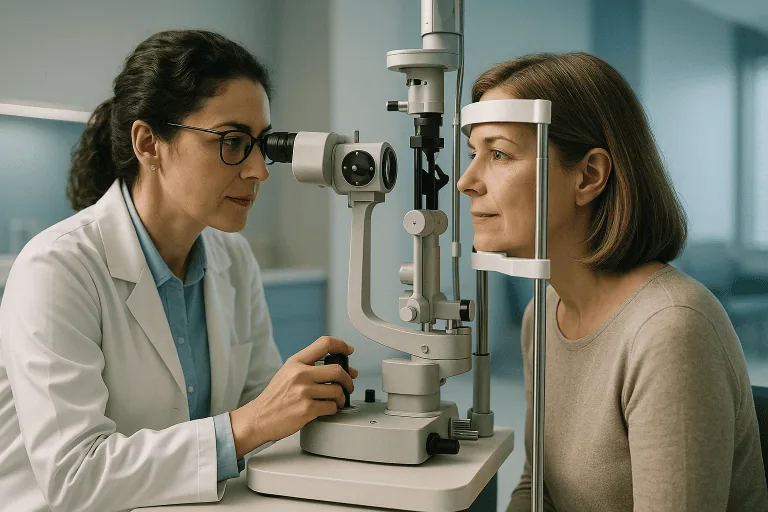
- Examination of the eye’s structures. Using specialized instruments, the doctor inspects the front of the eye, the lens, and the retina (the light-sensitive layer at the back of the eye) to rule out cataracts, other blockages, or diseases that could explain reduced vision.
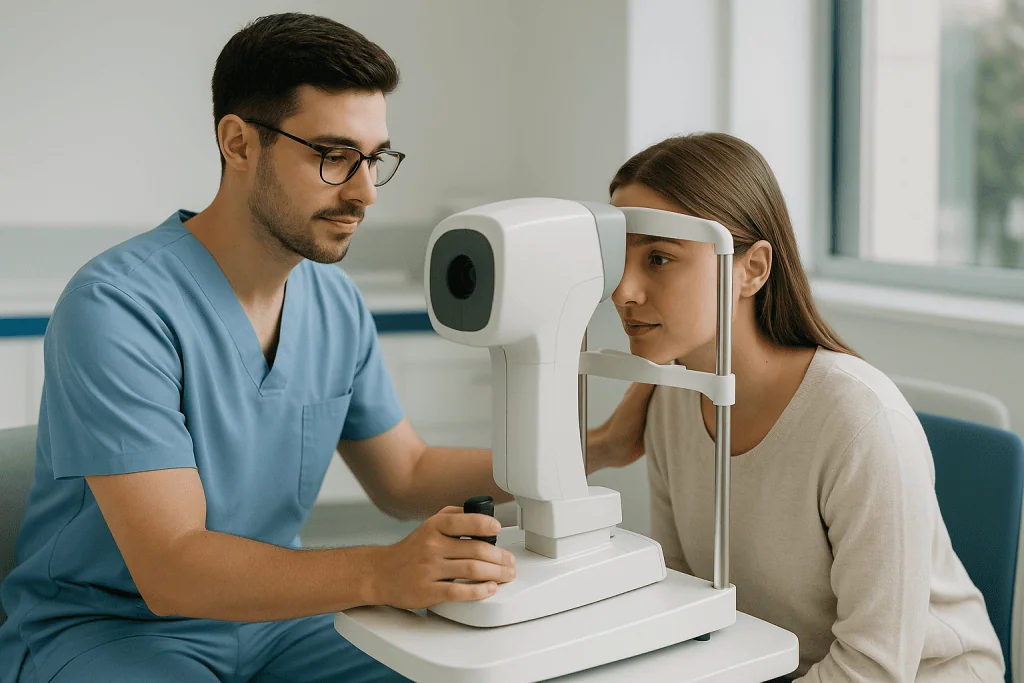
- Photoscreening or automated screening devices. In some settings, especially for very young or preverbal children, instrument-based screening can detect risk factors for amblyopia, such as significant refractive errors or misalignment, prompting referral for a full examination.
Doctors generally confirm amblyopia when vision in one eye is meaningfully worse than the other (or worse than expected for the child’s age), the reduction cannot be fully explained by an eye disease alone, and a known amblyopia-causing factor, such as strabismus, unequal refractive error, or visual deprivation, is present. Part of the diagnostic process is ruling out other causes of poor vision, which is why a thorough examination of the whole eye is essential.
Because early detection improves the chances of successful treatment, pediatric guidelines in many countries recommend vision screening at regular intervals during infancy and the preschool years, with prompt referral to an eye specialist if any concern arises. Within hospital systems such as Acibadem, this evaluation and follow-up care are typically managed by the ophthalmology department, often by specialists in pediatric ophthalmology.
Treatment options for amblyopia
Amblyopia treatment has two broad goals: first, to remove or correct whatever is preventing a clear image from reaching the brain, and second, to encourage the brain to use the weaker eye so that its visual pathways can strengthen. Treatment is usually most effective in early childhood, although older children, and in some cases even teenagers, may still benefit. The right plan depends on the cause, the child’s age, and the severity of the vision difference.
Correcting the underlying problem
- Glasses or contact lenses. When refractive error is the cause or a contributing factor, prescription glasses are typically the first step. In some children, wearing glasses consistently for a period of weeks to months improves vision substantially on its own, and the doctor may recommend a period of observation with glasses before adding other treatments.
- Surgery for blocking conditions. If a cataract, droopy eyelid, or other physical obstruction is depriving the eye of clear images, surgery to remove the blockage is often needed, usually as early as safely possible, followed by amblyopia therapy.
- Strabismus surgery. When the eyes are misaligned, surgery on the eye muscles may be recommended to straighten them. It is important to understand that alignment surgery repositions the eyes but does not by itself restore vision; amblyopia therapy is usually still required before or after surgery, as advised by the doctor.
Encouraging use of the weaker eye
- Patching. The most established amblyopia treatment involves covering the stronger eye with an adhesive patch for a prescribed number of hours each day. This forces the brain to rely on the weaker eye, stimulating its development. The daily duration and total length of patching vary with the child’s age and the severity of the amblyopia, and the doctor adjusts the plan based on progress at follow-up visits.
- Atropine eye drops. As an alternative to patching, drops of atropine, a medication that temporarily blurs near vision, can be placed in the stronger eye. This gently encourages the brain to use the weaker eye. Atropine can be a helpful option for children who resist wearing a patch, though it may cause light sensitivity and blurred near vision in the treated eye.
- Optical penalization. In selected cases, the doctor may deliberately blur the stronger eye using a modified glasses prescription or a filter placed on the lens, achieving a similar effect to patching.
- Vision therapy and digital approaches. Structured visual activities, and in some settings computer- or tablet-based programs designed to train both eyes together, are sometimes used alongside standard treatment. Evidence for these newer approaches is still developing, and they are generally considered a supplement to, not a replacement for, glasses, patching, or drops.
Watchful waiting alone is generally not appropriate once amblyopia is confirmed, because untreated amblyopia in a young child tends to persist or worsen. However, doctors do use scheduled observation in specific situations, for example, after prescribing glasses, to see how much vision improves before adding patching. Treatment often continues for months, and regular follow-up is essential both to track improvement and to watch for recurrence after treatment is tapered, which can happen in some children.
Care for amblyopia is coordinated through an eye-care team. Details about the relevant specialty can be found on the ophthalmology department page.
Living with amblyopia and outlook
The outlook for amblyopia depends heavily on how early it is detected and how consistently treatment is followed. When treatment begins in early childhood, many children achieve significant and lasting improvement in the weaker eye, and some reach normal or near-normal vision. When treatment starts later, improvement is often still possible but may be more limited, and in some cases a degree of reduced vision remains permanent. No treatment can guarantee a specific outcome.
Day-to-day life with amblyopia is manageable for most people. Practical points that families and adults often find helpful include:
- Consistency matters. The success of patching, drops, and glasses depends on daily use. Making patching part of a routine, during favorite activities, games, or screen time that engages the weaker eye, can improve cooperation in young children.
- Protecting the stronger eye. For people with lasting reduced vision in one eye, doctors often recommend protective eyewear during sports and hazardous activities, because an injury to the good eye would have greater consequences.
- Watching for recurrence. Vision can slip after treatment ends, particularly in younger children, so follow-up examinations remain important even after successful therapy.
- School and activities. Most children with amblyopia participate fully in school and sports. Depth perception may be reduced in some individuals, which can affect certain tasks, but many people adapt well over time.
Adults with long-standing amblyopia should continue routine eye care for both eyes. While the amblyopic eye may not regain full vision in adulthood, maintaining the health of the stronger eye is especially important.
Frequently asked questions
What is amblyopia in simple terms?
Amblyopia is reduced vision in one eye (or occasionally both) that develops in childhood because the brain does not learn to use that eye properly. The eye may be structurally normal, but the brain favors the other eye, so vision in the affected eye stays weak even with glasses. It is commonly known as lazy eye, although the eye itself is not lazy: the issue lies in the connection between the eye and the brain.
Can amblyopia heal on its own?
Amblyopia generally does not resolve without treatment. Because the brain actively suppresses the weaker eye, vision in that eye tends to stay the same or worsen if nothing is done during childhood. This is why doctors usually recommend starting treatment, such as glasses, patching, or eye drops, as soon as the condition is confirmed, rather than waiting to see whether it improves by itself.
How serious is amblyopia?
Amblyopia is not painful or life-threatening, but it can cause permanent vision loss in the affected eye if it is not treated during childhood. It can also reduce depth perception. Perhaps most importantly, a person with untreated amblyopia depends heavily on one good eye; if that eye is ever injured or affected by disease later in life, the consequences can be significant. Early treatment substantially reduces these risks in many cases.
What are the first signs of amblyopia in a child?
Early amblyopia symptoms can be hard to notice. Possible signs include an eye that drifts or turns, squinting or closing one eye, tilting the head to see, poor depth perception, or strong resistance when one particular eye is covered. Many children show no visible signs at all, especially when the cause is a difference in focusing power between the eyes, which is why routine vision screenings in infancy and the preschool years are so important.
Can amblyopia be treated in adults?
Treatment is most effective during childhood, while the visual system is still developing. In adults, the potential for improvement is generally more limited, although research into adult amblyopia treatment is ongoing and some individuals experience modest gains with certain therapies. Adults who suspect they have amblyopia should have a full eye examination, both to confirm the diagnosis and to protect the health of their stronger eye.
How long does amblyopia treatment take?
There is no single timeline. Some children improve within a few months of wearing glasses or patching, while others need treatment for a year or longer, followed by a gradual tapering phase and monitoring for recurrence. The duration depends on the child’s age, the severity and cause of the amblyopia, and how consistently the treatment plan is followed. Regular follow-up visits allow the doctor to adjust the plan as vision changes.
Is amblyopia the same as strabismus?
No, although the two are related. Strabismus means the eyes are misaligned, one eye turns in a different direction. Amblyopia means the brain has not developed normal vision in one eye. Strabismus is one of the main amblyopia causes, because the brain may suppress the image from a turned eye. However, a child can have strabismus without amblyopia, and amblyopia frequently occurs in children whose eyes look perfectly straight.
When to see a doctor
Any concern about a child’s vision or eye alignment deserves a professional evaluation, because early amblyopia diagnosis gives treatment the best chance of success. Even without symptoms, children should have vision screening at the intervals recommended by their pediatrician, and any abnormal screening result should be followed by a full eye examination.
Seek medical attention promptly if you notice any of the following warning signs in a child:
- An eye that turns or drifts in any direction after about four months of age, whether constantly or intermittently
- A white, gray, or cloudy appearance in the pupil, or an unusual reflection in the pupil in photographs
- A droopy eyelid that covers part of the pupil
- Persistent squinting, head tilting, or closing one eye to see
- Strong distress when one specific eye is covered, which may suggest the other eye sees poorly
- A sudden change in vision or eye alignment at any age
- Eye pain, redness, or injury, particularly in a person who already relies on one stronger eye
Adults with known amblyopia should seek urgent care for any new symptoms in their stronger eye, such as sudden blurring, flashes of light, new floaters, a shadow or curtain in the field of vision, or pain, since preserving vision in that eye is especially important. When in doubt, an eye examination is a safe and simple step; a doctor can determine whether the findings point to amblyopia, another condition, or normal variation.
Medically reviewed by the Acıbadem International Medical Board September 2, 2026
See our medical review board →
Update history
- PublishedJune 8, 2026
- Medical review approvedSeptember 2, 2026
- Last content updateSeptember 2, 2026