Medulloblastoma
Medulloblastoma is a fast-growing brain tumor of the cerebellum, mostly seen in children. Learn about symptoms, diagnosis, treatment options and outlook.

Quick answer
Medulloblastoma is a fast-growing cancerous brain tumor that starts in the cerebellum, the part of the brain controlling balance and coordination. It is the most common malignant brain tumor in children but can also occur in adults. Treatment usually combines surgery, radiation therapy and chemotherapy, and many patients become long-term survivors.
What is medulloblastoma?
Medulloblastoma is a fast-growing, cancerous brain tumor that begins in the cerebellum. The cerebellum is the part of the brain at the back of the head, just above the neck, that helps control balance, coordination and fine movement. Medulloblastoma belongs to a group of tumors called embryonal tumors, meaning they develop from immature cells left over from early brain development. Doctors classify it as a high-grade tumor, which means the cells look abnormal, divide quickly and can spread within the brain and spinal cord.
Medulloblastoma is the most common malignant (cancerous) brain tumor in children. It is most often diagnosed in young children, although it can occur at any age, including in teenagers and adults. Medulloblastoma in adults is uncommon and tends to behave somewhat differently from the childhood form, which is one reason adults are often treated by teams with experience in both adult and pediatric brain tumors.
One important feature of medulloblastoma is that it can spread through the cerebrospinal fluid, the clear fluid that surrounds the brain and spinal cord. Because of this, doctors examine both the brain and the spine when the tumor is diagnosed, and treatment is usually planned to address the whole central nervous system rather than the tumor alone.
Researchers now recognize that medulloblastoma is not a single disease. Based on the genetic features of the tumor cells, it is divided into several molecular groups, commonly referred to as WNT, SHH, Group 3 and Group 4. These groups differ in the age at which they usually appear, how they tend to behave and how they respond to treatment. This molecular information is increasingly used alongside traditional factors to guide care.
Medulloblastoma symptoms
Medulloblastoma symptoms are mainly caused by two things: pressure building up inside the skull, and damage to the cerebellum itself. As the tumor grows in the tight space at the back of the head, it can block the normal flow of cerebrospinal fluid. This causes hydrocephalus, a buildup of fluid inside the brain that raises pressure. Symptoms often develop over weeks to a few months and may be mistaken at first for a stomach illness, migraine or a viral infection.
Common medulloblastoma symptoms include:
- Headaches, often worse in the morning or on waking
- Nausea and vomiting, especially in the morning, sometimes without other signs of illness
- Loss of balance or clumsiness, such as stumbling, a wide-based walk or trouble with stairs
- Difficulty with coordination, including problems writing, using utensils or catching a ball
- Double vision or abnormal eye movements
- Tilting the head to one side or holding the neck stiffly
- Irritability, tiredness or changes in behavior, particularly in young children
- An enlarging head in infants whose skull bones have not yet fused
- Back pain or weakness in the legs, which may suggest the tumor has spread to the spine
In babies and toddlers, symptoms can be subtle. A child may become fussy, feed poorly, lose skills they had already learned, or seem less alert. Parents sometimes notice that a child has stopped walking as confidently as before.
Symptoms in adults and older teenagers are similar, but adults may describe headaches, dizziness, unsteadiness or vision changes more precisely. Because medulloblastoma in adults is rare, the diagnosis is sometimes not considered right away, and symptoms may be attributed to other, more common causes.
When the tumor has spread to other parts of the brain or the spinal cord, additional symptoms can appear, including seizures, weakness or numbness in the arms or legs, and problems with bladder or bowel control. Not everyone experiences all of these symptoms, and having some of them does not mean a person has medulloblastoma; many other conditions cause similar complaints.
Causes and risk factors
In most cases, the exact cause of medulloblastoma is not known. The tumor develops when immature cells in the cerebellum acquire changes in their DNA that make them multiply out of control. In the great majority of children and adults, these changes happen by chance during development and are not inherited from a parent, and they are not caused by anything the parents or the patient did.
A small number of people have an inherited genetic condition that raises the risk of medulloblastoma. These include:
- Gorlin syndrome (also called nevoid basal cell carcinoma syndrome), linked to changes in the PTCH1 or SUFU genes
- Li-Fraumeni syndrome, linked to changes in the TP53 gene
- Familial adenomatous polyposis and related conditions, linked to changes in the APC gene
- Fanconi anemia, a rare inherited blood disorder
Because of this, doctors may recommend genetic counseling and testing for some patients and their families, especially when the tumor belongs to certain molecular groups or when there is a family history of cancer at young ages.
There are no proven lifestyle or environmental risk factors that a person can change. Medulloblastoma is not contagious, and there is no evidence that diet, screen use, injuries or common infections cause it. Age is the main known risk factor, with the tumor occurring most often in childhood, and it is slightly more common in boys than in girls.
Diagnosis
Diagnosis usually begins with a careful medical history and a neurological examination. The doctor checks balance, coordination, eye movements, reflexes and, in young children, head size. If the findings raise concern about a brain tumor, imaging is arranged promptly.
Magnetic resonance imaging (MRI) is the main test used to detect medulloblastoma. MRI uses magnets and radio waves to produce detailed pictures of the brain without radiation. It is usually performed with a contrast dye injected into a vein to make the tumor stand out. Because medulloblastoma can spread along the spinal cord, an MRI of the entire spine is typically done as well. A computed tomography (CT) scan is sometimes performed first in an emergency setting because it is faster, but MRI provides more detail.
Imaging alone cannot confirm the diagnosis. The definitive diagnosis is made by examining the tumor tissue under a microscope. In most cases, this tissue is obtained during the operation to remove the tumor rather than through a separate biopsy. A pathologist, a doctor who specializes in examining tissue, identifies the type of tumor and its features.
Increasingly, the tumor sample is also sent for molecular testing, which looks at the genetic makeup of the cells to determine which molecular group the tumor belongs to. This information helps the medical team estimate how the tumor is likely to behave and choose the most appropriate treatment.
After surgery, doctors usually perform a lumbar puncture (spinal tap), in which a small amount of cerebrospinal fluid is drawn from the lower back with a thin needle and checked for tumor cells. Together with the spinal MRI, this shows whether the cancer has spread. The combination of how much tumor could be removed, whether it has spread, the patient’s age and the molecular group is used to assign a risk category, often described as average risk or high risk, which guides the intensity of treatment.
Before treatment starts, additional assessments are often carried out, such as hearing tests, vision tests, blood tests and hormone tests. These provide a baseline so that any side effects of treatment can be recognized and managed later.
Medulloblastoma treatment options
Medulloblastoma treatment almost always involves a combination of approaches rather than a single therapy. Care is planned by a multidisciplinary team that typically includes neurosurgeons, pediatric or medical oncologists, radiation oncologists, pathologists, radiologists, rehabilitation specialists and nurses. At Acibadem, the surgical part of care is handled through the neurosurgery department, working together with oncology teams. Observation without treatment is not a standard option for this tumor because it grows quickly.
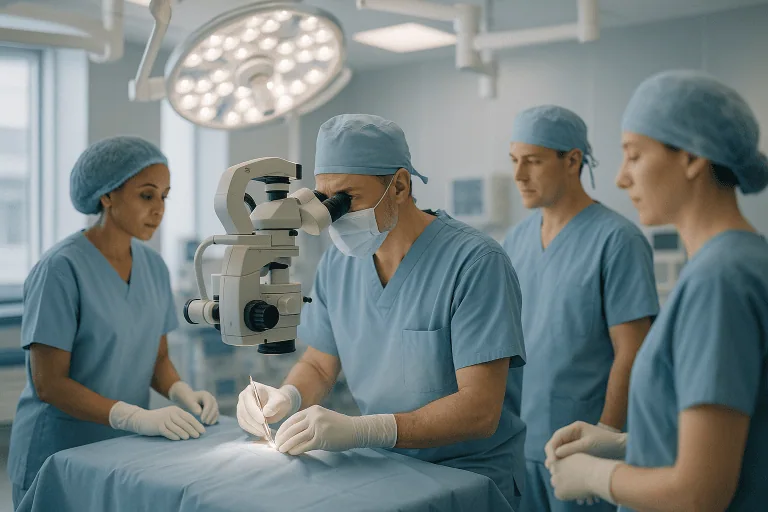
Surgery is usually the first step. The goal is to remove as much of the tumor as safely possible while protecting the surrounding brain. Removing most or all of the visible tumor is associated with better outcomes, but the surgeon must weigh this against the risk of damaging important structures in the brainstem and cerebellum. If hydrocephalus is causing dangerous pressure, the surgeon may first place a temporary drain or perform a procedure to restore fluid flow. Some patients need a permanent shunt, a thin tube that carries excess fluid from the brain to the abdomen.
A known complication after surgery in this area is posterior fossa syndrome, sometimes called cerebellar mutism. It may cause a temporary loss of speech, emotional changes, and difficulty swallowing or moving. It usually improves over weeks to months, although some effects can last longer, and rehabilitation plays an important role in recovery.
Radiation therapy uses high-energy beams to destroy remaining tumor cells. Because medulloblastoma can spread through cerebrospinal fluid, radiation is usually given to the entire brain and spine, known as craniospinal irradiation, with an extra dose to the area where the tumor was located. Radiation is very effective against this tumor, but it can affect the developing brain. For this reason, doctors try to avoid or delay radiation in very young children, and in average-risk patients they may use lower doses to the brain and spine. Techniques such as proton therapy are sometimes used to reduce the dose to healthy tissue.
Chemotherapy, the use of medicines that kill rapidly dividing cells, is a standard part of treatment for most patients. It is usually given after radiation, or in very young children it may be used instead of radiation or to postpone it. Chemotherapy may be given through a vein over several months. Side effects can include lowered blood counts, infection risk, nausea, hair loss, and effects on hearing or kidney function, which the team monitors closely.
Treatment for medulloblastoma in adults follows similar principles, with surgery, craniospinal radiation and chemotherapy, although adults may tolerate some chemotherapy combinations differently and their care is often adapted from pediatric protocols.
Clinical trials are an important part of medulloblastoma care, and many patients are treated within research studies that test ways to improve cure rates or reduce long-term side effects. Targeted therapies aimed at specific molecular groups are under investigation, and your doctor may discuss whether a trial is appropriate.
Rehabilitation and supportive care begin early and continue throughout treatment. Physical therapy helps with balance and strength, occupational therapy addresses daily skills, and speech therapy supports communication and swallowing. Psychological support for the patient and family, nutritional care and help with school or work are also standard components of comprehensive care.
Living with medulloblastoma and outlook
Medulloblastoma prognosis has improved considerably over recent decades, and many children treated for this tumor become long-term survivors. However, outcomes vary widely from one person to another. Factors that influence the outlook include the patient’s age, how much of the tumor could be removed, whether the cancer had spread at diagnosis, the molecular group of the tumor and how the tumor responds to treatment. Tumors in the WNT group are generally associated with a more favorable prognosis, while some other groups, particularly when the cancer has spread, are considered higher risk.
Statistics about medulloblastoma survival rate that you may find online describe large groups of patients treated in the past. They cannot predict what will happen to an individual, and they may not fully reflect current treatments. The medical team caring for a specific patient is best placed to explain what the findings mean for that person.
Treatment can be intensive and lasts many months. During this time, patients and families often need to adjust to hospital stays, frequent appointments and changes in daily routines. Fatigue, appetite changes and emotional ups and downs are common and expected.
After treatment ends, follow-up continues for many years. Regular MRI scans check for any return of the tumor, which is most likely in the first few years but can occur later. Survivors are also monitored for late effects of treatment, which can include learning and memory difficulties, hearing loss, hormone problems affecting growth and puberty, changes in balance or coordination, and a small increased risk of other cancers later in life. Early recognition allows these effects to be managed, for example with hormone replacement, hearing aids or educational support.
Many survivors go on to attend school, work and live independently, although some need ongoing support. Long-term follow-up clinics that specialize in survivors of childhood cancer can help coordinate this care into adulthood.
Frequently asked questions
What is the medulloblastoma survival rate?
Published survival figures show that a large proportion of children treated for medulloblastoma live for many years after diagnosis, and outcomes are generally better for patients with average-risk disease than for those with high-risk disease. These figures are averages from past groups of patients and do not predict any individual’s outcome. Your treating team can explain how factors such as spread, molecular group and response to treatment apply to a specific situation.
What are the first symptoms of medulloblastoma?
The earliest medulloblastoma symptoms are often morning headaches, nausea or vomiting, and unsteadiness or clumsiness. In young children, irritability, tiredness, poor feeding or loss of recently learned skills may be the first signs. These symptoms are common in many minor illnesses, so persistence or worsening over several weeks is what usually prompts further investigation.
Is medulloblastoma curable?
Medulloblastoma is considered a potentially curable cancer, and many patients treated with surgery, radiation and chemotherapy remain free of disease long term. However, not every tumor responds in the same way, and some do return after treatment. Doctors avoid using the word cure until a person has remained free of disease for a number of years, and they continue follow-up throughout life.
How is medulloblastoma in adults different?
Medulloblastoma in adults is rare and most often belongs to the SHH molecular group. Adults are generally treated with the same combination of surgery, craniospinal radiation and chemotherapy used in children, with adjustments for how adults tolerate certain medicines. Because adult cases are uncommon, care is often coordinated by centers with experience in both adult and pediatric neuro-oncology.
What does medulloblastoma treatment involve?
Standard medulloblastoma treatment typically starts with surgery to remove as much of the tumor as safely possible, followed by radiation therapy to the brain and spine in most patients over a certain age, and then several months of chemotherapy. Very young children may receive chemotherapy alone or have radiation delayed to protect the developing brain. Rehabilitation and supportive care are part of treatment from the beginning.
Does medulloblastoma run in families?
In most cases, medulloblastoma is not inherited and occurs by chance. A small proportion of patients have an underlying genetic syndrome, such as Gorlin syndrome or Li-Fraumeni syndrome, that increases the risk. Doctors may suggest genetic counseling when the tumor’s molecular features or the family history raise this possibility.
What is the long-term outlook after medulloblastoma treatment?
Many survivors lead full lives, but treatment can leave lasting effects on learning, hearing, hormones, growth and coordination. The likelihood and severity of these effects depend on age at treatment, the dose of radiation and the medicines used. Lifelong follow-up allows problems to be identified early and supported, and medulloblastoma prognosis discussions with the medical team should include both survival and quality of life.
When to see a doctor
Many of the symptoms described on this page are common and usually have harmless causes. However, medical evaluation is advisable when symptoms are persistent, progressive or unexplained, particularly in a child. It is reasonable to arrange an appointment if a child or adult has headaches that keep returning, repeated vomiting without other signs of illness, new clumsiness or unsteadiness, or changes in vision that last more than a few days.
Seek urgent or emergency medical care if any of the following red-flag signs occur:
- Severe headache with vomiting, especially on waking or during the night
- Sudden difficulty walking, standing or keeping balance
- Drowsiness, confusion or difficulty waking a child
- A seizure in someone who has never had one before
- Sudden double vision, loss of vision or eyes that do not move together
- A stiff neck with head tilt, fever or intense pain
- Weakness or numbness in the arms or legs, or new problems controlling the bladder or bowel
- In infants, a rapidly enlarging head, a bulging soft spot on the skull or persistent high-pitched crying
For people already diagnosed with medulloblastoma, the treatment team usually provides specific instructions about symptoms to report during and after treatment, including fever during chemotherapy, signs of infection, sudden headache or vomiting, and any return of the symptoms that led to the original diagnosis. Following those instructions and attending scheduled follow-up visits is an important part of ongoing care.
Medically reviewed by the Acıbadem International Medical Board September 8, 2026
See our medical review board →
Update history
- PublishedSeptember 8, 2026
- Medical review approvedSeptember 8, 2026
- Last content updateSeptember 8, 2026