Polyp Nodule
Learn what a polyp nodule on the vocal cords is, common polyp nodule symptoms and causes, how doctors diagnose it, and the treatment options often considered.
Quick answer
A polyp nodule refers to benign, non-cancerous growths on the vocal cords, namely vocal cord polyps and nodules, that form from voice strain or irritation. They cause hoarseness, a breathy or tired voice and reduced range. Diagnosis is by laryngoscopy, and treatment usually begins with voice rest and voice therapy, with surgery reserved for persistent cases.
What is polyp nodule?
The term polyp nodule is most often used by patients to describe two closely related growths on the vocal cords: vocal cord polyps and vocal cord nodules. The vocal cords (also called vocal folds) are two small bands of muscle and tissue inside the larynx, or voice box, that vibrate to produce sound when you speak or sing. When these bands are stressed or injured, small benign (non-cancerous) growths can form on their surface and change the way the voice sounds.
A vocal cord nodule is a firm, callus-like thickening that usually forms on both vocal cords at the point where they strike each other most forcefully. Nodules develop gradually over time. A vocal cord polyp is typically a softer, blister-like or fluid-filled swelling that often appears on only one vocal cord. Polyps can appear after a single episode of intense voice strain or after longer-term irritation. Because the two conditions share causes, symptoms and much of their treatment, doctors frequently discuss them together, and the everyday phrase "polyp nodule" reflects that overlap.
When people ask "what is polyp nodule," it is helpful to know that both growths are considered benign lesions. They are not cancer, although a specialist will always want to examine any growth on the vocal cords carefully to rule out other causes of voice change. Vocal cord nodules are seen frequently in people who use their voices heavily, such as teachers, singers, coaches and call-center workers, and they are also relatively common in children who shout often. Polyps are more often seen in adults. Both conditions are managed by doctors who specialize in the ear, nose and throat, a field known as otorhinolaryngology (ENT), sometimes working together with speech-language pathologists who focus on voice.
Symptoms of polyp nodule
Polyp nodule symptoms are mainly about the voice. Because the growth prevents the vocal cords from closing smoothly and vibrating evenly, the sound produced becomes rough or breathy. Symptoms usually develop slowly with nodules and may appear more suddenly with a polyp, especially one that follows a shouting episode or a severe cough.
- Hoarseness (a rough, raspy or strained voice) lasting more than a couple of weeks
- A breathy voice, or a voice that "cuts out" or cracks
- Reduced vocal range, particularly difficulty reaching high notes when singing
- Voice fatigue, meaning the voice tires or weakens after a short time of talking
- A lower-pitched voice than usual
- A feeling of a lump in the throat, or the urge to clear the throat frequently
- Neck or throat discomfort or a sense of tightness when speaking
- Occasional pain that shoots from ear to ear, described by some people with vocal strain
There are some general differences between the two types. With nodules, hoarseness is often mild at first and tends to be worse at the end of a day of heavy voice use, improving with rest. Over time, if the strain continues, the voice change can become constant. With a polyp, the voice may sound noticeably rougher, and some people describe a "double" tone because the two cords vibrate at different rates. A very large polyp can occasionally interfere with breathing or produce a sense of something moving in the throat, but this is uncommon.
It is important to remember that hoarseness has many possible causes, from a short-lived viral infection to acid reflux, smoking-related changes or, rarely, a cancerous growth. Symptoms alone cannot tell the difference, which is why persistent voice change should be evaluated rather than assumed to be a simple polyp or nodule.
Causes and risk factors
Polyp nodule causes come down to mechanical stress on the vocal cords. Each time you speak, the cords collide many times per second. When this collision is too forceful, too frequent or happens while the tissue is already irritated, the body responds by thickening the surface (forming a nodule) or by allowing fluid or blood to collect under the surface (forming a polyp). Doctors often group these causes under the heading of "phonotrauma," which simply means injury to the vocal cords from how the voice is used.
- Voice overuse: talking for long periods without rest, especially in noisy environments
- Voice misuse: shouting, screaming, cheering, or speaking at an unnaturally low or high pitch
- Prolonged coughing or throat clearing, which repeatedly slams the cords together
- Single intense event: a polyp may form after one episode of yelling or heavy coughing
- Smoking, which irritates and dries the lining of the larynx
- Acid reflux (stomach acid rising into the throat), which inflames the vocal cord tissue
- Allergies and sinus problems that lead to postnasal drip and repeated throat clearing
- Dehydration, which makes the vocal cords less flexible and more prone to injury
Certain people are at higher risk. Professional voice users such as singers, actors, teachers, lawyers, fitness instructors and people who work in sales or customer service are affected more often because of the sheer amount of speaking they do. Children who shout at play or in sports can develop nodules, and these sometimes improve as speaking habits change with age. Adult women appear to develop nodules more often than men, while polyps are seen in both sexes. Some medical conditions may also contribute, for example an underactive thyroid gland (hypothyroidism), which can cause swelling of the vocal cord tissue, or use of certain inhaled medications that dry the throat. Stress and tension in the neck and shoulder muscles can also lead to a strained speaking style that places extra load on the cords.
Diagnosis
Polyp nodule diagnosis starts with a careful history. Your doctor will ask how long the voice change has lasted, whether it is constant or comes and goes, how you use your voice at work and at home, and whether you smoke, have reflux symptoms or have recently had a cold or cough. A hoarse voice that has lasted longer than two to three weeks without an obvious cause is generally considered a reason for direct examination of the vocal cords.
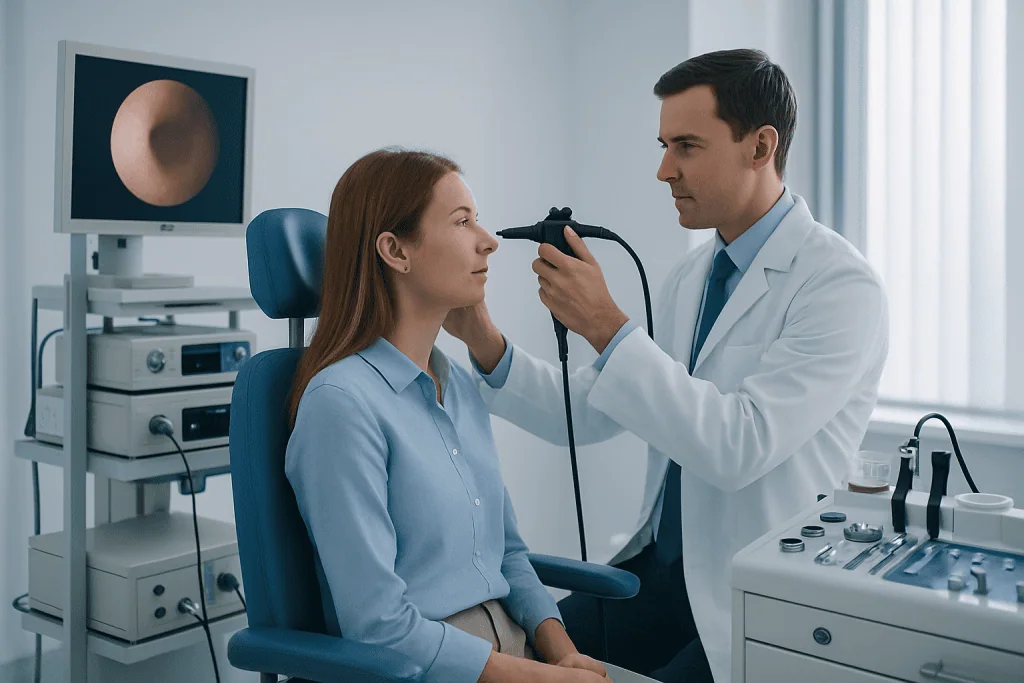
The key test is laryngoscopy, a procedure in which the doctor looks directly at the vocal cords. This can be done in several ways:
- Indirect laryngoscopy: a small mirror is placed at the back of the throat while a light is directed onto it.
- Flexible laryngoscopy: a thin, flexible tube with a camera is passed through the nose into the throat, usually after a numbing spray. This lets the doctor watch the cords while you speak.
- Rigid laryngoscopy: a straight telescope is placed in the mouth to give a magnified view of the cords.
- Videostroboscopy: a flashing light is synchronized with the vibration of the cords so the doctor can see them in slow motion. This is often considered the most useful office test for telling a nodule from a polyp and for judging how each affects vibration.
In many cases, the appearance on laryngoscopy is enough to make the diagnosis. Nodules typically look like small, symmetrical, pale bumps on both cords, while a polyp is usually a single, rounded, sometimes reddish swelling. A speech-language pathologist may also perform a voice evaluation, recording the voice and measuring qualities such as pitch range, loudness and how long you can sustain a sound. This helps establish a baseline for tracking improvement.
Additional tests are not always needed but may be considered. If reflux is suspected, your doctor may recommend a trial of acid-reducing medication or, less commonly, tests that measure acid in the throat. If the growth looks unusual, does not respond to treatment, or the person has risk factors such as smoking and alcohol use, a biopsy (removal of a small piece of tissue for examination under a microscope) may be recommended to rule out a precancerous or cancerous change. A biopsy is usually done in the operating room under general anesthesia. Blood tests may be ordered if a thyroid problem is suspected.
Treatment options for polyp nodule
Polyp nodule treatment options depend on the type of growth, its size, how much it is affecting the voice and, importantly, the person’s voice needs. Treatment is usually stepwise, beginning with the least invasive approach.
Voice rest and behavioral changes
For many nodules, and for some small polyps, the first step is reducing the strain that caused them. This may include a short period of relative voice rest (speaking less, not whispering, avoiding shouting), drinking enough water, limiting caffeine and alcohol that can dry the throat, and stopping smoking. Treating contributing conditions such as acid reflux, allergies or a chronic cough is also part of this stage.
Voice therapy
Voice therapy with a speech-language pathologist is often the main treatment for vocal cord nodules and is frequently recommended before or after treatment of a polyp. Therapy teaches healthier ways to produce sound: proper breathing, relaxed posture, appropriate pitch and loudness, and techniques to reduce tension in the throat. Sessions usually take place over several weeks to months. Nodules often shrink or disappear with consistent therapy, although the timing varies from person to person.
Medication
There is no medication that directly removes a polyp or nodule. Medications are used to control underlying irritation. Acid-reducing drugs may be prescribed if reflux is suspected. Antihistamines or nasal sprays may help when allergies cause postnasal drip. In some cases of acute swelling, a short course of corticosteroids (anti-inflammatory medication) may be considered, but this is decided case by case.
Surgery
Surgery is usually reserved for polyps that do not improve with conservative measures, for nodules that persist despite adequate voice therapy, or for any growth whose appearance raises concern. The standard procedure is microlaryngoscopy (also called phonomicrosurgery), performed under general anesthesia. The surgeon views the vocal cords through a microscope and removes the growth with very fine instruments or, in some cases, a laser, taking care to preserve the delicate vibrating layer of the cord. The procedure is typically done on a day-case or short-stay basis. A period of strict voice rest is usually required afterward, followed by voice therapy to prevent the growth from returning. Surgery carries the usual risks of anesthesia and a small risk of scarring that could affect voice quality, which is why it is not usually a first-line option for nodules.
Follow-up and rehabilitation
Whatever the treatment, follow-up laryngoscopy is often used to confirm that the growth has resolved. Rehabilitation focuses on keeping the new voice habits. For professional voice users, a gradual return to full performance or work demands is generally advised.
Living with polyp nodule and outlook
The outlook for both vocal cord nodules and polyps is generally favorable because they are benign and because effective treatments exist. Many people with nodules recover their normal voice with voice therapy alone, particularly when the therapy is followed consistently and the habits that caused the strain are changed. Polyps that require surgery are usually removed successfully, and most people regain good voice quality after healing and therapy. However, no outcome can be guaranteed, and results depend on factors such as how long the growth was present, how large it was, the health of the surrounding tissue and how completely the underlying causes are addressed.
The main challenge after treatment is prevention of recurrence. If the same patterns of shouting, prolonged talking, smoking or untreated reflux continue, a new nodule or polyp can form. Living well with this condition therefore means adopting long-term vocal hygiene: staying hydrated, taking regular voice breaks, using amplification when speaking to groups, avoiding whispering and throat clearing, and warming up the voice before heavy use. People who depend on their voice professionally may benefit from periodic check-ins with a voice specialist.
Emotionally, a voice problem can be more difficult than it sounds. Hoarseness may affect confidence at work, social life and, for singers and performers, identity and livelihood. It is reasonable to discuss these concerns with your care team; speech-language pathologists often address the psychological side of voice recovery alongside technique.
Frequently asked questions
What is polyp nodule and is it the same as cancer?
A polyp nodule refers to benign growths on the vocal cords caused by strain or irritation. They are not cancer. However, because hoarseness can also be an early sign of laryngeal cancer, particularly in people who smoke or drink heavily, a specialist examination is important to confirm that a growth is truly a simple polyp or nodule.
What are the first polyp nodule symptoms people usually notice?
The earliest sign is usually a hoarse or rough voice that does not go away after a cold has cleared, or a voice that tires quickly by the end of the day. Singers often notice a loss of high notes or a voice that cracks before they notice hoarseness in everyday speech.
What are the most common polyp nodule causes?
The most common cause is repeated or forceful voice use, sometimes called phonotrauma: shouting, talking for long hours, frequent coughing or throat clearing. Smoking, acid reflux, allergies and dehydration make the vocal cord tissue more vulnerable, so they often contribute alongside voice strain.
How is polyp nodule diagnosis confirmed?
Diagnosis is confirmed by looking directly at the vocal cords with a laryngoscope, a small camera passed through the nose or mouth. Videostroboscopy, which shows the cords vibrating in slow motion, helps distinguish a nodule from a polyp. A biopsy is only recommended if the growth looks unusual or does not respond to treatment.
What are the polyp nodule treatment options without surgery?
Non-surgical options include voice rest, hydration, stopping smoking, treating reflux or allergies, and voice therapy with a speech-language pathologist. Voice therapy is the main treatment for nodules and often helps polyps as well. Surgery is generally considered only when these measures have not produced enough improvement.
Can a polyp nodule go away on its own?
Small nodules may shrink if the voice is rested and the causes of strain are removed, and some small polyps also settle with time. Larger or long-standing growths are less likely to disappear without treatment. Your doctor may suggest a period of observation combined with voice therapy before considering other steps.
Will my voice return to normal after treatment?
Many people regain a normal or near-normal voice, especially when treatment is followed by good vocal habits. Outcomes vary, and some people experience mild lasting changes, particularly if a growth was large or had been present for a long time. Your care team can give you a more individual sense of what to expect.
When to see a doctor
Voice changes are common and often resolve within a week or two after a cold or a period of heavy voice use. You should arrange an evaluation with a doctor, ideally an ENT specialist, if hoarseness lasts longer than two to three weeks, if it keeps returning, or if it interferes with your work or daily communication. At Acibadem, this evaluation is generally carried out through the otorhinolaryngology (ENT) department in cooperation with voice therapists.
Seek prompt or urgent medical attention if you notice any of the following red-flag signs, because they can point to a more serious problem than a simple polyp or nodule:
- Difficulty breathing, noisy breathing, or a feeling that your airway is narrowed
- Difficulty swallowing, or pain when swallowing, that is worsening
- Coughing up blood
- A lump in the neck that you can feel
- Complete loss of voice that lasts more than a few days
- Hoarseness combined with unexplained weight loss, persistent ear pain or night sweats
- Hoarseness in a person who smokes or drinks alcohol heavily, even if it is mild
- Voice change that appeared suddenly after an injury to the neck or after a surgical procedure
These symptoms do not mean that something serious is present, but they do mean that a doctor should look at the throat and vocal cords without delay.
Medically reviewed by the Acıbadem International Medical Board September 9, 2026
See our medical review board →
Update history
- PublishedSeptember 9, 2026
- Medical review approvedSeptember 9, 2026
- Last content updateSeptember 9, 2026