Quick answer
Thyroid eye disease is an autoimmune condition linked to thyroid dysfunction that causes inflammation and swelling around the eyes, leading to bulging, dryness, double vision, or vision changes. At Acibadem in Turkey, care focuses on confirming the diagnosis, monitoring eye and thyroid involvement, and treating it with measures such as lubrication, medication, and when needed, surgery to protect vision and…
What is thyroid eye disease?
Thyroid eye disease is an autoimmune condition, which means the body’s own immune system mistakenly attacks healthy tissue, in this case, the muscles and fatty tissue around the eyes. This attack causes inflammation (swelling and irritation) and, over time, can change the shape and position of the tissues inside the eye socket. The condition is also known as Graves’ orbitopathy, Graves’ ophthalmopathy, or thyroid-associated orbitopathy. In medical coding it appears under ICD-10 code H06.2, which describes eye problems related to thyroid dysfunction.
Most people who develop thyroid eye disease also have a thyroid disorder, most commonly Graves’ disease. Graves’ disease is an autoimmune condition in which the immune system stimulates the thyroid gland, a small, butterfly-shaped gland in the neck, to make too much thyroid hormone (a state called hyperthyroidism). However, thyroid eye disease can also occur in people whose thyroid hormone levels are normal or even low, and eye symptoms sometimes appear before, during, or years after the thyroid problem itself is discovered.
The condition affects women more often than men, although men who develop it may experience more severe disease. It most often appears in middle adulthood, but it can occur at almost any age. In many cases the disease is mild, causing dryness, redness, and a change in eye appearance. In a smaller number of people it becomes more severe, affecting eye movement, causing double vision, or, rarely, threatening sight. Understanding what is thyroid eye disease, how it progresses, and which warning signs matter can help patients and families work with their care team more confidently.
Symptoms of thyroid eye disease
Thyroid eye disease symptoms vary widely from person to person. Some people notice only mild irritation, while others experience visible changes in the appearance of their eyes or problems with vision. Common symptoms include:
- Dry, gritty, or irritated eyesoften described as a sandy or foreign-body feeling.
- Redness of the eyes or eyelids.
- Watering eyes, which may seem contradictory but often results from surface irritation.
- Swelling or puffiness around the eyes and eyelids, often worse in the morning.
- Eyelid retractionthe upper eyelid pulls upward, making the eyes look wide open or “staring.”
- Bulging eyes (proptosis or exophthalmos)the eyes push forward out of the eye socket because the tissues behind them have swollen or expanded.
- Sensitivity to light (photophobia).
- Pressure or pain behind the eyes, sometimes worse when looking up, down, or to the side.
- Double vision (diplopia)seeing two images of a single object, caused by swollen eye muscles that no longer move together smoothly.
- Difficulty closing the eyes fully, especially during sleep, which can worsen dryness.
- Blurred vision or changes in color visionthese are less common but important warning signs.
Doctors often describe thyroid eye disease as having two phases. The first is the active (inflammatory) phase, during which the immune attack is ongoing and symptoms may change or worsen. This phase commonly lasts from several months to a few years. During this time, redness, swelling, pain, and progression of eye bulging or double vision are more typical. The second is the inactive (stable) phase, when the inflammation settles down. In this phase, active symptoms such as pain and redness usually improve, but structural changes, for example, bulging eyes, retracted eyelids, or persistent double vision, may remain because the tissues have been altered or scarred.
Recognizing which phase a patient is in matters, because thyroid eye disease treatment during the active phase focuses on calming inflammation, while treatment in the stable phase often focuses on correcting lasting changes. Symptoms affecting vision itself, blurring that does not clear with blinking, dimming of colors, or a rapid change in how the eye looks, always deserve prompt medical attention, as they can signal pressure on the optic nerve, the nerve that carries visual signals from the eye to the brain.
Causes and risk factors
The exact trigger of thyroid eye disease is not fully understood, but researchers agree it is an autoimmune process. In Graves’ disease, the immune system produces antibodies (immune proteins) that stimulate the thyroid gland. Similar targets exist on cells within the eye socket, particularly on fibroblasts, cells that produce connective tissue and can turn into fat cells. When antibodies and immune cells activate these fibroblasts, the tissues behind the eye swell, produce excess substances that attract water, and may expand with new fat tissue. Because the bony eye socket cannot stretch, the swollen tissue pushes the eye forward and can squeeze the muscles and the optic nerve.
Understanding thyroid eye disease causes also means understanding what raises the risk of developing it or of having a more severe course. Recognized risk factors include:
- Graves’ disease or other autoimmune thyroid conditions, including Hashimoto’s thyroiditis (an autoimmune cause of underactive thyroid) in a smaller share of cases.
- Smokingthis is the strongest modifiable risk factor. Smokers are more likely to develop thyroid eye disease, tend to have more severe disease, and often respond less well to treatment. Quitting smoking is one of the most important steps a patient can take.
- Uncontrolled thyroid hormone levelsboth overactive and underactive thyroid states that are not well managed appear to worsen eye disease.
- Radioactive iodine treatment for hyperthyroidism can, in some patients, temporarily worsen eye disease; doctors may take precautions, such as prescribing steroid medication around the time of treatment, in people at higher risk.
- Female sexwomen are affected more often, although men may experience more severe forms.
- Family history of thyroid or autoimmune disease may increase susceptibility.
- Stress and other environmental factors are suspected contributors in autoimmune disease generally, though their exact role is not proven.
It is important to note that thyroid eye disease is a separate condition from the thyroid gland disorder itself. Treating the thyroid problem does not always prevent or cure the eye disease, and the two conditions can follow different timelines. This is why care usually involves both an endocrinologist (a doctor specializing in hormone disorders) and an ophthalmologist (an eye specialist).
Diagnosis
Thyroid eye disease diagnosis usually begins with a careful history and physical examination. In many cases, a doctor can strongly suspect the condition based on the combination of typical eye findings and a known or newly discovered thyroid disorder. To confirm the diagnosis and assess severity, doctors commonly use the following:
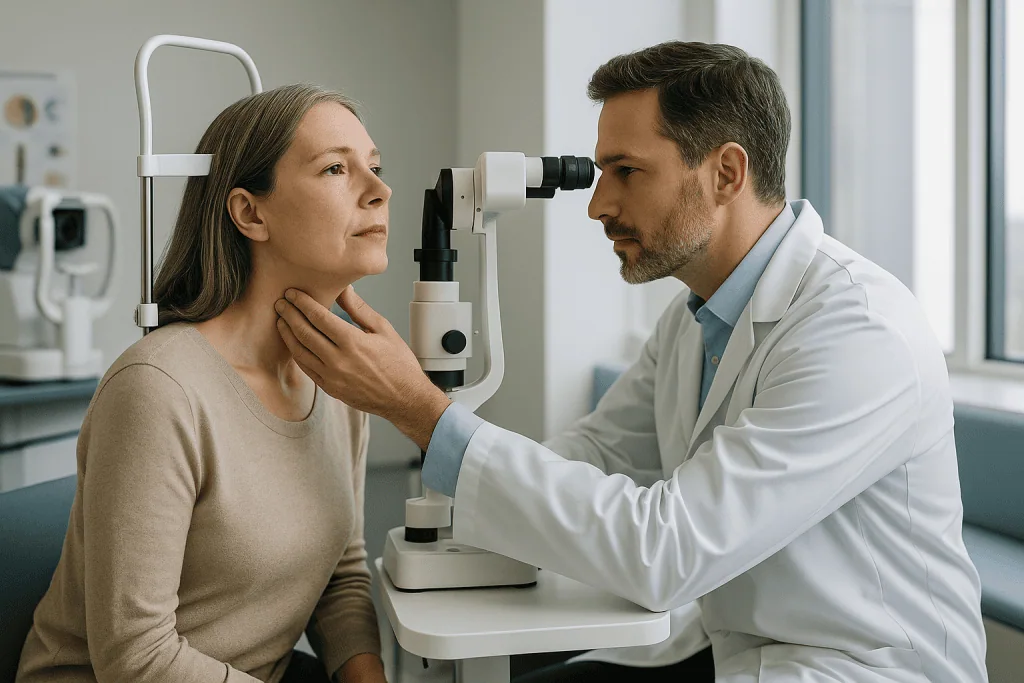
- Eye examinationan ophthalmologist checks visual acuity (sharpness of vision), color vision, eye movements, eyelid position, and the health of the cornea (the clear front surface of the eye). Color vision testing is important because loss of color perception can be an early sign of optic nerve compression.
- Exophthalmometrya simple measurement, using a small instrument called an exophthalmometer, of how far the eyes protrude from the eye socket. Repeated measurements over time help track progression.
- Blood teststhyroid function tests measure thyroid-stimulating hormone (TSH) and thyroid hormones (T3 and T4). Doctors may also test for thyroid antibodies, particularly TSH receptor antibodies (often called TRAb or TSI), which are closely linked to Graves’ disease and can support the diagnosis, especially when thyroid hormone levels are normal.
- Imaginga CT scan (computed tomography, a detailed X-ray-based scan) or MRI (magnetic resonance imaging, which uses magnetic fields rather than radiation) of the eye sockets can show enlarged eye muscles and expanded fat tissue. Imaging is especially useful when the diagnosis is uncertain, when only one eye is affected, or when surgery is being planned. Enlargement of the eye muscles that spares their tendons is a characteristic finding.
- Clinical activity scoringdoctors often use structured scoring systems, such as the Clinical Activity Score, which counts signs of active inflammation (pain, redness, swelling) to judge whether the disease is in its active phase. This helps guide treatment decisions.
- Visual field testing and optic nerve assessmentif there is any concern about pressure on the optic nerve, additional tests of peripheral vision and the appearance of the nerve may be performed.
Because eye symptoms sometimes appear before any thyroid abnormality is found, a person with typical eye findings but normal thyroid tests may need repeat blood tests over time. Conversely, anyone diagnosed with Graves’ disease is usually asked about eye symptoms and may be referred for an eye assessment.
Treatment options
Thyroid eye disease treatment depends on the phase of the disease (active or stable), its severity, and how much it affects vision and quality of life. Care is typically shared between endocrinology and ophthalmology teams; at hospital groups such as Acibadem, the underlying thyroid disorder is managed within the Endocrinology & Metabolism department, working alongside eye specialists.
Managing the thyroid condition
Restoring and maintaining normal thyroid hormone levels is a foundation of care, because both overactive and underactive thyroid states can worsen the eye disease. This may involve antithyroid medications, careful monitoring, and in some cases radioactive iodine or thyroid surgery, with the choice individualized by the treating team. Stopping smoking is strongly advised for every patient, as smoking is linked to worse outcomes and reduced response to treatment.
Watchful waiting and supportive care for mild disease
In many cases, thyroid eye disease is mild and does not require aggressive treatment. Supportive measures often include:
- Artificial tears and lubricating gels or ointments to relieve dryness and protect the eye surface, especially at night.
- Sunglasses to reduce light sensitivity and wind irritation.
- Sleeping with the head slightly elevated, which may reduce morning swelling.
- Cool compresses for comfort.
- Selenium supplementssome evidence suggests selenium may help in mild, active disease, particularly in regions where selenium intake is low; patients should discuss this with their doctor rather than self-prescribing.
- Prism lenses in glasses, which can help correct mild double vision.
Medications for moderate to severe active disease
When inflammation is more significant, with pain, progressive bulging, worsening double vision, or threat to vision, doctors may recommend medication to suppress the immune attack:
- Corticosteroids (steroids)anti-inflammatory medicines, often given intravenously (through a vein) in scheduled courses for moderate to severe active disease. Steroids can reduce swelling and pain but do not usually reverse eye bulging that has already occurred, and they carry side effects that require monitoring.
- Targeted biologic therapiesnewer medicines that block specific steps in the autoimmune process, such as the insulin-like growth factor 1 receptor, have been developed for thyroid eye disease. Availability varies by country, and suitability is assessed individually.
- Other immunosuppressive drugsmedicines that dampen the immune system may be used in selected cases, sometimes alongside or after steroids.
- Orbital radiotherapylow-dose radiation to the tissues behind the eye is sometimes used, often combined with steroids, particularly when double vision from muscle inflammation is a main problem.
Surgery
Surgery is generally reserved for the stable phase of the disease, once inflammation has settled, except in emergencies. When multiple operations are needed, they are usually performed in a specific order:
- Orbital decompressionan operation that removes small amounts of bone or fat from the eye socket to create more space, allowing the eye to settle back. It may be performed urgently if the optic nerve is compressed and vision is at risk, or electively to reduce eye bulging.
- Eye muscle (strabismus) surgeryrepositions the eye muscles to reduce persistent double vision.
- Eyelid surgeryadjusts retracted eyelids to improve eye closure, comfort, and appearance.
Not every patient needs surgery, and the decision is made together with the surgical team after weighing benefits, risks, and expectations. No treatment can guarantee a return to exactly how the eyes looked or functioned before the disease, but many patients achieve meaningful improvement.
Living with thyroid eye disease and outlook
For most people, thyroid eye disease eventually stabilizes. The active inflammatory phase is self-limiting in the majority of cases, and mild disease often improves substantially with supportive care alone. However, the course is unpredictable: some patients experience a short, mild illness, while others have a longer active phase or are left with lasting changes in eye appearance or movement that may benefit from later surgery. Sight-threatening complications occur in only a small minority of patients, particularly when the disease is recognized and managed early.
Living with the condition can be challenging beyond the physical symptoms. Changes in eye appearance can affect self-image, and double vision can interfere with driving, reading, and work. It is reasonable to discuss these difficulties openly with the care team, as practical solutions, from prism glasses to staged surgery, often exist. Emotional support, whether from family, patient groups, or counseling, can also help, since anxiety and low mood are common in people managing a visible, fluctuating condition.
Practical steps that may support recovery and reduce the risk of worsening include stopping smoking completely, attending all thyroid monitoring appointments so hormone levels stay well controlled, using lubricating drops consistently, and reporting any new or changing symptoms promptly. Regular follow-up with both the endocrinologist and the ophthalmologist allows the team to detect changes early and adjust treatment. While no one can promise a specific outcome, most patients can expect the disease to become inactive over time, with a range of options available to address any changes that remain.
Frequently asked questions
What is thyroid eye disease in simple terms?
Thyroid eye disease is a condition in which the immune system attacks the muscles and fatty tissue around the eyes, causing swelling, irritation, and sometimes bulging of the eyes or double vision. It is closely linked to thyroid disorders, especially Graves’ disease, but it is a separate condition from the thyroid problem itself and can follow its own course.
Can thyroid eye disease heal on its own?
In many mild cases, the active inflammation settles down on its own over months to a few years, and symptoms such as redness, swelling, and discomfort improve. However, some structural changes, like eye bulging or eyelid retraction, may persist after the inflammation resolves. Medical review is still important even in mild cases, because early treatment can help in more active disease and vision must be monitored.
How serious is thyroid eye disease?
Severity varies greatly. Most people have mild to moderate disease that affects comfort and appearance more than vision. A small minority develop severe disease with pressure on the optic nerve or damage to the eye surface, which can threaten sight if untreated. Because it is difficult to predict who will develop severe disease, regular monitoring is recommended, and warning signs such as blurred vision or fading colors should be reported promptly.
What are the first symptoms of thyroid eye disease?
Early thyroid eye disease symptoms often include dryness, a gritty or sandy feeling, redness, watering, light sensitivity, and puffiness around the eyes, symptoms that can be mistaken for allergies or ordinary dry eye. A staring appearance from eyelid retraction or the beginning of eye bulging may follow. Anyone with a thyroid disorder who notices persistent eye changes should mention them to their doctor.
Does treating my thyroid cure the eye disease?
Not necessarily. Keeping thyroid hormone levels stable and normal is important and supports better eye outcomes, but the eye disease is driven by its own immune process and may continue, improve, or occasionally worsen independently of thyroid control. This is why patients are usually followed by both an endocrinologist and an eye specialist rather than by one doctor alone.
How long does recovery from thyroid eye disease take?
The active phase typically lasts from several months to around two or three years before the disease becomes inactive, though timelines vary from person to person. Recovery from any corrective surgery adds its own timeline, and operations are usually staged after the disease has been stable for a period defined by the surgical team. Patience is often needed, as improvement tends to be gradual rather than sudden.
Will my eyes go back to normal after thyroid eye disease?
Many people see significant improvement, especially in symptoms caused by active inflammation. However, changes such as eye bulging, eyelid position, or double vision may not fully reverse on their own once tissues have been stretched or scarred. Surgical procedures performed in the stable phase can often improve both function and appearance, though results vary and no outcome can be guaranteed.
When to see a doctor
Anyone with a thyroid disorder who develops eye symptoms, or anyone with unexplained eye changes such as bulging or persistent double vision, should be evaluated by a doctor. Some symptoms need urgent attention because they may indicate pressure on the optic nerve or damage to the eye surface. Seek medical care promptly, the same day where possible, if you experience any of the following:
- Sudden or worsening blurred vision that does not clear with blinking.
- Fading, dulling, or loss of color vision, even in one eye.
- Loss of part of your field of vision or a dark shadow in your sight.
- Rapidly increasing eye bulging, pain, or swelling over days.
- Severe eye pain, especially with movement of the eye.
- Inability to close the eye, with increasing surface pain, as this can lead to corneal damage.
- New or suddenly worsening double vision that interferes with daily activities.
Even without red-flag symptoms, regular follow-up matters. Thyroid eye disease can change over time, and early recognition of a shift from mild to more active disease gives the care team the best chance to protect vision and comfort. If you are unsure whether a symptom is significant, it is always reasonable to ask your doctor rather than wait.
Medically reviewed by the Acıbadem International Medical Board September 2, 2026
See our medical review board →
Update history
- PublishedJune 14, 2026
- Medical review approvedSeptember 2, 2026
- Last content updateSeptember 2, 2026