Angioplasty in Turkey: Hospitals, Safety & What to Expect

Angioplasty opens narrowed heart arteries and may be performed urgently during a heart attack or electively for coronary artery disease. Not everyone with chest symptoms or coronary narrowing needs angioplasty; the decision is based on symptoms, tests, anatomy and overall health.
Key Takeaways
- Angioplasty opens narrowed heart arteries and may be performed urgently during a heart attack or electively for coronary artery disease.
- Not everyone with chest symptoms or coronary narrowing needs angioplasty; the decision is based on symptoms, tests, anatomy and overall health.
- The procedure is commonly performed through an artery in the wrist or groin using local anaesthetic and imaging guidance.
- Most people leave hospital within one or two days after an uncomplicated planned procedure, but recovery needs vary.
- Taking prescribed antiplatelet medicines after stent placement is essential to help prevent a clot inside the stent.
- International patients should arrange medical records, travel timing, accommodation and follow-up before travelling home.
Angioplasty in Turkey is a catheter-based procedure used to improve blood flow through narrowed coronary arteries, usually by placing a small stent. A safe treatment journey depends on appropriate clinical assessment, an experienced interventional cardiology team, accredited hospital standards, and a clear plan for recovery and follow-up.
Overview: What does angioplasty in Turkey involve?
Angioplasty in Turkey refers to coronary angioplasty performed at a Turkish hospital for narrowed or blocked arteries that supply the heart muscle. Also called percutaneous coronary intervention (PCI), it is a minimally invasive procedure in which a cardiologist guides a thin catheter through an artery, inflates a small balloon at the narrowed area and usually places a mesh tube called a stent to help keep the artery open.
It may be offered as emergency treatment for a heart attack or as planned treatment for symptoms such as angina that continue despite medicines and lifestyle measures. The aim is to improve blood flow, relieve symptoms and, in an emergency, limit damage to heart muscle. It does not cure the underlying tendency to develop artery disease, so long-term medicines and heart-healthy habits remain important.
For people travelling for care, the central considerations are clinical suitability, hospital standards, communication, medication planning and safe follow-up after returning home. The dedicated angioplasty treatment page explains the procedure and care pathway in more detail.
How angioplasty works and who may be a candidate
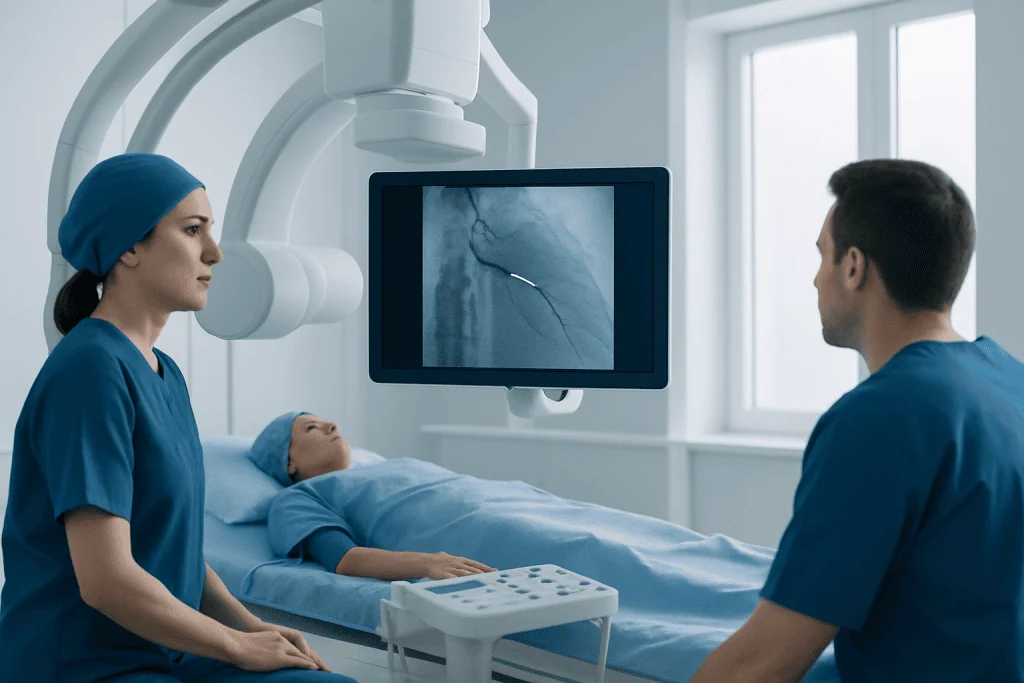
Coronary artery disease develops when fatty deposits, inflammation and scar tissue narrow the arteries around the heart. During angioplasty, contrast dye and X-ray imaging allow the interventional cardiologist to identify the narrowing. A balloon is briefly expanded inside the artery, and a stent is commonly deployed to support the vessel wall and restore a wider channel for blood flow.
A person may be considered for angioplasty after tests suggest that a coronary narrowing is causing significant reduced blood flow or symptoms. These tests can include an electrocardiogram, blood tests, echocardiography, exercise or imaging stress tests, CT coronary angiography, or invasive coronary angiography. The treatment decision is individual and considers symptoms, the number and location of narrowed arteries, heart function, kidney function, bleeding risk and other health conditions.
Some people benefit most from medicines and lifestyle treatment alone. Others may be better suited to coronary artery bypass surgery, particularly when several complex arteries are affected or certain high-risk patterns of disease are present. A cardiology team should explain why angioplasty, surgery or medical treatment is recommended in each case.
- Planned angioplasty may help persistent angina despite appropriate medical treatment.
- Emergency angioplasty is often used for certain types of acute heart attack.
- People with contrast allergy, kidney disease, bleeding disorders or complex artery anatomy need tailored planning.
Choosing a hospital and planning care in Turkey

When considering angioplasty abroad, patients should look beyond the procedure itself. Useful questions include whether the hospital has a dedicated cardiac catheterisation laboratory, round-the-clock emergency capability, intensive care support, cardiac surgery backup where clinically appropriate, and a multidisciplinary team of interventional cardiologists, nurses, anaesthesiology and imaging professionals.
Accreditation can be one indicator of organised quality and safety systems. JCI accreditation refers to standards developed by Joint Commission International covering areas such as patient safety, infection prevention, medication management and continuity of care. It does not replace personal clinical assessment, but it can be a relevant factor when reviewing hospital arrangements.
Before travel, the treating team generally needs recent medical records, a medication list, reports from prior heart tests, information about allergies and relevant laboratory results. International patients should also discuss interpreter support, airport and local transport, accommodation for a companion, expected length of stay and a written discharge plan that can be shared with their doctor at home.
Acibadem International’s multidisciplinary specialists and JCI-accredited hospitals support international patients who require assessment and treatment for coronary artery disease. Travel should be scheduled only after the clinical team confirms that flying and the proposed timeline are appropriate.
What happens during the procedure?
Angioplasty is performed in a cardiac catheterisation laboratory rather than a conventional operating theatre. The person is usually awake but may receive medicines to promote comfort and relaxation. The skin at the wrist or groin is cleaned and numbed with local anaesthetic, and a small tube called a sheath is placed into the artery.
The cardiologist advances a catheter to the coronary arteries under X-ray guidance. Contrast dye is injected to create coronary angiogram images. If angioplasty is needed and appropriate, a very fine wire crosses the narrowed segment, a balloon is expanded and a stent may be released. The balloon is then removed, while the stent remains in the artery.
The procedure time varies with the number and complexity of treated arteries. Patients may feel temporary warmth when contrast is injected or mild pressure during balloon inflation, but they should promptly tell the team about chest discomfort, breathlessness, itching or any other new symptom. Afterward, the access site is sealed or compressed, and the patient is monitored for heart rhythm, blood pressure and bleeding.
In emergency situations, details may need to be discussed quickly with the patient or family. In planned care, patients should have time to ask about alternatives, expected benefits, possible complications and the medicines required after a stent.
Benefits, risks and safety considerations
For suitable patients, angioplasty can improve blood flow and reduce angina-related chest pressure or breathlessness. In a heart attack caused by a blocked coronary artery, prompt PCI can restore blood flow and is an important emergency treatment. Symptom improvement differs between individuals and depends on the extent of heart disease and other contributing conditions.
Like all invasive procedures, angioplasty has risks. Possible complications include bruising or bleeding at the wrist or groin, damage to the blood vessel, abnormal heart rhythms, contrast-related kidney injury, allergic reaction, heart attack, stroke or, rarely, death. A treated artery may narrow again over time, and a blood clot can form in a stent, particularly if antiplatelet medicine is stopped too soon.
Clinicians reduce risk through pre-procedure assessment, careful imaging, sterile technique, monitoring and individually selected medicines. Patients can contribute to safety by accurately reporting all medicines, allergies, kidney problems, prior bleeding, pregnancy possibility and previous reactions to contrast dye. They should not stop aspirin, other antiplatelet medicines or anticoagulants unless their cardiology team specifically instructs them to do so.
After a stent, dual antiplatelet therapy is often prescribed for a defined period. The exact combination and duration depend on the clinical situation and bleeding risk, so it must be followed exactly as advised by the treating clinician.
Recovery timeline, travel and ongoing heart care
After an uncomplicated planned angioplasty, monitoring in hospital commonly continues overnight, although the length of stay depends on the reason for treatment, access site, general health and any complications. The wrist or groin can feel tender or bruised for several days. Staff check the puncture site, pulse, blood pressure, heart rhythm and symptoms before discharge.
Many people can resume light daily activities within a few days, but strenuous exercise, heavy lifting and driving may need to wait until the cardiologist says they are safe. Recovery is often longer after a heart attack because the heart itself needs time to heal. A personalised discharge summary should cover wound care, medicines, activity, diet, cardiac rehabilitation and follow-up appointments.
Flying soon after angioplasty is not appropriate for everyone. Timing depends on whether the procedure was planned or performed after a heart attack, whether there were complications and the patient’s overall stability. International patients should receive explicit clearance from their treating cardiologist and should carry enough prescribed medicine, plus a current medical summary, for the journey and the period after returning home.
Long-term care focuses on preventing future artery narrowing: stopping smoking, eating a heart-supportive diet, being physically active as advised, managing blood pressure, cholesterol and diabetes, and attending cardiac rehabilitation where available. These measures also support care for coronary artery disease.
When to seek medical care
Anyone with new, severe or persistent chest pressure, chest tightness, pain spreading to the arm, jaw, back or shoulder, sudden shortness of breath, fainting, cold sweating or nausea should seek emergency medical help immediately. These symptoms can indicate a heart attack and should not be managed by waiting for a scheduled consultation or travelling to another country for care.
After angioplasty, urgent medical assessment is needed for chest pain that is new, severe or worsening; significant bleeding or rapidly increasing swelling at the wrist or groin; a cold, pale or numb limb; fever; fainting; or severe breathlessness. Patients should use local emergency services rather than drive themselves.
Less urgent concerns, such as mild bruising at the access site, questions about returning to activity or medication side effects, should still be discussed promptly with the hospital team or a local doctor. Clear communication between the treating centre and the patient’s cardiologist at home supports safer continuity of care.
Frequently asked questions
Is angioplasty in Turkey safe?
Angioplasty can be performed safely in Turkey when it is clinically appropriate and carried out by an experienced interventional cardiology team in a properly equipped hospital. Safety also depends on an individual’s health, the urgency and complexity of the coronary disease, medication management and follow-up planning.
How long should a patient stay in Turkey after angioplasty?
The required stay varies depending on whether angioplasty was planned or performed during a heart attack, as well as the patient’s recovery and travel fitness. The treating cardiologist should confirm when the patient can safely fly and arrange discharge documentation and follow-up.
Will a stent cure coronary artery disease?
A stent treats a specific narrowed area of an artery, but it does not remove the underlying process that causes coronary artery disease. Ongoing medicines, smoking cessation, exercise, nutrition and management of blood pressure, cholesterol and diabetes remain important.
Is angioplasty painful?
The access site is numbed with local anaesthetic, so sharp pain is not usually expected. Some people notice pressure at the access site, warmth from contrast dye or brief chest discomfort when the balloon is inflated; the team should be told about any discomfort immediately.
What medicines are needed after angioplasty?
Many people need antiplatelet medicines after a stent to reduce the risk of a clot forming inside it. Other medicines may be prescribed to manage cholesterol, blood pressure, angina or diabetes, and the exact plan should be followed without stopping medication independently.
Can someone travel alone for angioplasty?
A companion can be helpful for transport, communication and the first days of recovery, especially after sedation or an overnight hospital stay. Whether a person can travel alone depends on their health, treatment complexity, local support and the advice of the treating team.
References
- World Health Organization
- European Society of Cardiology
- American Heart Association
- National Heart, Lung, and Blood Institute
- Joint Commission International
This article is for general information only and is not a substitute for professional medical advice. Please consult a qualified doctor about your individual situation.
Heart care in Turkey — expert evaluation and treatment
JCI-accredited · board-certified surgeons · reply within 24h
Add us as a Preferred Source to see more of our trusted health content across Google Search, AI Overviews and Discover.

More from the Health Library



Related Specialists

Dr. Alp Mustaf A Günay
Gastroenterology
Dr. Didem Çevik Gündoğan
Pediatrics
Dr. Etem Aytaç Yazar
Orthopedic Surgery & Traumatology
Dr. Murat Dutipek
Otorhinolaryngology