Arm Muscles: An Evidence-Based Guide for Patients

Arm muscles include upper arm and forearm muscles that work together with tendons, nerves, and joints. The biceps and triceps are well known, but many forearm muscles control wrist, finger, and grip function.
Key Takeaways
- Arm muscles include upper arm and forearm muscles that work together with tendons, nerves, and joints.
- The biceps and triceps are well known, but many forearm muscles control wrist, finger, and grip function.
- Arm muscle pain is often related to overuse, strain, poor technique, or tendon irritation, but nerve or joint problems can also contribute.
- Persistent pain, weakness, swelling, numbness, or loss of function should be evaluated by a qualified clinician.
- Most arm muscle problems improve with activity modification, guided exercise, and treatment of the underlying cause.
Arm muscles are the groups of muscles in the upper arm and forearm that help lift, push, pull, rotate, grip, and perform fine hand movements. Understanding how arm muscles work can help patients recognize normal soreness, identify possible injury, and know when medical assessment may be helpful.
Overview: what arm muscles do
Arm muscles are the muscles of the upper arm and forearm that allow the arm and hand to move with strength, control, and coordination. They help with daily activities such as lifting a bag, opening a jar, typing, dressing, carrying a child, or reaching overhead. Although many people think mainly of the biceps and triceps, the arm contains several muscle groups that work together with bones, tendons, joints, and nerves.
From a patient perspective, it can be helpful to think of arm muscles by function rather than by memorizing every anatomical name. Some muscles bend the elbow, some straighten it, some rotate the forearm so the palm faces up or down, and many smaller forearm muscles move the wrist, fingers, and thumb. When one part becomes irritated or injured, symptoms may be felt in a wider area because these structures are closely connected.
Arm muscle discomfort is common and is often caused by overuse, a sports injury, repetitive work, poor posture, or a sudden strain. In many cases, the problem is not serious and improves with rest, time, and appropriate care. However, severe pain, marked swelling, weakness, numbness, or a visible deformity can suggest a more significant issue that needs medical attention.
Main groups of arm muscles
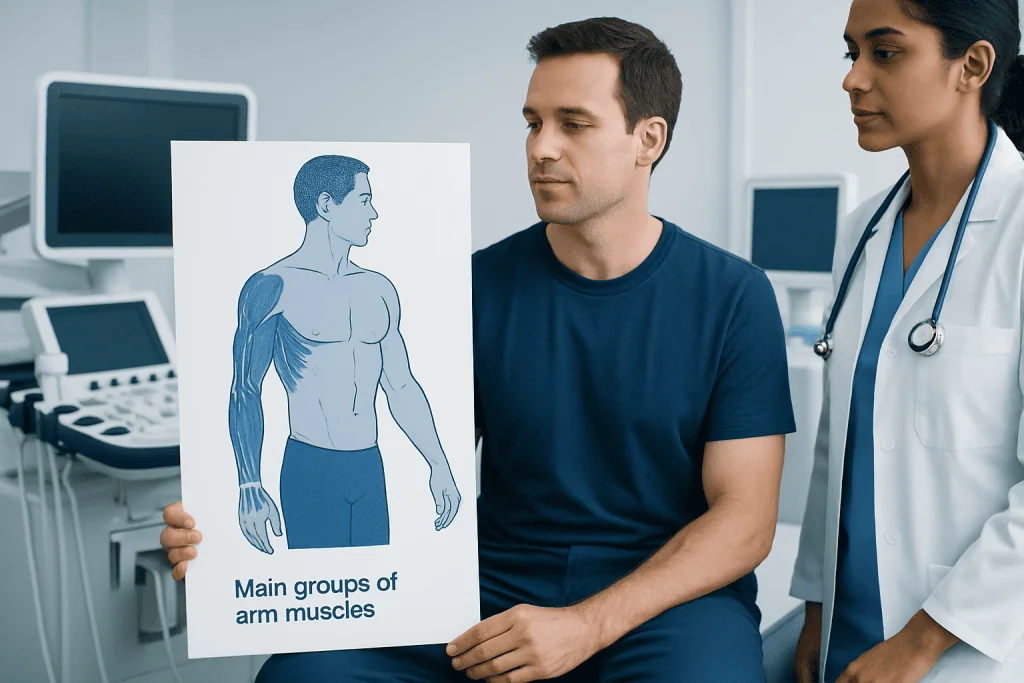
The upper arm has two main muscle compartments. At the front is the biceps brachii, assisted by the brachialis and coracobrachialis. These muscles mainly help bend the elbow, and the biceps also helps turn the forearm so the palm faces upward. At the back of the upper arm is the triceps brachii, which straightens the elbow and helps with pushing movements.
The forearm contains a larger number of muscles. Broadly, these include flexor muscles on the palm side and extensor muscles on the back side. Flexors help bend the wrist and fingers and support gripping. Extensors help straighten the wrist and fingers. Other forearm muscles rotate the forearm inward and outward, allowing movements such as using a screwdriver or turning a doorknob.
These muscles do not act alone. They rely on tendons attaching them to bone, healthy joints at the shoulder, elbow, and wrist, and normal nerve function from the neck and arm. This is why pain that feels like it is “in the muscle” may sometimes come from tendon inflammation, nerve compression, or a joint problem such as tennis elbow or shoulder dysfunction.
- Upper arm muscles: mainly support elbow bending and straightening.
- Forearm muscles: mainly control wrist, hand, finger, and grip movement.
- Stabilizing muscles: smaller muscles support posture, coordination, and precise movement.
Common symptoms and what they may mean

Symptoms involving arm muscles can vary widely. Many people notice soreness after exercise, especially after a new or intense activity. This kind of delayed muscle soreness usually improves within a few days. A strain, by contrast, may cause sudden pain during lifting, throwing, pulling, or pushing, sometimes followed by tenderness, weakness, or mild swelling.
Overuse symptoms often come on gradually. Patients may feel aching, tightness, heaviness, fatigue, cramping, or pain that worsens with repeated motion. If the forearm muscles are affected, gripping, typing, writing, or lifting objects can become uncomfortable. Tendon irritation around the elbow may create pain that seems to spread into the forearm or upper arm.
Some symptoms suggest that the issue may not be a simple muscle problem. Numbness, tingling, burning pain, neck pain radiating into the arm, or hand clumsiness may point toward nerve irritation. Significant swelling, bruising, severe weakness, or inability to move the arm normally can suggest a more substantial injury. In some cases, patients with persistent stiffness or deep aching may need assessment for joint, tendon, or inflammatory conditions.
Causes and risk factors for arm muscle problems
The most common causes of arm muscle pain are overuse and strain. Repetitive tasks such as racket sports, weight training, manual labor, lifting, painting, keyboard use, or prolonged phone use can overload the muscles and tendons. A sudden increase in activity, poor conditioning, or incorrect technique can make injury more likely.
Posture and movement patterns also matter. Shoulder weakness, reduced flexibility, or poor ergonomics at work can place extra stress on the elbow and forearm muscles. Neck problems may alter the way the arm muscles are used, while nerve compression can create weakness or pain that mimics a muscle injury. Some people who have pain around the elbow or forearm may ultimately be diagnosed with a tendon condition such as golfer's elbow.
Less common causes include direct trauma, muscle tears, tendon rupture, inflammatory conditions, medication side effects, dehydration, and mineral imbalance. In older adults, age-related changes in muscle mass and tendon resilience can increase the risk of strain. People with diabetes, thyroid disease, or certain neurologic conditions may also be more prone to arm symptoms.
- Repetitive work or sports
- Sudden increase in exercise intensity
- Poor technique or inadequate warm-up
- Weakness or limited mobility in nearby joints
- Nerve irritation from the neck, shoulder, elbow, or wrist
How doctors diagnose arm muscle pain
Diagnosis begins with a careful medical history and physical examination. A clinician will ask when symptoms started, whether there was a specific injury, which movements trigger pain, and whether there is weakness, numbness, swelling, or bruising. Details about work, sports, hobbies, exercise routine, and previous injuries can be very important.
The physical exam usually includes checking tenderness, range of motion, strength, sensation, reflexes, and specific movements that reproduce symptoms. Because upper limb structures are connected, the shoulder, neck, elbow, wrist, and hand may all be examined. This helps distinguish a true muscle strain from tendon disorders, nerve compression, joint inflammation, or referred pain.
Imaging is not always necessary for mild cases, but it may be useful when symptoms are severe, persistent, or unclear. Ultrasound or MRI can help assess muscle tears, tendon injuries, or soft tissue inflammation, while X-rays may be used if a bone or joint issue is suspected. In selected cases, nerve testing or blood tests may be recommended to look for other causes of pain or weakness.
Treatment options and recovery
Treatment depends on the cause, location, and severity of the problem. For mild muscle strain or overuse, the first steps often include reducing or modifying the activity that caused symptoms, using cold packs early if the area is acutely painful, and gradually returning to movement as tolerated. Prolonged complete rest is usually not ideal, because gentle motion often supports recovery better than immobilization unless a doctor advises otherwise.
Many patients benefit from physical therapy or a structured rehabilitation plan. This may include stretching, strengthening, posture correction, ergonomic adjustments, and technique changes for sport or work. If the problem involves nearby tendons or joints, treatment may also focus on those areas. Depending on the diagnosis, a clinician may suggest physical therapy and rehabilitation to restore strength and function safely.
When pain is more persistent or linked to a specific structural problem, further treatment may be needed. This can include bracing, supervised exercise, treatment for tendon disorders, or management of nerve-related symptoms. For selected patients with shoulder-related causes of arm dysfunction, evaluation by specialists in orthopedics and traumatology may be appropriate. If there are signs of a nerve problem rather than a simple muscle issue, assessment in neurology can help clarify the cause.
Recovery time varies. Simple soreness may improve in days, while a strain, tendon irritation, or nerve-related problem can take weeks or longer. Returning too quickly to the activity that caused the injury can delay healing, so a gradual plan is usually best.
Prevention and self-care for healthy arm muscles
Good prevention focuses on conditioning, balance, and technique. Arm muscles function best when the shoulder, upper back, and core also work well, so exercise plans should not focus only on one visible muscle group. Warming up before activity, progressing training gradually, and alternating repetitive tasks can reduce overload.
At work or home, ergonomic changes may help. Examples include adjusting keyboard and mouse position, avoiding prolonged gripping, taking regular movement breaks, and using proper lifting mechanics. People who play sports may benefit from coaching on technique, especially for throwing, racket use, or weight training.
General self-care measures include staying hydrated, getting adequate recovery between workouts, and paying attention to early warning signs such as recurring tightness or pain with a certain movement. A balanced program often includes flexibility, strength, endurance, and rest. If symptoms keep returning despite these steps, professional assessment is sensible to identify the underlying reason.
When to seek medical care
Medical care is advisable if arm muscle pain is severe, lasts longer than expected, keeps coming back, or limits daily activities. Patients should also seek assessment if they notice marked swelling, extensive bruising, a visible change in muscle shape, or significant weakness after an injury. These features can suggest a more serious muscle or tendon problem.
Urgent evaluation is important if arm symptoms occur with numbness, tingling, hand weakness, chest pain, shortness of breath, fever, or signs of infection such as redness and warmth. New arm pain after a fall or direct trauma should also be checked, especially if movement is difficult or a fracture is possible.
For international patients who need specialist evaluation, Acibadem International offers multidisciplinary assessment and treatment through JCI-accredited hospitals. This can be helpful when symptoms involve several structures at once, such as muscles, tendons, joints, or nerves.
Frequently asked questions
What are the main arm muscles?
The best-known arm muscles are the biceps at the front of the upper arm and the triceps at the back. The forearm also contains many important muscles that move the wrist, fingers, and thumb and help create grip strength.
Why do arm muscles hurt after exercise?
Mild soreness after exercise is often due to normal muscle stress, especially after a new or more intense workout. This usually improves within a few days. Pain that is sharp, severe, or associated with weakness or swelling may indicate a strain or another injury.
How can someone tell the difference between muscle pain and nerve pain in the arm?
Muscle pain is often sore, tight, tender, or worse with use of a specific movement. Nerve-related pain may include burning, tingling, numbness, shooting discomfort, or weakness that extends into the hand or fingers. A clinician can help distinguish between them with an exam.
Do arm muscle problems always need imaging?
No. Many mild cases can be diagnosed through history and physical examination alone. Imaging such as ultrasound, X-ray, or MRI is more often used when symptoms are severe, persistent, or suggest a tear, tendon injury, or another structural problem.
What helps arm muscles recover from strain?
Recovery usually involves relative rest, avoiding the aggravating activity, and gradually reintroducing movement. Guided stretching and strengthening may help once pain settles. If symptoms do not improve, medical assessment is important to confirm the diagnosis and guide treatment.
Can poor posture cause arm muscle pain?
Yes. Poor posture can change how the shoulder, neck, and upper back support the arm, which may place extra strain on muscles and tendons. Over time, this can contribute to pain, fatigue, or recurrent overuse symptoms.
References
- American Academy of Orthopaedic Surgeons
- National Institute of Arthritis and Musculoskeletal and Skin Diseases
- MedlinePlus
- Mayo Clinic
- Cleveland Clinic
This article is for general information only and is not a substitute for professional medical advice. Please consult a qualified doctor about your individual situation.
Joint and spine care in Turkey — expert assessment & treatment
JCI-accredited · board-certified surgeons · reply within 24h
Add us as a Preferred Source to see more of our trusted health content across Google Search, AI Overviews and Discover.

More from the Health Library



Related Specialists

Dr. Mehmet Yörübulut
Radiology
Dr. Mustafa Tolga Ünsür
Pediatrics
Dr. Hasan Cem Güneyli
Anesthesiology
Assoc. Prof. Dr. Murat Saylık
Orthopedic Surgery & Traumatology