Augmented Reality in Surgery: How Surgeons Use Digital Guidance
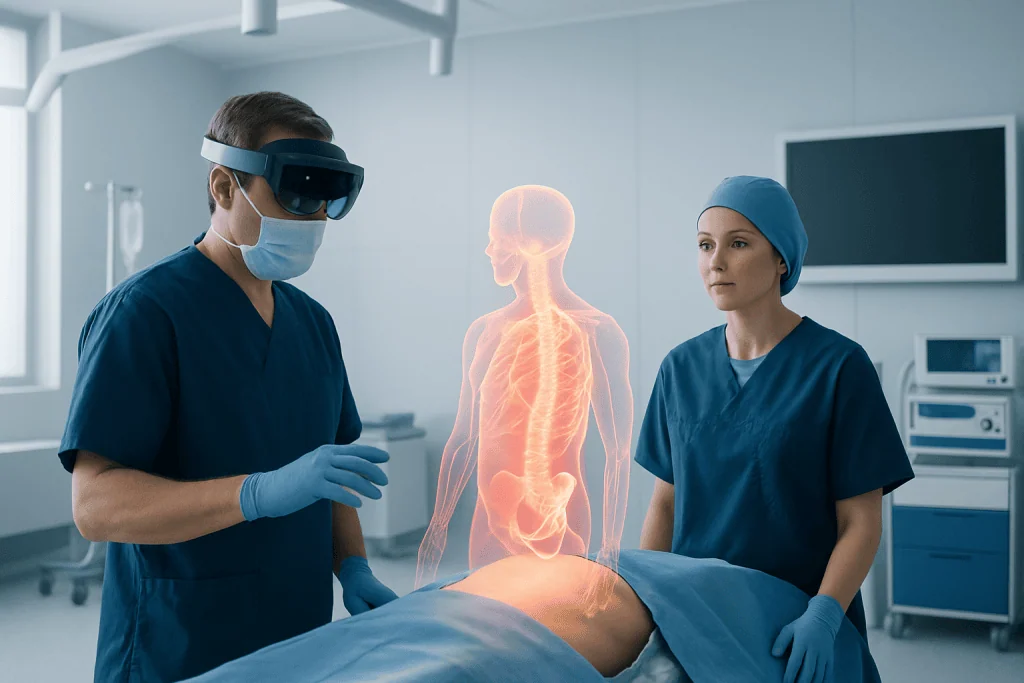
Augmented reality overlays digital information onto the surgeon’s real view during planning or surgery. It may help with orientation, precision, and understanding of complex anatomy.
Key Takeaways
- Augmented reality overlays digital information onto the surgeon’s real view during planning or surgery.
- It may help with orientation, precision, and understanding of complex anatomy.
- AR is used in selected fields such as neurosurgery, orthopedics, ENT, liver surgery, and minimally invasive procedures.
- It does not replace surgical skill, conventional imaging, or patient safety checks.
- Benefits and limitations vary depending on the procedure, equipment, and the patient’s anatomy.
Augmented reality in surgery uses digital images and data overlays to help surgeons plan and perform operations with greater visual guidance. It is an evolving tool that can support precision, teamwork, and education, while still relying on a surgeon’s judgment and standard safety practices.
Overview: What Augmented Reality in Surgery Means
Augmented reality in surgery is a technology that places digital information over a real-world view. In the operating room, this can mean that scans such as CT or MRI images are matched to the patient’s anatomy and displayed on a screen, headset, microscope view, or navigation system. The goal is to give the surgeon extra visual guidance without taking attention away from the procedure.
Unlike virtual reality, which creates a fully digital environment, augmented reality adds computer-generated information to the real surgical field. This may include outlines of tumors, blood vessels, bones, nerves, implant positions, or planned cutting lines. The surgeon still sees the patient and uses standard instruments and techniques, but with an additional layer of information to support decision-making.
AR is part of a broader group of image-guided and computer-assisted surgical tools. It is being used and studied in several specialties, especially where anatomy is complex or where very precise positioning is important. Examples include brain surgery, spinal procedures, joint replacement, sinus surgery, liver operations, and some minimally invasive procedures.
How Surgeons Use Digital Guidance During Operations
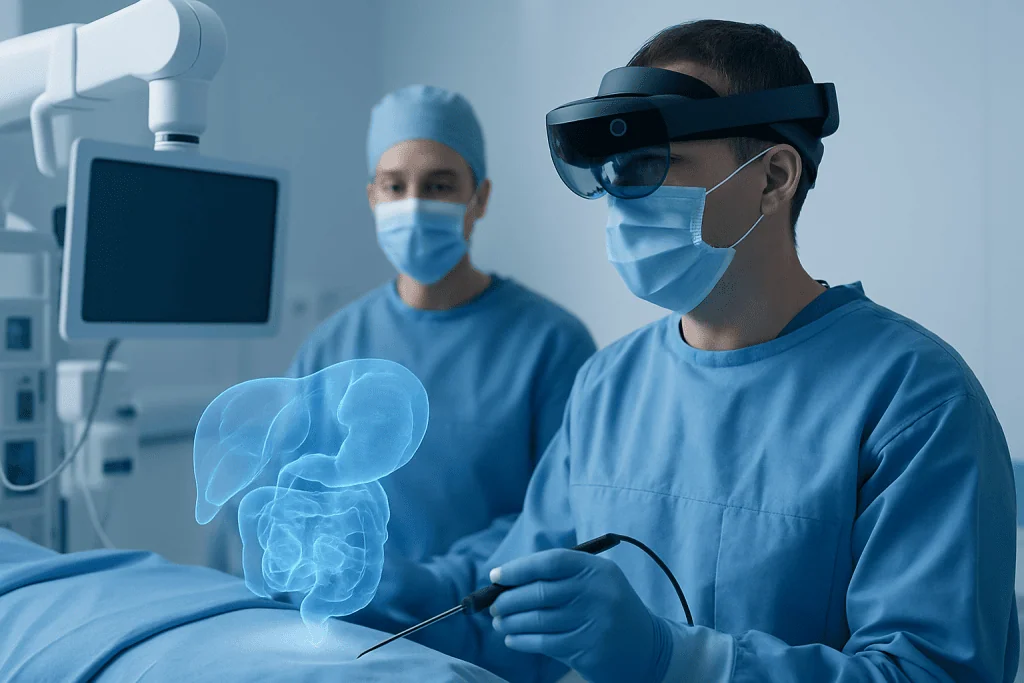
The process usually begins before surgery. The care team reviews the patient’s imaging and creates a digital map of the anatomy. Important structures such as tumors, blood vessels, bones, or nerves may be identified so they can be highlighted during the procedure. In some cases, surgeons can rehearse the operation virtually and decide on the safest route before entering the operating room.
During surgery, the system aligns the digital images with the patient’s actual position. This is called registration. Once aligned, the surgeon can see guidance on a monitor or navigation display showing where an instrument is in relation to anatomy that may not be directly visible. In a minimally invasive operation, this may complement camera views. In open surgery, it may improve orientation in deep or delicate areas.
Augmented reality can support several tasks, including:
- Planning the surgical path or incision
- Identifying hidden structures such as vessels or nerves
- Positioning screws, implants, or cutting guides
- Estimating the borders of a tumor or diseased tissue
- Helping the surgical team communicate during complex cases
Even with these tools, surgery is not performed by the technology alone. The surgeon continuously compares the digital guidance with what is seen and felt during the operation. If the anatomy differs from the preoperative image, or if tissue shifts during surgery, the team may rely more heavily on real-time findings and standard surgical judgment.
Where Augmented Reality Is Used Most Often
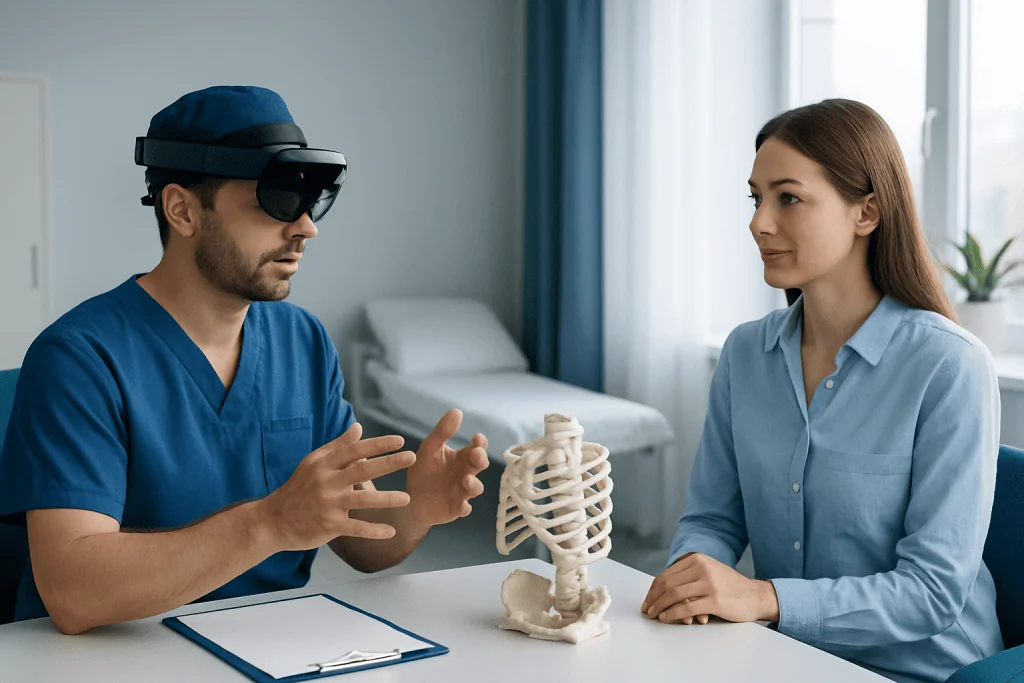
Some of the most practical uses of AR are in operations that depend on exact spatial understanding. In neurosurgery and spinal surgery, digital guidance can help the team plan approaches around sensitive brain tissue, nerves, and blood vessels. In orthopedic surgery, it may assist with alignment, implant positioning, or bone cuts, especially when high precision is needed.
Ear, nose, and throat procedures are another common area. The sinuses and skull base have narrow spaces and important nearby structures, so digital navigation can improve orientation. Similarly, liver and other abdominal surgeries may use AR to visualize vessels and lesion locations based on preoperative scans, especially when planning tissue-sparing approaches.
Augmented reality may also work alongside established techniques such as MRI scanning and CT scanning, which provide the detailed images used to build the digital model. In certain cases, it complements robotic surgery or advanced navigation platforms by improving the surgeon’s ability to understand three-dimensional anatomy.
Its use is not identical in every hospital or specialty. Some centers use AR mainly for preoperative planning and teaching, while others integrate it more directly into the live procedure. The right approach depends on the operation, the available equipment, and the experience of the surgical team.
Potential Benefits for Patients and Surgical Teams
The main promise of augmented reality in surgery is better visualization. When surgeons can see anatomy more clearly and understand spatial relationships more easily, they may perform some steps with greater confidence and efficiency. This can be especially valuable in areas where vital structures are close together or where anatomy varies from person to person.
AR may also improve preoperative planning and communication. Surgeons can review the case in detail, explain the procedure to colleagues, and sometimes help patients understand what the operation involves. For training, it can be a useful educational tool because it makes anatomy and operative strategy easier to demonstrate.
Possible advantages may include:
- More accurate orientation in complex anatomy
- Support for precise implant or instrument placement
- Better planning for minimally invasive or tissue-preserving surgery
- Improved team coordination during technically demanding operations
- Enhanced education for residents and fellows
It is important to keep expectations realistic. Although AR can support precision, outcomes still depend on many factors, including the patient’s overall health, the type of surgery, the underlying condition, and the skill of the team. Technology is a tool that may enhance care, but it is not a guarantee of a specific result.
Limits, Challenges, and Safety Considerations
Like all medical technologies, augmented reality has limitations. One challenge is that the body can change during surgery. Organs may shift, tissues may move, and the patient’s position may differ slightly from the original imaging. If the digital model no longer perfectly matches the anatomy, the displayed overlay may become less accurate. For that reason, surgeons must always confirm what they see with direct observation and standard navigation methods.
Another issue is workflow. AR systems require high-quality imaging, careful setup, and reliable registration. If this process is time-consuming or technically difficult, it may be less useful in some cases. Equipment costs, staff training, and operating room integration also affect how widely the technology can be used.
Safety remains the top priority. AR should support, not distract, the surgeon. Systems must be easy to interpret so that they do not add confusion during a delicate operation. The best use of AR is usually as one part of a larger safety framework that includes imaging review, surgical checklists, direct visualization, and intraoperative decision-making.
Patients may also want to know that not every procedure needs this technology. In many operations, excellent results can be achieved with conventional techniques. A surgeon will recommend AR or other digital guidance only when it is likely to add meaningful value to planning or performance.
What Patients Can Expect Before and During AR-Guided Surgery
From a patient’s point of view, the experience often begins with imaging tests and surgical planning. The surgeon may explain that digital guidance will be used to map anatomy or support key steps of the operation. This does not usually change the basic goals of surgery, but it may influence how the team prepares and what equipment is used in the operating room.
During the procedure, the patient is not aware of the AR system itself because the technology is used by the surgical team. The operation may still involve standard anesthesia, routine monitoring, and conventional sterile technique. In other words, AR usually works in the background as an added support layer rather than changing the patient’s direct experience in a dramatic way.
After surgery, recovery depends mainly on the type of operation performed, not on the use of augmented reality alone. Patients should follow the usual postoperative instructions about wound care, pain management, movement, medication, and follow-up visits. If imaging is needed afterward, it is typically to assess the result of the procedure rather than to evaluate the AR system.
When patients are considering surgery for complex conditions such as brain tumors or scoliosis, it can be reasonable to ask whether digital planning or image guidance may be helpful. Near the end of the care journey, some international patients may also explore centers such as Acibadem International, where multidisciplinary specialists in JCI-accredited hospitals diagnose and treat complex surgical conditions using advanced imaging and navigation technologies when appropriate.
The Future of Augmented Reality in Surgery
Augmented reality in surgery is still developing. Researchers and clinicians are working to improve how accurately digital images match the patient’s anatomy in real time. Better tracking systems, faster computing, and improved displays may make AR easier to use and more useful across a wider range of procedures.
Another important direction is combining AR with artificial intelligence, robotics, and real-time imaging. In the future, systems may help identify anatomical landmarks, suggest safer pathways, or update digital overlays as tissues move. These advances could make surgery more personalized and responsive, especially in highly complex operations.
Even as the technology becomes more advanced, careful evaluation will remain essential. New tools must be tested for safety, reliability, and real clinical benefit. For patients, the most important question is not whether a hospital has the newest system, but whether the chosen approach is suitable for their specific condition and carried out by an experienced surgical team.
Frequently asked questions
What is augmented reality in surgery?
It is a technology that adds digital images or data to the surgeon’s real view of the patient. This can help the team see anatomy, plan the procedure, and navigate more precisely during certain operations.
Is augmented reality the same as robotic surgery?
No. Robotic surgery uses robotic instruments controlled by the surgeon, while augmented reality provides digital visual guidance. The two can sometimes be used together, but they are different technologies.
Does augmented reality make surgery safer?
It may improve orientation and support precision in selected procedures, which can contribute to safer decision-making. However, safety still depends on the overall surgical plan, the patient’s condition, and the experience of the medical team.
Will every patient benefit from AR-guided surgery?
Not necessarily. Some operations are well managed with standard surgical methods and do not require additional digital guidance. The usefulness of AR depends on the anatomy, the condition being treated, and the goals of the procedure.
Do patients need special preparation for surgery that uses augmented reality?
Usually, preparation is similar to that for the planned surgery itself. The main difference is that the surgeon may need detailed imaging beforehand so the digital model can be created and matched to the patient.
Can augmented reality replace a surgeon’s judgment?
No. It is a support tool, not a replacement for training, experience, or intraoperative decision-making. Surgeons still rely on direct observation, anatomy, and established safety practices throughout the operation.
References
- World Health Organization
- U.S. Food and Drug Administration
- National Institutes of Health
- American College of Surgeons
- Radiological Society of North America
This article is for general information only and is not a substitute for professional medical advice. Please consult a qualified doctor about your individual situation.
Explore treatments in Turkey — costs, top hospitals & a free quote
JCI-accredited · board-certified surgeons · reply within 24h
Add us as a Preferred Source to see more of our trusted health content across Google Search, AI Overviews and Discover.