Bamboo Spine: An Evidence-Based Guide for Patients

Bamboo spine is an imaging description, not a separate disease. It most commonly develops from longstanding ankylosing spondylitis, a form of axial spondyloarthritis.
Key Takeaways
- Bamboo spine is an imaging description, not a separate disease.
- It most commonly develops from longstanding ankylosing spondylitis, a form of axial spondyloarthritis.
- Inflammation can lead to new bone formation and fusion of spinal joints and ligaments over time.
- A fused spine is more vulnerable to fractures, including after relatively minor falls or injuries.
- Treatment aims to control inflammation, maintain mobility, manage pain, and protect bone health.
Bamboo spine describes the appearance of an extensively fused spine on an X-ray, most often caused by longstanding ankylosing spondylitis. While it cannot usually be reversed, early specialist care, exercise, medication, and fracture prevention can help preserve comfort, posture, and function.
What Is Bamboo Spine?
Bamboo spine is a term used to describe a characteristic X-ray appearance in which much of the spine becomes rigid because several spinal joints have fused together. The spine may look like a single, continuous column of bone with thin bony bridges between the vertebrae, resembling the segmented appearance of bamboo. This change most often occurs in advanced ankylosing spondylitis, an inflammatory condition affecting the spine and joints where the spine meets the pelvis.
Bamboo spine is not a diagnosis by itself. Rather, it is a structural result of chronic inflammation and healing responses that lead to extra bone formation. Not everyone with ankylosing spondylitis develops this finding, and modern treatment may reduce inflammation and help limit progression. The rate and extent of spinal change vary considerably from person to person.
In medical practice, ankylosing spondylitis is part of a broader group of conditions called axial spondyloarthritis. Some people have symptoms and inflammation before X-rays show clear structural changes. Identifying inflammatory back pain and seeking assessment early can support timely treatment and ongoing monitoring.
How Bamboo Spine Develops
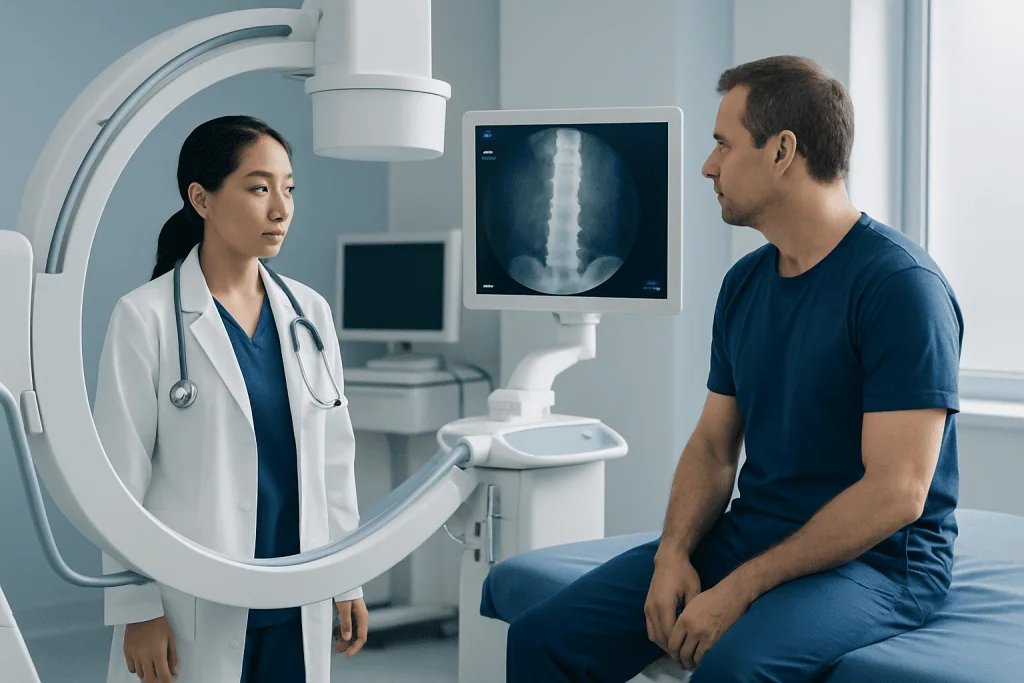
In ankylosing spondylitis, the immune system causes inflammation primarily at entheses, the areas where ligaments and tendons attach to bone. In the spine, inflammation can affect the small joints between vertebrae, spinal ligaments, and the sacroiliac joints in the pelvis. Early inflammation may cause pain, stiffness, and reduced movement, particularly after rest.
Over time, the body may repair inflamed areas by forming new bone. Thin vertical bony growths called syndesmophytes can develop along the outside of the vertebrae. When these bridges join across multiple spinal levels, they may gradually fuse the spine. Fusion can also involve the sacroiliac joints and, less commonly, parts of the rib cage, hips, shoulders, or neck.
These changes are different from ordinary age-related spinal wear, such as osteoarthritis or degenerative disc disease. Degenerative conditions commonly involve disc narrowing and bone spurs in different patterns. A clinician uses symptoms, examination findings, blood tests, and imaging to distinguish among possible causes of back pain and spinal stiffness.
Symptoms and Everyday Effects

Symptoms usually relate to the underlying inflammatory disease rather than the X-ray finding alone. Common early features include persistent low back or buttock pain, morning stiffness lasting for a prolonged period, and improvement with movement rather than rest. Symptoms often begin before age 45, although diagnosis may occur later. Pain can alternate between the buttocks when the sacroiliac joints are affected.
As stiffness progresses, a person may find it harder to bend, turn the neck, stand fully upright, or look over the shoulder while driving. Reduced movement in the rib joints can make deep breathing feel restricted, although it does not necessarily mean the lungs themselves are diseased. Fatigue may also occur, especially when inflammation is active or sleep is disrupted by pain.
Some people experience symptoms outside the spine. These can include painful swelling in joints such as the hips, knees, ankles, or shoulders; heel pain from enthesitis; or episodes of a painful red eye called uveitis. Inflammatory bowel disease and psoriasis are also more common in people with spondyloarthritis. These symptoms should be discussed with a doctor because they can influence treatment choices.
- Stiffness that is worse after inactivity
- Back pain that improves with gentle activity
- Loss of spinal flexibility or a forward-stooped posture
- Neck stiffness and difficulty rotating the head
- Hip pain, heel pain, eye inflammation, or persistent fatigue
Causes and Risk Factors
The underlying cause of ankylosing spondylitis is not fully understood. It is considered an immune-mediated inflammatory disease involving a combination of inherited susceptibility and environmental factors. Many, but not all, affected people carry the HLA-B27 gene. Having this gene does not mean that a person will develop ankylosing spondylitis, and people without it can still develop the condition.
A family history of ankylosing spondylitis or another spondyloarthritis-related condition may increase risk. The condition often begins in adolescence or early adulthood, but symptoms and structural changes can develop at different times. Historically, it was recognized more often in men, but axial spondyloarthritis can affect people of all sexes and may be overlooked in women or in people whose X-rays do not initially show changes.
Smoking is associated with more severe symptoms and worse outcomes in axial spondyloarthritis. It can also affect bone health and lung function, which are especially important when the spine or chest wall is stiff. Stopping smoking, maintaining general fitness, and following an individualized treatment plan are practical ways to support long-term health.
Diagnosis and Imaging
Diagnosis begins with a detailed medical history and physical examination. A clinician may ask when back pain began, whether it improves with activity, whether there is morning stiffness, and whether there have been eye, skin, bowel, or joint symptoms. The examination may assess spinal movement, posture, chest expansion, hip motion, and tender areas where tendons attach to bone.
Imaging is central to identifying bamboo spine. Plain X-rays can show fusion of the sacroiliac joints, syndesmophytes, squaring of vertebrae, and more extensive spinal bridging. However, X-rays may not show inflammation in the earlier stages. Magnetic resonance imaging, or MRI, can detect active inflammation in the sacroiliac joints and spine before substantial structural changes are visible on X-ray.
Blood tests may include inflammatory markers such as C-reactive protein and erythrocyte sedimentation rate, as well as HLA-B27 testing in appropriate situations. These results support, but do not independently confirm or exclude, the diagnosis. A rheumatologist commonly coordinates assessment and treatment, often working with physiotherapists, ophthalmologists, gastroenterologists, and orthopedic or spine specialists when needed.
Treatment, Movement, and Long-Term Care
Once bamboo spine has developed, existing bony fusion generally cannot be removed with medication. Treatment focuses on controlling active inflammation, reducing pain and stiffness, maintaining mobility, improving daily function, and preventing complications. Care is individualized according to symptoms, imaging findings, other health conditions, and whether there are features such as uveitis, psoriasis, or inflammatory bowel disease.
Nonsteroidal anti-inflammatory drugs may help relieve pain and stiffness for some people when they are medically appropriate. If disease activity remains significant, a rheumatologist may consider advanced therapies that target specific inflammatory pathways, including biologic medicines or targeted synthetic medicines. These treatments require assessment for suitability and monitoring for side effects. Corticosteroid injections may sometimes be used for a specific inflamed joint or tendon attachment, while long-term oral corticosteroids are generally not a routine treatment for spinal disease.
Regular, guided exercise is a core part of management. Physiotherapy may include posture work, spinal mobility exercises, strengthening, stretching, balance training, and breathing exercises. Swimming, walking, cycling, yoga adapted to the individual, and other low-impact activities can be helpful. The most appropriate program is one a person can perform consistently and safely, rather than an overly demanding routine.
Bone health also deserves attention. A doctor may review fracture risk, vitamin D status where appropriate, nutrition, fall risks, and whether bone-density testing is needed. Acibadem International’s multidisciplinary specialists and JCI-accredited hospitals evaluate and treat inflammatory spine conditions for international patients, with care plans tailored to each person’s clinical needs.
Safety, Prevention, and When to Seek Medical Care
There is no guaranteed way to prevent ankylosing spondylitis or bamboo spine. However, early evaluation of inflammatory back pain, adherence to treatment, regular physical activity, smoking cessation, and attention to posture and bone health may help reduce the impact of the disease. A physiotherapist can advise on safe movement, including how to protect the neck and back during everyday tasks.
A rigid, fused spine behaves differently from a flexible spine and can fracture more easily, sometimes after a low-impact fall, sudden movement, or minor vehicle collision. Fractures may be unstable and can occasionally injure the spinal cord. People with known advanced spinal fusion should use practical fall-prevention measures, wear seat belts correctly, and avoid high-risk activities unless they have discussed safety with their treating team.
Seek urgent medical care after any fall, accident, or injury that causes new neck or back pain in a person with a fused or very stiff spine, even if the injury seems minor. Emergency assessment is also important for new weakness, numbness, trouble walking, loss of bladder or bowel control, or severe pain that is rapidly worsening. Prompt medical review is also advised for a painful red eye with light sensitivity or blurred vision, as this may be uveitis and needs timely treatment.
Frequently asked questions
Is bamboo spine the same as ankylosing spondylitis?
No. Bamboo spine is an imaging term for extensive spinal fusion, most commonly resulting from longstanding ankylosing spondylitis. Ankylosing spondylitis is the underlying inflammatory disease, while bamboo spine is one possible later structural outcome.
Can bamboo spine be reversed?
Bony fusion that has already formed is generally not reversible. However, treatment can control active inflammation, ease symptoms, maintain mobility, and help reduce the risk of further complications. A personalized plan can still make an important difference to comfort and function.
Does everyone with ankylosing spondylitis develop bamboo spine?
No. The course of ankylosing spondylitis varies widely, and not everyone develops extensive spinal fusion. Earlier recognition and appropriate treatment may help limit inflammation and progression, although outcomes differ between individuals.
Why is a bamboo spine more likely to fracture?
When several spinal segments fuse, the spine becomes less flexible and may act more like a long bone. This can make it more vulnerable to unstable fractures during falls or trauma, including injuries that might otherwise seem minor. New pain after an injury should be assessed urgently.
What type of exercise is safe with bamboo spine?
Many people benefit from regular low-impact activity, mobility exercises, strengthening, posture training, and balance work. The safest program depends on spinal stability, symptoms, bone health, and other medical conditions. A physiotherapist or rheumatology team can recommend suitable exercises and modifications.
When should someone with bamboo spine see a doctor urgently?
Urgent assessment is needed after a fall, collision, or other injury that causes new neck or back pain. Emergency care is also needed for weakness, numbness, walking difficulty, or changes in bladder or bowel control. A red, painful eye with sensitivity to light should also be evaluated promptly.
References
- American College of Rheumatology
- Spondylitis Association of America
- National Institute of Arthritis and Musculoskeletal and Skin Diseases
- National Health Service
- European Alliance of Associations for Rheumatology
This article is for general information only and is not a substitute for professional medical advice. Please consult a qualified doctor about your individual situation.
Joint and spine care in Turkey — expert assessment & treatment
JCI-accredited · board-certified surgeons · reply within 24h
Add us as a Preferred Source to see more of our trusted health content across Google Search, AI Overviews and Discover.

More from the Health Library



Related Specialists

Dr. İletişim | 444 55 44
Oral & Dental Health
Ahmet Turan
Physical Medicine & Rehabilitation
Fzt. Perihan Yıldız
Physical Medicine & Rehabilitation
Prof. Dr. Şükrü Yazar
Aesthetic Plastic & Reconstructive Surgery