Blue Light Therapy for Skin Cancer: How It Works, Results and What to Expect

Blue light therapy is photodynamic therapy: a topical photosensitizing medicine is activated by a specific wavelength of light. It is mainly used for actinic keratoses and, in selected cases, superficial non-melanoma skin cancers.
Key Takeaways
- Blue light therapy is photodynamic therapy: a topical photosensitizing medicine is activated by a specific wavelength of light.
- It is mainly used for actinic keratoses and, in selected cases, superficial non-melanoma skin cancers.
- Treatment can cause burning or stinging during illumination, followed by redness, swelling, crusting and peeling as the skin heals.
- It is not appropriate for melanoma, deeply invasive cancers or every type of basal or squamous cell carcinoma.
- Follow-up skin examinations remain important because new lesions and skin cancers can develop over time.
Blue light therapy for skin cancer is a form of photodynamic therapy (PDT) that combines a light-sensitive medication with blue light to destroy abnormal cells near the skin surface. It is most often used for actinic keratoses and may be appropriate for carefully selected superficial skin cancers after specialist assessment.
Overview: What Is Blue Light Therapy for Skin Cancer?
Blue light therapy for skin cancer usually refers to photodynamic therapy (PDT), a treatment that destroys abnormal cells close to the skin surface. A clinician first applies a light-sensitive medicine to the affected area. After a planned waiting period, blue light activates the medicine, creating a reaction that damages targeted abnormal cells while aiming to preserve as much healthy tissue as possible.
Despite its name, blue light therapy is not a treatment for every skin cancer. It is used most commonly for actinic keratoses, which are sun-related precancerous lesions. In selected situations, dermatologists may also consider PDT for superficial basal cell carcinoma or squamous cell carcinoma in situ (Bowen disease), particularly when lesions are thin and superficial.
The choice of treatment depends on the exact diagnosis, the lesion’s depth and location, its borders, previous treatment history, and the person’s overall health. A suspicious spot should be examined by a qualified clinician before treatment; a biopsy may be needed to confirm the diagnosis and guide care.
How Photodynamic Therapy Works
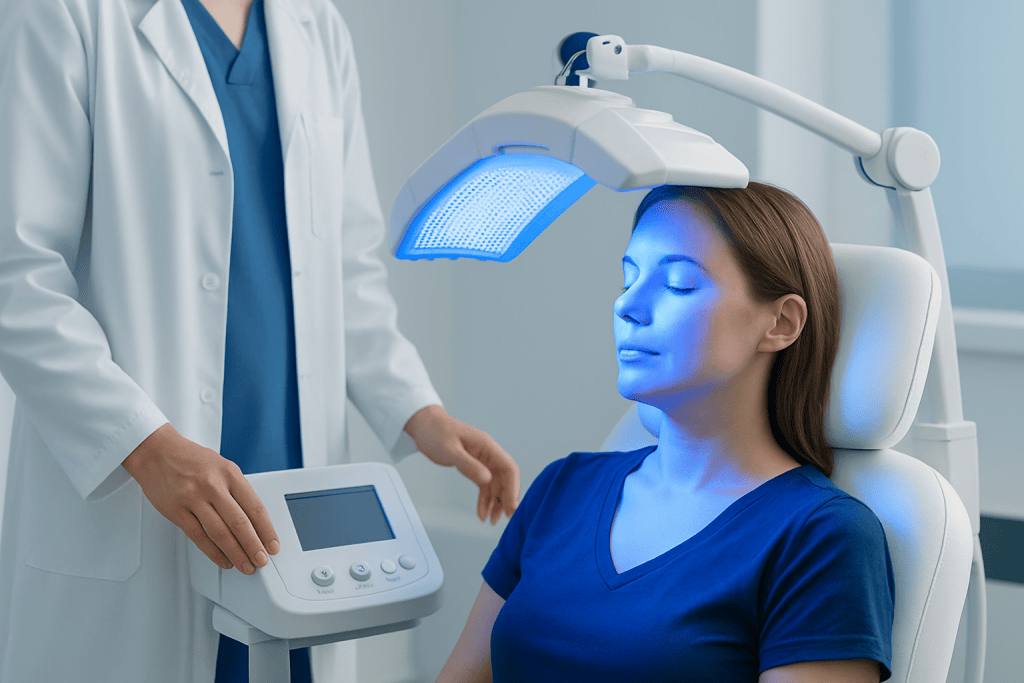
PDT relies on three elements: a photosensitizing medicine, light of an appropriate wavelength, and oxygen in the tissue. The medication is often applied as a cream or solution to the lesion and nearby sun-damaged skin. Abnormal cells may take up or retain the medication differently from surrounding healthy cells.
When blue light is directed at the prepared area, it activates the medicine. This produces reactive oxygen molecules that damage the treated abnormal cells. The body then clears the damaged cells as the skin repairs itself over the following days and weeks.
Blue light is generally used for lesions on the surface of the skin because light does not penetrate deeply. For this reason, PDT cannot replace surgery or other treatments when a cancer is invasive, thick, high risk, or located in a setting where complete removal and tissue examination are especially important.
Photodynamic therapy can treat a broader field of sun-damaged skin rather than only one visible lesion. This may be useful for people with multiple actinic keratoses on the face, scalp, ears, chest, forearms or hands.
Who May Be a Candidate?

Suitability begins with an accurate diagnosis. Blue light PDT may be considered for multiple actinic keratoses, especially when they occur across an area of chronically sun-exposed skin. It may also be an option for selected superficial basal cell carcinomas or squamous cell carcinoma in situ when a dermatologist determines that the lesion is appropriate for this approach.
A clinician may recommend a different treatment when there is concern for invasive squamous cell carcinoma, nodular or infiltrative basal cell carcinoma, melanoma, a recurrent tumor, or a lesion with poorly defined margins. Skin cancer includes several distinct diseases, and each requires an individualized management plan.
Before recommending PDT, the care team reviews the lesion’s site, size, appearance and pathology results, as well as medications, allergies, prior skin procedures and any condition associated with light sensitivity. Pregnancy, breastfeeding, porphyria, or use of certain photosensitizing medicines may require additional discussion or a different approach.
- PDT may be useful for superficial lesions and areas with several actinic keratoses.
- It is not a home treatment and should be performed or directed by an experienced clinician.
- Confirmation of the diagnosis is essential before treating a lesion thought to be cancerous.
What Happens During the Procedure?
The appointment usually starts with skin preparation. The clinician may gently remove scale, crust or thickened surface skin so the photosensitizing medication can reach the target cells more effectively. Depending on the product and the treatment plan, the medication is then applied to the lesion or the wider treatment field.
After application, there is an incubation period. Its length varies by the medication, body area and protocol. The area may be covered and should be protected from bright light as instructed. The patient then sits or lies comfortably while a blue light device is positioned over the treatment area for a controlled period.
During illumination, many people feel warmth, tingling, stinging or burning. The intensity differs among individuals and can vary with the size and location of the treatment area. Clinicians can use practical comfort measures, such as breaks, cooling air or other strategies suited to the person and the protocol.
At the end of the session, the treated skin is protected from light. The clinician provides written aftercare instructions, including how long to avoid sunlight and bright indoor light. When PDT is recommended for a confirmed superficial cancer, it should be part of a planned dermatology follow-up pathway. Photodynamic therapy may be discussed alongside other evidence-based skin cancer treatments.
Benefits, Expected Results and Limitations
A key benefit of blue light PDT is that it can address multiple visible and early abnormal lesions within a sun-damaged area. It generally does not involve cutting or stitches, and cosmetic healing can be favorable for appropriate lesions. Some people prefer it when treating a field of actinic keratoses rather than having each spot treated individually.
Results are assessed after the skin has healed, not immediately after the light exposure. The treated area may appear more inflamed before it improves. Some people require more than one treatment session, particularly for extensive actinic keratoses or when the response is incomplete.
PDT has limits. It does not provide a surgical specimen to confirm that all cancer cells have been removed, and it may not be as suitable as excision or other approaches for cancers with a higher risk of persistence or spread. A dermatologist may recommend surgery, curettage and electrodessication, topical treatment, radiation therapy, or another approach depending on the diagnosis.
People should continue regular surveillance even after an excellent response. PDT treats the selected area at that time but does not remove the underlying tendency to develop sun-related skin damage or future skin cancers.
Recovery Timeline, Side Effects and Self-Care
Redness, tenderness, swelling, dryness, peeling, crusting and temporary darkening or lightening of the skin are common after PDT. These effects often begin shortly after treatment and may become more noticeable over the next few days. Healing commonly occurs over one to several weeks, depending on the treated area, the intensity of the reaction and individual skin characteristics.
During the first day or two, strict light protection is particularly important because remaining photosensitizing medicine can still be activated. The care team will explain the specific precautions for the medicine used. In general, patients should avoid direct sunlight and bright light exposure for the stated period, wear protective clothing when outdoors, and use shade carefully after the initial restricted period.
Gentle skin care can support healing. Patients should use only products recommended by their clinician, avoid picking crusts or peeling skin, and protect the area from friction. Makeup, shaving, swimming, exercise and other activities may need to be adjusted temporarily based on the location and degree of irritation.
Less common complications can include blistering, infection, persistent color change or scarring. Contact the treating team if pain is severe or worsening, redness spreads significantly, pus develops, fever occurs, or the wound does not appear to be healing as expected.
Preventing Future Sun Damage and Supporting Long-Term Skin Health
Sun protection remains important after blue light therapy. Ultraviolet exposure contributes to actinic keratoses and many non-melanoma skin cancers, so reducing exposure can help lower the chance of additional damage. This includes seeking shade, wearing broad-brimmed hats and protective clothing, and using broad-spectrum sunscreen as advised by a clinician.
Regular self-checks can help people notice changes between professional examinations. New or changing spots, a sore that does not heal, a scaly patch that persists, or a lesion that bleeds repeatedly should be assessed. People who have had actinic keratoses or skin cancer may benefit from a clinician-recommended schedule of full-skin examinations.
A dermatology team may combine prevention with other treatments for chronically sun-damaged skin. For example, selected patients may be offered topical field therapies, cryotherapy or dermatology care tailored to their diagnosis, skin type and pattern of lesions. No treatment replaces ongoing sun protection and follow-up.
When to Seek Medical Care
Medical assessment is appropriate for any new, changing, bleeding, painful or non-healing skin lesion. Prompt review is especially important for a dark or irregularly pigmented spot, a rapidly growing bump, a persistent rough patch, or a sore that repeatedly forms a scab. These features do not always mean cancer, but they deserve professional evaluation.
After blue light PDT, patients should contact their clinician if they develop severe pain that is not controlled by the recommended plan, extensive blistering, increasing warmth or swelling, drainage, fever, or a reaction that seems to worsen rather than gradually settle. They should also attend all planned follow-up visits so treatment response can be checked.
Acibadem International’s multidisciplinary specialists and JCI-accredited hospitals support international patients with assessment and treatment planning for skin conditions, including appropriate follow-up after PDT. The safest next step for a suspicious lesion is a consultation with a qualified dermatologist rather than attempting to treat it independently.
Frequently asked questions
Is blue light therapy a cure for skin cancer?
Blue light therapy can effectively treat certain superficial, carefully selected abnormal skin lesions, but it is not a universal cure for skin cancer. Its role is determined by the exact diagnosis, depth, location and risk features of the lesion. Follow-up examinations are needed to assess response and monitor for new lesions.
Does blue light therapy hurt?
Many people experience stinging, burning, warmth or discomfort while the blue light is on. The sensation can be more noticeable when a larger area is treated or when the skin is inflamed. The treating team can discuss methods to improve comfort during the session.
How long does it take for skin to heal after blue light therapy?
Redness and irritation may last for several days, while peeling, crusting and full visible healing can take one to several weeks. Healing time varies with the body site, treatment area and individual reaction. The clinician will advise when normal skincare and usual activities can be resumed.
Can blue light therapy treat melanoma?
No. Blue light photodynamic therapy is not a standard treatment for melanoma. A lesion that may be melanoma needs prompt assessment by a dermatologist, often including biopsy and treatment planning based on pathology results.
Can a person go outside after blue light therapy?
The treated area must be protected from sunlight and other bright light sources for the specific period advised by the clinician, often especially during the first one to two days. Instructions differ according to the photosensitizing medicine and protocol used. Patients should follow their care team’s written guidance closely.
Will blue light therapy leave a scar?
Scarring is uncommon with appropriately performed PDT, and the treatment may offer good cosmetic healing for suitable superficial lesions. However, temporary redness, crusting and changes in skin color can occur. Individual healing and the severity of the treatment reaction affect the final appearance.
References
- American Academy of Dermatology Association
- National Cancer Institute
- National Comprehensive Cancer Network
- British Association of Dermatologists
- DermNet
This article is for general information only and is not a substitute for professional medical advice. Please consult a qualified doctor about your individual situation.
Skin Cancer in Turkey — costs, top hospitals & a free quote
JCI-accredited · board-certified surgeons · reply within 24h
Add us as a Preferred Source to see more of our trusted health content across Google Search, AI Overviews and Discover.