Cataract Surgery in Turkey: What International Patients Should Plan For

Most patients need a preoperative eye assessment, lens discussion, and a clear travel timeline before cataract surgery in Turkey. Cataract surgery is usually a short procedure, but recovery and follow-up visits still need planning.
Key Takeaways
- Most patients need a preoperative eye assessment, lens discussion, and a clear travel timeline before cataract surgery in Turkey.
- Cataract surgery is usually a short procedure, but recovery and follow-up visits still need planning.
- International patients should organize medical records, medications, companion support, and return-travel timing ahead of treatment.
- Choosing an experienced eye team and asking about aftercare can improve confidence and continuity of care.
- Patients should avoid rushing travel plans and should follow the surgeon’s guidance about flying, eye drops, and activity restrictions.
Cataract surgery in Turkey can be a practical option for international patients when travel, testing, lens selection, and follow-up are planned in advance. Understanding the process helps patients prepare for a smoother treatment journey and recovery.
Overview: What Cataract Surgery in Turkey Involves
Cataract surgery in Turkey generally follows the same medical principles used in leading eye centers worldwide. A cataract develops when the natural lens of the eye becomes cloudy, causing blurred vision, glare, duller colors, and difficulty with reading or night driving. Surgery removes the cloudy lens and replaces it with a clear artificial intraocular lens.
For international patients, the journey involves more than the procedure itself. It usually includes remote communication before travel, an in-person eye examination after arrival, surgery planning, the operation, and short-term follow-up before returning home. Because cataract surgery is commonly performed as day surgery, many patients are surprised that the main planning needs relate to testing, recovery, and travel timing rather than hospital stay.
The exact schedule depends on the patient’s eye health, general health, and lens choice. Some people only need standard cataract treatment, while others may also need evaluation for conditions such as cataracts with astigmatism, glaucoma, retinal problems, or previous eye surgery. These factors can affect both the surgical plan and how long a patient should remain in Turkey after the procedure.
Who May Consider Traveling for Cataract Surgery
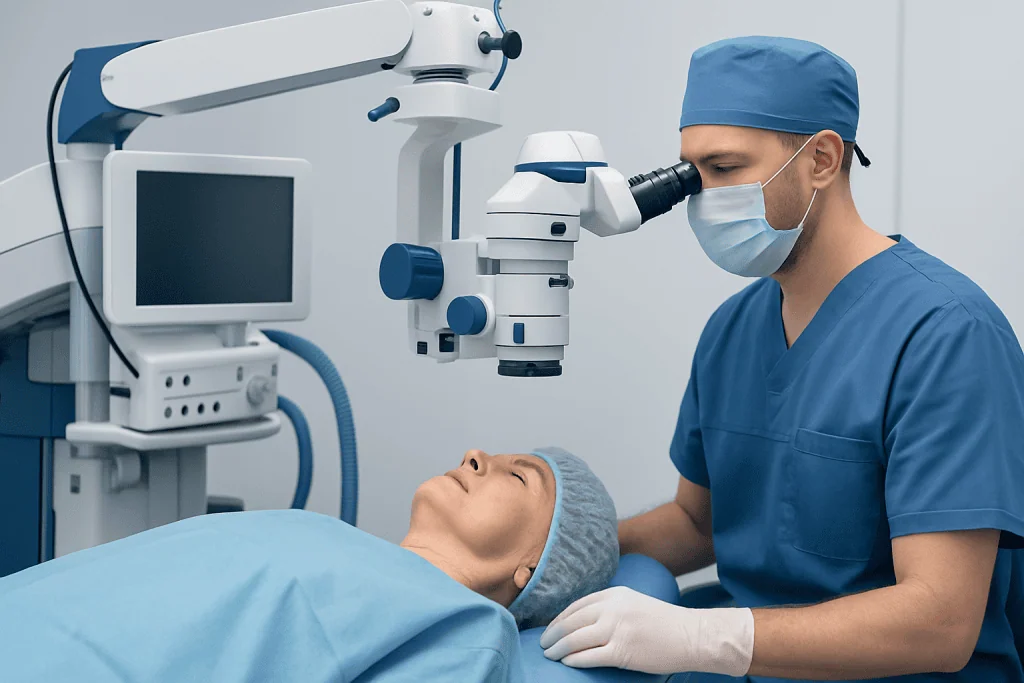
International patients often consider treatment abroad when cataracts begin to interfere with daily life. Common reasons include blurry vision, sensitivity to light, reduced contrast, halos around lights, or increasing trouble with tasks such as reading, driving, or seeing faces clearly. Surgery is usually considered when symptoms affect quality of life rather than at a fixed stage alone.
Traveling for care may be suitable for adults who are medically stable, able to attend assessments, and comfortable following postoperative instructions. Patients should be ready to discuss other eye conditions, prior laser or eye surgery, diabetes, high blood pressure, heart disease, and any medicines that could affect surgery or healing.
Not every patient is an ideal travel candidate. If there is a complex retinal disorder, very advanced glaucoma, active eye infection, or an unstable medical condition, the care team may recommend additional evaluation or a modified travel plan. A realistic conversation before booking flights can help avoid unnecessary stress and make sure the patient has enough time for safe care.
Before Travel: Medical Records, Tests, and Practical Preparation

Good preparation starts before the trip. Patients should gather recent eye examination records if available, including glasses prescriptions, prior surgical reports, and information about any diagnosed eye disease. A list of medications, allergies, and chronic health conditions is equally important. Bringing this information can help the ophthalmology team understand the full picture quickly and reduce repeated testing where appropriate.
One of the most important parts of planning is the preoperative assessment. This typically includes visual acuity testing, slit-lamp examination, measurement of the eye, and calculations to choose the most suitable artificial lens. The surgeon may also check the cornea, retina, and eye pressure. If the patient is considering premium lens options, extra measurements may be needed. In many centers, this evaluation is part of a broader eye check-up before surgery.
Travel planning should also include practical details. Patients should arrange accommodation that is easy to access, avoid a tightly packed sightseeing itinerary, and consider traveling with a family member or friend if possible. It is helpful to ask in advance how many visits are expected, how long to stay after surgery, whether both eyes can be treated on separate dates during the same trip, and what documents will be provided for the doctor back home.
- Bring a full medication list and copies of medical records.
- Ask whether contact lenses need to be stopped before measurements.
- Confirm expected length of stay and follow-up visit dates.
- Prepare sunglasses and any regular health items needed during recovery.
Understanding the Procedure and Lens Choices
Cataract surgery is commonly performed using phacoemulsification, a technique that uses ultrasound energy to break up the cloudy lens before removal through a very small incision. In some cases, laser-assisted steps may be offered, depending on the patient’s eye anatomy and the center’s technology. The new lens is then placed inside the eye. Most surgeries are done under local anesthesia with sedation or numbing drops, so the patient is awake but kept comfortable.
Lens selection is an important part of the planning process. Standard monofocal lenses are designed to provide clear vision at one main distance, often with glasses still needed for near tasks. Other lenses may aim to reduce dependence on glasses or correct astigmatism. These options can be helpful for some people, but they may not suit every eye. A careful discussion of expectations, lifestyle, and eye health is essential.
International patients should ask simple, practical questions: What type of lens is recommended? What visual result is realistic? Are glasses likely to still be needed? Is there any reason a premium lens may not be suitable? A balanced explanation helps patients make informed decisions without unrealistic expectations. Where additional refractive correction is needed, the team may discuss options linked to broader laser eye surgery planning, although this is not part of routine cataract surgery for everyone.
Recovery, Follow-Up, and Return Travel
Recovery after cataract surgery is often smooth, but the eye still needs time to heal. Vision may improve quickly, sometimes within days, though fluctuations can happen early on. Mild irritation, watering, or a gritty feeling is not unusual. The surgeon usually prescribes eye drops to reduce inflammation and help prevent infection, and it is important to use them exactly as directed.
Patients should plan for at least one or more postoperative checks, depending on the case. These visits allow the eye team to confirm that healing is progressing normally, eye pressure is stable, and vision is improving as expected. International patients should avoid assuming that because the surgery is brief, follow-up is optional. Early review is a standard and important part of safe care.
Return-travel timing varies. Many patients can travel relatively soon after uncomplicated surgery, but this should always be confirmed by the treating surgeon. It is wise to avoid unnecessary rushing, heavy lifting, eye rubbing, swimming, dusty environments, or missed drop doses during the early recovery period. If surgery is being done in both eyes on separate dates, the overall stay may need to be longer. Some patients may also need future retina treatment or other specialist follow-up if additional eye conditions are found during assessment.
Possible Risks, Safety Questions, and How to Choose a Center
Cataract surgery is widely performed and generally has a strong safety profile, but no operation is entirely risk-free. Possible complications can include infection, inflammation, swelling, raised eye pressure, lens-related issues, retinal problems, or slower-than-expected visual recovery. In some cases, pre-existing eye disease has more effect on the final vision than the cataract itself, which is why thorough evaluation matters.
Patients planning surgery abroad should feel comfortable asking direct questions about safety. It is reasonable to ask who will perform the surgery, what preoperative tests are included, what type of lens is recommended and why, how complications are handled, and what support is available if symptoms develop after returning home. Patients can also ask how records will be shared with their local eye doctor.
Choosing a center should involve more than logistics alone. Experience in ophthalmology, access to diagnostic imaging, clear communication, and a structured follow-up plan are all important. If a patient also has a retinal or corneal condition, it may be helpful to choose a service with access to related specialty care such as cornea treatment when clinically needed. Near the end of the care journey, some international patients choose centers such as Acibadem International, where multidisciplinary specialists and JCI-accredited hospitals provide diagnosis and treatment planning for overseas patients.
Self-Care Tips and When to Seek Medical Advice
Simple self-care steps can support recovery. Patients should wash their hands before using eye drops, avoid pressing on the eye, and wear any protective shield or glasses advised by the surgeon. Sunglasses can help with light sensitivity outdoors. Rest is helpful, but light daily activity is often possible unless the doctor advises otherwise.
It is important to know which symptoms need prompt attention. Patients should contact a doctor urgently if they develop worsening pain, a sudden drop in vision, increasing redness, flashes, a shower of new floaters, significant discharge, or any symptom that feels markedly different from the expected recovery explained by the care team. These symptoms do not always mean a serious problem, but they should not be ignored.
Before leaving Turkey, patients should make sure they understand their drop schedule, activity limits, and follow-up needs at home. They should also have a written summary for their local doctor. This kind of continuity is especially useful if further care is needed for another eye condition such as retinal detachment, glaucoma, or diabetic eye disease identified during the work-up.
Frequently asked questions
How long should international patients stay in Turkey for cataract surgery?
The length of stay depends on the eye examination, surgery date, and planned follow-up visits. Many patients need time for preoperative measurements and at least one postoperative check, so it is best to confirm the timeline with the treating surgeon before booking travel.
Is cataract surgery painful?
Cataract surgery is usually not described as painful. Most patients have local anesthesia or numbing drops, and they may feel pressure or movement rather than pain. Mild discomfort or irritation can happen afterward, but severe pain is not expected and should be reported.
Can both eyes be treated during one trip?
Some international patients arrange treatment for both eyes during one trip, but this is usually done on separate dates rather than at the exact same time. The decision depends on the surgeon’s approach, the patient’s eye health, and how the first eye heals.
Will glasses still be needed after cataract surgery?
Many patients still need glasses for some tasks after surgery, depending on the lens selected and the eye’s natural characteristics. Monofocal lenses commonly improve one main distance, while other lens types may reduce glasses dependence for some people.
When is it safe to fly after cataract surgery?
Many people can fly soon after uncomplicated cataract surgery, but timing should always be confirmed by the surgeon. Safety depends on the healing process, the need for follow-up, and whether there were any concerns during or after the procedure.
What documents should patients bring for cataract surgery in Turkey?
It is helpful to bring past eye records, glasses prescriptions, a medication list, allergy information, and reports about chronic health conditions. If there has been previous eye surgery, a copy of that report can be especially useful.
This article is for general information only and is not a substitute for professional medical advice. Please consult a qualified doctor about your individual situation.
Cataract Surgery in Turkey — costs, top hospitals & a free quote
JCI-accredited · board-certified surgeons · reply within 24h
Add us as a Preferred Source to see more of our trusted health content across Google Search, AI Overviews and Discover.
Check your numbers in seconds
BMI, calories, due date, blood pressure and 30+ more clinical calculators — free, instant, doctor-reviewed ranges.

Ophthalmology
Comprehensive eye care from laser vision correction to retina, cornea and cataract surgery.
75 specialists in this unitMore from the Health Library

Pre-Travel Medical Evaluation Before Surgery Abroad

Gastric Sleeve Surgery in Turkey: How to Choose a Safe Hospital

Brain Aneurysm Treatment in Turkey: Coiling, Travel, and Follow-Up

How to Choose an IVF Clinic Abroad: Questions About Labs, Safety, and Success Rates

Travel Insurance and Medical Treatment Abroad: What to Check Before You Go