Childhood Scoliosis: Early Signs, Monitoring, and When Bracing or Surgery Is Considered

Childhood scoliosis can be mild and only require observation, but some curves worsen as a child grows. Early signs may include uneven shoulders, a prominent shoulder blade, uneven waist, or the body leaning to one side.
Key Takeaways
- Childhood scoliosis can be mild and only require observation, but some curves worsen as a child grows.
- Early signs may include uneven shoulders, a prominent shoulder blade, uneven waist, or the body leaning to one side.
- Monitoring usually involves physical exams and, when needed, imaging to measure the spinal curve over time.
- Bracing may help slow curve progression in growing children with certain moderate curves.
- Surgery is considered when curves are severe, progressing, or affecting balance, growth, or breathing.
Childhood scoliosis is a sideways curvature of the spine that can appear during growth and may range from mild to more progressive forms. Early recognition, regular follow-up, and timely treatment help protect spinal growth, posture, and overall function.
Overview of Childhood Scoliosis
Childhood scoliosis refers to an abnormal sideways curve of the spine that develops in infants, children, or adolescents. A normal spine has gentle curves when viewed from the side, but scoliosis causes the spine to curve to the side and sometimes rotate as well. This can make the shoulders, ribs, waist, or hips look uneven.
Not every spinal curve is serious. Many children have mild scoliosis that does not cause pain or major limitations and may only need regular observation during growth. However, some curves can progress, especially during growth spurts, which is why early recognition and follow-up are important.
Doctors often describe scoliosis by the age when it appears. Infantile scoliosis begins before age 3, juvenile scoliosis appears between ages 4 and 10, and adolescent idiopathic scoliosis is usually diagnosed from age 10 until skeletal maturity. Idiopathic means the exact cause is unknown, although it is the most common type in otherwise healthy children.
Some children have scoliosis linked to another condition, such as congenital spine differences present at birth, neuromuscular disorders, or syndromes that affect growth and connective tissues. Because the cause can influence treatment, evaluation by a pediatric specialist is helpful when scoliosis is suspected.
Early Signs and Symptoms Parents May Notice
Childhood scoliosis often develops gradually and may not be obvious at first. In many cases, children do not feel unwell, so the first clues are changes in posture or body symmetry rather than pain. A parent, school nurse, coach, or pediatrician may be the first to notice that something looks uneven.
Common early signs include one shoulder sitting higher than the other, one shoulder blade sticking out more, uneven waist creases, one hip appearing higher, or the body leaning slightly to one side. Clothes may seem to hang unevenly, and pant legs or skirt hems may look different in length even when they are not.
During a simple forward bend test, one side of the ribs or lower back may look more prominent because the spine has rotated. This rib hump is a useful clue and often leads to further assessment. Mild scoliosis usually does not cause clear symptoms, but larger curves can sometimes lead to back fatigue, muscle imbalance, or cosmetic concerns.
Severe or rapidly progressing scoliosis may affect the shape of the chest and, in uncommon cases, influence breathing. Back pain alone does not necessarily mean a child has scoliosis, and significant pain may suggest another issue that should be evaluated separately.
Causes and Risk Factors
The most common form of childhood scoliosis is idiopathic scoliosis, meaning no single definite cause can be identified. It is thought to involve a combination of genetic and growth-related factors. It does not happen because a child carried a heavy backpack, had poor posture, or played sports incorrectly.
Congenital scoliosis is different. It occurs when the bones of the spine do not form normally before birth. This type can progress as a child grows and may occur along with differences in other organs, so doctors sometimes recommend additional evaluations.
Neuromuscular scoliosis can develop in children with conditions that affect muscle control or nerve function, such as cerebral palsy, muscular dystrophy, or spinal cord disorders. In these cases, the muscles that support the spine may be weaker or imbalanced, which allows the curve to develop. Related neurological causes may be evaluated alongside conditions such as scoliosis or spinal abnormalities.
Several factors increase the chance that a curve may worsen. These include younger age at diagnosis, remaining growth potential, female sex in idiopathic scoliosis, and a larger curve at the time it is first measured. A family history of scoliosis may also raise risk, so parents should mention any relatives who had bracing or spine surgery.
How Childhood Scoliosis Is Diagnosed and Monitored
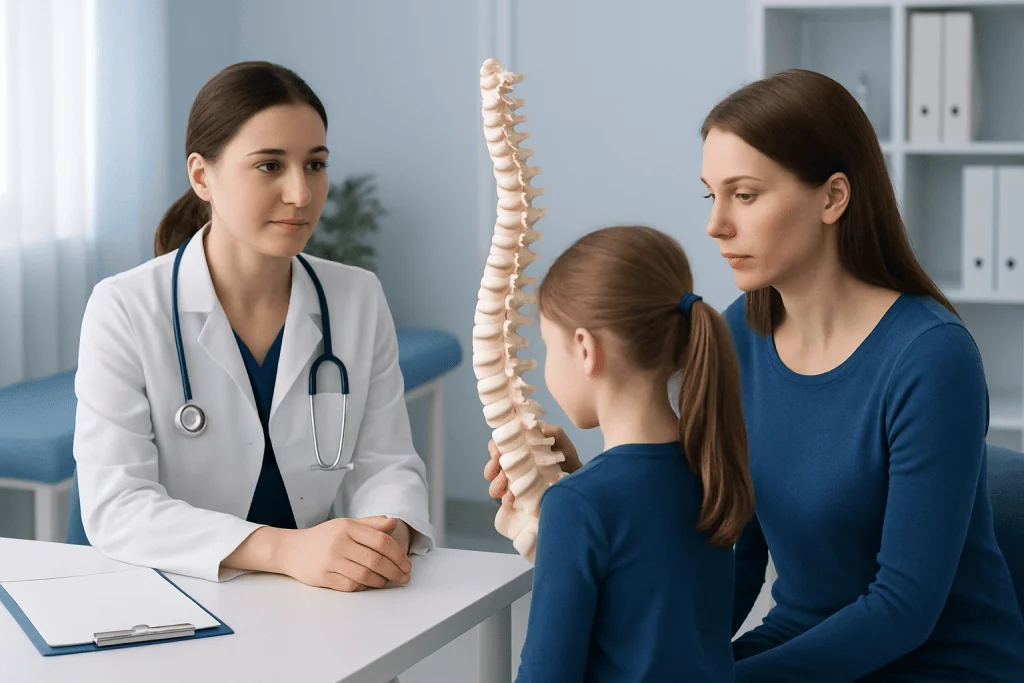
Diagnosis begins with a medical history and physical examination. The doctor asks when the curve was first noticed, whether it seems to be changing, whether there is pain, and whether the child has any neurological symptoms or other medical conditions. The exam includes checking posture, shoulder and hip level, spinal flexibility, and the forward bend test.
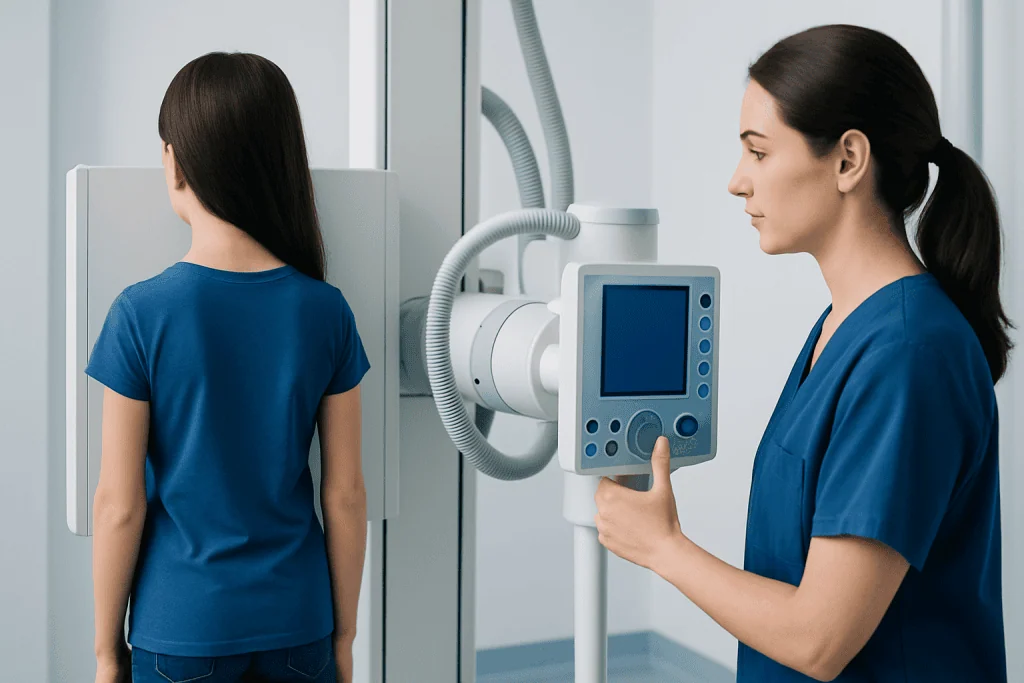
If scoliosis is suspected, imaging may be used to confirm it and measure the curve. X-rays are commonly used because they allow doctors to calculate the Cobb angle, a standard way to describe curve size. Growth stage is also important, because the risk of progression depends greatly on how much growth remains.
Some children need additional imaging, such as MRI, if the curve pattern is unusual, symptoms suggest a neurological cause, or scoliosis starts very early in life. The goal is not simply to label the curve, but to understand why it is present and whether it is likely to progress.
Monitoring is often scheduled every few months during active growth, though the exact interval depends on the child’s age and curve size. Follow-up allows the care team to compare measurements over time and decide whether observation remains appropriate or whether treatment should begin. In specialized centers, spinal assessment may be coordinated with spine care services when progression becomes a concern.
When Observation, Bracing, or Surgery Is Considered
Treatment decisions are individualized and usually depend on the child’s age, growth remaining, curve size, curve pattern, and whether the curve is progressing. Mild curves in growing children are often observed with regular exams and imaging. Observation is an active plan, not neglect; its purpose is to detect change early enough to act if needed.
Bracing is commonly considered for growing children with moderate curves that have a meaningful risk of getting worse. A brace does not usually straighten the spine permanently, but it can help slow or prevent progression while the child continues to grow. Success depends on the type of curve, the child’s growth stage, and how consistently the brace is worn according to medical guidance.
There are different brace designs, and the care team chooses one based on the child’s anatomy and curve pattern. Children and families often need support adjusting to brace wear, school routines, sports, and body image concerns. Clear explanations and follow-up visits can help make bracing more manageable and effective.
Surgery may be considered if the curve is severe, continues to progress despite bracing, or threatens balance, chest development, or lung function. Surgical planning may involve growth-friendly techniques in younger children or spinal fusion in older children and adolescents. Depending on the case, options may be discussed with teams experienced in scoliosis surgery and, when relevant, broader pediatric orthopedic care.
Daily Life, Exercise, and Self-care
Many children with scoliosis continue school, play, and sports with little or no restriction. Regular movement supports overall health, strength, confidence, and well-being. In most cases, scoliosis does not mean a child should stop normal physical activity unless a doctor gives specific instructions.
Exercise is not a replacement for bracing or surgery when those treatments are indicated, but it may still be useful. Stretching, core strengthening, posture awareness, and supervised physical therapy can support comfort and body mechanics. Some children are referred for scoliosis-specific exercise programs as part of a broader treatment plan.
Emotional support matters too. Visible changes in posture or brace wear can affect self-esteem, especially during adolescence. Families can help by listening to concerns, communicating with teachers and coaches, and encouraging the child to stay engaged in normal routines.
Healthy habits such as balanced nutrition, adequate sleep, and attending scheduled follow-up appointments also support care. Families should avoid unproven treatments that promise to cure scoliosis, and instead rely on advice from qualified pediatric spine professionals.
When to See a Doctor
Parents should arrange a medical evaluation if they notice uneven shoulders, a prominent shoulder blade, a tilted waist, or leaning to one side. It is also wise to seek advice if there is a family history of scoliosis or if a school screening or routine pediatric visit suggests a spinal curve.
Prompt review is especially important when a child is young and still growing quickly, because early-onset curves can change over time. New back asymmetry during a growth spurt should not be ignored, even if the child feels well.
Urgent medical review is needed if scoliosis is accompanied by significant pain, weakness, numbness, changes in walking, bowel or bladder problems, fever, or unexplained weight loss. These features are not typical of common idiopathic scoliosis and may point to another condition that needs attention.
For families seeking specialist assessment, Acibadem International’s multidisciplinary specialists in JCI-accredited hospitals evaluate and treat childhood scoliosis for international patients. A pediatrician or spine specialist can guide the next steps and explain whether observation, bracing, or surgery is most appropriate.
Frequently asked questions
What is childhood scoliosis?
Childhood scoliosis is a sideways curvature of the spine that appears in infants, children, or teenagers. Some curves are mild and stable, while others can progress as a child grows.
Can a child have scoliosis without pain?
Yes. Many children with scoliosis do not have pain, especially in the early stages. The first signs are often uneven shoulders, waist asymmetry, or a rib prominence rather than discomfort.
Does poor posture cause scoliosis?
No. Poor posture does not cause true scoliosis, and neither do heavy schoolbags or ordinary sports activities. Scoliosis involves a structural curve of the spine, often with rotation, and should be evaluated medically.
How often does childhood scoliosis need to be checked?
The timing depends on the child’s age, growth stage, and curve size. During active growth, doctors often recommend regular follow-up visits to watch for progression and adjust treatment if needed.
When is a brace used for scoliosis?
A brace is usually considered for children who are still growing and have a moderate curve that may worsen over time. The goal is to reduce the chance of progression, not to permanently cure the curve.
When is surgery considered for childhood scoliosis?
Surgery may be discussed if the curve is severe, keeps progressing, or affects spinal balance, chest development, or breathing. The exact surgical approach depends on the child’s age, growth, and curve pattern.
Can children with scoliosis play sports?
In many cases, yes. Most children with scoliosis can remain physically active, and exercise is generally encouraged for overall health. Any restrictions should come from the child’s own doctor, especially if bracing or surgery is part of treatment.
References
- World Health Organization
- Scoliosis Research Society
- American Academy of Orthopaedic Surgeons
- American Academy of Pediatrics
- National Institute of Arthritis and Musculoskeletal and Skin Diseases
This article is for general information only and is not a substitute for professional medical advice. Please consult a qualified doctor about your individual situation.
Joint and spine care in Turkey — expert assessment & treatment
JCI-accredited · board-certified surgeons · reply within 24h
Add us as a Preferred Source to see more of our trusted health content across Google Search, AI Overviews and Discover.