Cyst Inside Eyeball: A Complete Medical Overview

A cyst inside eyeball is not one single condition; it can describe several different intraocular cysts. Many eye cysts are benign, but some may blur vision, raise eye pressure, or signal another eye problem.
Key Takeaways
- A cyst inside eyeball is not one single condition; it can describe several different intraocular cysts.
- Many eye cysts are benign, but some may blur vision, raise eye pressure, or signal another eye problem.
- Diagnosis usually requires a detailed ophthalmic exam and imaging such as slit-lamp evaluation or ocular ultrasound.
- Treatment depends on the cyst’s location, size, cause, and whether it is affecting vision or eye health.
- Prompt medical review is important for pain, sudden vision changes, flashes, floaters, or redness.
A cyst inside eyeball usually refers to a fluid-filled or tissue-lined sac located within the eye, most often involving structures such as the iris, ciliary body, or retina. Some are harmless and simply monitored, while others can affect vision, eye pressure, or nearby tissues and may need treatment by an eye specialist.
Overview
A cyst inside eyeball is an uncommon finding that should be assessed by an ophthalmologist rather than assumed to be dangerous or ignored as harmless. In simple terms, it is a sac-like structure located within the eye itself, not on the eyelid or surface of the eye, and it may contain fluid, pigment, or cellular material depending on the type.
The term can refer to several different conditions. Examples include iris cysts, ciliary body cysts, and retinal cystic changes. Some are discovered by chance during a routine eye examination and never cause symptoms. Others may interfere with vision, touch nearby structures, or contribute to complications such as increased eye pressure.
Because the inside of the eye contains delicate structures that support clear vision, the exact type of cyst matters. A specialist aims to answer a few key questions: where the cyst is located, whether it is stable or growing, whether it is affecting vision, and whether it could represent another condition that looks similar to a cyst.
For that reason, self-diagnosis is not reliable. A person who has been told they may have a cyst inside eyeball usually needs a full eye examination, and sometimes imaging, to confirm what it is and whether observation or treatment is the safest plan.
Types of cysts that can occur inside the eye
Not all intraocular cysts behave the same way. One of the better-known forms is an iris cyst, which develops in or behind the colored part of the eye. Many iris cysts are benign and remain unchanged for long periods, but larger ones may disturb vision or affect the drainage angle that helps control eye pressure.
Cysts may also arise near the ciliary body, the structure behind the iris that helps the eye focus and produces the fluid inside the eye. These can be difficult to see without specialized examination. Some are incidental findings, while others may contribute to pressure-related problems if they alter the anatomy of the front part of the eye.
Further back in the eye, cystic lesions may involve the retina or be associated with inflammation, degeneration, trauma, or infection. In some situations, doctors distinguish a true cyst from cystoid changes or other retinal abnormalities. Conditions affecting the retina may overlap with disorders such as retinal detachment, so careful evaluation is important when symptoms such as flashes, floaters, or a curtain-like shadow appear.
Specialists also consider whether a lesion is congenital, inflammatory, parasitic, traumatic, or postoperative. Very rarely, a mass that appears cystic may need to be differentiated from a tumor or another structural eye disorder. This is why a precise diagnosis, rather than the general phrase “cyst inside eyeball,” is central to safe care.
Symptoms and possible complications

Some people with a cyst inside eyeball have no symptoms at all. The lesion may be found during a routine eye check, especially if it is small and located away from the visual axis. When symptoms do occur, they depend largely on where the cyst is and whether it is pressing on or disturbing normal eye structures.
Possible symptoms include blurred vision, a shadow in the field of view, glare, floaters, a feeling that vision is intermittently blocked, or reduced clarity in one eye. If the cyst affects the iris or the front chamber angle, it may influence eye pressure. In that case, symptoms can sometimes overlap with other eye conditions, including glaucoma.
Less commonly, there may be redness, eye discomfort, light sensitivity, or the sensation of pressure inside the eye. Pain is not always present, but painful red eye should never be ignored. Sudden symptoms deserve more urgent review because they can point to complications or a different diagnosis altogether.
Potential complications vary by type but can include obstruction of fluid drainage, secondary glaucoma, corneal touch, inflammation, distortion of the pupil, reduced visual quality, or retinal complications. Many of these problems are preventable when a cyst is identified early and followed appropriately.
Causes and risk factors
A cyst inside eyeball can develop for different reasons. Some are primary cysts, meaning they arise on their own without another disease process being identified. These may be congenital or appear later in life and often remain stable. Others are secondary cysts caused by trauma, inflammation, surgery, medications, infection, or changes in nearby eye tissues.
Eye injury is an important risk factor because trauma can implant surface cells into the eye or trigger structural changes that later form a cyst. Previous eye surgery may also alter tissues in a way that allows a cystic lesion to develop, although this is not common. Inflammatory eye disease can play a role as well, particularly if irritation affects the iris, ciliary body, or retina.
Doctors also think about infection in selected cases, especially when travel history, immune status, or examination findings raise suspicion. Rarely, parasites or inflammatory debris may create a cyst-like appearance. In children, some lesions are present from birth and may only become noticeable later.
Risk assessment includes more than medical history alone. Age, symptoms, change over time, family history of eye disease, and findings on imaging all help clarify whether the lesion is likely benign and stable or whether it requires closer investigation. The main goal is to identify anything that could threaten vision while avoiding unnecessary treatment for lesions that are unlikely to cause harm.
How doctors diagnose a cyst inside eyeball
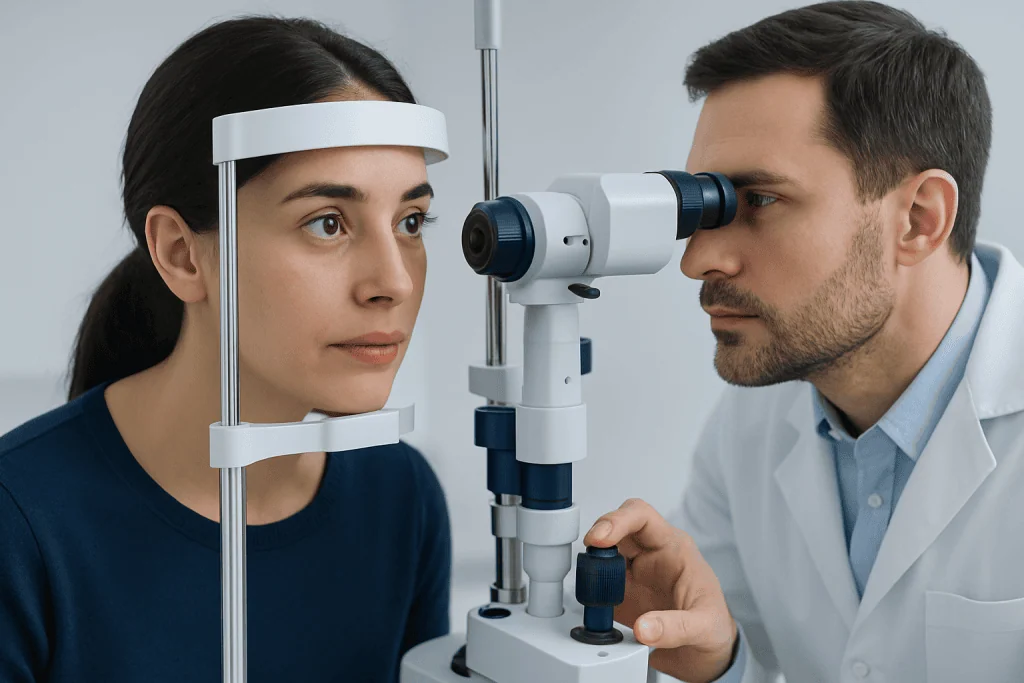
Diagnosis begins with a complete eye examination by an ophthalmologist. This usually includes a review of symptoms, visual acuity testing, measurement of eye pressure, and a slit-lamp examination to look at the front structures of the eye in detail. Dilated examination allows the specialist to inspect the retina and vitreous more fully.
If the cyst is located in the front of the eye, doctors may use slit-lamp photography, gonioscopy, or imaging such as ultrasound biomicroscopy or anterior segment optical coherence tomography. These tests help show the cyst’s size, wall, location, and relationship to nearby tissues. For lesions further back, ocular ultrasound and retinal imaging may be used.
The most important part of diagnosis is often distinguishing a benign cyst from another type of mass or from a non-cystic eye disorder. Depending on the findings, the doctor may consider inflammatory disease, traumatic changes, retinal tears, or less commonly tumors. In some cases, a patient may be referred for more specialized eye exam and diagnostics to characterize the lesion safely.
Follow-up examinations are frequently part of diagnosis because stability over time is informative. A cyst that remains unchanged and causes no problems may only need periodic monitoring. A lesion that enlarges, changes shape, raises eye pressure, or begins to affect vision may call for active treatment.
Treatment options and follow-up
Treatment for a cyst inside eyeball depends on the type of cyst, its size, its location, the person’s symptoms, and whether complications are present. Many small, uncomplicated cysts do not need immediate treatment. Instead, the ophthalmologist may recommend observation with regular follow-up visits to monitor growth, vision, and eye pressure.
When treatment is needed, options may include medication to manage inflammation or pressure-related effects, laser procedures in selected cases, or surgical removal or drainage if the cyst is large, recurrent, or threatening vision. The approach is individualized because the same intervention is not appropriate for every type of intraocular cyst. If pressure is affected, care may overlap with management used for glaucoma treatment.
Retinal cystic problems are managed differently from iris or ciliary body cysts. If there is associated retinal traction, tear, or detachment risk, a retina specialist may be involved and treatment may relate to retinal detachment surgery or other retinal procedures. This highlights why exact diagnosis comes before treatment planning.
At experienced centers, care may involve cornea, glaucoma, retina, and ocular imaging specialists working together. Acibadem International’s multidisciplinary eye specialists in JCI-accredited hospitals diagnose and treat complex eye conditions for international patients, particularly when imaging and subspecialty review are needed to confirm the safest plan.
Self-care, monitoring, and protecting eye health
There is no single home remedy that can treat a true cyst inside eyeball. Because the lesion is internal, over-the-counter eye drops or internet remedies cannot remove it. The safest self-care step is to follow the eye specialist’s monitoring schedule and report any change in symptoms promptly.
Patients are often advised to protect the eyes from injury by using appropriate eyewear during sports, home projects, or work with flying particles. This is especially important for people who have already had trauma-related eye problems. Good follow-up after any eye surgery or inflammatory eye disease also helps clinicians detect changes early.
It can also help to keep track of vision in each eye separately. If one eye becomes blurrier, develops new floaters, sees flashes of light, or notices a shadow or curtain in the field of view, the change should be reported rather than waiting for the next routine appointment. People with known eye pressure problems should be particularly careful with follow-up.
General health habits support eye health overall, even though they do not specifically dissolve an intraocular cyst. These include controlling chronic conditions, avoiding smoking, using prescribed eye medications correctly, and attending regular comprehensive eye examinations when advised.
- Do not rub or press on the eye.
- Do not stop prescribed eye medicines without medical advice.
- Use protective eyewear if there is any risk of eye injury.
- Seek urgent care for sudden vision loss, severe pain, or new flashes and floaters.
When to seek medical care
Medical care should be sought if a person notices symptoms that could suggest a problem inside the eye, especially blurred vision, a new dark spot, increased floaters, flashes of light, eye redness, or a feeling of pressure. Even if symptoms seem mild, they are worth discussing because internal eye lesions cannot be judged accurately without examination.
More urgent assessment is important if there is sudden loss of vision, severe pain, nausea with eye pain, a curtain-like shadow, or symptoms after an eye injury. These signs do not always mean a cyst is causing the problem, but they can be associated with time-sensitive eye emergencies that should not be delayed.
Anyone previously diagnosed with a cyst inside eyeball should return sooner than scheduled if symptoms change or if the eye becomes red, painful, or more sensitive to light. New symptoms may indicate growth, inflammation, pressure changes, or another eye condition that needs treatment.
Early evaluation often makes management simpler and more reassuring. In many cases, the outcome is careful monitoring rather than invasive treatment, but only a qualified ophthalmologist can make that decision safely.
Frequently asked questions
Is a cyst inside eyeball always dangerous?
No. Many intraocular cysts are benign and may simply be monitored over time. The important step is having an ophthalmologist confirm the type of cyst and check whether it is affecting vision or eye pressure.
Can a cyst inside eyeball go away on its own?
Some cysts remain stable for years, and some may change little over time without treatment. Others do not go away and may need observation or intervention if they enlarge or cause complications.
What does a cyst inside eyeball feel like?
Some people feel nothing at all. Others may notice blurred vision, floaters, glare, pressure, or occasional visual obstruction depending on the cyst’s size and location.
How is a cyst inside eyeball different from a cyst on the eyelid?
A cyst on the eyelid or eye surface affects external tissues and is often easier to see directly. A cyst inside eyeball is located within the eye itself and usually requires specialized examination and imaging to diagnose.
Can an eye cyst cause glaucoma?
Yes, some cysts can contribute to increased eye pressure if they interfere with the eye’s normal fluid drainage pathways. This is one reason regular follow-up and pressure checks are important.
Will surgery always be needed?
No. Surgery is not the standard for every case and is usually reserved for cysts that affect vision, grow, recur, or cause complications. Many patients are managed safely with monitoring alone.
References
- American Academy of Ophthalmology
- National Eye Institute
- Mayo Clinic
- Merck Manual Professional Edition
- Royal College of Ophthalmologists
This article is for general information only and is not a substitute for professional medical advice. Please consult a qualified doctor about your individual situation.
Explore treatments in Turkey — costs, top hospitals & a free quote
JCI-accredited · board-certified surgeons · reply within 24h
Add us as a Preferred Source to see more of our trusted health content across Google Search, AI Overviews and Discover.

More from the Health Library

Cbt-i — Explained by Medical Evidence, Not Myths

Sperm Cell — Explained by Medical Evidence, Not Myths

Occult Blood in Urine: What Patients Need to Know

Manganese: What Patients Need to Know

Shoulder: An Evidence-Based Guide for Patients