Elbow Joint Anatomy: Which Bones Form the Joint?

The elbow joint is formed by the humerus, radius, and ulna. The elbow is made up of three articulations within one joint capsule.
Key Takeaways
- The elbow joint is formed by the humerus, radius, and ulna.
- The elbow is made up of three articulations within one joint capsule.
- Ligaments provide stability, while muscles and tendons create movement.
- The elbow allows flexion, extension, pronation, and supination.
- Pain, swelling, stiffness, or weakness can point to injury or joint disease.
Elbow joint anatomy centers on three bones—the humerus, radius, and ulna—that form a stable but mobile joint. Together with cartilage, ligaments, muscles, nerves, and blood vessels, these structures allow the arm to bend, straighten, and rotate smoothly.
Overview of Elbow Joint Anatomy
Elbow joint anatomy can seem complex at first, but its basic structure is straightforward. The elbow is the meeting point between the upper arm and the forearm. It connects the humerus in the upper arm with the radius and ulna in the forearm. These three bones form a joint that is strong enough for lifting and pushing, yet flexible enough for many everyday movements.
The elbow is often described as a hinge joint, but it does more than simply bend and straighten. It also helps the forearm rotate so the palm can face up or down. This combined function is what makes activities such as eating, writing, turning a doorknob, and using tools possible.
Several important tissues support the bones of the elbow joint. Smooth cartilage covers the bone ends to reduce friction. Ligaments hold the bones together and help stabilize the joint. Muscles and tendons move the elbow, while nerves and blood vessels pass nearby to supply the arm and hand.
Which Bones Form the Elbow Joint?
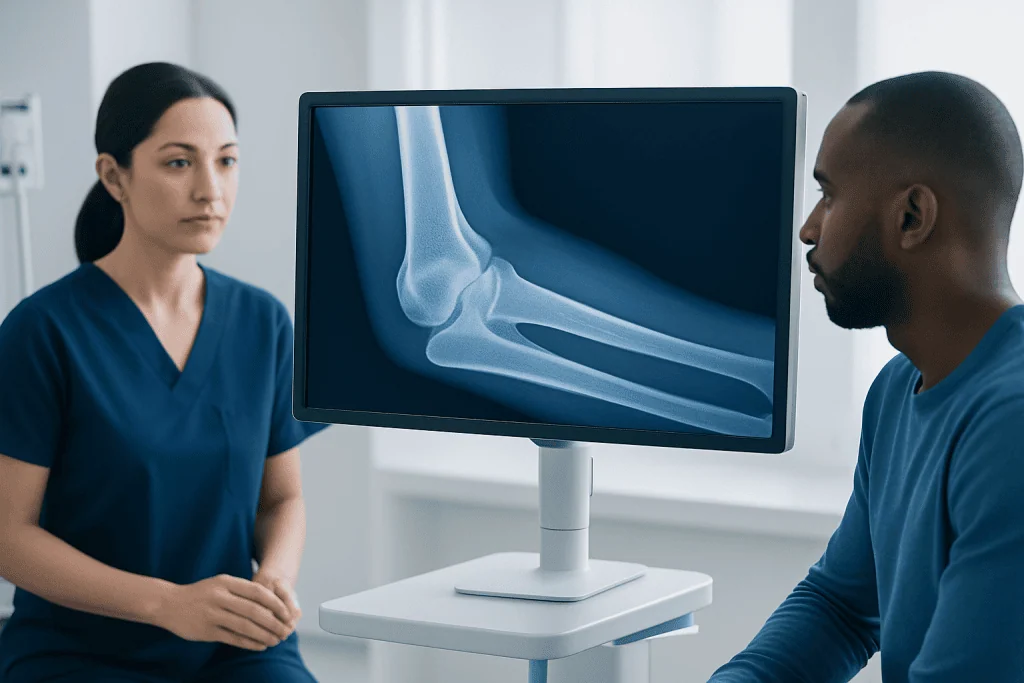
The elbow joint is formed by three bones: the humerus, the radius, and the ulna. The humerus is the long bone of the upper arm. At its lower end, it widens to create surfaces that meet the two forearm bones. The ulna lies on the side of the little finger, and the radius lies on the thumb side of the forearm.
The ulna forms the main hinge part of the elbow. Its curved upper end wraps around the lower humerus, creating a strong connection that allows bending and straightening. The pointed tip of the ulna, called the olecranon, is the bony prominence felt at the back of the elbow. The radius, by contrast, plays a major role in rotation of the forearm.
These bones meet in three separate articulations inside one joint capsule:
- Humeroulnar joint: mainly responsible for flexion and extension.
- Humeroradial joint: helps with bending and load transfer through the forearm.
- Proximal radioulnar joint: allows the radius to rotate around the ulna during pronation and supination.
Because the elbow includes these three articulations, it combines stability with precise motion. This is why understanding elbow joint anatomy is important in diagnosing pain, stiffness, fractures, and overuse problems.
Cartilage, Joint Capsule, and Supporting Structures
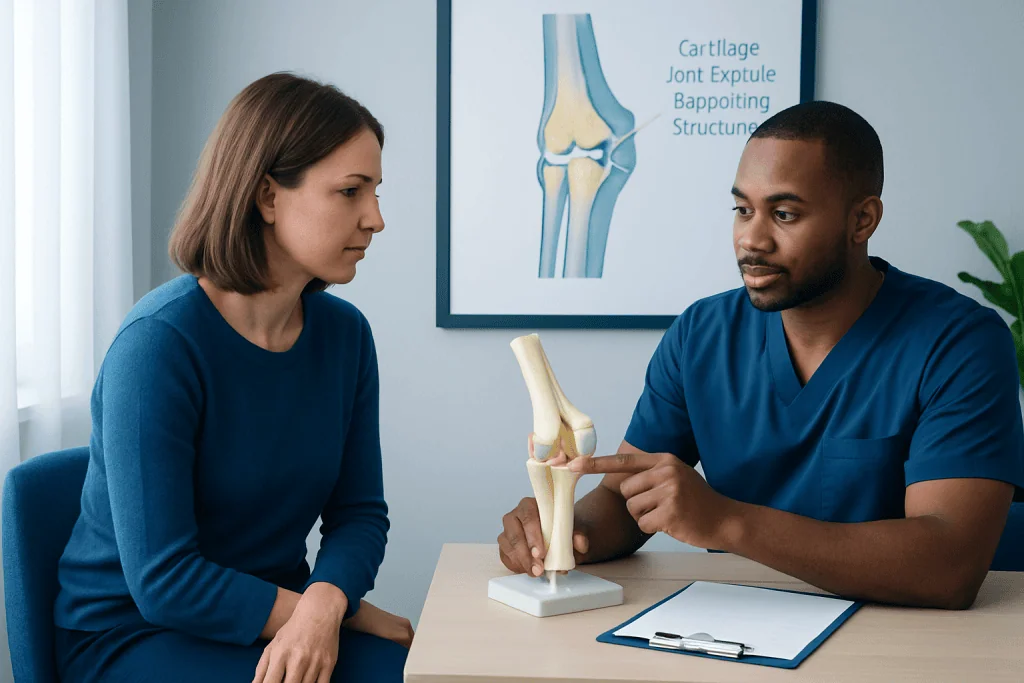
The ends of the humerus, radius, and ulna are covered with articular cartilage. This smooth, protective tissue helps the bones glide against one another with minimal friction. Healthy cartilage is essential for comfortable movement. When cartilage becomes damaged through injury, wear, or inflammatory disease, the elbow may become painful or stiff.
The elbow joint is enclosed in a fibrous capsule lined with synovial membrane. The synovial membrane produces fluid that lubricates the joint and nourishes the cartilage. This capsule helps contain and protect the structures within the elbow while still allowing normal movement.
Several bursae, or small fluid-filled sacs, also help reduce friction around the elbow. One of the best known is the olecranon bursa, located over the bony tip at the back of the elbow. When irritated, it can become swollen and tender. Understanding these soft tissue structures is helpful because not all elbow pain comes directly from the bones.
Ligaments, Muscles, and How the Elbow Moves
Ligaments are strong bands of connective tissue that link bone to bone. On the inner side of the elbow, the ulnar collateral ligament helps resist stress when the joint is forced inward. On the outer side, the radial collateral ligament complex helps support the joint against outward stress. A ring-shaped ligament called the annular ligament holds the head of the radius in place while allowing it to rotate.
Muscles around the elbow create movement through their tendons. The biceps at the front of the upper arm helps bend the elbow and turn the palm upward. The brachialis is another important flexor. At the back of the arm, the triceps straightens the elbow. Muscles in the forearm also attach near the elbow and help move the wrist and fingers.
The elbow performs four main movements:
- Flexion: bending the elbow.
- Extension: straightening the elbow.
- Pronation: turning the forearm so the palm faces down.
- Supination: turning the forearm so the palm faces up.
These movements depend on the coordinated work of bones, ligaments, muscles, and tendons. Problems affecting any of these structures may reduce motion or cause discomfort, such as in tennis elbow or other overuse conditions.
Nerves and Blood Supply Around the Elbow
Important nerves travel across the elbow on their way to the forearm and hand. The ulnar nerve passes behind the inner part of the elbow, where it can be felt in the area commonly called the “funny bone.” When this nerve is irritated or compressed, it may cause tingling, numbness, or weakness in the ring and little fingers.
The median nerve and radial nerve also cross near the elbow. These nerves help control muscle function and carry sensation from different parts of the hand and forearm. Because nerves are close to the joint, swelling, injury, or repetitive strain can sometimes affect them.
Blood reaches the elbow through branches of the brachial artery and a network of smaller vessels around the joint. This rich blood supply helps nourish tissues and supports healing after minor injuries. However, significant trauma can affect circulation and requires prompt medical assessment.
Common Problems That Affect the Elbow
Because the elbow is used frequently in daily life, it can be affected by many conditions. Sudden injuries include sprains, dislocations, and fractures of the humerus, radius, or ulna. Repetitive strain may lead to tendon problems such as tennis elbow on the outer side or golfer’s elbow on the inner side. Inflammation of the olecranon bursa can also cause visible swelling at the back of the elbow.
Joint disease may also affect the elbow. Osteoarthritis can develop over time, especially after previous injury, while inflammatory conditions such as rheumatoid arthritis may damage the joint lining and cartilage. In some cases, nerve compression around the elbow can lead to pain, numbness, or hand weakness.
Symptoms vary depending on the cause, but common signs include:
- Pain with movement or at rest
- Swelling or warmth around the joint
- Stiffness or reduced range of motion
- Locking, clicking, or a feeling of instability
- Numbness, tingling, or weakness in the hand or forearm
If symptoms continue, a doctor may evaluate for tendon injury, arthritis, fracture, or related conditions such as nerve compression disorders. Understanding normal elbow joint anatomy helps explain why these problems can affect both movement and comfort.
How Elbow Problems Are Diagnosed
Diagnosis usually begins with a medical history and physical examination. A doctor may ask when symptoms started, whether there was a fall or repeated strain, and which movements cause pain. The elbow may be checked for swelling, tenderness, stability, range of motion, strength, and signs of nerve involvement.
Imaging tests can help show which part of the elbow is affected. X-rays are commonly used to look for fractures, dislocations, arthritis, or changes in bone alignment. Ultrasound may help assess tendons, bursae, or fluid collections. MRI provides detailed images of soft tissues such as ligaments, cartilage, and tendons when needed.
In some cases, additional tests may be recommended. Nerve conduction studies can help when numbness or weakness suggests nerve compression. Blood tests may be used if inflammatory arthritis or infection is suspected. Accurate diagnosis is important because treatment depends on whether the problem involves bone, ligament, tendon, cartilage, or nerve.
Treatment, Self-care, and When to Seek Medical Advice
Treatment for elbow problems depends on the cause and severity. Minor strains and overuse injuries often improve with rest, activity adjustment, ice, and guided exercises. A brace or splint may sometimes be recommended for short-term support. Physical therapy can help restore movement, strengthen muscles, and reduce stress on the joint. In selected cases, doctors may consider medications or injections to ease pain and inflammation.
More serious injuries may need specialist care. Fractures, unstable ligament injuries, major tendon tears, and advanced joint damage can require procedures such as orthopedic rehabilitation or orthopedic surgery. If symptoms are linked to persistent tendon damage, treatment may also overlap with care used for sports injuries. The right plan is individualized after a careful assessment.
Simple self-care habits can support elbow health:
- Warm up before sports or repetitive activities.
- Use proper technique for lifting, throwing, or racquet sports.
- Take breaks during repetitive hand and arm tasks.
- Strengthen the shoulder, arm, and forearm muscles gradually.
- Avoid leaning on the elbow for long periods if it causes nerve irritation.
Medical advice is important if elbow pain follows a fall, if the joint looks deformed, or if there is severe swelling, loss of movement, fever, numbness, or persistent weakness. Ongoing pain lasting more than a few days, especially when it limits daily activities, also deserves evaluation. For international patients who need assessment or treatment, Acibadem International’s multidisciplinary specialists in JCI-accredited hospitals diagnose and treat a wide range of elbow conditions.
Frequently asked questions
What three bones make up the elbow joint?
The elbow joint is formed by the humerus, radius, and ulna. The humerus is the upper arm bone, while the radius and ulna are the two bones of the forearm.
Is the elbow only a hinge joint?
Not exactly. The elbow works mainly as a hinge for bending and straightening, but it also includes a pivot function that allows the forearm to rotate. This is what lets the palm turn upward and downward.
What is the bony point at the back of the elbow?
That point is called the olecranon, and it is part of the ulna. It forms the hard prominence at the back of the elbow and helps the joint act like a hinge.
Why does the elbow sometimes feel stiff or painful?
Elbow stiffness or pain can come from many causes, including overuse, tendon irritation, bursitis, arthritis, ligament injury, or fracture. Nerve irritation around the elbow can also cause discomfort, tingling, or weakness.
What ligaments support the elbow?
The main stabilizing ligaments include the ulnar collateral ligament on the inner side and the radial collateral ligament complex on the outer side. The annular ligament also helps by holding the head of the radius in place during forearm rotation.
When should someone see a doctor for elbow pain?
A doctor should be consulted if elbow pain is severe, follows an injury, or comes with swelling, deformity, numbness, or weakness. Medical advice is also important if symptoms do not improve with rest or begin to affect daily activities.
References
- American Academy of Orthopaedic Surgeons
- National Institute of Arthritis and Musculoskeletal and Skin Diseases
- MedlinePlus
- Cleveland Clinic
- Mayo Clinic
This article is for general information only and is not a substitute for professional medical advice. Please consult a qualified doctor about your individual situation.
Joint and spine care in Turkey — expert assessment & treatment
JCI-accredited · board-certified surgeons · reply within 24h
Add us as a Preferred Source to see more of our trusted health content across Google Search, AI Overviews and Discover.