Endovascular Neurosurgery vs Open Brain Surgery: How Doctors Choose

Endovascular neurosurgery uses catheters placed through blood vessels, while open brain surgery involves an incision and direct access to the brain. Neither approach is automatically better; the right choice depends on the disease, location, size, shape, and urgency.
Key Takeaways
- Endovascular neurosurgery uses catheters placed through blood vessels, while open brain surgery involves an incision and direct access to the brain.
- Neither approach is automatically better; the right choice depends on the disease, location, size, shape, and urgency.
- Some patients may benefit from a combined plan that uses both endovascular and open surgical techniques.
- Imaging tests such as CT, MRI, and angiography help doctors decide which treatment is most suitable.
- Recovery time, possible risks, and long-term durability are all part of treatment planning.
- A multidisciplinary team often makes the decision, especially for complex aneurysms, strokes, AVMs, or tumors.
Endovascular neurosurgery and open brain surgery are two different ways to treat problems in the brain and its blood vessels. Doctors choose between them by looking at the exact condition, how urgent it is, the anatomy involved, and which approach offers the best balance of safety and effectiveness.
Overview: Two Different Paths to Treating Brain Conditions
When doctors compare endovascular neurosurgery vs open brain surgery, they are choosing between two very different ways to reach and treat a problem inside the brain or its blood vessels. Endovascular neurosurgery is minimally invasive. It usually involves guiding thin tubes called catheters through an artery, often from the wrist or groin, to treat a condition from inside the blood vessel. Open brain surgery, also called craniotomy in many cases, gives surgeons direct access to the brain through an opening in the skull.
Both approaches are important in modern neurological care. Endovascular techniques are commonly used for conditions such as certain aneurysms, strokes caused by blocked arteries, and some arteriovenous malformations. Open surgery may be preferred when a lesion needs direct removal, when anatomy is not suitable for catheter-based treatment, or when lasting surgical repair is more appropriate.
The main goal is not to choose the newest or least invasive option at all costs. Instead, doctors focus on which treatment can most safely and effectively solve the specific problem. In many cases, the decision is made by a team that may include neurosurgeons, interventional neuroradiologists, neurologists, anesthesiologists, and intensive care specialists.
How Endovascular Neurosurgery Works
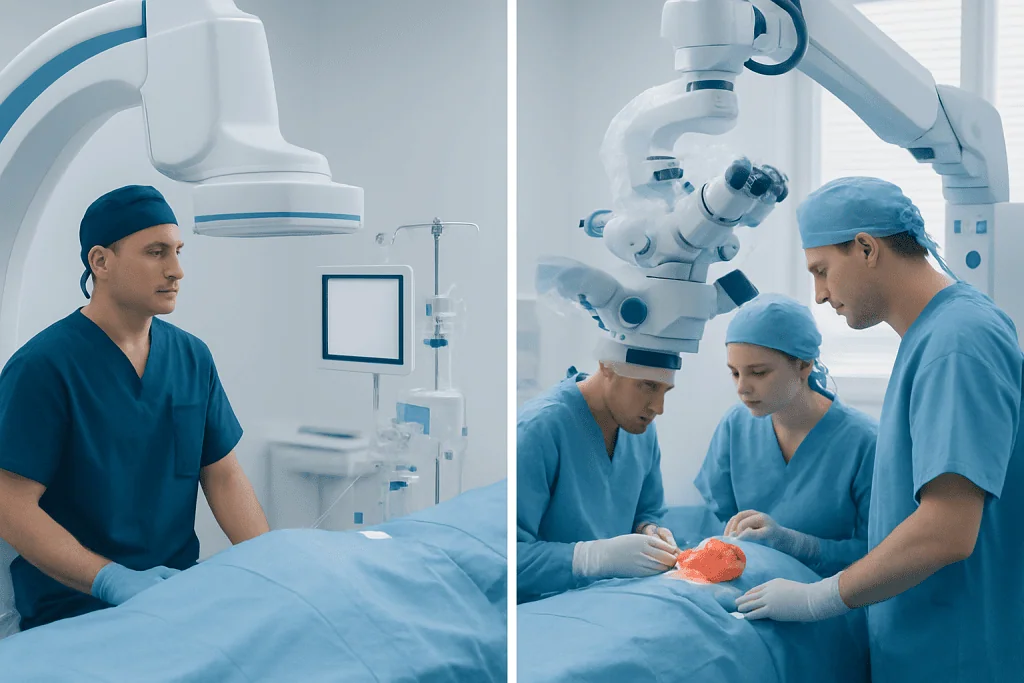
Endovascular neurosurgery treats certain brain and spine vascular conditions from inside the blood vessels. The doctor inserts a catheter into an artery and carefully guides it to the target area using real-time imaging. Tiny devices can then be delivered through the catheter to remove a clot, close off an aneurysm, block abnormal blood vessels, or place a stent to support blood flow.
This approach avoids a large scalp incision and avoids opening the skull in many situations. Because of that, it may lead to shorter hospital stays and faster early recovery for selected patients. It is often used in emergency stroke care, where rapid clot removal can help restore blood flow to the brain, and in some forms of brain aneurysm treatment.
Examples of endovascular treatment include coiling for aneurysms, flow-diverting stents for some complex aneurysms, embolization for certain vascular malformations, and mechanical thrombectomy for large-vessel ischemic stroke. However, minimally invasive does not mean minor. These procedures still require advanced expertise, specialized imaging, careful follow-up, and attention to risks such as bleeding, vessel injury, stroke, or recurrence.
How Open Brain Surgery Works

Open brain surgery allows surgeons to see and directly handle the area being treated. In a craniotomy, part of the skull is temporarily opened so the surgeon can reach the brain, blood vessel, or lesion. This may be necessary when a problem cannot be safely reached from inside a vessel, when tissue needs to be removed, or when direct repair provides the best long-term result.
Open surgery is often used for certain brain tumors, some aneurysms that are better treated with surgical clipping, bleeding that needs evacuation, and vascular malformations with anatomy that does not favor endovascular treatment. It can also be important when pressure inside the skull must be relieved quickly or when a diagnosis depends on tissue sampling.
Because it is more invasive, open brain surgery generally involves a longer initial recovery than endovascular treatment. There may be more postoperative discomfort, closer wound care needs, and a longer stay in hospital or rehabilitation in some cases. Even so, open surgery can be the most effective and durable choice for the right patient, and in some situations it provides the clearest path to cure or long-term control.
How Doctors Choose Between the Two
The choice between endovascular neurosurgery vs open brain surgery starts with the diagnosis. Doctors look closely at what the condition is, where it is located, how large it is, whether it is bleeding, and how urgently treatment is needed. A tiny aneurysm in one location may be a good fit for endovascular coiling, while another aneurysm with a wide neck or unusual branch pattern may be better managed with clipping through open surgery.
The patient also matters just as much as the disease. Age, general health, use of blood thinners, prior surgeries, kidney function, and the ability to tolerate anesthesia can all affect the decision. In emergencies such as severe bleeding or major stroke, the best option may be the one that can be performed most quickly and safely with the greatest chance of preserving brain function.
Imaging is central to planning. Doctors may use CT, MRI, CT angiography, MR angiography, and catheter angiography to study anatomy in detail. These tests help the team understand vessel shape, blood flow, surrounding brain tissue, and whether a catheter-based route is feasible. The expected durability of treatment is also considered, since some conditions need long-term vessel closure or complete lesion removal.
In many hospitals, difficult cases are reviewed in a multidisciplinary conference. This team approach helps balance the benefits and risks of each method. Sometimes the recommendation is clearly one approach. In other situations, either strategy could work, and the final decision is made after discussing goals, risks, recovery, and patient preferences.
Conditions Commonly Treated and Why the Choice Differs
One of the clearest examples is aneurysm care. Some aneurysms are treated from inside the vessel using coils or flow-diverting stents, while others are treated with open clipping. The choice depends on the aneurysm’s size, shape, neck width, location, whether it has ruptured, and how nearby arteries branch from it. For selected patients, brain aneurysm treatment may involve either technique, and the best approach is highly individualized.
Stroke is another important area. In ischemic stroke caused by a blocked large artery, endovascular thrombectomy can be lifesaving and time-sensitive. Open surgery is not the standard first treatment for most of these cases, but surgery may still play a role in complications such as swelling, bleeding, or pressure that requires decompression. By contrast, hemorrhagic stroke may sometimes require open surgery if there is a large blood clot or a ruptured vascular lesion.
Arteriovenous malformations, fistulas, and some skull base lesions can also require nuanced planning. Endovascular embolization may be used as the main treatment, as preparation before surgery, or as one part of staged therapy. Tumors are another example where open surgery is often needed to remove tissue, but endovascular techniques may support care by reducing blood supply before an operation in selected cases.
For this reason, endovascular and open procedures should not be seen as competitors in every situation. They are complementary tools. The most appropriate plan may use one method alone or a thoughtful combination of both.
Benefits, Risks, and Recovery
Endovascular treatment often offers smaller incisions, less direct tissue disruption, and faster early recovery. Many patients appreciate that it may reduce pain and shorten the hospital stay. It can be especially valuable in delicate vascular conditions where reaching the problem through the bloodstream is safer than approaching it through the skull.
However, endovascular treatment has limitations. Not every lesion can be reached safely, and some procedures may require follow-up imaging or additional treatment over time. There can also be procedure-related risks such as clot formation, bleeding, vessel perforation, contrast reactions, or problems related to antiplatelet medicines when stents are used.
Open brain surgery offers direct visualization and immediate access to the target area. This can be a major advantage when a surgeon needs to remove tissue, clip an aneurysm with durable closure, control bleeding directly, or relieve pressure on the brain. For some disorders, open surgery provides the most complete treatment in a single procedure.
The trade-off is that open surgery is more invasive and may involve longer recovery, more postoperative monitoring, and a higher burden of wound care and rehabilitation. Neurological recovery depends not only on the procedure itself, but also on the original condition, the part of the brain involved, and how quickly treatment occurred. Doctors usually explain both the short-term and long-term expectations before recommending a plan.
Questions Patients Can Ask Before Treatment
Patients and families often feel more comfortable when they understand why one treatment is being recommended over another. Helpful questions include whether the condition can be treated by either method, what the main goal of treatment is, and what doctors expect to happen if treatment is delayed. It is also reasonable to ask how urgent the decision is and whether a multidisciplinary team has reviewed the case.
Other useful questions focus on recovery and follow-up. Patients may ask how long the hospital stay is likely to be, whether rehabilitation might be needed, what kind of imaging follow-up is expected, and whether there is a possibility of needing another procedure later. When stents or vessel implants are used, it is important to ask about medication needs and monitoring.
For international patients or those seeking complex neurovascular care, center experience and coordinated specialties may also matter. Near the end of the care journey, patients may want to know who will manage long-term follow-up, warning signs to watch for at home, and when normal activities can safely resume. At centers such as Acibadem International, multidisciplinary specialists in JCI-accredited hospitals evaluate and treat complex brain and vascular conditions for international patients.
Some patients may also benefit from asking whether related procedures such as embolization or Gamma Knife radiosurgery are part of the treatment pathway for their specific diagnosis. Not every option fits every case, but understanding the full range of therapies can make decision-making clearer and more reassuring.
When to Seek Urgent Medical Care
Some neurological symptoms need emergency evaluation because fast treatment can protect brain function. Sudden weakness on one side, trouble speaking, facial drooping, sudden vision loss, severe confusion, loss of balance, or a sudden severe headache should never be ignored. These can be signs of stroke, bleeding, or another serious brain event.
Urgent medical attention is also important after a recent brain procedure if there is worsening headache, new weakness, seizures, loss of consciousness, fever, confusion, or bleeding from the procedure site. Even if symptoms seem brief or improve quickly, medical assessment is still important because some events can come and go before worsening.
In non-emergency situations, people should speak with a doctor if they have been told they have an aneurysm, vascular malformation, or other brain lesion and are unsure about treatment options. A specialist consultation can help explain whether monitoring, endovascular therapy, open surgery, or a combined approach is most suitable.
The Bottom Line
There is no one-size-fits-all answer to endovascular neurosurgery vs open brain surgery. The right choice depends on the condition itself, the anatomy involved, the urgency of care, and the patient’s overall health and goals. A treatment that is ideal for one person may not be the safest or most effective option for another.
Modern brain care is strongest when decisions are individualized and team-based. Advanced imaging, experienced specialists, and thoughtful discussion of risks and benefits all help guide treatment. For patients, understanding that both approaches have important roles can make the decision process feel more manageable and less overwhelming.
Anyone facing this choice should discuss the options with a qualified neurology, neurosurgery, or interventional neuroradiology team. Clear communication, timely evaluation, and careful follow-up are key to the best possible outcome.
Frequently asked questions
Is endovascular neurosurgery safer than open brain surgery?
Not always. Endovascular treatment is less invasive, but safety depends on the exact condition, the patient's health, and whether the anatomy is suitable for a catheter-based approach. In some cases, open surgery may offer a safer or more durable solution.
Why would a doctor recommend open brain surgery if a minimally invasive option exists?
A minimally invasive option is not always the most effective one. Doctors may recommend open surgery when they need direct access to remove tissue, control bleeding, relieve pressure, or repair a lesion that cannot be securely treated from inside the blood vessel.
Can the two approaches be used together?
Yes. Some patients benefit from combined care, such as endovascular embolization before open surgery or staged treatment over time. This depends on the diagnosis and the goals of treatment.
Which approach has a faster recovery?
Endovascular procedures often have a faster early recovery because they usually avoid opening the skull. However, long-term recovery depends on the underlying brain condition, whether there was bleeding or stroke, and whether rehabilitation is needed.
How do doctors decide the best treatment for a brain aneurysm?
They look at the aneurysm's size, shape, location, rupture status, and how nearby blood vessels branch. They also consider the patient's age, general health, and whether endovascular devices or surgical clipping are more likely to give a safe and lasting result.
Do all strokes need endovascular treatment?
No. Endovascular thrombectomy is mainly used for certain ischemic strokes caused by blockage of a large artery. Many strokes are treated with other emergency therapies, and some bleeding-related strokes may require surgery instead.
References
- World Health Organization
- American Stroke Association
- National Institute of Neurological Disorders and Stroke
- American Association of Neurological Surgeons
- Society of NeuroInterventional Surgery
This article is for general information only and is not a substitute for professional medical advice. Please consult a qualified doctor about your individual situation.
Neurosurgery in Turkey — costs, top hospitals & a free quote
JCI-accredited · board-certified surgeons · reply within 24h
Add us as a Preferred Source to see more of our trusted health content across Google Search, AI Overviews and Discover.