Erythema Toxicum: A Complete Medical Overview

Erythema toxicum is a benign rash seen in many healthy newborns. It usually appears within the first few days after birth and resolves on its own.
Key Takeaways
- Erythema toxicum is a benign rash seen in many healthy newborns.
- It usually appears within the first few days after birth and resolves on its own.
- The rash does not usually need tests or treatment when the baby is otherwise well.
- Parents should seek medical advice if a newborn has fever, poor feeding, lethargy, or an unusual-looking rash.
- A doctor can distinguish erythema toxicum from other newborn skin conditions that may need care.
Erythema toxicum is a very common and harmless newborn rash that appears in the first days of life and usually fades without treatment. Although its name can sound worrying, it is not toxic, not contagious, and typically does not cause a baby discomfort.
Overview
Erythema toxicum is a common newborn skin rash that often appears as small red patches with tiny pale or yellowish bumps in the center. It usually develops in full-term babies during the first two to three days after birth, though it can arise a little earlier or later. In most cases, it clears naturally within several days to a couple of weeks.
Despite its name, erythema toxicum is not dangerous. It is not caused by toxins, infection, allergy, or poor hygiene. Babies with this rash generally look well, feed normally, and behave as expected for their age. The main reason it matters is that it can be mistaken for other rashes, some of which do need medical attention.
This condition is sometimes called erythema toxicum neonatorum. It is considered a normal variation in newborn skin adaptation after birth rather than a disease. For families, reassurance and clear guidance are usually the most important parts of care.
What the Rash Looks Like
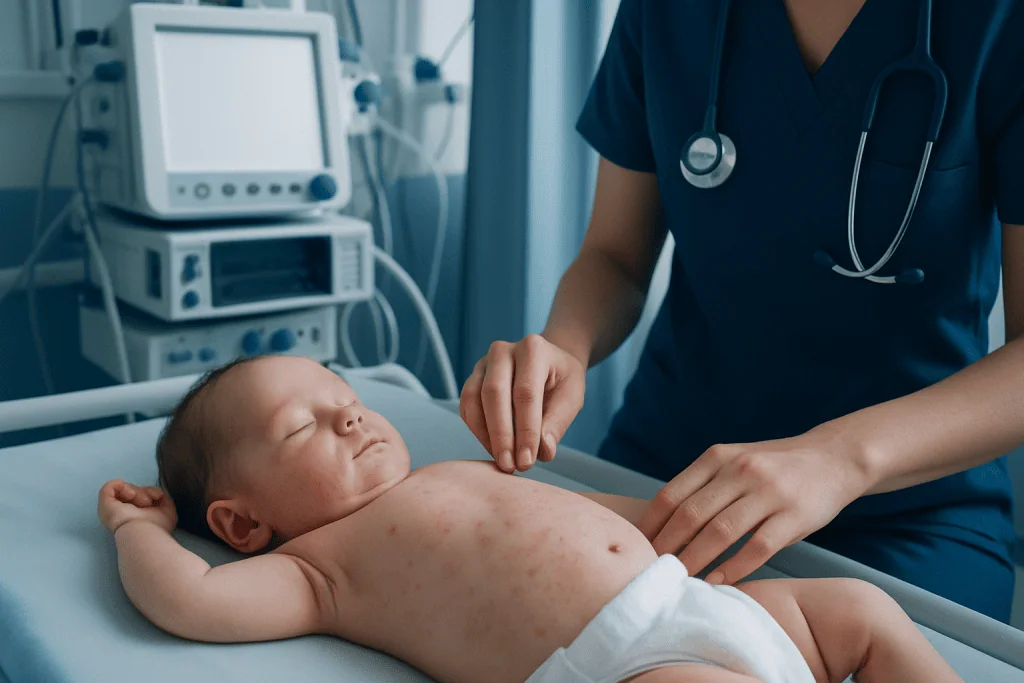
The rash typically consists of blotchy red areas with small raised bumps or pustule-like spots in the middle. These spots may come and go, changing location over hours. They often appear on the face, chest, back, arms, and legs, but they usually spare the palms of the hands and soles of the feet.
Erythema toxicum can look dramatic even though it is harmless. One area may fade while another appears, which can make the rash seem unpredictable. The skin between spots usually looks normal, and the baby does not generally seem bothered by touching the rash.
Parents often worry that the bumps contain pus or signal infection. In erythema toxicum, the center of the spot can look pale or yellow, but this alone does not mean a bacterial infection is present. A clinician can usually recognize the pattern by examination.
- Common onset: first 1 to 3 days of life
- Common sites: trunk, face, upper arms, thighs
- Usually absent on palms and soles
- Typical course: fades without scarring
Why It Happens and Who Gets It

The exact cause of erythema toxicum is not fully understood. Experts believe it reflects a normal inflammatory response as a newborn’s skin adapts to life outside the womb. It is not related to anything a parent did or did not do during pregnancy or after delivery.
The rash is more often seen in healthy full-term babies than in premature infants. It may be absent at birth and then appear after the first day, which can make families think something new has gone wrong. In reality, its timing is part of the usual pattern.
Erythema toxicum is not contagious, so it cannot spread from one baby to another. It is also not an allergic reaction to breast milk, formula, laundry detergent, or skincare products in most cases. Other newborn rashes, such as newborn acne or heat-related skin irritation, may look somewhat similar but have different causes and timing.
How Doctors Diagnose It
Diagnosis is usually clinical, meaning a doctor identifies erythema toxicum by looking at the rash and assessing the baby’s overall health. A well-appearing newborn with the typical pattern and no fever, feeding problems, or signs of illness generally does not need testing.
The most important part of diagnosis is distinguishing this harmless rash from conditions that can resemble it. These include neonatal acne, transient neonatal pustular melanosis, miliaria, contact irritation, and rare infections. If the rash appears unusual or the baby seems unwell, a doctor may consider further evaluation.
In uncertain situations, a pediatrician or dermatologist may examine the skin more closely. Rarely, simple tests may be used to rule out infection or other causes, but this is not routine for classic erythema toxicum. Families seeking expert evaluation of newborn skin changes may also benefit from dermatology assessment when recommended by a physician.
Treatment and Daily Care
Erythema toxicum does not usually require treatment. The rash resolves on its own, and creams, antibiotics, or home remedies are generally unnecessary. Trying multiple products can sometimes irritate sensitive newborn skin and make assessment more difficult.
Gentle skin care is usually all that is needed. Parents can bathe the baby with lukewarm water and use mild, fragrance-free products if necessary. Loose, soft clothing can help reduce friction, but no special washing routine is required beyond normal newborn care.
It is best not to squeeze, scrub, or pick at the bumps. Doing so can irritate the skin or introduce infection. If a doctor is uncertain whether the rash is truly erythema toxicum, they may recommend review by pediatric specialists to confirm the diagnosis and rule out other causes.
Parents often ask whether lotions or medicated creams will make the rash fade faster. In most cases, they do not. Since the condition is self-limited, reassurance, observation, and routine newborn care remain the standard approach.
How It Differs From Other Newborn Rashes
Newborns commonly develop several harmless skin findings, and these can overlap in appearance. Erythema toxicum often differs by its timing, red blotchy base, and small pale or yellow-centered bumps that shift from place to place. It usually starts after birth rather than being fully present at delivery.
For example, transient neonatal pustular melanosis may be present at birth and can leave small dark spots after the pustules fade. Miliaria, also called heat rash, tends to be linked to overheating or blocked sweat ducts. eczema is usually not a typical newborn-day-one rash and tends to cause dry, itchy, inflamed skin later in infancy.
Infectious rashes are a different concern because the baby may also have fever, poor feeding, unusual sleepiness, breathing difficulty, or widespread blisters. If these features are present, a clinician should assess the baby promptly. Correct diagnosis matters because treatment ranges from simple reassurance to urgent medical care depending on the cause.
When to Seek Medical Care
Although erythema toxicum itself is harmless, any rash in a very young baby should be considered in the context of the baby’s overall condition. Medical advice is important if the newborn has a fever, seems difficult to wake, feeds poorly, vomits repeatedly, has breathing problems, or appears unusually irritable or floppy.
Parents should also seek care if the rash involves the palms or soles, forms large blisters, oozes significantly, becomes crusted, or is accompanied by mouth sores. A rash that is present with bruising, purple spots, or signs of dehydration also needs prompt assessment. These features are not typical of erythema toxicum.
If there is uncertainty, it is reasonable to contact a pediatrician rather than wait. At Acibadem International, multidisciplinary specialists in pediatrics and skin health at JCI-accredited hospitals diagnose and treat newborn skin conditions for international patients when further evaluation is needed.
Frequently asked questions
Is erythema toxicum dangerous for a newborn?
No. Erythema toxicum is considered a harmless and common newborn rash. Babies with this condition are usually otherwise healthy and the rash fades on its own.
How long does erythema toxicum last?
It often appears in the first few days after birth and usually clears within several days to two weeks. In some babies, spots may come and go briefly before disappearing completely.
Does erythema toxicum need treatment?
Most babies do not need any treatment. Gentle skin care and observation are usually enough, while medicated creams or antibiotics are not typically necessary unless a doctor identifies a different condition.
Can erythema toxicum spread to other babies or family members?
No. Erythema toxicum is not contagious and does not spread by touch, breastfeeding, or close contact. It is a normal newborn skin reaction rather than an infection.
What is the difference between erythema toxicum and baby acne?
Erythema toxicum usually appears in the first days of life and often shows red blotches with tiny pale or yellow-centered bumps. Baby acne tends to develop a little later and commonly affects the face with pimples but without the same shifting blotchy pattern.
When should parents worry about a newborn rash?
Parents should seek medical care if the baby has fever, poor feeding, lethargy, breathing difficulty, blisters, purple spots, or rash on the palms and soles. These signs are not typical of erythema toxicum and may need prompt assessment.
References
- American Academy of Pediatrics
- American Academy of Dermatology
- MedlinePlus
- Merck Manual Consumer Version
- National Health Service
This article is for general information only and is not a substitute for professional medical advice. Please consult a qualified doctor about your individual situation.
Explore treatments in Turkey — costs, top hospitals & a free quote
JCI-accredited · board-certified surgeons · reply within 24h
Add us as a Preferred Source to see more of our trusted health content across Google Search, AI Overviews and Discover.