Essential Tremor vs Parkinson’s Disease: Symptoms, Diagnosis, and Treatment Options

Essential tremor most often causes an action tremor, meaning shaking appears during movement or when holding a posture. Parkinson’s disease tremor often starts on one side and may be most noticeable when the hand is at rest, along with slowness, stiffness, or walking changes.
Key Takeaways
- Essential tremor most often causes an action tremor, meaning shaking appears during movement or when holding a posture.
- Parkinson’s disease tremor often starts on one side and may be most noticeable when the hand is at rest, along with slowness, stiffness, or walking changes.
- Diagnosis is mainly clinical, based on medical history and a neurological examination; imaging or laboratory tests may help in selected cases.
- Treatment for essential tremor may include lifestyle strategies, medications, botulinum toxin injections, or advanced procedures for severe symptoms.
- Treatment for Parkinson’s disease focuses on movement symptoms, non-motor symptoms, exercise, rehabilitation, medications, and sometimes device-based therapy.
- Anyone with a new, worsening, or function-limiting tremor should see a qualified doctor, preferably a neurologist.
Essential tremor and Parkinson’s disease can both cause shaking, but they are different neurological conditions with different symptom patterns, diagnostic clues, and treatment approaches. A careful neurological examination is usually the most important step in telling them apart and choosing the right care plan.
Overview
Tremor is an involuntary rhythmic movement of a body part, most commonly the hands. Because both essential tremor and Parkinson’s disease can cause shaking, people often worry that any hand tremor must be Parkinson’s disease. In reality, essential tremor is a separate and common movement disorder, while Parkinson’s disease is a progressive neurological condition that affects movement and several non-motor functions.
The key difference in Essential Tremor vs Parkinson’s Disease is not only whether a tremor is present, but when it appears and what other symptoms accompany it. Essential tremor usually becomes noticeable when a person uses the hands, such as when writing, drinking from a cup, using utensils, or holding the arms outstretched. Parkinson’s disease tremor is often more visible when the hand is relaxed at rest, although tremor patterns can overlap.
Both conditions can affect daily life, confidence, work, hobbies, and social activities. The reassuring point is that neurologists have well-established ways to evaluate tremor and offer treatment options. A clear diagnosis helps avoid unnecessary anxiety and allows care to be tailored to the person’s symptoms, goals, and overall health.
Symptoms: How the Tremors Differ
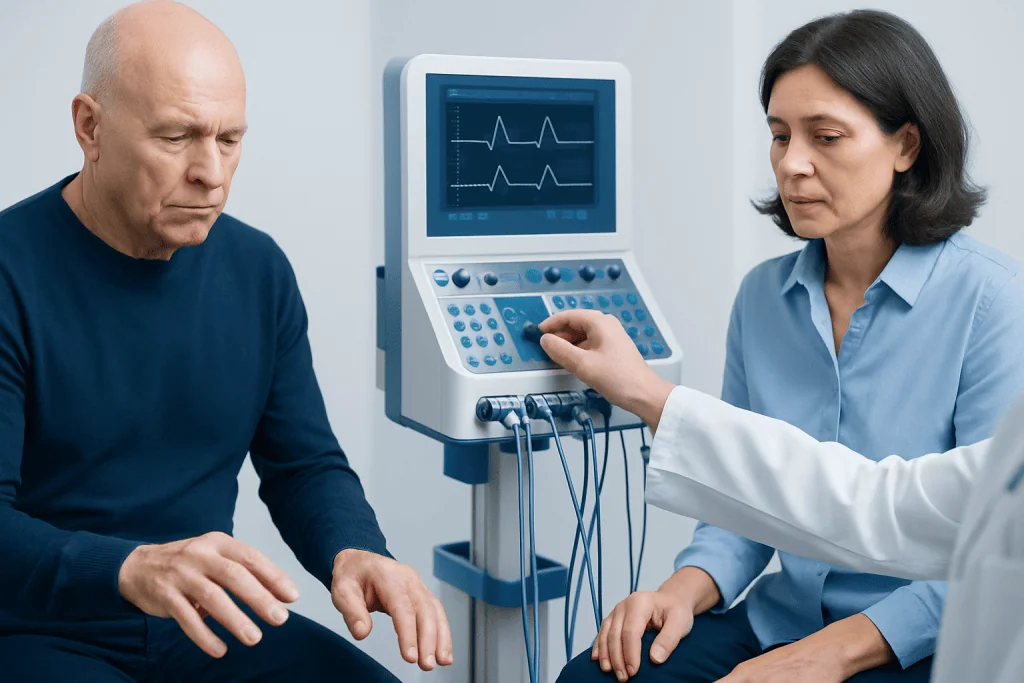
Essential tremor typically causes an action or postural tremor. This means the shaking appears or worsens when the person is doing something with the affected body part or trying to maintain a position against gravity. It most often affects both hands, although one side may be more noticeable. It can also involve the head, voice, jaw, or, less commonly, the legs.
In Parkinson’s disease, tremor often begins on one side of the body, commonly in one hand. It may be most noticeable when the hand is resting in the lap or hanging at the side, and it may decrease during purposeful movement. Parkinson’s disease is also associated with bradykinesia, which means slowness of movement, as well as muscle stiffness, reduced arm swing, small handwriting, changes in posture, and changes in walking.
There can be overlap, which is why self-diagnosis is difficult. Some people with Parkinson’s disease have action tremor, and some people with long-standing essential tremor may develop tremor at rest. Doctors look at the full pattern, including the tremor rhythm, affected body parts, symmetry, handwriting changes, balance, muscle tone, facial expression, and response to movement.
- More typical of essential tremor: shaking during writing, eating, pouring, or holding objects; head or voice tremor; often both hands affected.
- More typical of Parkinson’s disease: tremor at rest, symptoms starting on one side, slowness, stiffness, reduced facial expression, shuffling steps, or smaller handwriting.
Causes and Risk Factors
Essential tremor is considered a neurological movement disorder, but its exact cause is not fully understood. It appears to involve abnormal communication in brain circuits that coordinate movement, including areas such as the cerebellum and related pathways. Family history is common, and some people have several relatives with similar tremor, suggesting a genetic tendency in many cases.
Parkinson’s disease is linked to the gradual loss or dysfunction of dopamine-producing nerve cells in a region of the brain involved in movement control. Dopamine is a chemical messenger that helps regulate smooth, coordinated movement. Parkinson’s disease is not caused by normal aging alone, but age is an important risk factor, and genetic and environmental influences may contribute in some people.
Risk factors differ between the two conditions. Essential tremor can occur at many ages, though it often becomes more noticeable with age and may run in families. Parkinson’s disease is more likely to appear later in adulthood, although younger-onset cases do occur. A history of tremor, medication use, thyroid disease, anxiety, caffeine intake, and other medical issues can also influence shaking, so a broad medical review is important.
Diagnosis: What to Expect at the Neurology Visit
Diagnosis usually starts with a detailed medical history. The doctor may ask when the tremor began, whether it affects one side or both, whether it occurs at rest or during action, what makes it better or worse, and whether there are symptoms such as stiffness, slowness, balance problems, constipation, sleep changes, mood changes, or reduced sense of smell. A list of current medications and supplements is important because some substances can cause or worsen tremor.
The neurological examination is central to distinguishing essential tremor from Parkinson’s disease. The clinician may observe the hands at rest, with arms outstretched, and during movement tasks such as finger-to-nose testing, writing, drawing spirals, or pouring water. They may also assess muscle tone, speed of finger tapping, walking pattern, posture, reflexes, coordination, and eye movements.
Tests are not always required, but they may be used when the diagnosis is uncertain or another cause is suspected. Blood tests can help check for metabolic or endocrine problems such as thyroid disease. Brain imaging may be recommended if symptoms are unusual or there are signs suggesting another neurological condition. In selected cases, dopamine transporter imaging may help support a diagnosis of Parkinsonian disorders, but it does not replace a careful clinical assessment.
Treatment Options for Essential Tremor
Treatment for essential tremor depends on how much the tremor interferes with daily life. If symptoms are mild, education, reassurance, and practical adjustments may be enough. Some people benefit from using heavier utensils, cups with lids, wrist weights, voice amplification tools, or adaptive pens. Reducing tremor triggers such as sleep deprivation, stress, and excess caffeine may also help.
When tremor affects eating, writing, work, or social confidence, medications may be considered. Commonly used options include certain beta blockers and anti-seizure medicines, chosen according to the person’s medical history, other conditions, and potential side effects. These medicines may reduce tremor severity, but they do not cure essential tremor, and the response varies from person to person.
For tremor affecting specific muscles, such as head or voice tremor, botulinum toxin injections may be helpful in selected cases, although temporary weakness can occur. For severe tremor that does not respond adequately to medication, advanced therapies such as deep brain stimulation or focused ultrasound may be discussed with a movement disorders specialist. These options require careful evaluation, shared decision-making, and realistic expectations about benefits and risks.
Treatment Options for Parkinson’s Disease
Treatment for Parkinson’s disease is individualized because symptoms, age, activity level, work needs, and overall health vary widely. Medicines that improve dopamine signaling are commonly used to reduce movement symptoms such as slowness, stiffness, and tremor. Levodopa-based therapy is one of the most established treatments, while other medication classes may be used alone or in combination depending on the stage of disease and the person’s needs.
Care for Parkinson’s disease also includes non-medication strategies. Regular exercise, balance training, stretching, speech therapy, occupational therapy, and physical therapy can support mobility, posture, voice strength, swallowing safety, and independence. Non-motor symptoms such as constipation, sleep disturbance, mood changes, urinary symptoms, pain, and cognitive changes should be discussed openly because they can often be managed.
For some people whose symptoms are not well controlled with medication or who develop medication fluctuations, device-based treatments may be considered. Deep brain stimulation can help selected patients with motor symptoms, including tremor, when careful evaluation shows that the expected benefits outweigh the risks. Treatment planning is best done by a neurologist or movement disorders team familiar with the full range of Parkinson’s disease care.
Prevention, Self-Care, and When to See a Doctor
There is no proven way to prevent essential tremor or Parkinson’s disease in all cases. However, general brain and body health habits can support overall well-being. These include regular physical activity, adequate sleep, balanced nutrition, hydration, limiting excessive caffeine, avoiding smoking, moderating alcohol intake, and managing stress. People should not use alcohol as a tremor treatment, even if they notice temporary improvement, because it can create other health risks.
Practical self-care can make tremor easier to manage. Using two hands to hold cups, choosing clothing with easy fasteners, resting the elbows while writing, using speech-to-text tools, and planning difficult tasks for times when symptoms are milder may help. Emotional support is also important, as visible tremor can feel embarrassing even when it is medically benign. Counseling, patient education, and support groups may help people adjust and maintain confidence.
A doctor should be consulted for any new tremor, a tremor that worsens, tremor with weakness or numbness, tremor that starts suddenly, or shaking accompanied by slowness, stiffness, falls, balance changes, confusion, or speech changes. People should also seek medical advice if tremor interferes with eating, writing, work, or medication use. Acibadem International’s multidisciplinary specialists and JCI-accredited hospitals diagnose and treat movement disorders for international patients, including tremor and Parkinsonian conditions, with care plans based on individual assessment.
Frequently asked questions
Is essential tremor the same as Parkinson’s disease?
No. Essential tremor and Parkinson’s disease are different neurological conditions. Essential tremor usually causes shaking during action or posture, while Parkinson’s disease often includes rest tremor plus slowness, stiffness, and other movement or non-movement symptoms.
Can essential tremor turn into Parkinson’s disease?
Essential tremor does not simply turn into Parkinson’s disease. However, a person with essential tremor can later develop Parkinson’s disease, just as someone without tremor can. If symptoms change, a neurologist can reassess the diagnosis.
What is the most important clue in Essential Tremor vs Parkinson’s Disease?
One important clue is when the tremor appears. Essential tremor is usually most noticeable during activities such as writing, eating, or holding the hands out. Parkinson’s disease tremor is often more noticeable at rest and is commonly accompanied by slowness or stiffness.
Do all people with Parkinson’s disease have tremor?
No. Tremor is common in Parkinson’s disease, but not everyone has it. Some people mainly have slowness, stiffness, balance problems, or non-motor symptoms such as sleep changes, constipation, mood changes, or reduced sense of smell.
Can tests prove whether a tremor is essential tremor or Parkinson’s disease?
The diagnosis is mainly based on a medical history and neurological examination. Blood tests or imaging may help rule out other causes or support the diagnosis in selected cases. A normal or abnormal test result must always be interpreted in the context of the person’s symptoms and examination.
When should someone with hand shaking see a neurologist?
A person should see a doctor if a tremor is new, worsening, one-sided, interfering with daily tasks, or associated with stiffness, slowness, falls, weakness, numbness, or speech changes. A neurologist can identify the tremor type and recommend appropriate treatment or follow-up.
References
- International Parkinson and Movement Disorder Society
- National Institute of Neurological Disorders and Stroke
- Parkinson’s Foundation
- American Academy of Neurology
- Mayo Clinic
This article is for general information only and is not a substitute for professional medical advice. Please consult a qualified doctor about your individual situation.
Tremor in Turkey — costs, top hospitals & a free quote
JCI-accredited · board-certified surgeons · reply within 24h
Add us as a Preferred Source to see more of our trusted health content across Google Search, AI Overviews and Discover.

More from the Health Library



Related Specialists

Prof. Dr. Refik Erdim
Cardiology
Dr. Muhammet Beyazal
Ophthalmology
Dr. Ceyda Perçinoğlu
Gynecology & Obstetrics
Ahmet Turan
Physical Medicine & Rehabilitation