Gamma knife in Turkey: Hospitals, Safety & What to Expect

Gamma Knife is a form of stereotactic radiosurgery, not an open brain operation. It delivers many focused radiation beams to a defined target while aiming to protect nearby healthy brain tissue.
Key Takeaways
- Gamma Knife is a form of stereotactic radiosurgery, not an open brain operation.
- It delivers many focused radiation beams to a defined target while aiming to protect nearby healthy brain tissue.
- Not every brain condition is suitable; candidacy depends on diagnosis, size, location, prior treatment, and overall health.
- Treatment is commonly completed in one day, although effects develop gradually over weeks to months.
- Imaging follow-up is essential because the treatment response and possible delayed effects must be monitored.
- International patients should plan for medical records review, travel timing, accommodation, and post-treatment communication with their home clinicians.
Gamma Knife in Turkey may be considered by people with selected brain tumors, vascular abnormalities, trigeminal neuralgia, or other neurological conditions that can be treated with precisely focused radiation. Safe care depends on careful diagnosis, multidisciplinary planning, quality standards, and an individualized follow-up plan rather than the destination alone.
Gamma Knife in Turkey: what patients can expect
Gamma Knife in Turkey refers to stereotactic radiosurgery delivered by specialist teams for carefully selected conditions affecting the brain and nearby structures. Despite its name, Gamma Knife does not involve a surgical incision or removal of tissue. It uses precisely aimed beams of radiation that meet at a planned target, delivering a therapeutic dose while limiting exposure to surrounding areas.
For international patients, the most important considerations are whether the condition is appropriate for Gamma Knife, how treatment is planned, and how follow-up will be coordinated after travel. A reputable hospital should arrange review by relevant specialists, use high-quality imaging for planning, explain realistic benefits and risks, and provide a clear written care plan.
Gamma Knife is not a replacement for every neurosurgical or cancer treatment. Depending on the diagnosis, a person may instead need observation, medication, conventional radiotherapy, surgery, embolization, systemic cancer treatment, or a combination of approaches. The decision should be based on an individualized multidisciplinary assessment.
How Gamma Knife radiosurgery works
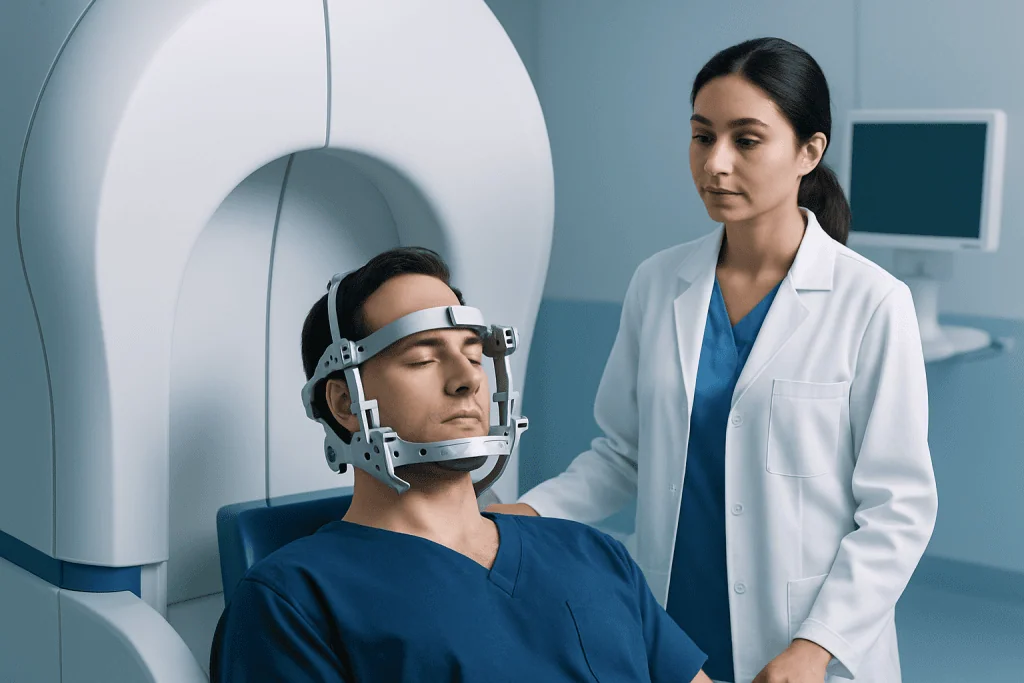
Gamma Knife treatment uses numerous small gamma radiation beams directed from different angles toward the same target. Each individual beam gives a low dose to the tissue it travels through, while the combined dose is concentrated where the beams intersect. This approach is designed to treat a defined abnormality with high precision.
Before treatment, specialists create a detailed three-dimensional map using MRI, CT, angiography, or a combination of imaging studies. A neurosurgeon, radiation oncologist, medical physicist, and other appropriate clinicians work together to define the treatment target and protect important structures such as the optic nerves, brainstem, hearing pathways, or healthy brain tissue.
The biological effect is usually gradual. For example, a tumor may stop growing or slowly shrink over time, while an arteriovenous malformation may close progressively. This is why follow-up scans are an essential part of care. For a broader explanation of indications and planning, patients can review Gamma Knife radiosurgery.
Who may be a candidate

Gamma Knife may be used for selected small or well-defined brain lesions and functional neurological conditions. Common examples include some benign and malignant brain tumors, metastases to the brain, vestibular schwannoma, pituitary tumors, meningioma, arteriovenous malformations, and trigeminal neuralgia. The best treatment approach differs substantially between these diagnoses.
Candidacy depends on the size, number, and location of the target; its relationship to sensitive brain structures; symptoms; previous surgery or radiotherapy; and the person’s general health. In some cases, surgery may be preferred because it can provide tissue for diagnosis or relieve pressure quickly. In others, Gamma Knife may be useful after surgery or alongside other treatments.
People being evaluated for cancer-related brain lesions may need input from neuro-oncology, medical oncology, neurosurgery, and radiation oncology. A diagnosis of a brain tumor, for example, requires individualized discussion of all suitable options rather than assuming one procedure is appropriate for every case.
- Bring recent MRI, CT, PET, or angiography images and reports when available.
- Provide pathology reports, prior treatment summaries, and a current medication list.
- Tell the team about implanted devices, allergies, kidney problems, pregnancy, or previous head radiation.
The procedure: assessment, planning and treatment day
The process typically begins with a remote or in-person review of medical records and imaging. If Gamma Knife appears potentially suitable, the hospital may request updated scans or additional testing. International patients should ask how images will be transferred securely, whether an in-person consultation is needed before treatment, and which clinicians will participate in the decision.
On the treatment day, the head is kept still using either a lightweight stereotactic frame or a custom-fitted mask, depending on the system and condition being treated. Imaging is then performed or checked for accurate targeting. The planning team calculates the radiation plan, which is reviewed before treatment begins.
During radiation delivery, the patient lies on a treatment couch while the machine administers the planned beams. The procedure is painless, and the patient can communicate with staff. The overall visit can take several hours because preparation, imaging, and planning take time; the radiation delivery itself varies according to the treatment plan.
Before discharge, staff explain short-term symptoms to watch for, prescribed medicines if needed, activity guidance, and the date of follow-up imaging. Patients should ensure they receive a treatment summary in English or another preferred language for their local doctor.
Benefits, safety and possible risks
The potential benefits of Gamma Knife include avoiding an incision and general anesthesia in many cases, preserving normal tissue as much as possible, and allowing many people to return home the same day or shortly afterward. It can be particularly valuable when a target is in a deep or difficult-to-reach part of the brain, or when open surgery carries higher risk.
However, all radiation treatments have possible side effects. Short-term effects can include tiredness, headache, nausea, scalp tenderness, or temporary swelling near the treated area. Depending on the target location, some people may develop temporary or delayed neurological symptoms, such as changes in balance, sensation, vision, hearing, speech, or strength. Steroid medication may sometimes be used to manage treatment-related swelling.
Less common but important risks include radiation-related tissue injury, seizure, bleeding in specific conditions, or loss of function affecting nearby nerves or brain structures. Gamma Knife may not control the condition fully, and additional treatment can sometimes be needed. The care team should explain the risks that apply to the individual diagnosis, not only general procedure risks.
Safety is strengthened by accurate imaging, experienced treatment planning, quality assurance checks, and coordinated follow-up. Patients considering care abroad can ask how the hospital verifies dose delivery, handles urgent complications, communicates records, and works with clinicians after the patient returns home.
Recovery, travel and follow-up planning
Most people have a short recovery after Gamma Knife and may leave the hospital on the same day once the clinical team is satisfied that they are well. If a head frame was used, there can be mild soreness, swelling, or small pin-site marks for a few days. People should follow individualized advice about driving, returning to work, exercise, and travel.
Immediate results are not expected for most conditions. Symptoms may improve slowly, remain stable while treatment takes effect, or occasionally worsen temporarily due to swelling. Follow-up MRI or other imaging is commonly scheduled over the following months and may continue for longer, depending on the condition. The treating team uses these scans to assess response and decide whether any additional care is needed.
Patients travelling for Gamma Knife in Turkey should allow enough time for consultation, planning, treatment, and post-treatment assessment before flying home. Accommodation near the hospital, a companion when appropriate, travel insurance that covers medical needs, and a plan for follow-up with a neurologist, neurosurgeon, oncologist, or primary doctor at home can make the process more manageable.
Acibadem International’s multidisciplinary specialists and JCI-accredited hospitals support international patients through assessment, Gamma Knife planning, treatment, and coordination of follow-up records. The appropriate length of stay and travel timing should always be confirmed by the treating clinical team.
When to seek medical care
Anyone with a known brain tumor, vascular brain condition, facial pain syndrome, or previous brain radiation should seek specialist advice before considering Gamma Knife. A doctor can determine whether symptoms, imaging findings, and treatment history require urgent assessment or whether a planned outpatient consultation is appropriate.
Urgent medical evaluation is needed for sudden or severe headache, a new seizure, fainting, new weakness or numbness, trouble speaking, sudden vision loss or double vision, severe confusion, or a major change in balance. These symptoms can have several causes and should not be assumed to be related to a known diagnosis or prior treatment.
After Gamma Knife, patients should contact the treating team or seek urgent local care if they develop worsening headache, persistent vomiting, new neurological symptoms, fever, severe pain or redness at frame pin sites, or any symptom that feels severe or rapidly progressive. Bringing the treatment summary to local emergency clinicians can help support timely assessment.
Frequently asked questions
Is Gamma Knife in Turkey safe?
Gamma Knife can be a safe and established treatment when it is recommended for the right condition and delivered with careful imaging, planning, and quality assurance. Safety also depends on the target’s location, the radiation dose, prior treatments, and the patient’s overall health. A specialist team should explain the individual balance of expected benefit and risk.
Is Gamma Knife surgery an operation?
No. Gamma Knife is a type of stereotactic radiosurgery that uses focused radiation rather than a surgical incision. It does not remove tissue during the appointment, and many patients do not need general anesthesia. Its effects develop over time after the radiation has been delivered.
How long does Gamma Knife treatment take?
The full appointment often lasts several hours because it includes positioning, imaging, treatment planning, safety checks, and radiation delivery. The exact time varies with the diagnosis, target size and number, and treatment plan. The care team can provide a more specific estimate after reviewing imaging.
Can international patients fly after Gamma Knife?
Many patients can travel after a short period of observation, but timing should be decided by the treating team. It may depend on symptoms, use of a head frame, medications, the underlying condition, and the length of the flight. Patients should have written discharge information and a follow-up plan before returning home.
What is recovery like after Gamma Knife?
Recovery is often quicker than after open brain surgery, and many people resume light activities within a short time. Mild fatigue, headache, nausea, or local soreness can occur, especially if a head frame was used. Imaging follow-up remains important because treatment effects are usually gradual and delayed effects are possible.
Will Gamma Knife cure a brain tumor?
Gamma Knife may control the growth of certain tumors, reduce their size over time, or treat selected metastases, but outcomes depend on the tumor type, size, location, and other treatments. It is not suitable for every tumor and cannot be described as a cure in all situations. The treating specialists can explain the goals of treatment for the individual diagnosis.
References
- International Atomic Energy Agency
- National Cancer Institute
- American Society for Radiation Oncology
- National Institute of Neurological Disorders and Stroke
- European Society for Radiotherapy and Oncology
This article is for general information only and is not a substitute for professional medical advice. Please consult a qualified doctor about your individual situation.
Gamma Knife in Turkey — costs, top hospitals & a free quote
JCI-accredited · board-certified surgeons · reply within 24h
Add us as a Preferred Source to see more of our trusted health content across Google Search, AI Overviews and Discover.

Neurology
Diagnosis and treatment of disorders of the brain, spinal cord, nerves and muscles.
51 specialists in this unit