Hair Translpant: Procedure, Recovery and Results

Hair transplantation redistributes existing follicles; it does not create new hair or stop future hair loss. FUE and FUT are the two main surgical approaches, each with different donor-area scarring and recovery considerations.
Key Takeaways
- Hair transplantation redistributes existing follicles; it does not create new hair or stop future hair loss.
- FUE and FUT are the two main surgical approaches, each with different donor-area scarring and recovery considerations.
- Temporary shedding after surgery is common, while visible new growth usually develops over several months.
- A transplant is not guaranteed to produce full density or prevent thinning of untreated native hair.
- Sudden, patchy, painful or inflamed hair loss should be assessed medically before a transplant is considered.
A hair transplant moves healthy hair follicles from a donor area to areas affected by thinning or baldness. Results develop gradually, and a careful assessment, realistic planning and appropriate aftercare are important for a natural-looking outcome.
Hair transplant: what it is and who may benefit
A hair transplant is a surgical method that moves healthy hair follicles from a donor area, usually the back or sides of the scalp, to areas with thinning or hair loss. It may improve coverage when the person has sufficient stable donor hair and a suitable type of hair loss. The procedure does not create new follicles or stop ongoing hair loss, so results depend on careful planning as well as surgery.
It is most often considered for pattern hair loss, also called androgenetic alopecia, in men and women. A clinician should first confirm the cause of hair loss because sudden shedding, patchy loss, scalp inflammation, nutritional deficiencies, hormonal changes and some medications may require a different approach. Hair transplantation is usually postponed when a scalp condition is active or the pattern of loss is not yet clear.
Follicles are transplanted as small groups called grafts. The surgeon considers the person’s age, facial proportions, hair texture, donor density and likely future hair-loss pattern when designing a hairline or adding coverage. A conservative, long-term plan can be especially important for younger people whose native hair may continue to thin.
Planning the hair transplant procedure
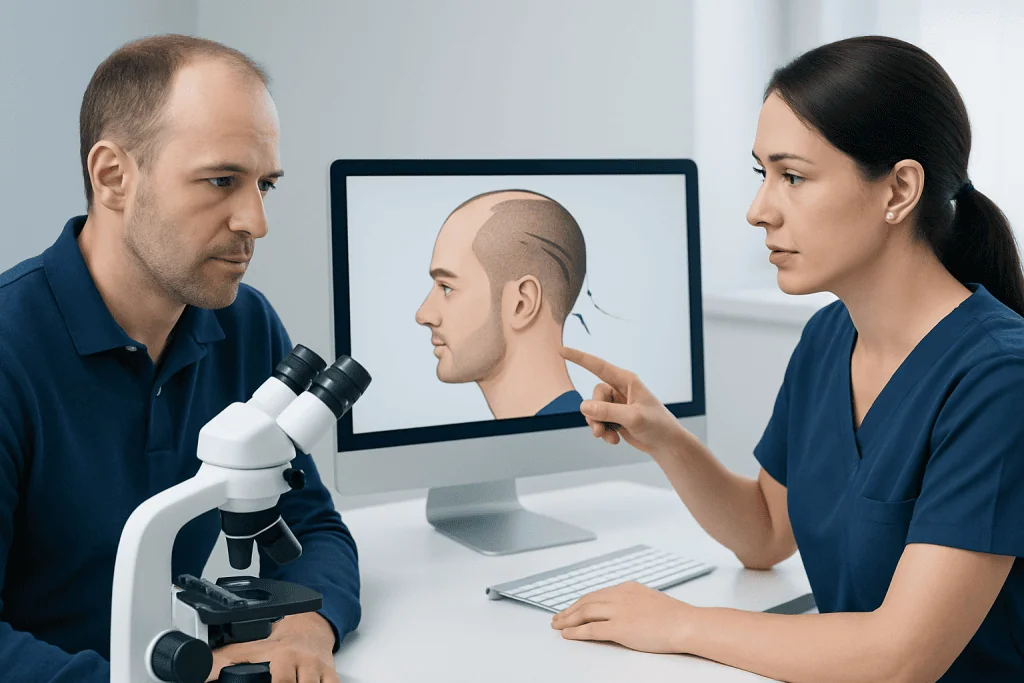
Before surgery, the clinician reviews the person’s medical history, medications, allergies, previous procedures and goals. The scalp and donor area are examined to assess hair density, shaft thickness and the quality of available donor follicles. Blood tests or further assessment may be advised only when the history or examination suggests an underlying contributor to hair loss.
The two commonly used methods are follicular unit extraction, or FUE, and follicular unit transplantation, or FUT. In FUE, individual follicular units are removed from the donor area, leaving very small dot-like scars. In FUT, a narrow strip of donor scalp is removed and divided into grafts, leaving a linear scar that may be suitable for some hairstyles and treatment plans.
Hair transplantation is usually performed under local anaesthesia, sometimes with additional sedation when appropriate. The surgical team harvests grafts, prepares the recipient sites and places follicles at carefully planned angles and directions. A session may take several hours, and the person receives individual instructions about washing, activity, sleeping position and follow-up before leaving the clinic.
Hair transplant recovery process: a practical timeline

During the first few days, small crusts, mild redness, tenderness and swelling can occur in the treated areas. The scalp should be protected from rubbing, scratching and accidental impact while grafts settle. The surgeon’s instructions for gentle washing, sleeping and returning to normal activities take priority because recommendations vary according to the technique used and the individual’s healing needs.
Crusting commonly loosens over the following one to two weeks, while the donor area continues to heal. Between several weeks and the first few months, many transplanted hair shafts shed; this is a normal part of the growth cycle and does not necessarily mean the follicles have been lost. Temporary shedding of nearby, pre-existing hair can also occur, particularly when surrounding hair is already fine or miniaturised.
New growth often becomes noticeable after several months and gradually gains length and thickness. Results are commonly assessed around 9 to 12 months, although the crown area may take longer to mature. Hair transplant recovery process pictures can help explain typical stages, but photographs should be interpreted carefully because lighting, hair length, styling, camera angle and individual healing can make recovery and density look different.
How painful is hair transplant recovery?
Most people describe hair transplant recovery as involving manageable soreness, tightness, itching or tenderness rather than severe pain, but individual experiences vary. The local anaesthetic injections may briefly sting, while the procedure itself is intended to be comfortable. Donor-area tightness can be more noticeable after FUT because a strip of scalp is closed with stitches, while FUE may cause tenderness across a broader shaved area.
The surgical team may recommend pain relief that is safe for the person’s health history and procedure. Increasing pain after initial improvement, marked warmth, spreading redness, discharge or fever is not typical and should be reported promptly. Patients should not start or stop medicines, including non-prescription pain medicines or supplements, without checking with the treating team.
What I wish I knew before a hair transplant
People considering treatment often wish they had understood that a transplant is part of a long-term hair-loss plan rather than a one-day solution. Existing, non-transplanted hair can continue to thin after surgery, which may change the overall appearance over time. A clinician may discuss medical or non-surgical options to help manage ongoing pattern hair loss when these are appropriate for the individual.
The donor supply is limited, so it must be used thoughtfully. A lower, denser hairline is not always the most sustainable choice, particularly when future thinning is likely. It is also helpful to understand the trade-offs between FUE’s small individual scars and FUT’s linear donor scar, as well as the possibility that some people may need staged treatment to meet realistic coverage goals.
Recovery also has a social aspect: visible crusting, temporary redness, shaving and the later shedding phase may affect when someone feels ready for work, travel or events. Before-and-after photographs are useful only when they show comparable hair characteristics, loss patterns and time frames. A thorough consultation with an appropriately qualified clinician should include discussion of risks, expected density, donor management and what the person can realistically expect.
What happens 10 years after a hair transplant?
Transplanted follicles usually retain many of the characteristics of the donor area and may continue producing hair for many years. However, no outcome is permanent in exactly the same way for every person. Natural ageing, changes in hair quality and progression of hair loss in untreated areas can affect the appearance a decade after surgery.
The most common long-term consideration is continued thinning of native hair around or behind the transplanted area. This can make an originally successful result appear less even over time, especially if the initial hairline was designed too aggressively or donor hair was used too quickly. Follow-up with a dermatologist or hair-restoration clinician can help determine whether monitoring, medical management or a future revision should be considered.
Long-term satisfaction often depends on having a realistic initial plan that preserves donor hair for possible future needs. People travelling for assessment can discuss their situation with Acibadem International, where multidisciplinary specialists at JCI-accredited hospitals diagnose and treat hair-loss conditions for international patients.
Is a hair transplant 100% successful?
No. A hair transplant cannot guarantee that every graft will grow, that the final density will meet every expectation or that future hair loss will stop. Technical graft survival and cosmetic satisfaction are different measures: follicles may grow successfully while the person still feels that coverage is limited because donor hair was scarce or native hair continued to thin.
Results are influenced by the diagnosis, donor-hair quality, scalp health, graft handling, placement technique and the person’s healing response. Smoking, untreated scalp disease and difficulty following aftercare instructions can affect healing, but even with excellent care there is no absolute guarantee. A reputable clinician should discuss uncertainty openly rather than promising a particular density or result.
Possible complications include temporary swelling, numbness, itching, scarring, infection, inflammation of follicles and an unnatural-looking distribution if the design is not suitable. These problems are not expected in every case, but they are important to understand before consenting to surgery. Choosing a qualified surgical team and attending follow-up appointments supports early recognition and management of concerns.
When to seek medical care
After a transplant, the person should contact the surgical team promptly for worsening pain, persistent or increasing swelling, spreading redness, pus-like drainage, a fever, significant bleeding or an unexpected reaction to a medicine or dressing. A clinician can distinguish expected healing changes from signs that need treatment. Follow-up should also be arranged if crusting does not improve as instructed or if the patient is uncertain about washing or activity restrictions.
- Sudden or rapidly worsening hair loss
- Patchy areas of hair loss, especially with scalp scaling or broken hairs
- Scalp pain, burning, marked itching, sores or scarring
- Hair loss accompanied by fatigue, weight change or other new health symptoms
Before considering a transplant, these symptoms warrant a medical assessment to identify treatable causes of hair loss. Early diagnosis can protect remaining hair and may help determine whether surgery is appropriate, should be delayed or is unlikely to provide a useful result.
Frequently asked questions
How long does it take for a hair transplant to look normal?
Visible crusting and redness commonly improve within the first couple of weeks, although the exact timeline varies. Transplanted hairs often shed before regrowing, so the fuller cosmetic result usually takes many months to develop.
Can transplanted hair fall out after surgery?
Shedding of the transplanted hair shafts in the weeks after surgery is common and is often part of the normal growth cycle. The follicles generally remain beneath the skin and may begin producing new hair several months later, but the treating clinician should assess unexpected or persistent concerns.
Can women have a hair transplant?
Some women are suitable candidates, particularly when they have stable, localised thinning and adequate donor density. Because diffuse hair loss and hormonal or medical causes are relatively common, a diagnosis is important before surgery is planned.
What is the difference between FUE and FUT?
FUE removes individual follicular units and generally leaves tiny, scattered donor scars. FUT removes a strip of donor scalp and leaves a linear scar, but may be appropriate for selected patients depending on donor area, hairstyle preferences and treatment goals.
When can someone wash their hair or exercise after a transplant?
The timing depends on the surgical method, the condition of the scalp and the treating team's protocol. Gentle washing is often introduced early under specific instructions, while strenuous exercise and activities that cause sweating or friction may need to be delayed.
Will a person need hair-loss medicine after a transplant?
Some people are advised to consider medical treatment to help preserve non-transplanted hair that could continue to thin. Whether this is suitable depends on the diagnosis, health history, potential side effects and the person's preferences, so it should be discussed with a qualified clinician.
References
- American Academy of Dermatology Association
- International Society of Hair Restoration Surgery
- National Health Service
- Mayo Clinic
This article is for general information only and is not a substitute for professional medical advice. Please consult a qualified doctor about your individual situation.
Hair transplant in Turkey — costs, graft counts & a free assessment
JCI-accredited · board-certified surgeons · reply within 24h
Add us as a Preferred Source to see more of our trusted health content across Google Search, AI Overviews and Discover.