Heart Catheterization Procedure: An Evidence-Based Patient Guide

Heart catheterization is commonly performed through an artery or vein in the wrist, groin, arm, or neck. The procedure can diagnose coronary artery disease, valve problems, congenital heart conditions, and abnormal heart pressures.
Key Takeaways
- Heart catheterization is commonly performed through an artery or vein in the wrist, groin, arm, or neck.
- The procedure can diagnose coronary artery disease, valve problems, congenital heart conditions, and abnormal heart pressures.
- Most people are awake with local anesthetic and sedation, although individual plans vary.
- Serious complications are uncommon, but bleeding, blood vessel injury, contrast reactions, arrhythmias, and kidney problems can occur.
- Recovery often involves same-day discharge after a diagnostic procedure, with activity restrictions for several days depending on the access site and treatment performed.
A heart catheterization procedure is a minimally invasive test in which a cardiologist guides a thin, flexible tube through a blood vessel to the heart. It can measure pressures, examine coronary arteries, collect diagnostic information, and in some cases allow treatment during the same session.
Overview: what a heart catheterization procedure involves
A heart catheterization procedure, also called cardiac catheterization or cardiac cath, is a test that allows a cardiologist to obtain detailed information from inside the heart and its blood vessels. A narrow flexible tube, called a catheter, is inserted into a blood vessel and carefully advanced using X-ray guidance. The procedure may be used to measure pressures, take blood samples, assess blood flow, or inject contrast dye to make the coronary arteries visible on imaging.
Cardiac catheterization is often diagnostic, meaning it helps clarify the cause of symptoms or abnormal test results. It can also become therapeutic when an intervention is needed, such as opening a narrowed coronary artery with a balloon and stent. The exact approach depends on whether the catheter enters an artery, a vein, or both, and on the question the care team needs to answer.
Common related evaluations include coronary artery disease assessment when symptoms or tests suggest reduced blood flow to the heart muscle. A clinician should explain why catheterization is recommended, what information it may provide, and whether a treatment could be performed during the same visit.
Why it is recommended and who may be a candidate
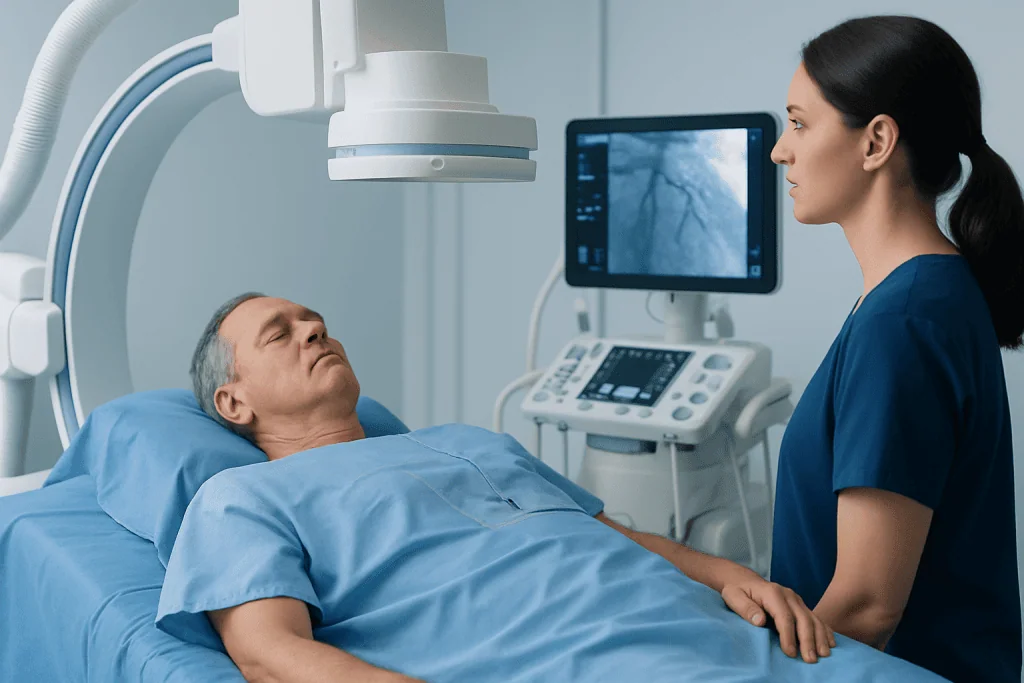
A clinician may recommend cardiac catheterization when noninvasive tests, such as an electrocardiogram, echocardiogram, stress test, or CT scan, do not provide enough information. It may help investigate chest discomfort, shortness of breath, unexplained fatigue, an abnormal stress test, heart failure, valve disease, congenital heart disease, or suspected <a href="https://acibademinternational.com/diseases/pulmonary-hypertension/”>pulmonary hypertension.
Left heart catheterization is commonly used to view the coronary arteries and measure pressure in the left side of the heart. Coronary angiography involves injecting contrast through the catheter so narrowed or blocked coronary arteries can be seen. Right heart catheterization travels through a vein into the right side of the heart and pulmonary arteries, helping measure pressures and blood flow through the heart and lungs.
Suitability is individualized. The cardiology team considers symptoms, medical history, kidney function, allergies, bleeding risk, medications, pregnancy status, and prior imaging results. For some people, the expected benefit of obtaining precise information or treating an important blockage outweighs procedural risk; for others, noninvasive testing or monitoring may be more appropriate.
How the procedure works: step by step

Before the procedure, the person usually changes into a hospital gown and has an intravenous line placed. The team checks vital signs, reviews medicines and allergies, and may perform blood tests. The skin at the access site—often the wrist or groin—is cleaned, and sterile drapes are placed. Local anesthetic numbs the area; sedating medicine may be offered to help the person relax while still allowing communication with the team.
The cardiologist places a small sheath into the blood vessel, then advances the catheter under continuous X-ray imaging. Contrast dye may be injected, which can cause a brief warm or flushing sensation. For a right heart catheterization, pressure readings and blood samples may be taken at several locations. For coronary angiography, images are captured as contrast flows through the coronary arteries.
If a significant coronary narrowing is identified and treatment is appropriate, the team may proceed with coronary angioplasty and stent treatment. This is discussed in advance whenever possible, though the final decision also depends on the findings, the urgency of the situation, and the person’s clinical condition.
Afterward, the catheter and sheath are removed. The access site is closed with direct pressure, a compression device, or a closure device. The person then rests in a monitored recovery area while staff observe the puncture site, circulation, heart rhythm, blood pressure, and overall comfort.
What should you not do before a heart catheterization?
Instructions vary by hospital and by the type of catheterization, so the care team’s directions should always take priority. In general, people are commonly asked not to eat or drink for a specified period before the procedure, particularly if sedation is planned. They should not assume that routine medicines should be stopped without medical guidance.
It is important not to take certain medicines, supplements, or diabetes treatments differently unless the prescribing clinician or catheterization team has advised this. Blood thinners, antiplatelet medicines, insulin, and some diabetes medicines may need individualized adjustments. The team should be told about all prescription medicines, over-the-counter products, herbal supplements, contrast dye allergies, kidney disease, bleeding problems, and possible pregnancy.
People should avoid driving themselves home if sedatives are expected. They should arrange a responsible adult to accompany them and should avoid applying lotions or creams near the expected access site unless instructed otherwise. Bringing a current medication list and relevant test results can help the team prepare safely.
What is the rule of 5 for a right heart cath?
The phrase “rule of 5” is sometimes used informally in clinical teaching, but it does not have one universal, patient-facing meaning or replace interpretation by a cardiology specialist. In some settings, clinicians use simple numerical prompts to remember that right-heart pressure measurements are taken sequentially and must be interpreted together with cardiac output, oxygen levels, symptoms, imaging, and the person’s overall condition.
Right heart catheterization provides direct measurements from the right atrium, right ventricle, pulmonary artery, and pulmonary capillary wedge position. These readings can help evaluate the circulation between the heart and lungs, clarify certain forms of heart failure, and confirm or characterize pulmonary hypertension. Small differences in technique, breathing, fluid status, and measurement conditions can affect results.
For this reason, a person should ask their cardiologist what measurements will be collected and what they mean in their individual case rather than relying on a rule of thumb. The report is most useful when interpreted alongside symptoms and other cardiac and respiratory tests.
How serious is a heart catheterization procedure?
Heart catheterization is an invasive procedure, so it is more involved than external imaging tests. However, it is performed routinely by trained cardiac teams, often with local anesthetic and careful monitoring. For many people, it provides information that cannot be obtained as accurately with noninvasive testing and can guide timely decisions about medicines, procedures, or surgery.
Possible complications include bruising or bleeding at the access site, blood vessel injury, irregular heart rhythms, infection, allergic reaction to contrast dye, and temporary kidney stress from contrast. More serious events, such as heart attack, stroke, major bleeding, or emergency surgery, are uncommon but possible. Risks can be higher in people with significant kidney disease, severe heart disease, clotting disorders, or complex vascular anatomy.
The care team reduces risk by reviewing medical history, monitoring throughout the procedure, using imaging guidance, and providing recovery instructions. Patients should feel comfortable asking about the reason for the test, alternative options, expected benefits, and the particular risks relevant to their health.
How many days should you rest after a heart catheterization?
Recovery time depends on the access site, whether the procedure was diagnostic or included treatment, the medicines used, and the person’s overall health. After an uncomplicated diagnostic catheterization through the wrist, many people return home the same day and may resume light daily activities within a day or two. Groin access may require a longer period of lying flat immediately afterward and more cautious activity for several days.
Heavy lifting, vigorous exercise, and strenuous work are commonly restricted for a short time to protect the access site. The exact time frame varies, especially after angioplasty or stent placement, when recovery and medication plans may be different. A clinician should provide specific instructions about showering, driving, work, exercise, wound care, and when to restart regular medicines.
Mild tenderness or a small bruise near the insertion site can occur. The site should be kept clean and monitored for increasing pain, swelling, redness, warmth, drainage, numbness, coolness in the limb, or persistent bleeding. Following the discharge plan and attending follow-up appointments supports a safe recovery.
When to seek medical care
Urgent medical care is needed after catheterization for chest pain, severe shortness of breath, fainting, new weakness or trouble speaking, uncontrolled bleeding from the access site, rapidly enlarging swelling, or a limb that becomes cold, pale, painful, or numb. If bleeding occurs, the person should apply firm pressure as instructed and seek emergency help rather than trying to manage significant bleeding alone.
A doctor should also be contacted promptly for fever, increasing redness or drainage at the puncture site, worsening bruising, or symptoms that are concerning but not immediately life-threatening. People should not delay evaluation if they feel unwell after returning home, particularly if symptoms differ from expected mild soreness.
For patients seeking coordinated evaluation, Acibadem International’s multidisciplinary cardiology specialists and JCI-accredited hospitals diagnose and treat heart conditions for international patients. Care plans may include evaluation for heart valve surgery or other treatments when catheterization findings indicate a need for further care.
Frequently asked questions
Is heart catheterization painful?
The skin and tissue at the access site are numbed with local anesthetic, so most people feel pressure rather than significant pain when the catheter is inserted. Some may feel brief warmth when contrast dye is injected or temporary discomfort when lying still. The team should be told promptly about any pain, nausea, breathing difficulty, or other discomfort during the procedure.
How long does a heart catheterization procedure take?
A diagnostic heart catheterization often takes about 30 to 60 minutes, although preparation and recovery take additional time. More complex testing or treatment, such as angioplasty and stent placement, can take longer. The care team can provide a more individualized estimate before the procedure.
Will a person be awake during cardiac catheterization?
Many people are awake but relaxed with local anesthetic and light sedation. This allows the team to communicate with them if needed while monitoring heart rhythm, blood pressure, and oxygen levels. In some situations, deeper sedation or anesthesia may be used based on the procedure and the person’s condition.
Can heart catheterization find blocked arteries?
Yes. Coronary angiography, which is commonly performed during left heart catheterization, uses contrast dye and X-ray imaging to show narrowing or blockages in the coronary arteries. The images help the cardiologist decide whether medication, a catheter-based procedure, surgery, or another approach is appropriate.
What should someone wear and bring to a heart catheterization?
Comfortable, loose-fitting clothing is useful for going home, although the person will generally wear a hospital gown during the procedure. They should bring identification, insurance or administrative documents if applicable, a current medication list, and details about allergies. Valuables and jewelry are best left at home unless the hospital advises otherwise.
When can a person return to work after heart catheterization?
Return-to-work timing varies with the access site, the type of job, whether treatment was performed, and the person’s recovery. Desk-based work may be possible after a short recovery period following an uncomplicated diagnostic procedure, while physically demanding work may require more time. The treating clinician should provide personalized clearance based on the procedure results and recovery progress.
References
- American Heart Association
- American College of Cardiology
- National Heart, Lung, and Blood Institute
- Society for Cardiovascular Angiography and Interventions
- Mayo Clinic
This article is for general information only and is not a substitute for professional medical advice. Please consult a qualified doctor about your individual situation.
Heart care in Turkey — expert evaluation and treatment
JCI-accredited · board-certified surgeons · reply within 24h
Add us as a Preferred Source to see more of our trusted health content across Google Search, AI Overviews and Discover.
Check your numbers in seconds
BMI, calories, due date, blood pressure and 30+ more clinical calculators — free, instant, doctor-reviewed ranges.