How Cancer Is Diagnosed: Tests, Biopsy, and Imaging Explained

A biopsy is often the main test used to confirm a cancer diagnosis. Imaging tests can show the size, location, and spread of a suspicious area but may not confirm cancer on their own.
Key Takeaways
- A biopsy is often the main test used to confirm a cancer diagnosis.
- Imaging tests can show the size, location, and spread of a suspicious area but may not confirm cancer on their own.
- Blood tests and tumor markers can support diagnosis and guide monitoring, but they are rarely enough by themselves.
- Pathology and molecular testing help identify the cancer type and may guide personalized treatment.
- Not every abnormal scan or lump is cancer, so a careful step-by-step evaluation is important.
- Early medical assessment can improve the chance of timely diagnosis and treatment.
Cancer diagnosis usually involves several steps, including a medical history, physical exam, imaging, laboratory tests, and often a biopsy. Each test provides different information, helping doctors confirm whether cancer is present, determine its type, and plan the most appropriate treatment.
Overview: How cancer diagnosis works
Cancer diagnosis is a process rather than a single test. Doctors usually begin by reviewing symptoms, personal medical history, family history, and any risk factors such as smoking, occupational exposures, infections, or prior radiation treatment. A physical examination may then help identify abnormal lumps, swelling, skin changes, enlarged lymph nodes, or other signs that need closer evaluation.
If cancer is suspected, the next step is often a combination of laboratory tests and imaging studies. These tests help doctors look for unusual changes inside the body and decide whether a suspicious area needs a biopsy. In many cases, several tests are used together because each one answers a different question.
The goal of cancer diagnosis is not only to confirm whether cancer is present, but also to learn the exact type, location, and extent of disease. This information is essential for staging and treatment planning. A clear diagnosis can also help distinguish cancer from noncancerous conditions such as infections, cysts, inflammation, or benign tumors.
Symptoms and signs that may lead to testing
Cancer can cause many different symptoms, depending on the organ involved. Some people notice a new lump, unexplained weight loss, ongoing fatigue, unusual bleeding, a persistent cough, changes in bowel habits, difficulty swallowing, or skin changes that do not heal. Others may have no symptoms at all and are diagnosed through routine screening or tests done for another reason.
It is important to remember that these symptoms do not automatically mean cancer. Many common health problems can cause similar signs. However, symptoms that are persistent, worsening, or unexplained should be assessed by a doctor so that the cause can be identified.
Doctors may recommend further testing when symptoms suggest a possible tumor, when a screening test is abnormal, or when imaging done for another reason shows an unexpected mass. Examples include a suspicious finding on a mammogram, an abnormal colonoscopy result, or a lung nodule seen on a chest scan.
- Symptoms lasting several weeks without a clear reason
- A new or growing lump
- Bleeding that is unusual for the person
- Changes in a mole or skin lesion
- Persistent pain, cough, or swallowing difficulty
Medical history, physical exam, and screening tests

The first part of cancer diagnosis is often a careful conversation and physical exam. A doctor may ask when symptoms started, whether they are changing, and whether there is a family history of cancers such as breast, ovarian, colorectal, or prostate cancer. Questions about smoking, alcohol use, diet, workplace exposures, and past illnesses can also be relevant.
A physical examination may include checking the skin, mouth, neck, breasts, abdomen, rectum, prostate, or lymph nodes, depending on the symptoms. Although an exam alone cannot diagnose most cancers, it can help guide which tests should be done next.
Screening tests are different from diagnostic tests. Screening aims to detect cancer before symptoms begin in people who feel well but may be at average or increased risk. Examples include mammography, cervical screening, and colon cancer screening. When a screening result is abnormal, more specific diagnostic testing is usually needed to confirm whether cancer is present.
In some cases, a doctor may also consider whether inherited cancer risk should be assessed. If several close relatives have had related cancers or if cancer occurs at an unusually young age, genetic counseling and testing may be discussed as part of the broader evaluation.
Imaging tests: what scans can and cannot show
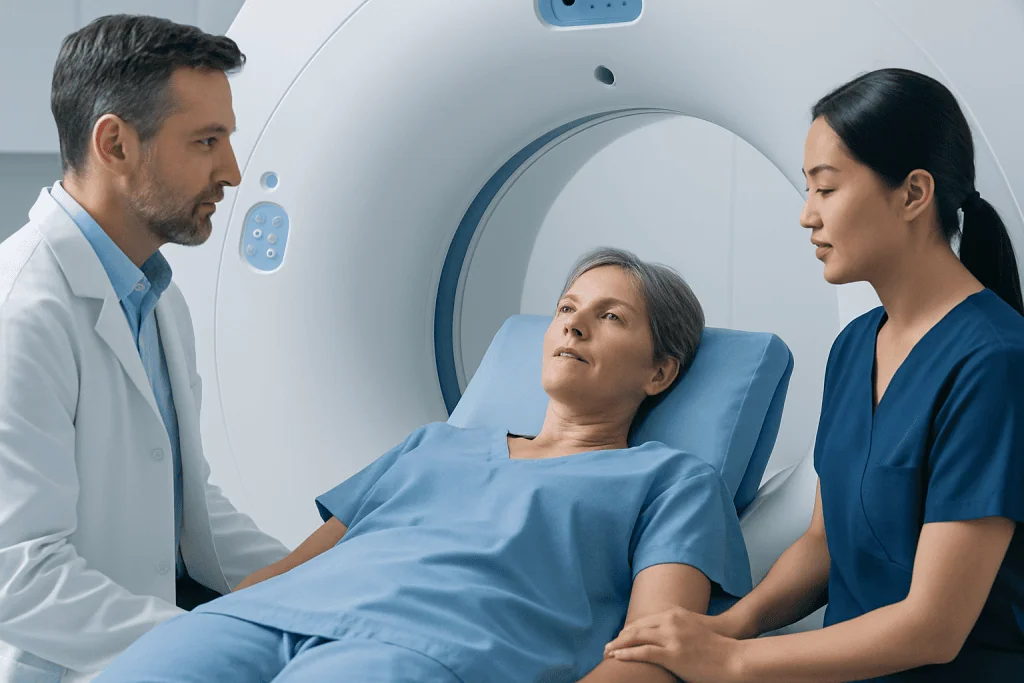
Imaging tests allow doctors to look inside the body without surgery. Common imaging studies used in cancer diagnosis include ultrasound, X-ray, computed tomography (CT), magnetic resonance imaging (MRI), mammography, and positron emission tomography (PET), often combined with CT. The best choice depends on the body area being examined and the question the doctor needs answered.
These tests can show the size, shape, and location of an abnormal area. They may also help determine whether a tumor appears localized or whether there are signs it has spread to nearby lymph nodes or distant organs. Imaging is also useful for guiding procedures, such as placing a needle into a suspicious lesion during a biopsy.
However, imaging usually cannot confirm cancer by itself. A scan may show that something is abnormal, but it may not be able to tell whether the change is cancer, infection, scar tissue, inflammation, or a benign growth. That is why doctors often recommend tissue sampling after an abnormal scan.
Different scans have different strengths. Ultrasound is often used for soft tissues and can help guide needle biopsies. CT scans provide detailed cross-sectional images and are widely used to evaluate the chest, abdomen, and pelvis. MRI can offer greater detail in the brain, spine, liver, prostate, and soft tissues. PET-CT may help show areas of increased metabolic activity and can be valuable in staging certain cancers.
Biopsy and pathology: confirming the diagnosis
A biopsy is often the most important step in cancer diagnosis because it allows doctors to examine actual cells or tissue under a microscope. During a biopsy, a sample is taken from the suspicious area and sent to a pathology laboratory. A pathologist then studies the tissue to determine whether cancer is present and, if so, what type it is.
There are several kinds of biopsy. A fine-needle aspiration uses a thin needle to collect cells. A core needle biopsy removes a small cylinder of tissue and often provides more detail. Endoscopic biopsy may be done during procedures such as colonoscopy or bronchoscopy. In some cases, a surgical biopsy is needed to remove part or all of a mass.
Pathology testing can do more than confirm cancer. It can identify the tumor subtype, grade, and certain features that influence treatment decisions. Additional laboratory methods, including immunohistochemistry and molecular testing, may show whether the cancer has markers that make it more likely to respond to specific drugs.
For many patients, waiting for biopsy results can feel stressful. The process may take several days because tissue often needs special preparation and additional testing. Although the wait can be difficult, these details are important because a precise diagnosis helps doctors choose the safest and most effective treatment approach.
Blood tests, tumor markers, and staging
Blood tests are commonly used during cancer evaluation, but they usually do not diagnose cancer on their own. Doctors may order a complete blood count, liver and kidney function tests, and other routine laboratory studies to look for indirect signs of illness and to assess general health before treatment. In blood cancers, these tests may be particularly important and sometimes strongly suggest the diagnosis.
Some cancers are associated with tumor markers, which are substances found in blood, urine, or tissues. Tumor markers can support diagnosis in certain situations, but they are not specific enough to be used as a stand-alone test for most people. Noncancerous conditions can also raise some markers, and some patients with cancer have normal results.
Once cancer is confirmed, doctors usually perform staging tests to understand how far it has spread. Staging may involve additional scans, blood work, endoscopy, or sometimes surgery. Staging helps the care team recommend the most appropriate options, which may include chemotherapy, radiotherapy, immunotherapy, or surgery depending on the cancer type and stage.
In many modern cancer programs, molecular and genetic analysis of the tumor is also part of staging and treatment planning. These tests can identify changes in the cancer cells that may help predict prognosis or indicate whether targeted therapy could be useful.
What happens after a diagnosis
After cancer is diagnosed, the next step is usually a detailed discussion with specialists about the findings and treatment plan. This often includes information about the cancer type, stage, grade, and whether it has certain biomarkers. Patients may meet with more than one specialist, such as a medical oncologist, radiation oncologist, surgeon, pathologist, or radiologist.
Treatment planning is increasingly personalized. The same type of cancer can behave differently from one person to another, so decisions are based on the exact diagnosis, overall health, age, symptoms, and patient preferences. Some cancers are treated mainly with surgery, while others may need a combination of systemic therapy and radiation. Related information may also be helpful for patients learning about specific diseases such as breast cancer or lung cancer.
It is often helpful for patients to bring a family member or friend to appointments, write down questions, and ask for copies of test results. A second opinion can also be appropriate, especially when the diagnosis is complex or treatment choices are not straightforward. In experienced centers, multidisciplinary team review helps ensure that pathology, imaging, and clinical findings are considered together.
Near the end of the diagnostic journey, some people may seek care in specialized centers. Acibadem International’s multidisciplinary specialists and JCI-accredited hospitals diagnose and treat cancer for international patients, with evaluation tailored to the individual case.
When to see a doctor and how to prepare
A doctor should be consulted if symptoms are persistent, unexplained, or concerning, especially if they continue for several weeks or keep returning. A person should also seek medical advice after an abnormal screening result, a new lump, unexplained bleeding, or a notable change in bowel, urinary, or breathing patterns. Prompt assessment does not mean cancer is likely, but it does help clarify the cause sooner.
Preparing for an appointment can make the process easier. It may help to bring a list of symptoms, when they started, past illnesses, medications, allergies, and any family history of cancer. If imaging or test results have already been done elsewhere, copies can help avoid delays or repeated testing.
During the visit, patients can ask what the suspected finding might mean, which tests are recommended, what each test can show, and how long results may take. Clear communication often reduces uncertainty and helps patients feel more involved in decisions about their care.
Even when cancer is diagnosed, many treatment options are available, and care is guided by a structured, evidence-based process. Early evaluation, accurate testing, and a coordinated medical team are the foundation of effective cancer care.
Frequently asked questions
What is the most important test to confirm cancer?
In many cases, a biopsy is the key test used to confirm cancer. It allows a pathologist to examine cells or tissue directly and determine whether cancer is present and what type it is.
Can a scan show cancer without a biopsy?
Imaging tests such as CT, MRI, ultrasound, or PET can strongly suggest cancer, but they usually cannot confirm it by themselves. Many noncancerous conditions can look similar on a scan, so tissue testing is often needed.
Do blood tests diagnose cancer?
Blood tests can provide useful clues and help assess overall health, but they rarely diagnose cancer on their own. Some blood cancers are an exception, though additional specialized tests are often still needed.
How long do biopsy results usually take?
Biopsy results often take several days, but timing can vary depending on the type of sample and whether extra testing is needed. More detailed pathology or molecular analysis may take longer because it helps make the diagnosis more precise.
What is cancer staging?
Staging describes how much cancer is in the body and whether it has spread. Doctors use staging information to guide treatment decisions and discuss outlook in a more informed way.
Can screening tests diagnose cancer?
Screening tests are designed to find possible cancer early, often before symptoms begin. If a screening test is abnormal, further diagnostic tests such as imaging, endoscopy, or biopsy are usually needed to confirm the result.
References
- World Health Organization
- National Cancer Institute
- American Cancer Society
- National Comprehensive Cancer Network
- European Society for Medical Oncology
This article is for general information only and is not a substitute for professional medical advice. Please consult a qualified doctor about your individual situation.
Oncology care in Turkey — second opinion and treatment plan
JCI-accredited · board-certified surgeons · reply within 24h
Add us as a Preferred Source to see more of our trusted health content across Google Search, AI Overviews and Discover.