How Huntington’s Disease Is Diagnosed: Neurological Exams, Genetic Tests, and Imaging

A diagnosis is based on symptoms, neurological findings, family history, and genetic testing. Genetic testing can confirm Huntington’s disease by identifying a change in the HTT gene.
Key Takeaways
- A diagnosis is based on symptoms, neurological findings, family history, and genetic testing.
- Genetic testing can confirm Huntington’s disease by identifying a change in the HTT gene.
- Brain imaging does not diagnose Huntington’s disease on its own, but it can support the evaluation and help rule out other causes.
- Counseling is an important part of testing because the diagnosis can affect both the individual and family members.
- Early evaluation may help with symptom management, planning, and access to specialist care.
Huntington’s disease diagnosis usually combines a neurological examination, a review of symptoms and family history, genetic testing, and sometimes brain imaging. Because symptoms can overlap with other conditions, a careful step-by-step evaluation helps confirm the diagnosis and guide support and treatment.
Overview
Huntington’s disease is an inherited neurodegenerative condition that affects movement, thinking, and mood. It develops because of a change in the HTT gene, which leads to gradual damage in certain areas of the brain. Symptoms often appear in adulthood, but the age of onset and the pattern of symptoms can vary from person to person.
Diagnosing Huntington’s disease is not based on one symptom alone. Many early signs, such as changes in mood, clumsiness, or difficulty concentrating, can be caused by other health conditions as well. For this reason, doctors usually make the diagnosis by combining the medical history, family history, neurological examination, and a genetic test.
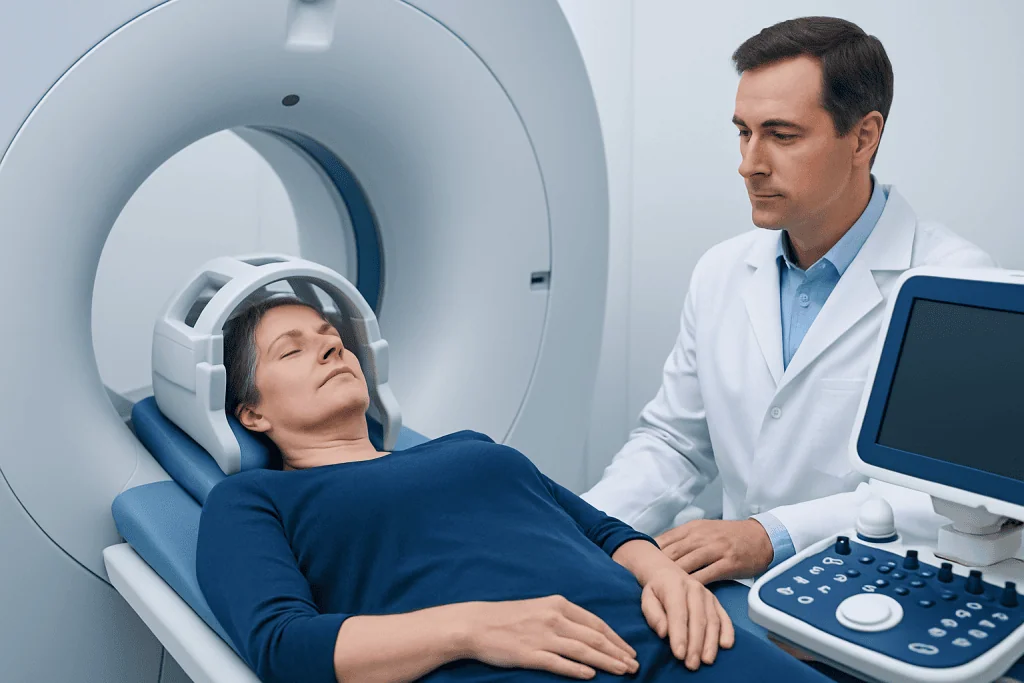
Imaging tests such as MRI or CT scans may also be used during the evaluation. These scans cannot confirm Huntington’s disease by themselves, but they can help doctors look for changes in the brain and exclude other possible explanations for symptoms. A thorough and careful assessment is important, especially when symptoms are mild or when there is no clear known family history.
When Huntington’s Disease May Be Suspected
Doctors may suspect Huntington’s disease when a person develops a combination of movement, cognitive, and emotional or behavioral changes. The movement symptoms can include involuntary jerking or writhing movements, often called chorea, trouble with balance, slowed movements, stiffness, or changes in speech and swallowing. In some people, the first signs are subtle and may seem easy to overlook.
Cognitive symptoms may include trouble organizing tasks, slower thinking, problems with attention, difficulty learning new information, or challenges with judgment. Emotional and psychiatric symptoms may include irritability, depression, anxiety, apathy, or noticeable changes in personality. These symptoms do not always appear at the same time, and one group of symptoms may be more prominent than another.
A family history can raise suspicion, since Huntington’s disease is passed down in an autosomal dominant pattern. This means a child of an affected parent has a 50% chance of inheriting the altered gene. However, not every person being evaluated knows their family history clearly, and in some cases a diagnosis may first be considered because of symptoms rather than because of known relatives with the condition.
Neurological Exam and Medical History

The neurological exam is a central part of Huntington’s disease diagnosis. A neurologist looks at movement, coordination, balance, muscle tone, eye movements, reflexes, walking pattern, and speech. The exam helps identify whether symptoms fit the pattern commonly seen in Huntington’s disease or whether another neurological condition may be more likely.
The doctor also asks detailed questions about symptoms and when they started. It can be helpful to bring a family member or close friend to the visit, because changes in behavior, memory, or movement may be easier for others to notice over time. The history often includes information about mood changes, sleep, work performance, daily functioning, and any difficulties with swallowing or falls.
Family history is reviewed carefully. The doctor may ask whether any relatives had involuntary movements, unexplained psychiatric illness, early dementia, or a diagnosis of Huntington’s disease. At the same time, the clinician considers other causes of similar symptoms, such as medication side effects, stroke, Wilson disease, thyroid disorders, or other movement disorders. This broad assessment helps make the diagnosis more accurate.
In some cases, formal cognitive or neuropsychological testing is recommended. These tests assess memory, attention, language, planning, and problem-solving. They do not confirm the gene change, but they can document the effects of the condition and help with treatment planning, work advice, driving discussions, and long-term support needs.
Genetic Testing for Huntington’s Disease
Genetic testing is the most definitive test for Huntington’s disease. It looks for a specific expansion of CAG repeats in the HTT gene. When a person has symptoms that strongly suggest Huntington’s disease, this test can confirm the diagnosis. The result is interpreted together with the person’s symptoms and neurological examination.
Testing is usually performed with a blood sample. Before the test, genetic counseling is strongly recommended. Counseling helps the person understand what the test can and cannot show, how results may affect emotional well-being, and what the findings may mean for children, siblings, and other relatives. This is an important part of patient-centered care.
Genetic testing may be diagnostic, predictive, or prenatal, depending on the situation. Diagnostic testing is used in someone who already has symptoms. Predictive testing is for a person who has no symptoms but has a family history and wants to know whether they inherited the gene change. Because predictive testing can have significant emotional, family, and practical effects, it is done within a structured counseling process rather than as a routine blood test.
A positive result shows the presence of the disease-causing gene expansion, but it does not predict exactly when symptoms will begin or how severe they will become. A negative result can help rule out Huntington’s disease when the diagnosis is uncertain. If symptoms are present but the test is negative, doctors may investigate other neurological conditions with overlapping features.
How Brain Imaging Helps
Brain imaging is often used as part of the evaluation, especially when symptoms are new, atypical, or need further clarification. MRI is commonly preferred because it gives detailed images of brain structures. CT scans may also be used in some situations. Imaging is not the main way to diagnose Huntington’s disease, but it can provide helpful supporting information.
On imaging, doctors may look for changes in areas such as the caudate nucleus and putamen, which can become affected in Huntington’s disease. These changes may be more obvious in later stages and less clear early on. For that reason, a normal scan does not exclude the disease, particularly if symptoms are subtle or the condition is in an early phase.
One important role of imaging is to rule out other causes of symptoms. For example, doctors may want to exclude stroke, tumor, <a href="https://acibademinternational.com/diseases/normal-pressure-hydrocephalus/”>normal pressure hydrocephalus, multiple sclerosis, or other structural brain disorders. If symptoms suggest a broader movement disorder evaluation, the specialist may also discuss related conditions such as Parkinson’s disease when explaining why different tests are needed.
Depending on the person’s symptoms, other assessments may also be arranged, such as speech and swallowing evaluation, psychiatric assessment, or rehabilitation review. When clinically appropriate, supportive services such as physical therapy and rehabilitation or neurology care may become part of the broader management plan after diagnosis.
Other Tests and the Differential Diagnosis
Because Huntington’s disease can resemble other neurological or psychiatric conditions, doctors often perform additional tests to exclude other causes. Blood tests may be used to check thyroid function, vitamin deficiencies, liver problems, copper metabolism disorders such as Wilson disease, or metabolic conditions. Medication review is also important, as some drugs can cause involuntary movements or changes in thinking.
The differential diagnosis may include other hereditary movement disorders, spinocerebellar ataxias, chorea from autoimmune or metabolic causes, frontotemporal disorders, and psychiatric illnesses that affect behavior and cognition. In older adults, doctors may also consider vascular changes in the brain or other neurodegenerative disorders. A careful work-up helps avoid misdiagnosis.
Juvenile Huntington’s disease, which begins in childhood or adolescence, may look different from adult-onset disease. Instead of chorea, younger patients may develop stiffness, slower movement, behavioral changes, school difficulties, or seizures. This makes specialist assessment especially important when symptoms begin early.
Sometimes the diagnosis becomes clearer over time rather than at a single appointment. Follow-up visits allow the doctor to observe how symptoms progress and whether new findings emerge. If uncertainty remains, referral to a center with expertise in movement disorders and genetic testing may be helpful.
What Happens After Diagnosis
A diagnosis of Huntington’s disease can bring relief at finally having an explanation for symptoms, but it can also feel emotionally challenging. After diagnosis, care usually focuses on symptom management, practical support, and planning for the future. There is currently no cure that stops the disease, but treatment can help address movement problems, mood symptoms, sleep issues, communication difficulties, and everyday functioning.
Care is often multidisciplinary. Depending on needs, the team may include a neurologist, psychiatrist, psychologist, genetic counselor, physical therapist, occupational therapist, speech and language therapist, dietitian, and social worker. This coordinated approach can support independence and quality of life for as long as possible.
Family members may also need support, especially because the condition is inherited. Some relatives may want counseling about their own risk or whether to consider predictive testing. Advance planning, work discussions, driving assessment, and home safety reviews may be appropriate as part of ongoing care.
Near the end of the diagnostic journey, some people choose care in specialized international centers. Acibadem International’s multidisciplinary specialists and JCI-accredited hospitals diagnose and treat Huntington’s disease for international patients, including access to supportive services such as MRI when imaging is needed as part of the evaluation.
When to See a Doctor
A person should see a doctor if they notice persistent involuntary movements, worsening coordination, changes in speech, balance problems, or unexplained changes in thinking or behavior. Medical advice is also important when these symptoms interfere with work, school, driving, or daily life. Early assessment can help identify the cause and connect the person with appropriate support.
Anyone with a known family history of Huntington’s disease should speak with a qualified healthcare professional if symptoms appear. Even when symptoms seem mild, a careful neurological review can be valuable. Predictive genetic testing should not be rushed and is best discussed with a genetic counselor and specialist team.
Urgent medical attention may be needed if there are severe falls, choking, sudden confusion, suicidal thoughts, or major changes in mental state. These problems are not specific to Huntington’s disease, but they deserve prompt medical care. In general, a calm, stepwise evaluation with an experienced clinician is the best way to reach a reliable diagnosis.
Frequently asked questions
What is the main test used to diagnose Huntington’s disease?
The main confirmatory test is a genetic test that looks for a specific change in the HTT gene. Doctors usually use it together with a neurological exam, symptom review, and family history rather than relying on the blood test alone.
Can MRI or CT scan confirm Huntington’s disease?
No. Brain imaging can support the evaluation and may show changes in areas of the brain affected by Huntington’s disease, but it cannot confirm the diagnosis by itself. Its other important role is helping rule out other causes of similar symptoms.
Does a family history always have to be present?
Not always. Many people diagnosed with Huntington’s disease do have an affected parent or other relative, but some do not know their family history clearly. In these situations, the diagnosis may be raised because of symptoms and then confirmed with genetic testing.
What is predictive genetic testing?
Predictive genetic testing is testing done in a person who has no symptoms but has a family history of Huntington’s disease and wants to know whether they inherited the altered gene. Because the result can have emotional and family implications, it is typically offered with genetic counseling before and after the test.
At what age is Huntington’s disease usually diagnosed?
Many people are diagnosed in adulthood, often between middle age and later adulthood, but the age can vary widely. Some develop symptoms earlier or later, and a juvenile form can appear in children or teenagers.
If the genetic test is positive, does it show how severe the disease will be?
A positive test confirms the presence of the gene change associated with Huntington’s disease, but it does not predict the exact course for an individual person. Symptom type, age at onset, and progression can differ, so regular follow-up with a specialist remains important.
References
- National Institute of Neurological Disorders and Stroke
- National Institute on Aging
- NHS
- GeneReviews
- Huntington's Disease Society of America
This article is for general information only and is not a substitute for professional medical advice. Please consult a qualified doctor about your individual situation.
Explore treatments in Turkey — costs, top hospitals & a free quote
JCI-accredited · board-certified surgeons · reply within 24h
Add us as a Preferred Source to see more of our trusted health content across Google Search, AI Overviews and Discover.

More from the Health Library



Related Specialists

Dr. Abdurrahman Şaban
Pulmonology
Dr. Salim Sırrı Türker
Orthopedic Surgery & Traumatology
Asst. Prof. Dr. Ceren Meriç Özgündüz
Psychiatry
Dr. Iretiola Albert
Inpatient Clinic Physicians Clinical Service