How to Remove Age Spots Naturally? Here Is What the Evidence Says

Most age spots are harmless and linked to cumulative UV exposure. No natural remedy is proven to remove age spots reliably; sunscreen is the most evidence-based step.
Key Takeaways
- Most age spots are harmless and linked to cumulative UV exposure.
- No natural remedy is proven to remove age spots reliably; sunscreen is the most evidence-based step.
- A doctor should assess any spot that changes color, shape, size, or starts to itch or bleed.
- Diagnosis is often made by skin examination, sometimes with dermoscopy or a biopsy if needed.
- Medical treatments such as prescription creams, chemical peels, and laser therapies may help when age spots are confirmed.
Age spots are usually harmless flat brown patches caused by long-term sun exposure, and many people want to know how to remove age spots naturally. The best evidence shows that daily sun protection can prevent darkening and new spots, while most home remedies have limited proof and should never replace medical evaluation of any changing or unusual mark.
Overview: What the evidence says about natural age spot removal
For most people, age spots are harmless areas of increased pigment that develop over time, especially on sun-exposed skin such as the face, hands, shoulders, and forearms. They are also called solar lentigines or sun spots. When people ask how to remove age spots naturally, the clearest evidence-based answer is that natural remedies do not reliably erase them, but consistent sun protection can help prevent them from becoming darker and reduce the chance of new spots forming.
That distinction matters. Many home ingredients are promoted online for fading pigmentation, yet strong clinical evidence for natural spot removal is limited. Some ingredients may mildly brighten the skin over time, but results are unpredictable, often incomplete, and can irritate sensitive skin. Because several skin conditions can resemble age spots, self-treatment is best approached cautiously.
A reassuring starting point is that true age spots are usually benign. Even so, not every brown mark is an age spot. A spot that looks different from others, grows quickly, develops irregular borders, has several colors, or bleeds should be checked by a qualified doctor. If there is any doubt, a dermatologist can tell whether the lesion is a simple sun spot or a condition that needs further attention, including skin cancer.
How age spots look and how they differ from other marks
Age spots are typically flat, oval or round patches that range from light brown to dark brown. They often appear on areas that receive repeated sun exposure over many years. Unlike freckles, which may fade when sun exposure decreases, age spots tend to persist. They are usually painless and do not feel raised or scaly.
However, several other skin findings can look similar. Melasma causes broader patches of pigmentation, often on the face. Seborrheic keratoses may be brown but usually feel raised or waxy. Some moles are harmless, while others may require monitoring. Certain precancerous or cancerous lesions can also mimic a simple pigment spot, which is why appearance alone is not always enough for diagnosis.
People should seek medical review if a spot shows warning signs such as asymmetry, an irregular edge, multiple colors, noticeable enlargement, crusting, bleeding, tenderness, or itching. A new dark spot appearing suddenly in adulthood also deserves attention. These signs do not always mean cancer, but they are important reasons not to rely only on home remedies.
What causes age spots and who is more likely to get them

Age spots develop when pigment-producing skin cells make extra melanin in response to ultraviolet light. This process is most strongly linked to cumulative exposure to sunlight over the years, though tanning beds can have a similar effect. The spots become more common with age because the skin has had more time to accumulate UV-related change.
Risk is generally higher in people who spend more time outdoors without adequate sun protection, have a history of sunburns, or use tanning devices. They can occur in any skin tone, although they may be more noticeable in lighter skin. Genetics may also influence who develops more visible pigmentation changes.
Hormonal changes, inflammation, and some medications can contribute to other forms of pigmentation, which may be confused with age spots. Because not all discoloration has the same cause, effective management starts with identifying the correct type of lesion rather than assuming every brown patch is the same.
Natural remedies: what may help, what has limited proof, and what can irritate skin
The most evidence-supported “natural” step is not a fading remedy but prevention: broad-spectrum sunscreen used every day. It does not remove existing age spots quickly, but it helps stop ongoing UV stimulation that can darken spots and trigger new ones. Protective clothing, hats, and shade are similarly important and often do more for long-term appearance than homemade treatments.
Some plant-derived skincare ingredients are studied for brightening effects, including soy, licorice extract, vitamin C from topical formulations, and niacinamide. These are not the same as applying kitchen ingredients directly to the skin. Commercial products may be better formulated for stability and safety, but even then, benefits are usually gradual and modest rather than dramatic. They may help uneven tone more than they remove a true solar lentigo.
Popular home remedies such as lemon juice, apple cider vinegar, baking soda scrubs, or garlic are not well supported by good-quality evidence and can cause irritation, contact dermatitis, or post-inflammatory hyperpigmentation. In other words, a harsh home treatment can sometimes leave the area darker instead of lighter. Essential oils can also trigger reactions in sensitive skin.
If someone wants to try a nonprescription approach, a gentle routine is safer than aggressive DIY treatment. A daily sunscreen, a well-formulated brightening product, and patience are more reasonable than abrasive scrubs or acidic home mixtures. Patch testing on a small area first and stopping if stinging, redness, or rash occurs is sensible. Any uncertain spot should be assessed before treatment, especially if it does not clearly fit the pattern of a benign age spot.
How doctors diagnose age spots
Diagnosis usually begins with a clinical skin examination. A doctor will ask when the spot appeared, whether it has changed, whether there is a history of sun exposure or tanning bed use, and whether there are symptoms such as itching or bleeding. They will also consider personal and family history of skin cancer and the overall pattern of pigment changes on the body.
Dermatologists often use a dermatoscope, a handheld device that magnifies and illuminates the skin, to look at pigment patterns more closely. This can help distinguish a typical age spot from a mole, seborrheic keratosis, melasma, or a suspicious lesion. If the appearance is not fully reassuring, the doctor may recommend a biopsy to examine a small tissue sample under the microscope.
This stepwise approach is important because treatment should follow diagnosis. A harmless age spot may need no treatment at all, while a look-alike lesion may need monitoring or removal. If pigmentation is part of a broader skin condition, the doctor may also discuss related topics such as eczema or irritation that can leave post-inflammatory discoloration.
Treatment options when age spots are confirmed
If a doctor confirms that the spots are benign and a person wants cosmetic improvement, several medical treatments may help. Topical prescription creams may reduce pigmentation gradually over time. These can include ingredients that slow melanin production or increase skin cell turnover. Results are usually not immediate, and skin irritation can occur, so treatment is best supervised by a clinician.
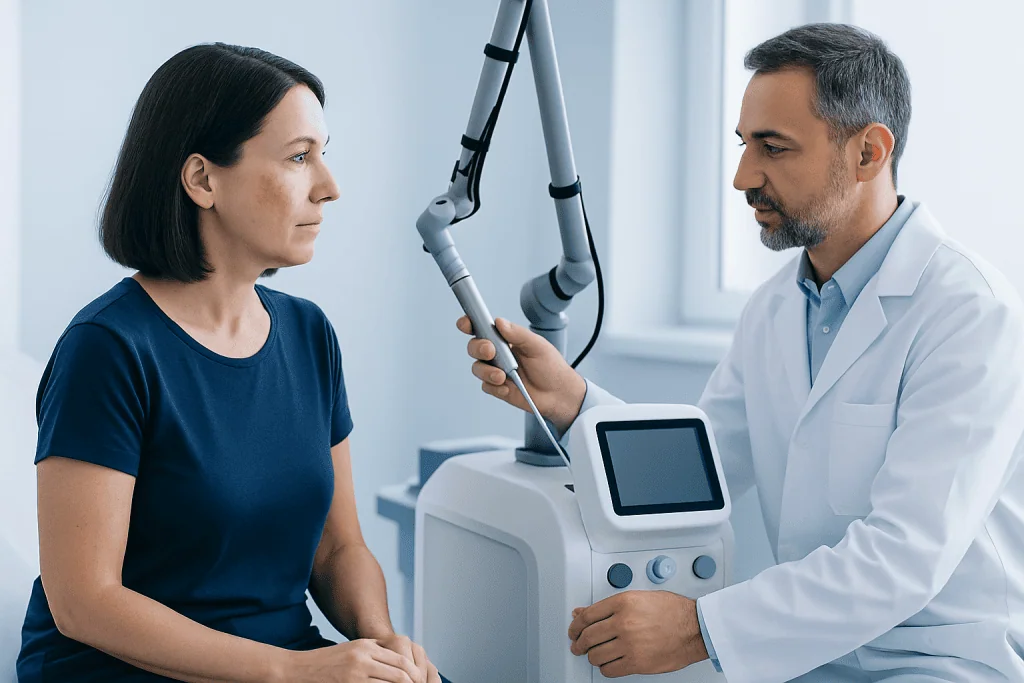
Procedure-based options may produce more visible improvement in selected patients. These include chemical peels, cryotherapy in some cases, and light- or energy-based approaches such as laser treatment. The right option depends on the person’s skin type, the depth of pigmentation, the number of spots, and the balance between expected benefit and the risk of irritation or altered pigmentation.
Some patients also benefit from a broader skin assessment if there are multiple concerns at once, such as texture change, sun damage, or suspicious moles. In those cases, a doctor may recommend ongoing dermatology follow-up or, when a lesion needs removal for diagnosis or treatment, a minor skin procedure. Even after treatment, new age spots can appear if UV exposure continues, which is why sun protection remains essential.
Prevention and self-care for healthier-looking skin
Daily prevention is the most reliable long-term strategy. A broad-spectrum sunscreen with regular reapplication, sun-protective clothing, a wide-brimmed hat, and seeking shade during strong midday sun can all reduce further UV-related pigmentation. Tanning beds are best avoided, as they add to cumulative UV exposure.
Gentle skincare supports the skin barrier and may help the complexion look more even. A mild cleanser, a fragrance-free moisturizer, and carefully chosen brightening products can be useful for some people. Products should be introduced one at a time so the skin can be monitored for irritation. Over-exfoliating or layering too many acids can worsen discoloration.
People should also resist picking, scratching, or using abrasive scrubs on dark spots. If a product causes burning, marked redness, or peeling, it should be stopped and the skin allowed to recover. For persistent or bothersome pigmentation, professional guidance is usually more effective and safer than repeated home experimentation.
Near the end of the care pathway, specialist input can be especially helpful for people with darker skin tones, sensitive skin, or mixed pigmentation problems, since treatment plans need to be individualized. Acibadem International’s multidisciplinary specialists and JCI-accredited hospitals evaluate pigment changes and offer dermatologic treatment options for international patients when appropriate.
When to seek medical care
A medical review is advisable if a spot is new, changing, irregular, multicolored, raised in an unusual way, itchy, painful, crusted, or bleeding. It is also reasonable to seek care if a spot looks distinctly different from the others on the skin or if there is a personal or family history of skin cancer. These changes do not confirm a serious problem, but they do mean the area should not be assumed to be a simple age spot.
People should also see a doctor if self-care is not helping, if over-the-counter products are causing irritation, or if there is uncertainty about the diagnosis. Early evaluation can provide reassurance when the spot is benign and allows timely treatment if it is not. In many cases, diagnosis is straightforward and can be made in the clinic with visual examination and dermoscopy.
Frequently asked questions
Can age spots go away naturally on their own?
True age spots usually do not disappear completely on their own. They may become less noticeable if sun exposure is reduced and sunscreen is used consistently, but they often persist. A doctor can explain whether a spot is an age spot or another type of pigmentation.
What is the best natural way to fade age spots?
The best evidence-based step is daily broad-spectrum sunscreen and sun avoidance measures, because they help prevent darkening and new spots. Some gentle brightening skincare ingredients may modestly improve overall uneven tone, but natural remedies do not reliably remove age spots. Harsh DIY treatments can irritate the skin.
Is lemon juice safe for age spots?
Lemon juice is not considered a reliable or ideal treatment for age spots. It can irritate the skin and may lead to redness, burning, or darker pigmentation afterward, especially in sensitive skin. Safer options include sunscreen and professionally guided skincare.
How can someone tell the difference between an age spot and skin cancer?
Age spots are usually flat, evenly colored, and stable over time. A lesion that changes shape, size, or color; has irregular borders; or itches, bleeds, or crusts should be assessed by a doctor. Dermoscopy and, if needed, biopsy can clarify the diagnosis.
Do over-the-counter creams work on age spots?
Some over-the-counter products may gradually improve mild uneven pigmentation, especially when used with sunscreen. However, results are variable, and true solar lentigines often respond better to prescription treatments or procedures. A dermatologist can recommend the safest option based on skin type and diagnosis.
Are age spots a sign of aging or sun damage?
They are mainly a sign of cumulative sun damage, although they become more common with age because UV exposure adds up over time. The term “age spot” can be misleading, as the main driver is usually long-term ultraviolet exposure. Prevention focuses on sun protection rather than age alone.
References
- American Academy of Dermatology
- National Institute on Aging
- National Cancer Institute
- Mayo Clinic
- British Association of Dermatologists
This article is for general information only and is not a substitute for professional medical advice. Please consult a qualified doctor about your individual situation.
Joint and spine care in Turkey — expert assessment & treatment
JCI-accredited · board-certified surgeons · reply within 24h
Add us as a Preferred Source to see more of our trusted health content across Google Search, AI Overviews and Discover.

More from the Health Library



Related Specialists

Prof. Dr. Umut Akgün
Orthopedic Surgery & Traumatology
Assoc. Prof. Dr. Ferda Çağavi
Neurosurgery
Prof. Dr. Gül Esen İçten
Breast Clinic Clinical Service
Dr. Yusuf İzzet Güngörmüş
Ophthalmology