How to Remove the Warts? A Doctor-Reviewed Answer

Most common warts are benign skin growths caused by human papillomavirus, or HPV. The safest removal method depends on the wart’s type, size, location, and the person’s age and skin health.
Key Takeaways
- Most common warts are benign skin growths caused by human papillomavirus, or HPV.
- The safest removal method depends on the wart’s type, size, location, and the person’s age and skin health.
- Home treatment may help some common warts, but cutting, burning, or picking at them is not recommended.
- Pain, bleeding, rapid change, uncertain diagnosis, or genital warts should be assessed by a doctor.
- Doctors diagnose warts mainly by examining the skin and can offer treatments such as salicylic acid, freezing, or minor procedures.
How to remove the warts depends on where they are, how long they have been present, and whether they are causing symptoms. Many warts are harmless and may go away over time, but some need medical treatment or closer evaluation.
Overview: how to remove the warts
For many people, the answer to how to remove the warts is reassuring: common warts are often harmless, and some disappear on their own as the immune system gradually clears the virus. When treatment is needed, the best option depends on the wart’s location, thickness, number, and whether it is painful, spreading, or cosmetically bothersome.
Warts are small skin growths caused by certain types of human papillomavirus (HPV). They can appear on the hands, feet, face, around the nails, or in the genital area. Although they are common, not every bump is a wart, which is why new, changing, or unusual lesions should not be self-diagnosed with confidence.
A practical approach starts with two questions: does this lesion truly look like a wart, and is it safe to treat at home? If there is pain, bleeding, dark pigmentation, rapid growth, immune suppression, diabetes with foot involvement, or any genital lesion, medical review is the safest next step before attempting removal.
What warts look and feel like
Common warts often feel rough and firm, with a grainy or cauliflower-like surface. They are frequently found on the fingers, backs of the hands, elbows, or knees. Tiny black dots may be visible inside the wart; these are small clotted blood vessels, not “seeds.” Flat warts are smoother and smaller, while filiform warts can look thread-like, especially on the face.
Plantar warts occur on the soles of the feet and may feel tender because body weight presses them inward. Instead of protruding clearly, they may look flattened with a callused surface. People sometimes mistake them for corns or calluses, but plantar warts often interrupt normal skin lines and can hurt when squeezed from the sides.
Warts can be single or multiple. They may stay the same size for months, spread to nearby skin, or slowly resolve. Picking, shaving over them, or sharing nail tools can spread the virus to other parts of the body or to other people.
- Common warts: rough, raised, usually on hands and fingers
- Plantar warts: on the soles, can be painful with walking
- Flat warts: small, smooth, flatter-topped, often on face or legs
- Filiform warts: narrow, finger-like growths, often on face
- Genital warts: need professional medical evaluation rather than home treatment
Why warts happen and who is more likely to get them

Warts develop when HPV enters the outer layer of the skin through tiny breaks. This can happen after minor skin trauma, biting the nails, shaving, or walking barefoot in damp public areas such as pool decks or locker rooms. The virus stimulates extra skin cell growth, forming the visible wart.
Children and teenagers often get warts more easily because their immune systems may not yet have developed strong resistance to the specific virus type. Adults can also develop them, especially if they have frequent skin irritation, moist skin, eczema, or jobs and activities that involve repeated hand trauma.
Some people are more prone to persistent or extensive warts, including those with weakened immune systems. Warts may also spread more easily around the nails or on shaved areas. Genital warts are caused by different HPV types than most common hand and foot warts and should be assessed separately.
When another skin condition may be involved, a dermatologist may need to distinguish a wart from other lesions such as a callus, mole, skin tag, or a form of skin cancer. This is one reason uncertain or changing skin growths should be examined rather than treated repeatedly at home.
How doctors diagnose warts
Doctors usually diagnose warts by looking closely at the skin and asking how long the lesion has been present, whether it hurts, and whether similar growths have appeared elsewhere. They may gently pare away thick surface skin to look for the tiny pinpoint blood vessels that support the diagnosis of a wart.
In most cases, no blood test or scan is needed. The key step is a careful clinical examination to confirm that the growth is actually a wart and not another skin problem. If the lesion is atypical, very dark, ulcerated, rapidly growing, or resistant to standard treatment, the doctor may recommend a small skin sample for laboratory analysis.
For genital lesions, a clinician will assess the area directly and may also discuss sexual health, transmission, and the need for additional evaluation. If a growth is not straightforward, a referral to a specialist in dermatology care may help clarify the diagnosis and guide the most suitable treatment plan.
Treatment options: what can remove warts
The most effective wart removal method varies from person to person. Some warts resolve without treatment, but others persist because the virus remains in the skin. Treatment aims to destroy infected skin, trigger the immune system, or both. Several sessions may be needed, and even successful treatment does not guarantee that a wart will never return.
For common warts on the hands or feet, salicylic acid is a widely used first-line treatment. It gradually softens and removes thickened skin. A doctor may recommend preparing the area by soaking and gently filing dead skin before applying the product regularly for several weeks. This approach requires patience but can be effective when used consistently and safely.
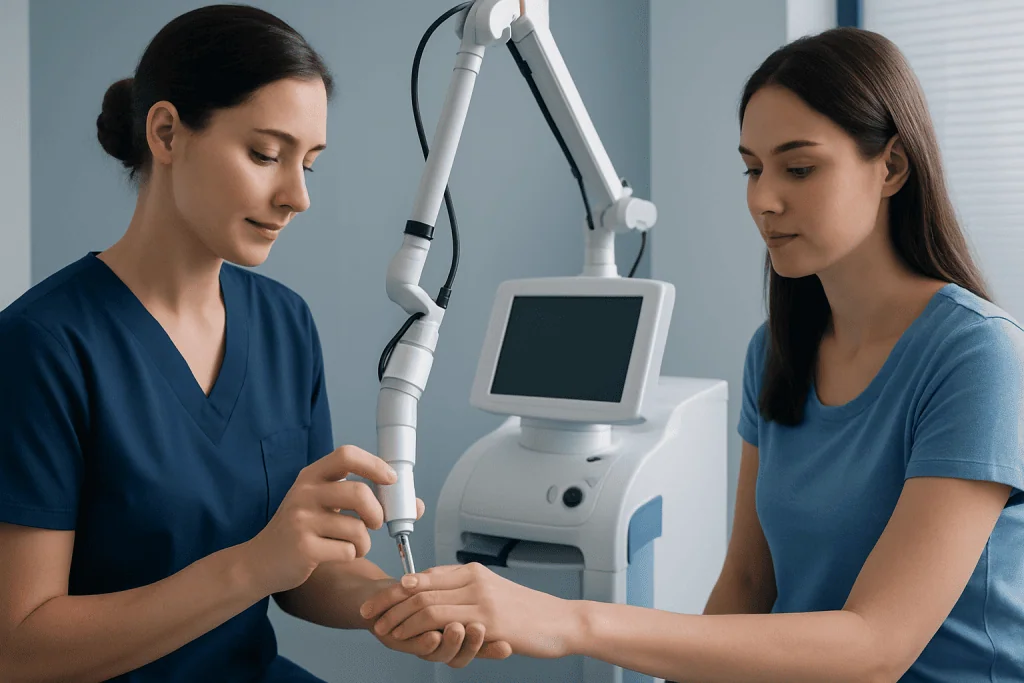
Cryotherapy, often called freezing treatment, is another common option. A clinician applies liquid nitrogen to destroy wart tissue, and the area may blister or peel afterward. Other options for stubborn warts include prescription topical medicines, electrocautery, curettage, laser treatment, or immunotherapy in selected cases. When a lesion is difficult, extensive, or in a sensitive area, a doctor may coordinate care through specialist dermatology treatment or, in selected cases, laser treatment.
- Salicylic acid for suitable common or plantar warts
- Cryotherapy for many office-based cases
- Minor procedures for persistent, painful, or thick warts
- Prescription treatments for selected types of warts
- Specialized management for genital or recurrent warts
What not to do at home and self-care tips
Home care can be helpful for some common warts, but safety matters. It is not recommended to cut, dig out, burn, or tie off a wart at home. These methods can cause infection, scarring, bleeding, and delay the correct diagnosis if the growth is not actually a wart.
Over-the-counter wart products should be used only as directed and usually should not be applied to the face, genitals, or broken skin unless a clinician specifically advises it. People with diabetes, poor circulation, or reduced sensation in the feet should be especially cautious with self-treatment because skin injury can be harder to detect and heal.
Simple habits can also reduce spread. Avoid picking at the wart, keep it clean and dry, do not share towels or nail tools, and wear footwear in communal wet areas. If shaving triggers spread, trimming around the area rather than shaving directly over it may help until the wart is treated.
If a wart is bothersome, recurrent, or affecting confidence or daily activities, professional removal may be more effective and less frustrating than repeated unsuccessful home treatment. In international settings, Acibadem International’s multidisciplinary specialists and JCI-accredited hospitals diagnose and treat skin conditions for patients seeking coordinated care.
When to seek medical care
Medical review is important if a suspected wart is painful, bleeding, rapidly changing, infected-looking, or located on the face, genitals, or under the nails. A doctor should also assess any lesion that is very dark, irregular, ulcerated, or simply does not look typical. This helps rule out other skin conditions that can resemble warts.
Foot lesions deserve extra caution in people with diabetes, circulation problems, or reduced sensation. In these situations, even a small area of skin damage can become more serious, so self-treatment is not the safest first option. Recurrent warts, many warts at once, or warts in someone with a weakened immune system also justify professional assessment.
A doctor can also help when home treatment has failed after several weeks, when walking becomes painful, or when the diagnosis is uncertain. If related concerns such as suspicious moles or severe skin changes are present, the clinician may broaden evaluation or consider care pathways used for conditions such as skin cancer.
Frequently asked questions
Can warts go away without treatment?
Yes. Many common warts eventually go away on their own as the immune system recognizes and clears the virus from the skin. This can take months or sometimes longer, so some people choose treatment because the wart is painful, spreading, or bothersome.
What is the fastest way to remove a wart?
There is not one single fastest method for everyone. Office treatments such as cryotherapy or minor procedures may work more quickly than home options, but the right choice depends on the wart’s type, location, and whether the diagnosis is certain.
Is it safe to remove a wart at home?
Some common hand or foot warts can be treated at home with appropriate over-the-counter products used exactly as directed. It is not safe to cut, burn, or pick at a wart, and home treatment is not recommended for facial, genital, uncertain, painful, or bleeding lesions.
Why do warts come back after treatment?
Warts can recur because the virus may persist in nearby skin even after the visible lesion is removed. Recurrence does not always mean treatment failed completely; sometimes more than one treatment session is needed, or the immune system needs more time to clear the infection.
Are warts contagious?
Yes, warts can spread through direct skin contact or by sharing items such as razors, nail tools, or towels. They are usually only mildly contagious, but small breaks in the skin make transmission easier, which is why covering the area and avoiding picking can help.
When should someone worry that a wart may be something else?
A lesion should be checked if it is dark, irregular, rapidly changing, ulcerated, persistently bleeding, or not responding as expected to treatment. Any growth on the genitals, face, or under the nails also deserves medical assessment because several other skin conditions can look similar.
References
- American Academy of Dermatology
- Centers for Disease Control and Prevention
- National Health Service
- Mayo Clinic
- DermNet
This article is for general information only and is not a substitute for professional medical advice. Please consult a qualified doctor about your individual situation.
Explore treatments in Turkey — costs, top hospitals & a free quote
JCI-accredited · board-certified surgeons · reply within 24h
Add us as a Preferred Source to see more of our trusted health content across Google Search, AI Overviews and Discover.

More from the Health Library



Related Specialists

Dr. Hacer Tuğça Malişi
Pediatrics
Prof. Dr. M. Nadir Şener
Orthopedic Surgery & Traumatology
Dr. Melis Erciyes Küçük
Internal Medicine
Fzt. Neslihan Yıldızdağı
Pediatric Rehabilitation