Joint Anatomy Explained: Types, Tissues, and How Movement Happens

Joints connect bones and allow different degrees of movement and stability. The main joint types are fibrous, cartilaginous, and synovial joints.
Key Takeaways
- Joints connect bones and allow different degrees of movement and stability.
- The main joint types are fibrous, cartilaginous, and synovial joints.
- Cartilage, ligaments, tendons, muscles, and synovial fluid all work together to support movement.
- Synovial joints such as the knee, shoulder, and hip are the most mobile and most commonly affected by injury.
- Healthy movement depends on joint alignment, muscle strength, flexibility, and tissue protection.
- Persistent pain, swelling, locking, or reduced function should be assessed by a doctor.
Joints are the places where two or more bones meet, helping the body move, bear weight, and stay stable. Understanding joint anatomy can make it easier to recognize how normal movement happens and why pain, stiffness, or injury may develop.
Overview: What Is a Joint?
A joint is the point where two or more bones meet. Joints are essential for both movement and stability. Some joints allow a wide range of motion, such as the shoulder, while others are designed mainly to provide support, such as the joints between certain bones of the skull.
Joint anatomy is not limited to bones alone. A working joint also depends on cartilage, ligaments, tendons, muscles, joint capsules, and in many cases synovial fluid. These structures help reduce friction, absorb shock, guide motion, and keep the bones aligned as the body moves.
Different joints are adapted for different tasks. For example, the hip joint must support body weight during standing and walking, while the fingers need fine, precise motion for gripping and writing. This balance between mobility and stability is a key feature of human joint design.
Types of Joints in the Body
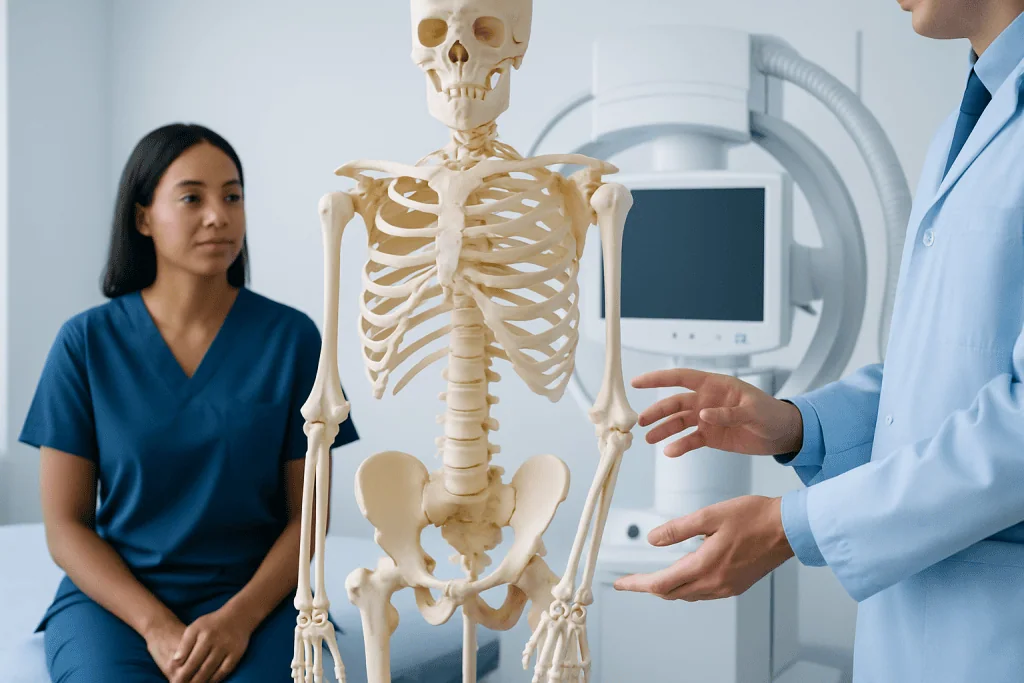
Joints are often classified by structure and by how much movement they allow. The three main structural types are fibrous, cartilaginous, and synovial joints. Each type has a specific role in the body.
Fibrous joints are connected by dense connective tissue and usually allow little or no movement. Examples include the sutures of the skull. Cartilaginous joints are linked by cartilage and provide limited movement, such as the joints between the vertebrae and the connection between the ribs and sternum.
Synovial joints are the most mobile and the most familiar. These include the knee, shoulder, elbow, hip, wrist, and ankle. They contain a joint cavity and specialized tissues that allow smooth motion. Most day-to-day actions, from walking to lifting to turning the head, rely on synovial joints.
Synovial joints can be divided further by shape and motion pattern:
- Ball-and-socket joints: shoulder and hip; allow movement in many directions
- Hinge joints: elbow, knee, fingers; mainly allow bending and straightening
- Pivot joints: upper neck and forearm; allow rotation
- Condyloid joints: wrist and knuckles; allow movement in two planes
- Saddle joints: thumb; support grasping and pinching
- Gliding joints: small joints in the wrist and foot; allow sliding motions
The Main Tissues That Make Up a Joint
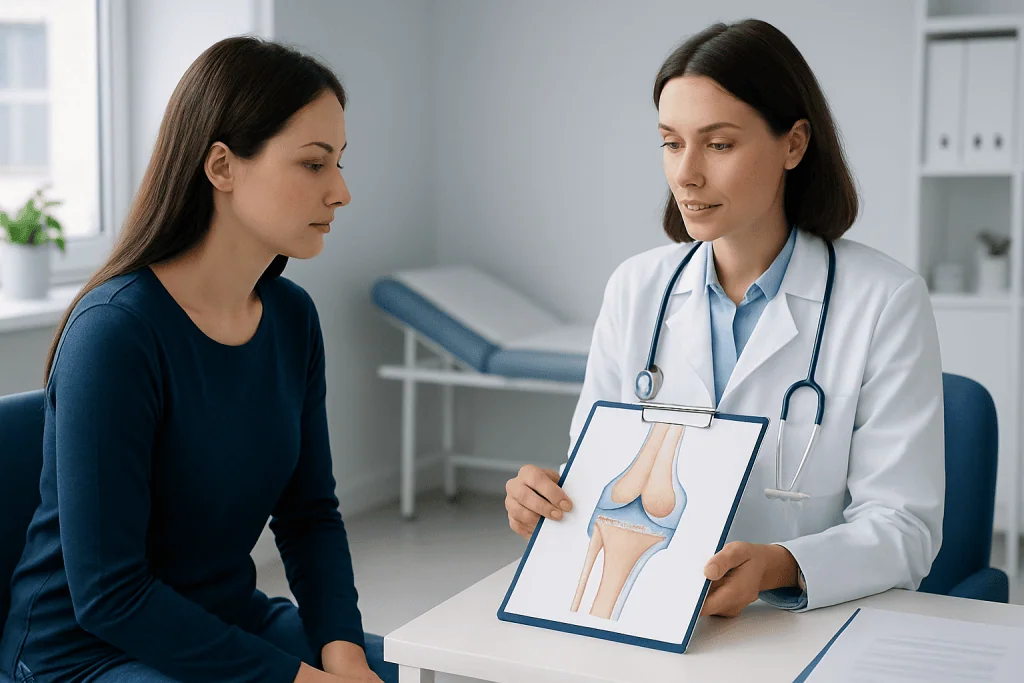
Bones form the framework of a joint, but the surfaces where they meet are usually covered with articular cartilage. This smooth, firm tissue helps the bones glide over one another with minimal friction. Cartilage also helps distribute pressure, especially in weight-bearing joints like the knees and hips.
Ligaments are strong bands of connective tissue that connect bone to bone. They help stabilize the joint and limit excessive motion. Tendons are different from ligaments: they connect muscle to bone. When muscles contract, tendons transmit force to the bones, creating movement across the joint.
Many movable joints are enclosed by a joint capsule. The inner lining of this capsule, called the synovial membrane, produces synovial fluid. This fluid lubricates the joint, nourishes cartilage, and supports smooth movement. In some joints, additional structures such as menisci, labrum, or bursae improve fit, cushioning, and motion control.
Muscles also play a major role in joint health. Even a well-formed joint depends on surrounding muscles for support and coordination. If muscles are weak, tight, or imbalanced, the joint may move less efficiently and become more prone to strain or wear over time.
How Movement Happens
Movement happens when the nervous system signals a muscle to contract. The contracting muscle pulls on its tendon, which then moves a bone at the joint. Because joints act like mechanical meeting points, the shape of the joint and the condition of its supporting tissues determine how that movement occurs.
Most motions can be described in basic terms such as flexion and extension, abduction and adduction, and rotation. Flexion means bending a joint, while extension means straightening it. Abduction moves a body part away from the midline, and adduction brings it back. Rotation turns a bone around its axis, as seen in the neck or shoulder.
Joints do not work in isolation. Walking, reaching, climbing stairs, or standing from a chair all require several joints to move together in a coordinated sequence. Healthy cartilage reduces friction, ligaments guide motion, and muscles help control speed and direction. When any part of this system is irritated or damaged, movement can become painful, stiff, weak, or unstable.
Good posture, strength, flexibility, and balance all influence how well joints move. This is one reason rehabilitation and physical therapy and rehabilitation can be helpful after injury or surgery, as well as for many long-term joint conditions.
Common Joint Problems and Why They Develop
Joint symptoms can develop for many reasons, including injury, overuse, age-related wear, inflammation, infection, or underlying disease. Strains and sprains may affect the surrounding tissues, while tears in cartilage or ligaments can disrupt stability and movement. Repetitive activities may also place stress on certain joints over time.
One of the most common long-term joint conditions is osteoarthritis, in which the cartilage gradually wears down and the joint may become painful or stiff. Inflammatory conditions such as rheumatoid arthritis can affect the joint lining and lead to swelling, warmth, and reduced function. These conditions differ in cause, but both can interfere with normal movement.
Other joint problems include dislocation, bursitis, tendon irritation, meniscus injury, and labral tears. The knee and shoulder are especially vulnerable because they are used often and can be exposed to sports injuries, falls, or repetitive strain. In some people, pain may come from structures near the joint rather than from the joint itself.
Risk factors vary by condition but often include aging, previous injury, obesity, heavy physical load, poor biomechanics, muscle weakness, family history, and autoimmune disease. Recognizing these factors can help people protect their joints and seek care early when symptoms do not improve.
How Joint Problems Are Diagnosed
Diagnosis usually begins with a medical history and physical examination. A doctor will ask about pain, stiffness, swelling, instability, locking, injury, activity level, and how symptoms affect daily life. During the exam, the joint may be checked for tenderness, range of motion, strength, alignment, and signs of inflammation.
Imaging tests may be used when needed. X-rays can show bone alignment, fractures, and changes related to arthritis. Soft tissues such as ligaments, tendons, cartilage, and menisci are often assessed more clearly with MRI. Ultrasound may also be useful for certain tendon or fluid-related problems.
In some cases, blood tests can help evaluate inflammatory or autoimmune causes of joint symptoms. If infection, gout, or unexplained swelling is suspected, a doctor may recommend analyzing fluid from the joint. The goal is to identify the source of symptoms accurately so that treatment can be matched to the underlying problem.
Treatment Options and Self-Care
Treatment depends on the cause, the joint involved, and the severity of symptoms. Many joint problems improve with a combination of rest, activity modification, exercise, supportive devices, and medication recommended by a doctor. Rehabilitation often focuses on reducing pain, restoring range of motion, and strengthening the muscles that support the joint.
For inflammatory conditions, treatment may include medicines that reduce inflammation or regulate immune activity under specialist supervision. For mechanical problems, structured exercise and movement retraining are often central. Injections may be considered in selected cases, depending on the diagnosis and treatment goals.
When there is advanced damage, significant instability, or failure of conservative treatment, surgery may be appropriate. Depending on the problem, this could include minimally invasive arthroscopy or, in severe joint degeneration, knee replacement for carefully selected patients. A doctor can explain the expected benefits, risks, and recovery process for each option.
Self-care also matters. Helpful strategies often include maintaining a healthy weight, staying physically active, warming up before exercise, using proper technique during sports or lifting, and avoiding long periods of immobility. Near the end of the care pathway, some international patients may choose centers such as Acibadem International, where multidisciplinary specialists in JCI-accredited hospitals diagnose and treat joint conditions.
When to See a Doctor
Mild joint discomfort after unusual activity may improve with rest and time. However, medical advice is important if pain persists, returns frequently, or starts to limit walking, work, sleep, or daily tasks. Stiffness lasting a long time in the morning or recurring swelling should also be evaluated.
Urgent assessment is recommended if a joint looks deformed, cannot bear weight, suddenly locks, or becomes very swollen after an injury. Redness, warmth, fever, or severe pain can suggest inflammation or infection and should not be ignored.
Early diagnosis can help protect joint function and prevent unnecessary worsening. Whether symptoms are caused by injury, arthritis, or another problem, a qualified doctor can guide the next steps and tailor treatment to the person’s needs.
Frequently asked questions
What is the main function of a joint?
A joint connects two or more bones and helps the body move in a controlled way. It also provides stability, absorbs forces, and supports activities such as walking, lifting, and turning.
What are the three main types of joints?
The three main structural types are fibrous, cartilaginous, and synovial joints. Synovial joints are the most mobile and include joints such as the shoulder, hip, knee, and elbow.
What tissues help a joint move smoothly?
Cartilage covers the ends of bones to reduce friction, and synovial fluid lubricates many movable joints. Ligaments stabilize the joint, while muscles and tendons create and control movement.
Why do joints become painful or stiff?
Joint pain or stiffness can result from injury, overuse, inflammation, arthritis, or problems in nearby muscles and tendons. The exact cause is not always the same, so persistent symptoms should be assessed by a doctor.
Which joints are most likely to be injured?
The knee, shoulder, ankle, and wrist are commonly injured because they are heavily used in sports, work, and daily movement. Joints that combine mobility with load-bearing or repetitive use may be more vulnerable.
Can joint problems improve without surgery?
Yes, many joint problems improve with non-surgical treatment such as exercise therapy, activity changes, weight management, and medicines recommended by a clinician. Surgery is usually considered when symptoms are severe or when other treatments do not help enough.
References
- World Health Organization
- National Institute of Arthritis and Musculoskeletal and Skin Diseases
- American Academy of Orthopaedic Surgeons
- MedlinePlus
- National Health Service
This article is for general information only and is not a substitute for professional medical advice. Please consult a qualified doctor about your individual situation.
Joint and spine care in Turkey — expert assessment & treatment
JCI-accredited · board-certified surgeons · reply within 24h
Add us as a Preferred Source to see more of our trusted health content across Google Search, AI Overviews and Discover.