Kinesiology Tape Knee: What Patients Need to Know

Kinesiology tape is stretchy and is designed to move with the skin, unlike rigid athletic tape. It may offer short-term pain relief or improve confidence with movement for some knee conditions.
Key Takeaways
- Kinesiology tape is stretchy and is designed to move with the skin, unlike rigid athletic tape.
- It may offer short-term pain relief or improve confidence with movement for some knee conditions.
- Correct placement, skin preparation, and an appropriate amount of stretch are important for safe use.
- Tape does not repair torn tissue, correct major knee instability, or replace strengthening and rehabilitation.
- New swelling, inability to bear weight, a locked knee, fever, or severe pain needs prompt medical assessment.
Kinesiology tape knee support is an elastic adhesive tape applied around the knee to provide gentle sensory feedback and, for some people, short-term pain relief during activity. It can be part of a broader rehabilitation plan, but it should not be used to diagnose, mask, or independently treat a knee injury.
Kinesiology Tape Knee: What It Can and Cannot Do
Kinesiology tape knee applications use a flexible, adhesive cotton-based tape placed on the skin around the kneecap, thigh, or lower leg. The tape is intended to move with the body rather than firmly restrict movement. Some people use it during exercise, sport, daily activities, or rehabilitation when knee pain makes movement feel uncomfortable.
Research suggests that kinesiology tape may provide modest, short-term benefits for pain or function in some people, particularly when used alongside exercise therapy. Its effects vary considerably: some people feel more comfortable or confident when moving, while others notice little change. The tape is not a cure for knee pain and does not heal cartilage damage, ligament tears, fractures, or arthritis.
A useful way to view taping is as a temporary support tool. It may help a person stay engaged in a clinician-guided rehabilitation program, but it should not be used to push through significant pain or return to sport before the knee is ready. Persistent or recurring symptoms deserve a clear diagnosis rather than repeated taping alone.
How Kinesiology Tape May Affect the Knee
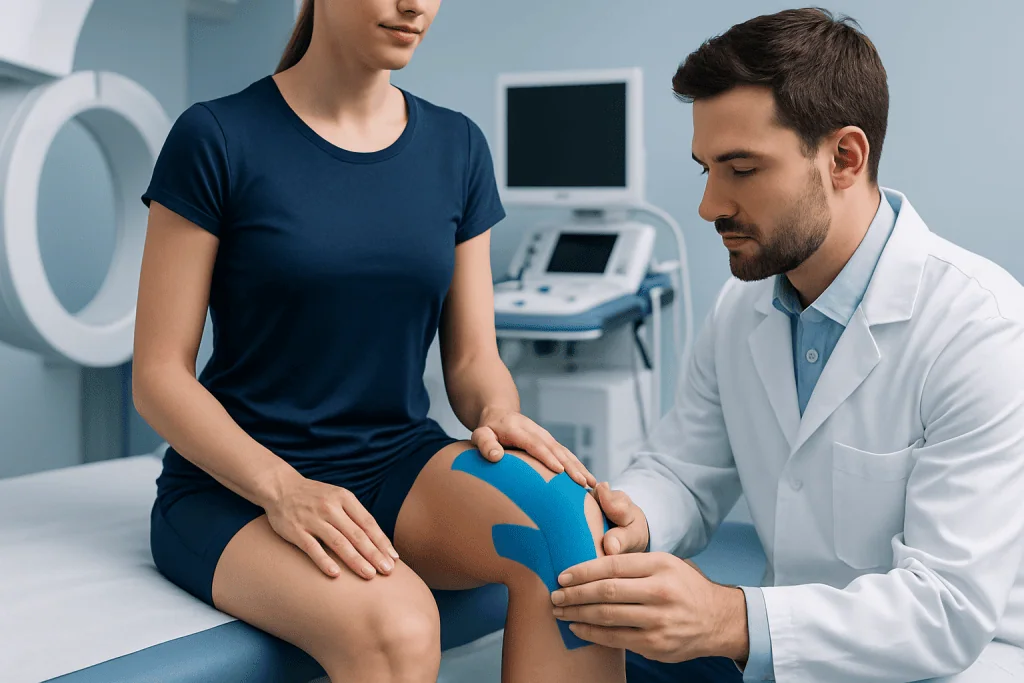
The proposed effects of kinesiology tape are mainly related to sensation rather than structural support. The tape stimulates skin receptors as the knee bends and straightens. This may increase awareness of knee position and movement, sometimes called proprioception, and may influence how a person moves during walking, squatting, stairs, or exercise.
Some taping approaches are designed to cue the kneecap to track more comfortably during movement. Others are applied over painful soft tissues or muscles to provide a sense of support. However, the tape does not physically hold the kneecap, ligaments, or joint in place with the same degree of support as a brace or rigid tape.
Because pain is influenced by activity, muscle strength, sleep, stress, prior injury, and tissue health, no single tape pattern works for everyone. A physiotherapist, sports medicine clinician, or other qualified healthcare professional can assess whether taping has a reasonable role and can teach an application that fits the person’s diagnosis and goals.
Knee Problems for Which Taping May Be Considered

Kinesiology tape is sometimes used for patellofemoral pain, often felt at the front of the knee during stairs, running, squatting, or prolonged sitting. It may also be considered during rehabilitation for mild overuse symptoms involving the quadriceps tendon, patellar tendon, or surrounding muscles. In these settings, tape is typically combined with progressive strengthening of the hip, thigh, and calf muscles.
People with <a href="https://acibademinternational.com/diseases/knee-osteoarthritis/”>knee osteoarthritis may occasionally use tape for short periods to make walking or exercise more tolerable. Osteoarthritis management usually also includes education, appropriate physical activity, weight management when relevant, and individualized pain treatment. For more information about this common condition, see knee osteoarthritis.
Tape may be used after a minor injury once serious damage has been excluded and a clinician has advised activity progression. It is not an appropriate stand-alone response to a suspected ligament rupture, meniscus tear, fracture, joint infection, or blood clot. A knee that gives way repeatedly, catches or locks, or becomes markedly swollen should be assessed before self-treatment.
- Potentially useful as an adjunct: mild anterior knee pain, selected overuse symptoms, and rehabilitation-related movement confidence.
- Not a substitute for assessment: acute twisting injuries, major swelling, deformity, inability to bear weight, or persistent instability.
- Not a replacement for rehabilitation: strength, mobility, balance, and gradual return to activity remain central to recovery.
Safe Application: Practical Points Before Using Tape
The skin should be clean, dry, and free of oils, lotions, or broken areas before tape is applied. Hair may be trimmed if needed to improve adhesion and reduce discomfort during removal. The tape should generally be placed with the knee in a comfortable position, following a technique recommended for the specific condition rather than copying a generic pattern from social media.
Too much stretch can irritate the skin and does not necessarily provide more benefit. The ends of the tape are commonly applied without tension to reduce peeling and skin pulling. After application, the tape may be gently rubbed to activate the adhesive. It should feel comfortable; numbness, tingling, worsening pain, coldness, or color changes below the tape are reasons to remove it promptly.
Many products can be worn for several days if the skin remains healthy, but the instructions on the specific product should be followed. Tape should be removed slowly, preferably while supporting the skin and peeling back low and parallel to the body rather than pulling upward. Applying oil or removing it in the shower may make removal easier for some people.
When knee symptoms require a structured plan, rehabilitation may include physical therapy to address the movement patterns, muscle weakness, flexibility limitations, and activity demands contributing to pain. Taping may be trialed during this process and continued only if it provides a meaningful, safe benefit.
Who Should Avoid or Use Extra Caution With Kinesiology Tape
People with known allergy or sensitivity to adhesives should be cautious. A small test strip on an unaffected area of skin for about a day can help identify irritation before a larger application, although a negative test does not guarantee that a reaction will not occur. Itching, burning, rash, blisters, or skin breakdown means the tape should be removed and not reapplied until the skin has recovered.
Tape should not be placed over open wounds, active rashes, sunburn, fragile skin, infected skin, or areas with reduced sensation. People with diabetes, poor circulation, lymphedema, a history of blood clots, nerve problems, or significant skin conditions should ask a clinician before using tape, especially if they have reduced ability to detect irritation or pressure.
Pregnancy, cancer treatment, and recent surgery do not automatically rule out taping, but they may change what is appropriate. A clinician should advise on placement near surgical scars, areas of swelling, or treated lymph nodes. Children and older adults may also need assistance with skin checks and tape removal.
Making Tape Part of Knee Recovery and Self-Care
For most non-urgent knee pain, the long-term focus is on identifying the cause and gradually restoring comfortable function. This may involve temporarily adjusting activities that consistently worsen symptoms, then building them back up in manageable steps. Complete rest for long periods can lead to stiffness and weakness, so activity changes are best individualized.
Exercises commonly focus on the quadriceps, hip muscles, calves, balance, and control of knee alignment during everyday tasks. A clinician can tailor the program to a person’s age, sport, work demands, previous injuries, and diagnosis. Supportive footwear, pacing, sleep, and maintaining a healthy body weight where appropriate can also help reduce stress on the knee.
Cold or heat may provide temporary comfort for some people, depending on the nature and timing of symptoms. Over-the-counter pain medicines may be suitable for certain adults, but they are not safe for everyone and should be discussed with a pharmacist or doctor when there are other medical conditions or regular medicines. If symptoms persist, evaluation may include an examination and, when clinically necessary, imaging or other treatments such as knee replacement surgery for advanced joint disease.
Acibadem International’s multidisciplinary specialists and JCI-accredited hospitals assess and treat knee conditions for international patients, with care plans based on the individual diagnosis and functional needs.
When to Seek Medical Care
Urgent medical care is important after a knee injury with visible deformity, severe swelling, inability to take steps, intense pain, or a sensation that the knee has dislocated. Prompt assessment is also needed if the knee becomes hot, red, and very painful, particularly with fever or feeling unwell, as these symptoms can indicate infection or another condition requiring urgent treatment.
A person should arrange a medical evaluation if knee pain does not improve with sensible activity changes, if it repeatedly returns, or if it affects sleep, work, walking, or sport. Catching, locking, repeated giving way, persistent swelling, or loss of normal range of motion can point to problems that tape cannot address.
Calf swelling, warmth, tenderness, or sudden shortness of breath should not be attributed to a knee problem or treated with tape. These symptoms require urgent medical attention. A clinician can determine whether symptoms are coming from the knee itself, nearby tissues, or another source and recommend the safest next step.
Frequently asked questions
Does kinesiology tape help knee pain?
Kinesiology tape may reduce pain or improve comfort with movement for some people in the short term. Benefits are usually modest and vary between individuals. It works best as one component of a broader plan that addresses the cause of knee symptoms.
How long can kinesiology tape stay on the knee?
Many kinesiology tape products are designed to be worn for several days, provided the skin remains comfortable and the product instructions allow it. The tape should be removed sooner if it causes itching, burning, rash, numbness, increased pain, or circulation changes. It should not be reapplied over irritated or damaged skin.
Can kinesiology tape stabilize a knee ligament injury?
No. Kinesiology tape is elastic and does not provide the level of mechanical stabilization needed for a significant ligament injury. A brace, rehabilitation program, or other treatment may be recommended depending on the injury. Anyone who has instability, major swelling, or difficulty bearing weight should be assessed by a clinician.
Is kinesiology tape the same as athletic tape?
No. Kinesiology tape is stretchy and intended to move with the skin, whereas traditional athletic tape is usually more rigid and is used to limit certain movements or provide firmer support. The choice depends on the condition, activity, and treatment goal. A healthcare professional can advise which, if either, is appropriate.
Can people with knee arthritis use kinesiology tape?
Some people with knee arthritis find that tape makes walking or exercise more comfortable for a short time. It does not reverse arthritis or replace exercise, weight management when appropriate, and medical treatment. A clinician can help decide whether a supervised trial is reasonable.
Should kinesiology tape be painful or tight?
No. The tape should feel supportive but not painful, restrictive, or overly tight. Tingling, numbness, coolness, skin color changes, or worsening symptoms are not expected and mean the tape should be removed. If symptoms continue after removal, medical advice is appropriate.
This article is for general information only and is not a substitute for professional medical advice. Please consult a qualified doctor about your individual situation.
Joint and spine care in Turkey — expert assessment & treatment
JCI-accredited · board-certified surgeons · reply within 24h
Add us as a Preferred Source to see more of our trusted health content across Google Search, AI Overviews and Discover.

More from the Health Library

Botox Frown Lines — Explained by Medical Evidence, Not Myths

Sleeping Pills: What Patients Need to Know

Transfeminine — Explained by Medical Evidence, Not Myths

Ashwagandha: An Evidence-Based Guide for Patients

Perky Nipples: What Patients Need to Know

Hamstring Injury — Explained by Medical Evidence, Not Myths
Orthopedic Surgery & Traumatology Specialists at Acibadem

Fzt. A.Sercan Soyarslan
Physical Medicine & Rehabilitation
Dr. Abdullah Yener İnce
Orthopedic Surgery & Traumatology
Dr. Adnan Abbasoğlu
Orthopedic Surgery & Traumatology
Prof. Dr. Ahmet Alanay
Orthopedic Surgery & Traumatology