

LASIK Age Limit: An Evidence-Based Patient Guide

LASIK is usually considered only after age 18 and after a stable glasses or contact lens prescription has been confirmed. There is no automatic upper age cutoff; healthy eyes and realistic goals matter more than age alone.
Key Takeaways
- LASIK is usually considered only after age 18 and after a stable glasses or contact lens prescription has been confirmed.
- There is no automatic upper age cutoff; healthy eyes and realistic goals matter more than age alone.
- People over 40 may still have LASIK, but reading glasses are commonly needed because of presbyopia.
- For adults over 60, cataracts and lens-based vision correction may be more appropriate than corneal laser surgery.
- A detailed eye examination is essential to assess corneal thickness, tear film, retinal health and the natural lens.
- LASIK can reduce dependence on distance glasses or contact lenses, but it cannot guarantee perfect vision or prevent age-related eye conditions.
The LASIK age limit is generally a minimum age of 18, when vision is more likely to be stable. There is no universal maximum age, but the suitability of LASIK later in life depends on prescription stability, eye-surface health, cataract changes and individual visual goals.
LASIK Age Limit: The Answer at a Glance
The usual LASIK age limit is a minimum age of 18 years, although many eye surgeons prefer to see a stable prescription for at least one year before recommending surgery. This helps reduce the chance that later changes in short-sightedness, long-sightedness or astigmatism will affect the result.
There is no single maximum age limit for LASIK. Instead, an ophthalmologist considers the health of the cornea, tear film, retina and natural lens, alongside the person’s prescription, general health and everyday visual needs. As people get older, presbyopia and cataracts become more important in deciding whether LASIK is the most suitable option.
The term “LASIK age restriction” can therefore be misleading. Age is one part of an individual assessment, not a stand-alone rule. A comprehensive consultation can clarify whether laser vision correction, glasses, contact lenses or a lens-based procedure is most appropriate.
How LASIK Works and What It Can Correct
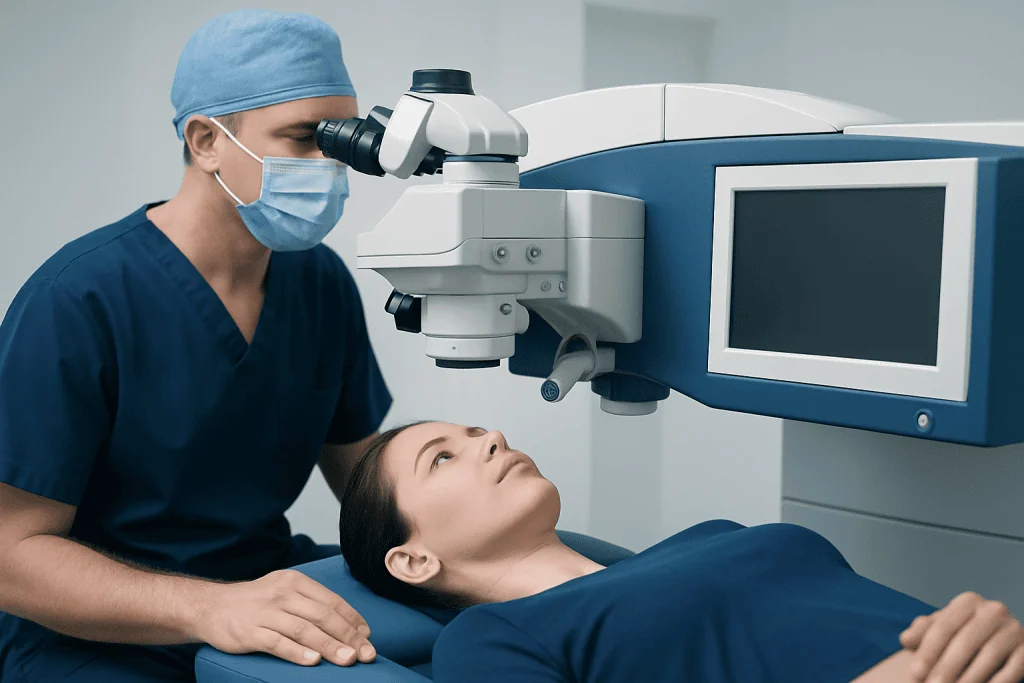
LASIK, short for laser-assisted in situ keratomileusis, is a refractive eye procedure. It reshapes the clear front surface of the eye, called the cornea, so that incoming light focuses more accurately on the retina. This can reduce dependence on glasses or contact lenses for short-sightedness, long-sightedness and astigmatism.
During LASIK, the surgeon creates a very thin corneal flap using a femtosecond laser or a precise surgical instrument. The flap is lifted, an excimer laser removes a carefully calculated amount of corneal tissue, and the flap is repositioned. It naturally adheres without stitches.
The treatment is designed around measurements taken before surgery, including corneal shape and thickness, pupil size and prescription. A discussion of LASIK eye surgery can help patients understand the testing, potential outcomes and alternatives relevant to their eyes.
LASIK changes the cornea; it does not stop normal aging of the eye. In particular, it does not prevent presbyopia, cataracts, glaucoma, retinal disease or dry eye disease. Continued routine eye care remains important after surgery.
LASIK Age Recommendation and Candidacy Checks
A common LASIK age recommendation is to wait until at least 18 years old, with a prescription that has remained reasonably stable. Refractive changes may continue in the late teenage years and early twenties, especially in people with progressing short-sightedness. Individual requirements can vary by country, laser system and clinical assessment.
Beyond age, suitability depends on having a prescription within the range the laser can safely treat and having adequate corneal thickness and regular corneal shape. The clinician will also check for conditions such as keratoconus, significant dry eye, corneal scarring, active eye infection, uncontrolled diabetes, autoimmune disease affecting healing, or retinal problems that may require treatment or make LASIK less suitable.
Contact lens wear can temporarily alter corneal measurements. The eye team will advise when lenses should be stopped before preoperative tests. A dilated eye examination may also be needed to assess the retina, especially for people with high short-sightedness or symptoms such as flashes and new floaters.
- Vision and refraction testing checks whether the prescription is stable.
- Corneal mapping and thickness measurements assess safety for laser reshaping.
- Tear-film testing identifies dry eye that may need treatment first.
- Lens and retinal examinations identify cataracts or other age-related eye conditions.
- A lifestyle discussion considers night driving, close-work needs, sport and expectations.
Is There a Maximum Age Limit for LASIK?
No. There is no formal maximum age limit for LASIK that applies to everyone. An otherwise healthy person in later adulthood may be eligible if the corneas are suitable, the prescription is appropriate and there is no visually significant cataract or other eye disease.
However, the clinical decision often changes with age because the natural lens inside the eye changes over time. Early cataracts can cause glare, reduced contrast, fading of colours or fluctuating vision. Reshaping the cornea with LASIK may be less useful if cataract surgery is likely to be needed in the near future.
For some older adults, replacing a cloudy or aging lens may better address the source of vision change. The appropriate choice should be made after an ophthalmic examination and a conversation about priorities, including distance vision, reading vision and night-time driving.
Rather than focusing on a LASIK age limitation alone, patients benefit from asking whether LASIK is likely to remain useful for their expected eye-health needs over the coming years.
Can I Do LASIK After 40?
Many people can do LASIK after 40 if they meet the same corneal and eye-health criteria as younger adults. LASIK may improve unaided distance vision for people who are short-sighted, long-sighted or have astigmatism. Yet, after about age 40, most adults gradually develop presbyopia, an age-related reduction in the eye’s ability to focus at close range.
As a result, a person who has LASIK for clear distance vision may still need reading glasses for phones, books, labels or close computer work. This is not usually a complication of LASIK; it is a normal lens-related change that occurs with aging, including in people who have never had laser vision correction.
Some people explore monovision, where one eye is adjusted mainly for distance and the other for near tasks. This approach can be helpful for selected patients but may reduce depth perception or visual quality in some settings. A contact lens trial is often used before surgery to see how comfortably the brain adapts.
Patients considering LASIK after 40 should discuss their work, hobbies and tolerance for reading glasses openly. The best outcome is one that matches the person’s visual priorities, rather than one based solely on freedom from all spectacles.
At What Age Is LASIK Not Worth It?
There is no particular age at which LASIK is automatically “not worth it.” Its value depends on a person’s eye health, prescription, expected need for cataract surgery, lifestyle and desired balance between distance and near vision. For example, LASIK may still be reasonable for an older adult with stable refraction, healthy corneas and no meaningful lens clouding.
LASIK may be less appealing when a cataract is already affecting vision or is expected to require surgery soon. In that situation, cataract surgery can correct the cloudy lens and may offer opportunities to address refractive error with an appropriately selected intraocular lens. An ophthalmologist can explain the timing and trade-offs without assuming that one option fits everyone.
It may also be unsuitable when a person has advanced dry eye, an irregular or thin cornea, unstable prescription, uncontrolled medical conditions affecting healing, or expectations that surgery cannot realistically meet. Glasses and contact lenses remain safe, effective options for many people.
The right question is not only whether a person meets the LASIK age limit, but whether the expected benefit is meaningful and durable for that person’s eyes and daily life.
Can You Get LASIK if You Are Over 60?
Yes, it may be possible to get LASIK if a person is over 60, but careful screening is particularly important. The eye specialist will look closely for cataracts, dry eye, glaucoma, retinal disease and corneal changes. These conditions become more common with age and can influence safety, visual quality or the most appropriate treatment choice.
Some adults over 60 have clear natural lenses and suitable corneas, and LASIK can be considered. Others may be better served by monitoring early cataract changes or planning cataract surgery when clinically indicated. The decision is individualized and should not be based on age alone.
Older patients should also consider that LASIK does not restore the youthful focusing ability of the natural lens. Reading glasses, task-specific glasses or a monovision strategy may still be needed. Clear discussion of these possibilities helps avoid disappointment.
People with an established diagnosis of cataract should seek individualized advice from an ophthalmologist before pursuing corneal laser surgery. The timing of vision correction is important when lens changes are present.
Procedure, Recovery, Benefits and When to Seek Medical Care
On the day of LASIK, numbing eye drops are used, and the patient remains awake. The laser treatment itself is brief, although preparation and checks take longer. Vision can be hazy initially, and many people notice improvement within the first day or two. Follow-up appointments are used to check healing, vision and eye-surface comfort.
Recovery instructions commonly include using prescribed drops, avoiding rubbing the eyes, protecting the eyes while sleeping if advised, and temporarily avoiding swimming, hot tubs, eye makeup and contact sports. Dryness, light sensitivity, glare or halos around lights can occur during early healing. These symptoms often improve, but some people have persistent dry eye or visual symptoms, and a small number may need further treatment or glasses for particular tasks.
Potential benefits include reduced reliance on distance glasses or contact lenses and greater convenience for selected activities. Risks include undercorrection, overcorrection, residual prescription, infection, inflammation, flap-related problems, reduced night-vision quality and, rarely, more serious loss of best-corrected vision. A qualified ophthalmologist can explain how individual test results influence these risks.
When to seek medical care: Anyone considering LASIK should arrange a full eye examination rather than relying on age alone. After LASIK, urgent ophthalmic care is needed for severe or worsening eye pain, a sudden drop in vision, increasing redness, discharge, injury to the eye, or new flashes, a shower of floaters or a curtain-like shadow in vision. Acibadem International’s multidisciplinary specialists and JCI-accredited hospitals assess and treat eye conditions for international patients, with care plans guided by individual ophthalmic findings.
Frequently asked questions
What is the minimum age for LASIK?
LASIK is generally considered from age 18 onward. The more important requirement is that the glasses or contact lens prescription has been stable, often for at least one year. An ophthalmologist confirms this through repeated vision measurements and a complete eye examination.
Why do doctors check whether a prescription is stable before LASIK?
LASIK corrects the prescription measured at the time of surgery. If the prescription is still changing, vision may change again after treatment and reduce the long-term benefit. Stable refraction suggests that the result is more likely to match the person’s ongoing visual needs.
Will I need reading glasses after LASIK?
Many adults eventually need reading glasses because presbyopia develops with age, typically beginning after 40. LASIK does not prevent this normal change in the natural lens. Some people may be candidates for monovision, but this requires careful assessment and may not suit everyone.
Can LASIK be done after cataract surgery?
In selected cases, LASIK or another corneal laser procedure may be considered after cataract surgery to fine-tune a remaining refractive error. The eye must be fully healed and stable first. The treating ophthalmologist determines whether the cornea and overall eye health make this appropriate.
Is LASIK safe for people over 60?
Age over 60 does not automatically make LASIK unsafe, but screening is essential because cataracts, dry eye and other eye conditions are more common. If the corneas and natural lenses are healthy, LASIK may be an option. If cataracts are affecting vision, lens-based treatment may be more suitable.
Does LASIK last forever?
The corneal reshaping from LASIK is intended to be permanent, but the eye can still change over time. Presbyopia, cataracts and small prescription shifts may affect vision later in life. Regular eye examinations remain important, whether or not a person has had LASIK.
References
- American Academy of Ophthalmology
- U.S. Food and Drug Administration
- National Eye Institute
- Royal College of Ophthalmologists
- Mayo Clinic
This article is for general information only and is not a substitute for professional medical advice. Please consult a qualified doctor about your individual situation.
LASIK in Turkey — costs, top hospitals & a free quote
JCI-accredited · board-certified surgeons · reply within 24h

More from the Health Library


Related Specialists

Prof. Dr. Hüsnü Görgen
Gynecology & Obstetrics
Prof. Dr. Evrim Kadriye Tezcanlı
Radiation Oncology
Embriyolog Seda Özkan
Vitro Fertilization and Reproductive Medicine Center
Dr. Göksel Aksu
Emergency Service