Mckenzie Exercises: An Evidence-Based Guide for Patients

McKenzie exercises are not one fixed routine; they are chosen according to how a person's symptoms respond to movement and posture. A key goal is centralization, meaning pain moving from the leg or arm toward the spine, which can be a useful clinical sign in some people.
Key Takeaways
- McKenzie exercises are not one fixed routine; they are chosen according to how a person's symptoms respond to movement and posture.
- A key goal is centralization, meaning pain moving from the leg or arm toward the spine, which can be a useful clinical sign in some people.
- Evidence suggests MDT-based care may help some people with spinal pain, particularly when combined with education, staying active, and individualized rehabilitation.
- Pain that spreads farther down a limb, becomes stronger, or causes new weakness should be reviewed rather than pushed through.
- Red-flag symptoms, including bowel or bladder changes, numbness around the groin, severe weakness, fever, or major injury, need urgent medical assessment.
McKenzie exercises are a set of repeated movements and posture strategies used in Mechanical Diagnosis and Therapy (MDT), often for back or neck pain. They are most helpful when selected after an individual assessment, because the same movement may ease symptoms for one person and aggravate them for another.
What are McKenzie exercises?
McKenzie exercises are guided movements and posture approaches used to assess and manage certain types of back, neck, and limb pain. They are part of the McKenzie Method of Mechanical Diagnosis and Therapy, often called MDT. The approach focuses on how symptoms change during repeated movement, sustained positions, and everyday activities such as sitting, bending, standing, or walking.
The main principle is simple: a movement that reduces pain, makes pain less widespread, or improves movement may be useful for that individual. A movement that makes symptoms travel farther into an arm or leg, persistently intensifies pain, or reduces function may not be appropriate. For this reason, McKenzie exercises should not be treated as a universal sequence of stretches.
Many people encounter the method in physiotherapy for low back pain, sciatica-like leg symptoms, neck pain, or pain spreading into an arm. A trained clinician uses the assessment to identify a possible directional preference, then teaches a small number of movements and practical self-management strategies. The aim is to help the person understand their symptoms and remain safely active.
The key idea: directional preference and centralization
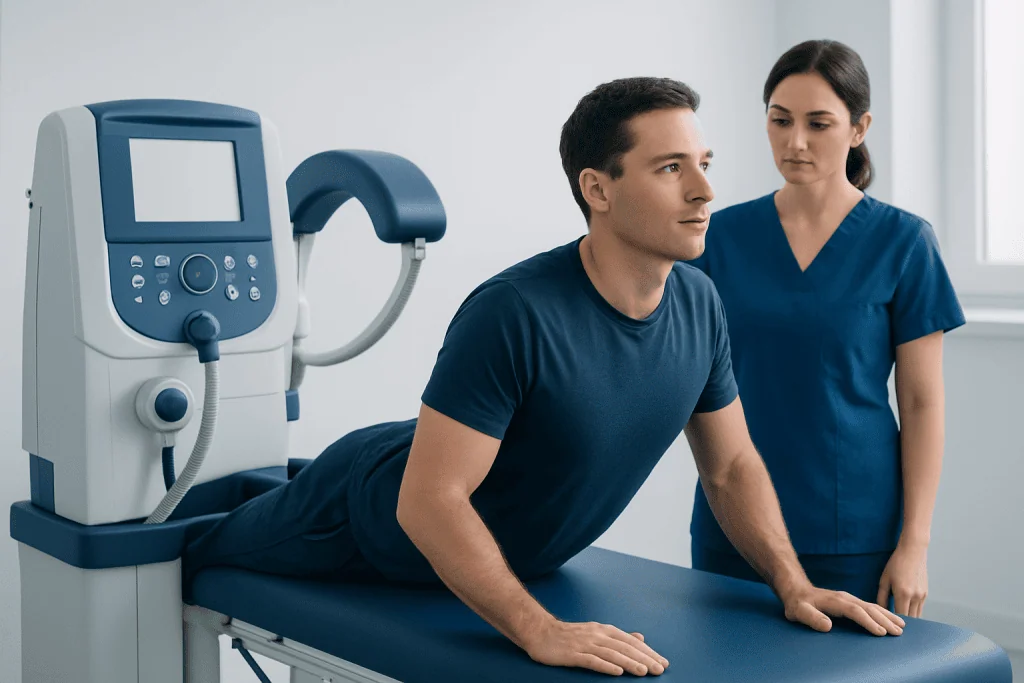
Directional preference means that symptoms respond more favorably to movement in one direction than another. For example, repeated backward bending may reduce symptoms for one person, while bending forward may be better tolerated by another. Some people do not have a clear directional preference, and MDT may then focus more on other movement, posture, loading, or rehabilitation strategies.
Clinicians also look for centralization. This describes pain that had been felt in the buttock, thigh, leg, shoulder, or arm becoming more concentrated closer to the spine. For example, leg pain that moves from the calf to the buttock and low back during a movement may be considered a favorable response, even if back discomfort is temporarily more noticeable. Centralization is not present in every case, but it can help guide care.
The opposite pattern is called peripheralization: symptoms spread farther away from the spine, such as back pain moving further down the leg. This can be a sign to stop the movement and seek guidance. Symptom location, intensity, numbness, strength, and daily function all matter; no single response alone provides a diagnosis.
Which movements may be used?

McKenzie exercises can include repeated spinal extension, flexion, side-gliding, rotation, or sustained postures. They may be performed lying down, on hands and knees, sitting, standing, or against a wall. The exact choice depends on the person’s assessment findings, current symptoms, mobility, and medical history.
A commonly recognized example is a prone extension movement, where a person lies on the stomach and gradually props up on the elbows or hands if comfortable. This may suit some people with low back pain that improves with extension, but it is not suitable for everyone. Other people may respond better to flexion-based movements, such as carefully bringing the knees toward the chest, or to side-directed movements that address pain that is worse on one side.
Posture advice can also be part of the plan. A clinician may discuss changing prolonged sitting habits, using movement breaks, modifying bending technique, or temporarily avoiding positions that repeatedly worsen symptoms. The purpose is not to maintain a rigid “perfect posture,” but to identify tolerable positions and gradually restore normal movement and activity.
What does the evidence say?
Research on the McKenzie Method suggests it can improve pain and function for some people with low back pain, especially when treatment is matched to a directional preference and delivered as part of an individualized rehabilitation plan. However, research findings vary because studies include people with different causes, durations, and patterns of pain, and because treatment programs are not identical.
Overall, MDT-based care appears to be one reasonable non-surgical option for mechanical spinal pain. It is not clearly superior for every person or every type of back or neck condition. Outcomes are often influenced by factors beyond the exercise itself, including regular activity, sleep, work demands, stress, confidence with movement, general fitness, and whether the underlying condition has been accurately identified.
For most uncomplicated episodes of back pain, contemporary guidelines support education, remaining as active as possible, and exercise-based rehabilitation when needed. McKenzie exercises may fit well within this broader plan. They should not delay assessment for serious symptoms or replace medical care for conditions that require different treatment.
How to use McKenzie exercises safely
A physiotherapist or doctor can first check whether the symptoms appear suitable for MDT. The assessment usually includes questions about symptom behavior, a review of health history, and observation of how repeated movements affect pain and range of motion. Imaging is not routinely needed for most new back pain, unless there are warning signs or the result would change treatment decisions.
When beginning a clinician-selected movement, it is generally reasonable to move slowly and observe the response during the exercise and afterward. A favorable response may include less pain, symptoms moving closer to the spine, easier movement, or improved ability to sit, stand, or walk. Mild short-lived discomfort can occur during rehabilitation, but persistent worsening should not be ignored.
People should stop and contact their clinician if a movement causes pain to spread farther down the arm or leg, produces new tingling or numbness, brings on weakness, or causes symptoms that remain worse after stopping. Avoid forcing end-range positions or copying exercises from another person’s plan. Age, pregnancy, osteoporosis, inflammatory disease, prior surgery, and other health conditions may affect which movements are appropriate.
McKenzie exercises as part of a wider recovery plan
Exercise is usually more effective when it supports a gradual return to meaningful daily activities. Depending on the diagnosis and goals, a rehabilitation program may also include walking, strengthening of the trunk and hips, mobility work, aerobic conditioning, pacing strategies, and advice on lifting or work tasks. A clinician can adapt the plan as symptoms and tolerance change.
For people with persistent pain, recovery may require attention to sleep, mood, stress, fear of movement, and workplace or home demands. This does not mean pain is “all in the mind.” Rather, pain and recovery are influenced by the whole person, and addressing practical barriers can improve participation in rehabilitation.
Some spinal conditions need specific evaluation rather than a self-directed exercise program. For example, a clinician may assess for disc-related symptoms, spinal stenosis, arthritis, fracture, inflammatory conditions, or nerve compression. Treatment is chosen according to the diagnosis, severity, and impact on daily life, not simply by the location of pain.
When to seek medical care
Medical assessment is advisable for back or neck pain that is severe, does not improve as expected, repeatedly returns, disrupts sleep, or limits work and daily activities. It is also sensible to arrange a review when pain travels into an arm or leg, or when tingling, numbness, or reduced strength develops. Early evaluation can help distinguish common mechanical pain from problems needing a different approach.
Urgent medical care is needed for new loss of bladder or bowel control, inability to urinate, numbness in the groin or saddle area, rapidly worsening weakness, or severe pain after a significant accident or fall. Prompt assessment is also important when spinal pain occurs with fever, unexplained weight loss, a history of cancer, serious infection risk, or use of medicines that weaken the immune system.
For international patients who need assessment, Acibadem International’s multidisciplinary specialists and JCI-accredited hospitals can evaluate back and neck symptoms and discuss appropriate rehabilitation or medical treatment. A qualified clinician can determine whether McKenzie exercises are suitable and provide an individualized plan.
Frequently asked questions
Are McKenzie exercises good for back pain?
McKenzie exercises can help some people with back pain, particularly when a specific movement direction reduces symptoms or improves movement. They are not the best choice for everyone, so an assessment by a physiotherapist or doctor is helpful. A broader plan that includes staying active and gradually rebuilding function is often important as well.
Can McKenzie exercises help sciatica?
Some people with leg pain related to spinal nerve irritation may improve with an MDT-based program, especially if repeated movements cause symptoms to move closer to the low back. However, not all leg pain is the same, and some causes require different treatment. New weakness, worsening numbness, or bladder or bowel symptoms need prompt medical assessment.
Should McKenzie exercises hurt?
Exercises should not cause symptoms to progressively worsen or spread farther down an arm or leg. A temporary increase in local back or neck discomfort may sometimes occur while limb symptoms centralize, but this should be discussed with a clinician. Stop the exercise and seek advice if pain remains worse, spreads, or is accompanied by new neurological symptoms.
How often should McKenzie exercises be done?
The frequency depends on the movement chosen, the stage of symptoms, and the person’s response. A clinician may recommend repeated short sessions during the day for some people, while others need a different plan. It is safer to follow individualized instructions than to use a fixed schedule found online.
Are McKenzie exercises the same as stretching?
No. Although some movements may resemble stretches, the McKenzie Method is a clinical assessment and treatment approach based on symptom response to repeated movements and postures. Its purpose is not simply to increase flexibility, but to identify movements that improve symptoms and function.
Can people do McKenzie exercises after back surgery?
Some people may use modified exercise as part of rehabilitation after back surgery, but timing and movement selection depend on the procedure, healing stage, and surgeon’s instructions. They should not begin or restart these exercises without approval from their surgical and rehabilitation team. New or worsening symptoms after surgery should be reviewed promptly.
References
- National Institute for Health and Care Excellence
- American College of Physicians
- World Health Organization
- International Association for the Study of Pain
- The McKenzie Institute International
This article is for general information only and is not a substitute for professional medical advice. Please consult a qualified doctor about your individual situation.
Joint and spine care in Turkey — expert assessment & treatment
JCI-accredited · board-certified surgeons · reply within 24h
Add us as a Preferred Source to see more of our trusted health content across Google Search, AI Overviews and Discover.