Mole Skin: A Complete Medical Overview

Most skin moles are harmless and remain stable over time. Changes in a mole’s size, shape, color, border, or symptoms can need medical review.
Key Takeaways
- Most skin moles are harmless and remain stable over time.
- Changes in a mole’s size, shape, color, border, or symptoms can need medical review.
- Doctors often use skin examination and dermoscopy to assess concerning moles.
- Sun protection helps reduce the risk of some mole changes and skin cancer.
- A biopsy is the most reliable way to diagnose whether a suspicious mole is benign or cancerous.
Mole skin usually refers to moles on the skin, which are common growths made of pigment-producing cells. Most are benign, but a mole that changes in appearance, bleeds, itches, or looks different from others should be assessed by a doctor.
Overview: What mole skin means
Mole skin generally means skin that has moles, also called nevi. These are very common spots or small growths that form when pigment-making cells, called melanocytes, grow in clusters rather than being evenly spread through the skin. Moles can appear anywhere on the body and may be flat or raised, smooth or slightly rough, and tan, brown, pink, or nearly skin-colored.
Most moles are benign, meaning they are not cancer. Many develop during childhood, the teenage years, or early adulthood, and a person may have only a few or several dozen. Some stay the same for years, while others slowly change in a harmless way, especially with age, hormone changes, or sun exposure.
Even though most moles are not dangerous, it is important to notice when one looks unusual or starts behaving differently. Doctors pay special attention to moles that become asymmetric, develop irregular borders, show multiple colors, grow quickly, or begin to itch, bleed, crust, or hurt. These features do not always mean cancer, but they do justify a professional skin check.
What normal moles can look like
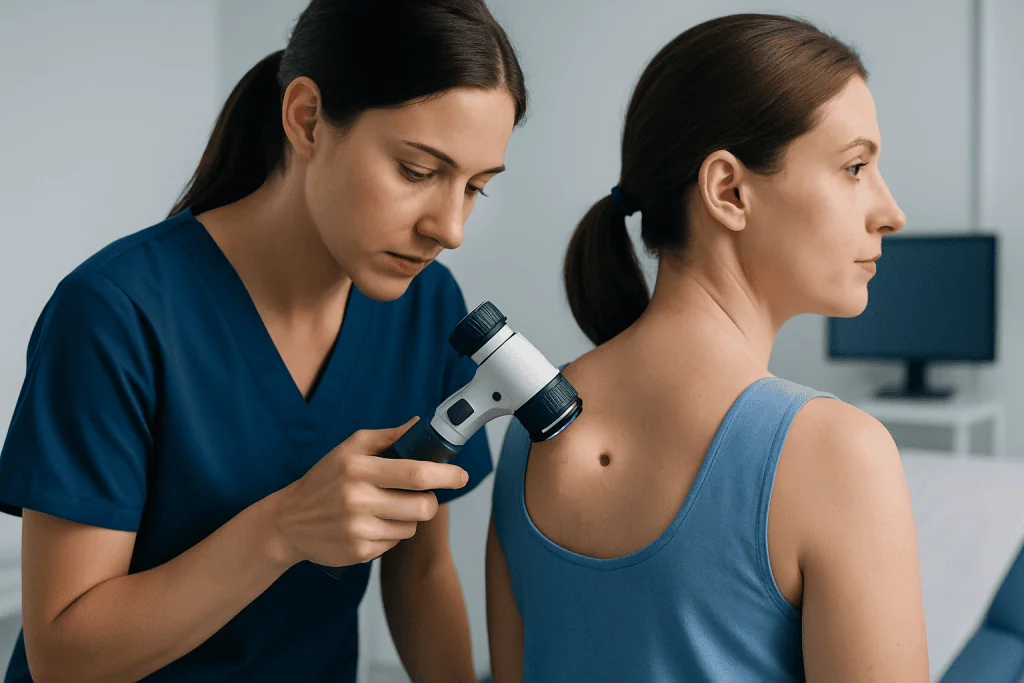
A normal mole may be small, round or oval, and evenly colored. It can be flat like a freckle or slightly raised above the skin. Some moles darken with sun exposure, while others become less noticeable over time. Hair can also grow from a mole, which is usually not a sign of disease.
There are several common types of moles. Congenital moles are present at birth, while acquired moles appear later. Dysplastic or atypical moles may look different from ordinary moles, often with larger size, uneven color, or irregular edges. Having atypical moles does not mean a person has skin cancer, but it can raise the need for regular skin monitoring.
People sometimes confuse moles with other skin marks. Freckles, seborrheic keratoses, skin tags, and sun spots can look similar. Some benign lesions may still need a doctor’s assessment if their appearance is unclear. A dermatologist can distinguish between harmless skin changes and lesions that need closer evaluation, including skin cancer.
Symptoms and warning signs to watch for
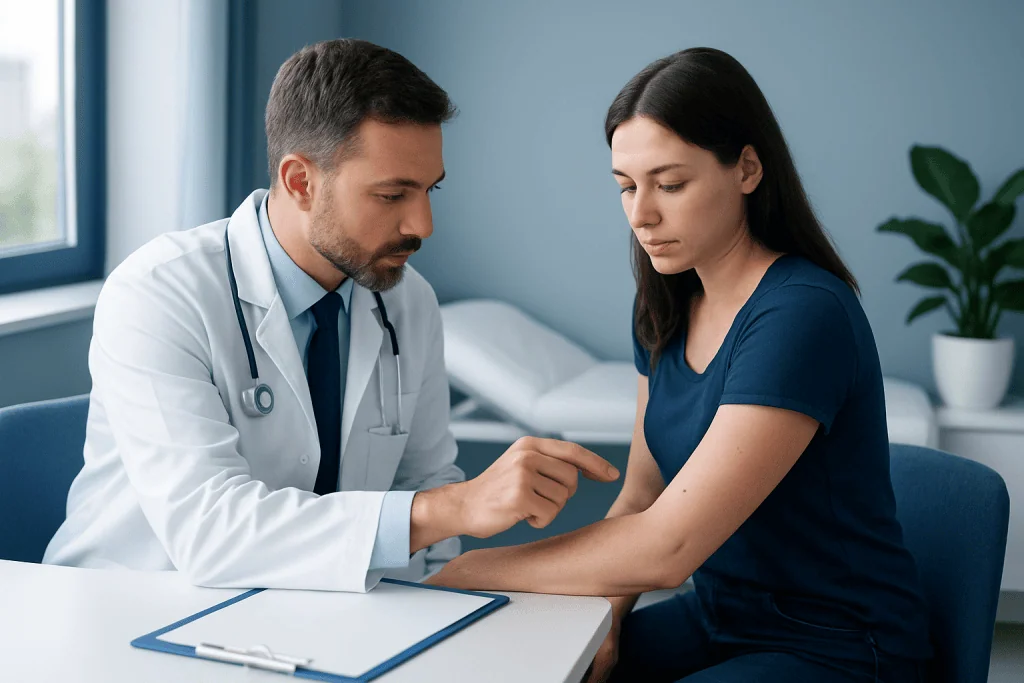
Most moles do not cause symptoms. They are often discovered incidentally and remain unchanged for long periods. A mole that stays similar in color, shape, and size is usually less concerning than one that evolves over time.
Doctors often advise the ABCDE rule when checking moles at home:
- Asymmetry: one half does not match the other
- Border irregularity: edges are ragged, blurred, or uneven
- Color variation: more than one shade appears in the same mole
- Diameter: larger size, especially if growing
- Evolving: any noticeable change over weeks or months
Other warning signs include itching, tenderness, bleeding, oozing, crusting, or a sore that does not heal. A mole that stands out as an “ugly duckling,” meaning it looks different from a person’s other moles, may also need medical review. These signs can occur in benign lesions too, but they should not be ignored.
Dark streaks under a nail, new pigmented spots on the palms, soles, scalp, or genital area, or a changing mole in older adulthood deserve prompt assessment. In some cases, a suspicious lesion may need further testing to rule out melanoma.
Causes and risk factors
Moles develop when melanocytes group together in one area of the skin. Genetics plays an important role, so some people naturally have more moles than others. Hormonal changes, such as during puberty or pregnancy, can also influence how moles appear or darken.
Ultraviolet radiation from the sun and tanning beds may contribute to the formation of some moles and can increase the risk of harmful skin changes. This is one reason doctors recommend daily sun protection, especially for people with fair skin, a history of blistering sunburns, or many moles.
Risk factors that increase the chance that a mole may need closer follow-up include:
- Having many moles or several atypical moles
- Fair skin, light eyes, or light hair
- A personal or family history of melanoma or other skin cancers
- Repeated intense sun exposure or tanning bed use
- A weakened immune system
- Large congenital moles present from birth
Not every person with risk factors will develop skin cancer, and not every changing mole is malignant. Still, people in higher-risk groups may benefit from regular full-body skin examinations and careful self-checks at home.
How doctors evaluate a mole
Assessment starts with a medical history and a visual skin examination. The doctor may ask when the mole first appeared, whether it has changed, and whether there is any bleeding, pain, itching, or family history of skin cancer. They may also examine the rest of the skin to compare similar lesions and look for any additional concerning spots.
A common office tool is dermoscopy, a handheld device that magnifies the lesion and helps reveal structures not visible to the naked eye. Dermoscopy can improve accuracy when distinguishing benign moles from lesions that need biopsy. Some clinics may also use total-body photography or digital mole mapping for patients with many atypical moles.
If a mole appears suspicious, the doctor may recommend a biopsy. This involves removing all or part of the lesion and sending it to a laboratory for examination under a microscope. Biopsy is the only reliable way to confirm whether a mole is benign, atypical, or cancerous.
Depending on the findings, care may involve monitoring over time, complete removal, or referral for further treatment. If advanced imaging or tissue assessment is needed, the broader workup can fit within diagnostic imaging and pathology pathways used for skin lesions and related conditions.
Treatment options and mole removal
Benign moles usually do not need treatment unless they are repeatedly irritated, catch on clothing, or are cosmetically bothersome. In these cases, a doctor may discuss removal options. It is important not to try cutting off or burning a mole at home, because this can cause infection, scarring, incomplete removal, or delayed diagnosis.
If a mole is suspicious, the goal is accurate diagnosis first. Removal may be done by shave excision, punch biopsy, or surgical excision, depending on the lesion’s size, depth, and location. When skin cancer is confirmed or strongly suspected, treatment planning focuses on complete removal and appropriate follow-up.
People sometimes seek removal for appearance or comfort. In selected cases, this may be addressed through minor skin procedures, and if reconstruction is needed after removal in a sensitive area, plastic surgery techniques may help restore form and function.
If pathology shows melanoma or another skin cancer, treatment may include wider excision and specialist follow-up. This may involve coordinated care with oncology and dermatology teams, depending on the diagnosis and stage. Near the end of the care pathway, patients may also seek evaluation at centers such as Acibadem International, where multidisciplinary specialists in JCI-accredited hospitals diagnose and treat skin lesions for international patients.
Prevention and self-care
Not all moles can be prevented, especially those influenced by genetics. However, protecting the skin from ultraviolet radiation can help lower the risk of harmful mole changes and skin cancer. A practical approach includes using broad-spectrum sunscreen, wearing protective clothing, seeking shade, and avoiding tanning beds.
Self-examination is another helpful habit. Checking the skin once a month in good light can make it easier to notice new lesions or changes in existing moles. A full-length mirror and a hand mirror can help with hard-to-see areas such as the scalp, back, and soles of the feet. Taking dated photos may also make subtle changes easier to track.
General skin self-care can support earlier detection:
- Note any new mole after age 30 and mention it to a doctor
- Watch for changes using the ABCDE rule
- Ask a partner to help check the scalp and back
- Protect children’s skin from sunburns
- Keep routine skin checks if a doctor recommends them
People with many moles, atypical moles, or a strong family history may need more personalized monitoring. A dermatologist can advise how often professional examinations are appropriate.
When to seek medical care
Medical care is appropriate if a mole changes in size, shape, or color, or if it starts to itch, bleed, crust, or become painful. A new dark lesion, a rapidly growing spot, or a mole that looks very different from others should also be checked. Early evaluation is especially important for people with a personal or family history of skin cancer.
Urgent assessment is sensible if there is a non-healing sore, sudden bleeding without injury, or a pigmented lesion under a nail, on the sole, or on the palm. These findings are not always serious, but they can be easier to diagnose and treat when reviewed promptly.
When in doubt, it is reasonable to arrange a skin examination rather than wait and see. A qualified doctor can decide whether the lesion is harmless, needs monitoring, or should be removed and tested.
Frequently asked questions
What is mole skin?
Mole skin usually refers to skin that has moles, which are common clusters of pigment-producing cells. Most moles are benign and do not cause health problems.
Are all moles dangerous?
No. Most moles are harmless and remain stable for many years. A doctor usually becomes more concerned when a mole changes or looks different from a person’s other moles.
How can someone tell if a mole should be checked?
The ABCDE rule can help: asymmetry, border irregularity, color variation, larger diameter, and evolving appearance. Itching, bleeding, crusting, or pain are also reasons to seek medical advice.
Can a normal mole turn into melanoma?
Yes, although many melanomas arise as new spots rather than from existing moles. Because change matters, any evolving mole should be assessed by a qualified doctor.
Is it safe to remove a mole at home?
No. Home removal can lead to infection, scarring, incomplete removal, and missed diagnosis of skin cancer. A doctor should examine a mole before removing it.
Do children get moles too?
Yes. Many moles appear during childhood and adolescence, and this is usually normal. Parents should still mention any rapidly changing or unusual-looking lesion to a doctor.
How often should skin checks be done?
A monthly self-check is a practical habit for many adults. People with many moles, atypical moles, or a family history of melanoma may need regular professional skin examinations based on a doctor’s advice.
This article is for general information only and is not a substitute for professional medical advice. Please consult a qualified doctor about your individual situation.
Explore treatments in Turkey — costs, top hospitals & a free quote
JCI-accredited · board-certified surgeons · reply within 24h
Add us as a Preferred Source to see more of our trusted health content across Google Search, AI Overviews and Discover.

More from the Health Library

Man Eating Pus: A Complete Medical Overview

Birth Control: An Evidence-Based Guide for Patients

Indigestion: A Complete Medical Overview

Keto Flu: An Evidence-Based Guide for Patients

Fluoride in Children’s Toothpaste: What Patients Need to Know