Molecular Jackhammer Cancer Treatment: How It Works, Results and What to Expect

Molecular jackhammers are light-activated molecules designed to move rapidly and disrupt cell membranes. Most evidence so far comes from laboratory and animal research, not large human clinical trials.
Key Takeaways
- Molecular jackhammers are light-activated molecules designed to move rapidly and disrupt cell membranes.
- Most evidence so far comes from laboratory and animal research, not large human clinical trials.
- The approach is different from radiation, chemotherapy, surgery, immunotherapy and other established cancer treatments.
- Cancer treatment choices depend on the cancer type, stage, molecular features, overall health and personal treatment goals.
- People should discuss experimental therapies with an oncology team and ask whether a regulated clinical trial may be appropriate.
Molecular jackhammer cancer treatment describes an experimental research approach in which specially designed molecules are activated to vibrate and physically damage cancer-cell membranes. Early laboratory findings are promising, but this method is not currently an established cancer treatment for patients and requires much more clinical research.
Overview: What Is Molecular Jackhammer Cancer Treatment?
Molecular jackhammer cancer treatment is a research concept that uses very small, engineered molecules to damage cancer cells through rapid mechanical movement. These molecules may be designed to attach to or enter cancer cells and then be activated by light, causing them to vibrate or rotate at extremely high speed. In laboratory experiments, this movement has been investigated as a way to disrupt the outer membrane of cancer cells.
The term “jackhammer” is descriptive rather than a formal name for an approved medical procedure. It refers to the proposed mechanical action of the activated molecules. At present, molecular jackhammers should be understood as an early-stage scientific strategy, not as a routine treatment offered for a particular cancer type.
Established cancer care continues to rely on treatments supported by clinical evidence, such as surgery, radiation therapy, systemic medicines and, for selected cancers, cellular or targeted treatments. An oncology team can explain which options have demonstrated safety and benefit for an individual diagnosis.
How Molecular Jackhammers Are Intended to Work
Molecular jackhammers are generally based on molecules that can absorb a specific type of light energy. Once activated, their chemical structure moves in a rapid, repeated motion. Researchers aim to use this motion to create physical stress within or at the surface of cancer cells, particularly in the cell membrane.
A cell membrane is an essential protective boundary that controls what enters and leaves a cell. If it becomes severely disrupted, the cell may lose its ability to maintain its internal environment and may die. This differs from treatments that primarily damage DNA, block cell-division signals or recruit the immune system to recognize cancer.
Scientists are also studying whether this approach could be made more selective by designing molecules that preferentially accumulate in tumor tissue or bind to markers found more often on cancer cells. Selectivity is a central challenge: any future treatment would need to minimize injury to healthy cells and tissues.
Light delivery is another practical issue. Light may be easier to direct to cancers near the skin or accessible through endoscopic or surgical techniques, while tumors deep inside the body may be more difficult to reach. These limitations are among the reasons further research is needed before this approach can move into wider clinical use.
Candidacy and the Current State of Research

There is currently no standard clinical candidacy pathway for molecular jackhammer cancer treatment because it is not an established treatment in routine oncology practice. A person should not delay proven treatment while seeking unvalidated options. If human clinical trials become available, eligibility would be determined by the study protocol and may include cancer type, stage, previous treatments, tumor location and general health.
Early laboratory results can be valuable because they help researchers identify new ways to target cancer cells. However, results in cell cultures or animal models do not always translate into safe, effective treatments for people. Human studies must clarify the best molecule, activation method, treatment schedule, tumor targeting, side effects and long-term outcomes.
People interested in emerging therapies can ask their oncologist about registered clinical trials. A well-designed clinical trial includes clear eligibility criteria, informed consent, safety monitoring and ethical review. It is also reasonable to ask what standard options are available alongside, before or after a trial.
For patients considering established treatment planning, an oncology evaluation may include pathology review, imaging, molecular testing and multidisciplinary discussion. These steps help match care to the biology and extent of the individual cancer.
What Would the Procedure and Recovery Involve?
Because molecular jackhammer cancer treatment is investigational, there is no universally accepted step-by-step procedure or recovery timeline. Any future procedure would depend on how the molecules are delivered, how they are activated and where the tumor is located. For example, a treatment aimed at a surface-accessible lesion may differ greatly from one being studied for an internal tumor.
In a clinical research setting, participants would usually first undergo screening, including medical history, physical examination, laboratory testing and scans where appropriate. The research team would explain the investigational nature of the treatment, expected visits, possible alternatives and known or uncertain risks before enrollment.
If the treatment required activation with light, imaging guidance, endoscopy or a minor procedure might be needed to position the light source near the target tissue. Monitoring could include observation after treatment, blood tests, symptom review and repeat imaging to assess the tumor response. The intensity of follow-up would be defined by the trial protocol.
Recovery cannot yet be predicted reliably. It could range from minimal short-term observation to recovery associated with the delivery method or local tissue reaction. Until human clinical data are available, claims about a typical recovery period would not be evidence-based.
Potential Benefits, Limitations and Risks
The potential benefit of molecular jackhammers is their proposed physical mechanism of action. In theory, directly disrupting a cancer-cell membrane may offer a way to damage cells that have developed resistance to some drug treatments. Researchers are interested in whether mechanical cell damage could complement other treatments, rather than replace them.
However, these potential advantages remain unproven in people. A promising laboratory mechanism does not establish that a treatment improves survival, controls cancer for longer or has acceptable side effects. It also does not show which cancers, if any, would respond best.
Possible risks would depend on the final technology and route of use. They could include inflammation, injury to normal tissue, pain, burns or tissue damage related to light activation, reactions to the molecule, infection or bleeding if an invasive delivery procedure were required, and unexpected effects that emerge only during human studies.
A careful comparison of benefits and harms is important for every cancer treatment. Patients should be cautious about websites or providers that present experimental methods as proven cures, particularly if they discourage standard oncology care or do not provide clear information about trial oversight and safety monitoring.
How Long Does It Take Radiation to Start Killing Cancer?
Radiation begins causing damage to cancer-cell DNA when treatment is delivered. However, cancer cells may not die immediately. Many cells die over days to weeks as they attempt to divide with damaged DNA, and the full tumor response may continue to develop for weeks or sometimes months after a course of radiation ends.
The timing depends on the cancer type, radiation dose and schedule, tumor size, location and how sensitive the cancer cells are to radiation. Imaging is therefore usually scheduled at an appropriate interval after treatment rather than immediately, since early scans can be difficult to interpret.
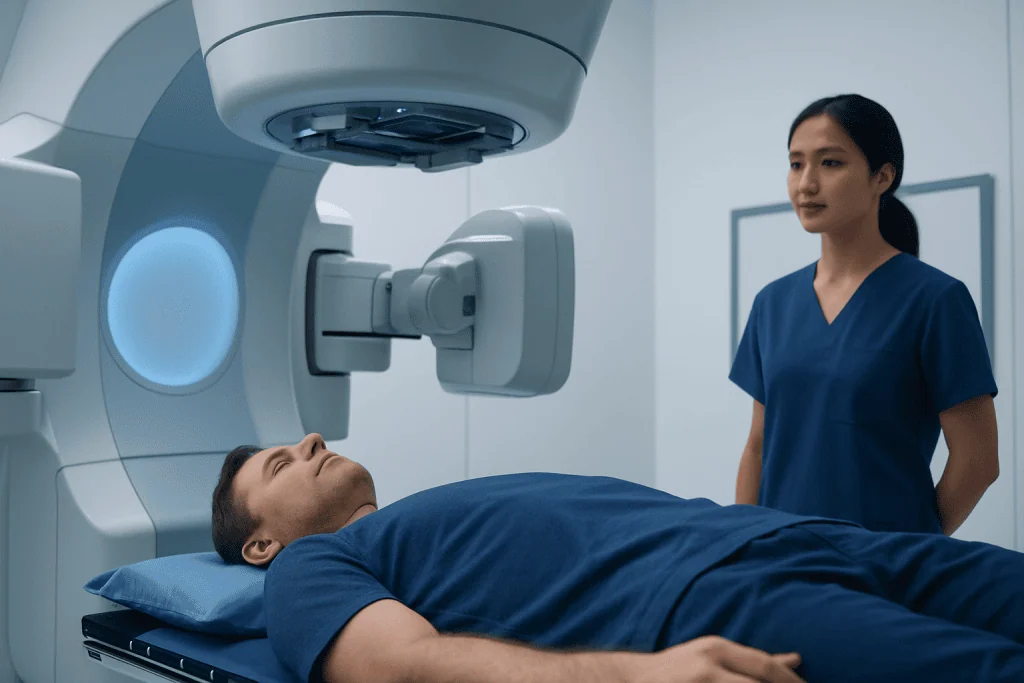
Radiation therapy is a well-established local cancer treatment and may be used alone or with surgery, chemotherapy, targeted therapy or immunotherapy. Patients can discuss the expected response timeline and possible side effects with their radiation oncology team.
What Two Treatments Destroy Cancer Cells?
Many treatments can destroy cancer cells, but two widely used examples are surgery and radiation therapy. Surgery physically removes a tumor when it can be safely taken out, while radiation uses high-energy beams to damage cancer-cell DNA and prevent cells from continuing to grow and divide.
Chemotherapy can also kill cancer cells or stop them from dividing. Depending on the diagnosis, other effective options may include targeted therapy, immunotherapy, hormone therapy, stem cell transplantation, ablation procedures or combinations of treatments.
There is no single best pair of treatments for every person. The most suitable plan depends on the exact cancer diagnosis, stage, pathology findings, biomarkers, previous treatment and the person’s preferences and general health.
Can Vibration Kill Cancer Cells?
In laboratory settings, mechanical forces and vibration-based methods have shown that physical stress can injure or kill cells under certain conditions. Molecular jackhammers are one experimental example: researchers are studying whether rapid movement of activated molecules can disrupt cancer-cell membranes.
This does not mean that ordinary external vibration, massage devices, sound therapy or consumer wellness products can treat cancer. There is no reliable clinical evidence that these approaches eliminate tumors, and they should not be used in place of evidence-based medical care.
Research into mechanical approaches remains scientifically interesting, but a cancer therapy must be tested carefully in people before its effectiveness and safety can be known. An oncologist can help patients distinguish between regulated clinical research and unsupported treatment claims.
What Is the Most Intense Cancer Treatment?
There is no single treatment that is objectively the “most intense” for every cancer or every patient. Intensity can refer to the physical demands of treatment, the risk of side effects, the amount of monitoring needed or the effect on daily life. Some high-dose chemotherapy regimens, stem cell transplants, major cancer surgery and combined chemotherapy-radiation treatment can be particularly demanding.
More intensive treatment is not automatically better. Oncology teams aim to choose a treatment plan with an appropriate balance of expected benefit, safety, quality of life and the patient’s individual goals. Supportive care, including symptom control, nutrition, rehabilitation and emotional support, is an important part of treatment at every level of intensity.
Acibadem International’s multidisciplinary specialists and JCI-accredited hospitals support international patients with diagnosis, treatment planning and evidence-based cancer care. A second opinion can be especially helpful when treatment choices are complex or when a patient is considering a clinical trial.
When to Seek Medical Care
Anyone with a new lump, unexplained bleeding, persistent pain, lasting change in bowel or bladder habits, unexplained weight loss, a persistent cough, trouble swallowing or other concerning symptoms should arrange a medical evaluation. These symptoms often have causes other than cancer, but timely assessment is important.
A person already diagnosed with cancer should contact their oncology team promptly for new or worsening symptoms, severe treatment side effects, fever during systemic treatment, shortness of breath, chest pain, confusion, uncontrolled pain or signs of dehydration. Urgent or emergency care is appropriate for severe symptoms, especially if they develop suddenly.
Questions about molecular jackhammers or other experimental methods are best discussed openly with an oncologist. The care team can explain the quality of available evidence, assess whether a clinical trial may be relevant and help ensure that promising research does not interrupt effective, time-sensitive treatment.
Frequently asked questions
Is molecular jackhammer cancer treatment available to patients?
Molecular jackhammer cancer treatment is currently an experimental research approach rather than a standard cancer treatment. Most discussion of it is based on laboratory and early preclinical work. Patients should ask an oncologist about evidence-based options and regulated clinical trials.
Do molecular jackhammers use chemotherapy?
No. Molecular jackhammers are intended to work through rapid molecular motion that may physically disrupt cell membranes after activation. Chemotherapy uses medicines that kill cancer cells or interfere with their growth and division through different biological mechanisms.
Could molecular jackhammers replace radiation therapy?
There is not enough clinical evidence to support replacing radiation therapy with molecular jackhammers. Radiation therapy has been extensively studied and is a standard treatment for many cancers. Any future use of molecular jackhammers would need rigorous clinical testing and may potentially be studied alongside other treatments.
Are experimental cancer treatments safe?
Safety varies by treatment and by stage of research. Before a treatment can be widely offered, studies must assess its side effects, dosing, delivery and effectiveness in people. Participation in a regulated clinical trial provides structured consent, monitoring and oversight, although risks and benefits may still be uncertain.
Can a person join a clinical trial for an experimental cancer treatment?
Possibly, if a suitable trial is recruiting and the person meets its eligibility criteria. Eligibility may depend on the cancer type and stage, test results, prior therapies, organ function and other health factors. An oncologist or trial team can help review available options.
What should patients ask about an emerging cancer treatment?
Useful questions include what evidence exists in humans, what the treatment is intended to achieve, what known and unknown risks are involved, and whether it is part of an ethically approved clinical trial. Patients should also ask how it compares with standard care and whether pursuing it could delay treatment with proven benefit.
References
- National Cancer Institute
- American Cancer Society
- U.S. Food and Drug Administration
- European Society for Medical Oncology
- World Health Organization
This article is for general information only and is not a substitute for professional medical advice. Please consult a qualified doctor about your individual situation.
Oncology care in Turkey — second opinion and treatment plan
JCI-accredited · board-certified surgeons · reply within 24h
Add us as a Preferred Source to see more of our trusted health content across Google Search, AI Overviews and Discover.