Nanomedicine in Cancer Care: What It Is and What Is Still Experimental

Nanomedicine uses very small particles to carry drugs, improve imaging, or interact with cancer cells in precise ways. A few nanomedicine-based cancer treatments are approved and used today, but many promising technologies are still experimental.
Key Takeaways
- Nanomedicine uses very small particles to carry drugs, improve imaging, or interact with cancer cells in precise ways.
- A few nanomedicine-based cancer treatments are approved and used today, but many promising technologies are still experimental.
- Potential benefits include better drug delivery, reduced exposure to healthy tissue, and support for diagnosis or monitoring.
- Nanomedicine is not a single treatment; it is a platform that can be applied to chemotherapy, imaging, radiation support, and immunotherapy research.
- Patients should discuss whether a nanomedicine approach is standard treatment, part of a clinical trial, or still in early development.
Nanomedicine in cancer care refers to the use of extremely small materials and particles to help detect, deliver, or monitor cancer treatment. Some nanoparticle-based therapies are already used in practice, while many newer approaches remain under study and are not yet standard care.
Overview: What nanomedicine means in cancer care
Nanomedicine in cancer care involves using materials that are engineered at a very small scale, often measured in nanometers. At this size, particles can behave differently from larger materials, which may help doctors deliver medicines, improve imaging, or study how tumors respond to treatment. In oncology, the goal is usually to make treatment more precise while limiting unnecessary effects on healthy tissue.
It is important to understand that nanomedicine is not one single therapy. Instead, it is a broad field that includes drug-carrying nanoparticles, contrast agents for imaging, heat-generating particles used in selected research settings, and experimental systems designed to release medicine only under certain conditions. Some of these tools are already part of modern cancer care, while others are being tested in laboratories and clinical trials.
For patients, the most practical point is that nanomedicine may be used to improve how an existing treatment works rather than replace standard oncology care entirely. Depending on the cancer type and treatment plan, it may be discussed alongside surgery, chemotherapy, radiotherapy, targeted therapy, or immunotherapy. Whether it is appropriate depends on the diagnosis, treatment goals, and the evidence available for that specific approach.
How nanomedicine works
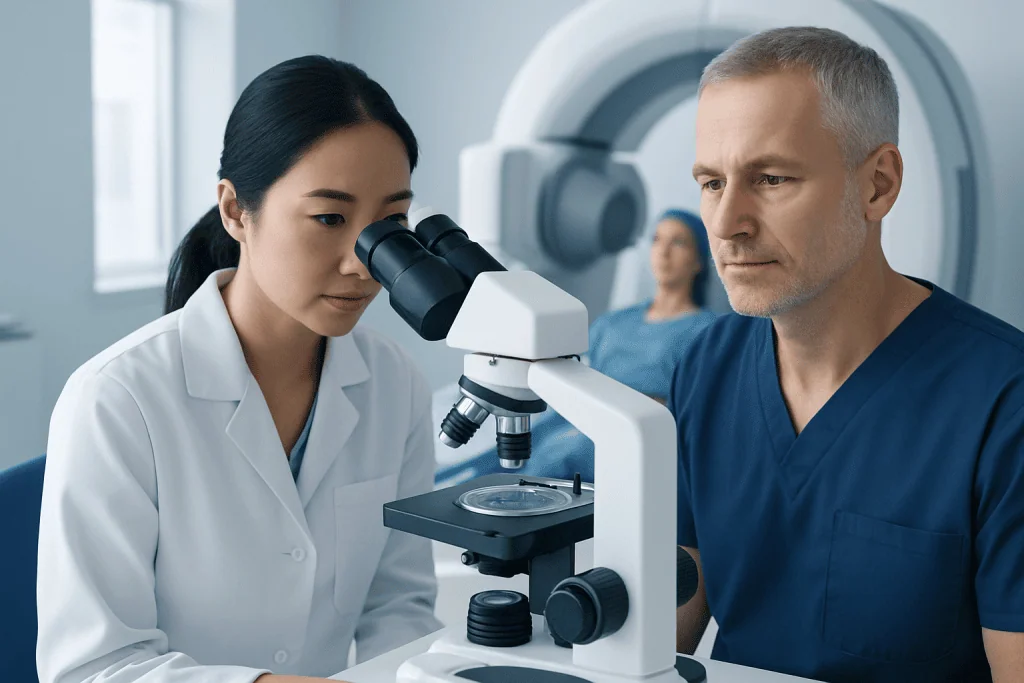
Nanoscale systems can be designed to carry chemotherapy drugs, protect them as they travel through the bloodstream, and release them in a more controlled way. Some particles are coated with materials that help them stay in circulation longer. Others are developed to interact with certain features of tumors, such as abnormal blood vessels or specific molecules on cancer cells.
In simple terms, these particles can act like tiny packages. A drug may be enclosed inside a lipid, polymer, or protein-based shell, or attached to the surface of a carrier. This may change how the medicine is absorbed, distributed, and cleared from the body. The aim is often to deliver more of the drug where it is needed and less where it can cause unwanted effects.
Nanomedicine can also support diagnosis and monitoring. Certain nanoparticles are being studied to enhance imaging quality during scans or to help identify disease at an earlier stage. Researchers are also exploring whether nanoscale tools can assist with biopsy guidance, measure treatment response, or support personalized care by giving more detailed information about a tumor.
Not every nanoparticle automatically “targets” cancer perfectly, and real-world tumor biology is complex. Even when a nanosystem is scientifically promising, it must still show consistent safety, reliable manufacturing quality, and clear benefit in human studies before it becomes routine medical practice.
What is already used and what is still experimental

Some nanoparticle-based medicines are already approved for cancer treatment in certain situations. These generally involve reformulated versions of established drugs, such as chemotherapy agents packaged in liposomes or other carriers. The reformulation may improve how the drug circulates in the body or reduce certain side effects compared with a conventional version, although it does not necessarily make the treatment easier for every patient.
At the same time, many widely discussed nanomedicine ideas remain experimental. These include highly selective particles meant to seek out only cancer cells, particles that release medicine in response to heat or acidity, nanorobotic concepts, and multifunctional systems that combine imaging and treatment in one platform. These areas are active in research, but many are not yet standard options in everyday oncology practice.
Patients may also hear about nanomedicine in relation to advanced tumor profiling, precision oncology, or combination treatment planning. While these fields can overlap, they are not the same. A person with cancer may receive modern targeted or immune-based treatment without receiving nanomedicine, and a nanoparticle-based drug may still be a form of chemotherapy rather than a completely new category of care.
Because the field evolves quickly, clear communication matters. A useful question for the care team is whether the proposed nanomedicine approach is an approved treatment, a locally available but specialized option, or part of a clinical trial. This helps patients understand both the evidence and the level of uncertainty involved.
Potential benefits of nanomedicine in oncology
The main promise of nanomedicine in cancer care is greater precision. By changing how a drug travels through the body, a nanoscale carrier may help increase drug exposure in tumor tissue while lowering exposure elsewhere. In some settings, this can improve tolerability or make it easier to deliver medicines that would otherwise be difficult to use.
Another possible benefit is controlled release. Instead of distributing a medicine all at once, some nanoparticle systems are designed to release it gradually. This may help maintain useful drug levels for longer periods or reduce peak exposure that contributes to side effects. Researchers are also interested in using nanotechnology to carry combinations of medicines together so they reach the tumor at the same time.
Nanomedicine may support better diagnostics as well. Improved imaging agents could help define tumor borders, detect small lesions, or show whether a treatment is working earlier in the course of care. In the future, nanoscale systems may also help integrate treatment with immunotherapy or other precision approaches by changing the tumor environment or delivering immune-active molecules more efficiently.
Even so, benefits vary by cancer type, treatment setting, and the specific product used. A nanomedicine approach that is useful for one tumor may not be effective for another. This is why treatment decisions remain based on established evidence, multidisciplinary review, and individual patient needs rather than the novelty of the technology alone.
Limits, risks, and unanswered questions
Although nanomedicine is promising, it has important limitations. Tumors differ greatly in blood flow, structure, immune activity, and surrounding tissue. These differences can affect whether nanoparticles actually reach the cancer in meaningful amounts. A design that works well in laboratory models may perform less predictably in human disease.
Safety is another key consideration. The body may react to the carrier material itself, not only the drug inside it. Doctors and researchers study how particles are metabolized, where they accumulate, and how they are removed. Possible concerns can include infusion reactions, unexpected immune responses, organ-related toxicity, or altered side-effect patterns compared with standard formulations.
Manufacturing and quality control also matter. Nanomedicines can be complex to produce consistently, and small changes in size, coating, or stability may affect how the product behaves. Regulators therefore require careful testing before approval. Cost, access, and availability across countries or hospitals can also influence whether a nanomedicine approach is realistically an option.
Perhaps the most important unanswered question for many emerging technologies is whether they improve major clinical outcomes, such as symptom control, quality of life, progression-free survival, or overall survival. Promising mechanisms alone are not enough. Strong evidence from well-designed clinical trials is needed before an experimental concept becomes standard cancer care.
How doctors evaluate and diagnose suitability
There is no single test that determines whether nanomedicine is right for a patient. Suitability is usually assessed as part of standard oncology evaluation, beginning with an accurate diagnosis, tumor type, stage, molecular features when relevant, general health, and treatment goals. Imaging, pathology, and laboratory studies remain the foundation of decision-making.
Doctors also consider whether a nanoparticle-based treatment is approved for that specific cancer and treatment setting. In some cases, it may be used because a standard drug in nanoparticle form offers practical advantages. In others, it may only be available through a research study. This distinction is important for informed consent and for setting realistic expectations.
Multidisciplinary review is often especially helpful in complex cancer care. Medical oncologists, radiation oncologists, surgeons, radiologists, pathologists, and other specialists may work together to decide whether conventional treatment, a nanoparticle-based formulation, or a clinical trial is the best fit. If symptoms or imaging suggest related conditions such as a tumor, the care pathway still follows established diagnostic standards rather than relying on nanotechnology alone.
Patients benefit from asking practical questions: What is the goal of this treatment? Is it approved or experimental? What side effects are expected? How will response be monitored? These conversations help patients understand both the science and the day-to-day realities of treatment.
Treatment options, clinical trials, and patient questions
When nanomedicine is part of treatment, it is usually integrated into a broader cancer plan rather than used in isolation. That plan may include surgery, systemic therapy, radiation, supportive care, and follow-up imaging. If a nanoparticle-based drug is recommended, the oncology team explains how it differs from a conventional formulation and what specific benefits or trade-offs are expected in that situation.
Clinical trials play a central role in this field. Trials may test new drug carriers, imaging particles, temperature-sensitive systems, or combinations with precision treatment such as targeted therapy. Participating in a trial can give access to emerging options, but it also means accepting that the treatment is still being evaluated. Trial eligibility depends on strict medical criteria designed to protect patient safety and produce reliable results.
Patients may find it helpful to ask whether the treatment goal is cure, disease control, symptom relief, or reduction of side effects from an existing medicine. They can also ask how often visits are needed, whether extra blood tests or scans are required, and what is known about short- and long-term safety. These questions support informed decisions without creating unrealistic expectations.
Near the end of the care journey, some people seek evaluation at specialized centers with experience in advanced oncology approaches and research access. Acibadem International’s multidisciplinary specialists and JCI-accredited hospitals diagnose and treat cancer for international patients, including assessment of established and investigational options when clinically appropriate.
When to speak with a doctor
Anyone diagnosed with cancer should discuss treatment options with a qualified oncology team rather than relying on technology claims alone. This is especially important if information online suggests a treatment is highly targeted, side-effect free, or able to replace standard care. In medicine, newer does not always mean better for every person or every tumor type.
A doctor should also be consulted if a patient is considering travel for treatment, looking into a clinical trial, or feeling uncertain about whether a proposed nanomedicine approach is evidence-based. A second opinion can be useful when treatment decisions are complex or when there is interest in specialized options not commonly available at every center.
Urgent medical attention is needed for severe treatment reactions, fever during cancer therapy, new breathing difficulty, chest pain, confusion, or rapidly worsening symptoms. These situations require prompt assessment regardless of whether the patient is receiving standard treatment or a nanoparticle-based therapy.
In general, the safest approach is informed, individualized care. Nanomedicine is an exciting and evolving part of oncology, but its value depends on matching the right tool to the right patient at the right time, with clear evidence and careful follow-up.
Frequently asked questions
What is nanomedicine in cancer care?
Nanomedicine in cancer care uses extremely small engineered particles or materials to help deliver treatment, improve imaging, or monitor disease. Some applications are already used in oncology, while many others are still being studied in clinical trials.
Is nanomedicine the same as targeted therapy?
No. Targeted therapy refers to drugs that act on specific molecules involved in cancer growth, while nanomedicine refers to the technology used to carry, deliver, or detect treatment at a very small scale. In some cases, nanomedicine and targeted therapy can be combined, but they are not the same thing.
Are nanomedicine treatments approved for cancer?
Yes, some nanoparticle-based or liposomal cancer medicines are approved and used in standard care for selected situations. However, many newer nanomedicine approaches discussed in research or the media remain experimental and are not yet routine treatments.
Does nanomedicine reduce side effects?
It can in some cases, but not always. A nanoparticle formulation may change where a drug goes in the body or how quickly it is released, which can reduce certain side effects while sometimes introducing different ones. The effect depends on the specific medicine and the patient's overall treatment plan.
Can nanomedicine cure cancer?
Nanomedicine is not a guaranteed cure. It is a tool or treatment platform that may improve drug delivery, imaging, or treatment precision in certain settings. Whether it helps depends on the cancer type, stage, and the evidence supporting that particular therapy.
How can a patient know if a nanomedicine option is experimental?
A patient can ask the oncology team whether the treatment is approved for that cancer type or offered through a clinical trial. It is also helpful to ask what evidence supports it, what is still unknown, and how it compares with standard treatment options.
References
- National Cancer Institute
- U.S. Food and Drug Administration
- European Medicines Agency
- American Society of Clinical Oncology
- World Health Organization
This article is for general information only and is not a substitute for professional medical advice. Please consult a qualified doctor about your individual situation.
Oncology care in Turkey — second opinion and treatment plan
JCI-accredited · board-certified surgeons · reply within 24h
Add us as a Preferred Source to see more of our trusted health content across Google Search, AI Overviews and Discover.