Nihss — Explained by Medical Evidence, Not Myths

The NIHSS is a standardized tool used to assess stroke-related neurological deficits. A higher NIHSS score generally reflects more severe impairment, but it does not predict every person's outcome by itself.
Key Takeaways
- The NIHSS is a standardized tool used to assess stroke-related neurological deficits.
- A higher NIHSS score generally reflects more severe impairment, but it does not predict every person's outcome by itself.
- The scale evaluates functions such as consciousness, speech, vision, facial movement, arm and leg strength, sensation, and attention.
- NIHSS is one part of stroke evaluation and is used alongside brain imaging, medical history, and physical examination.
- A normal or low NIHSS score does not completely rule out stroke, especially in some posterior circulation or mild strokes.
NIHSS stands for the National Institutes of Health Stroke Scale, a structured bedside exam used to measure how a stroke is affecting the brain and body. It helps clinicians describe stroke severity, make time-sensitive treatment decisions, and monitor changes over hours or days.
Overview: what NIHSS means and why it matters
NIHSS refers to the National Institutes of Health Stroke Scale. It is a standardized neurological exam used mainly when stroke is suspected or confirmed. Rather than being a treatment itself, it is a practical scoring system that helps clinicians describe what the patient can and cannot do at that moment.
The scale measures several brain functions that can be affected by stroke, including alertness, language, eye movements, visual fields, facial movement, arm and leg strength, coordination, sensation, speech clarity, and attention to one side of the body. Each item is scored in a defined way, and the points are added to produce a total score.
In everyday clinical care, the NIHSS helps emergency teams communicate clearly, compare changes over time, and decide how urgently further testing or treatment is needed. It is commonly used in the evaluation of stroke and may also be repeated during hospitalization to see whether the person is improving, staying stable, or worsening.
How the NIHSS is performed
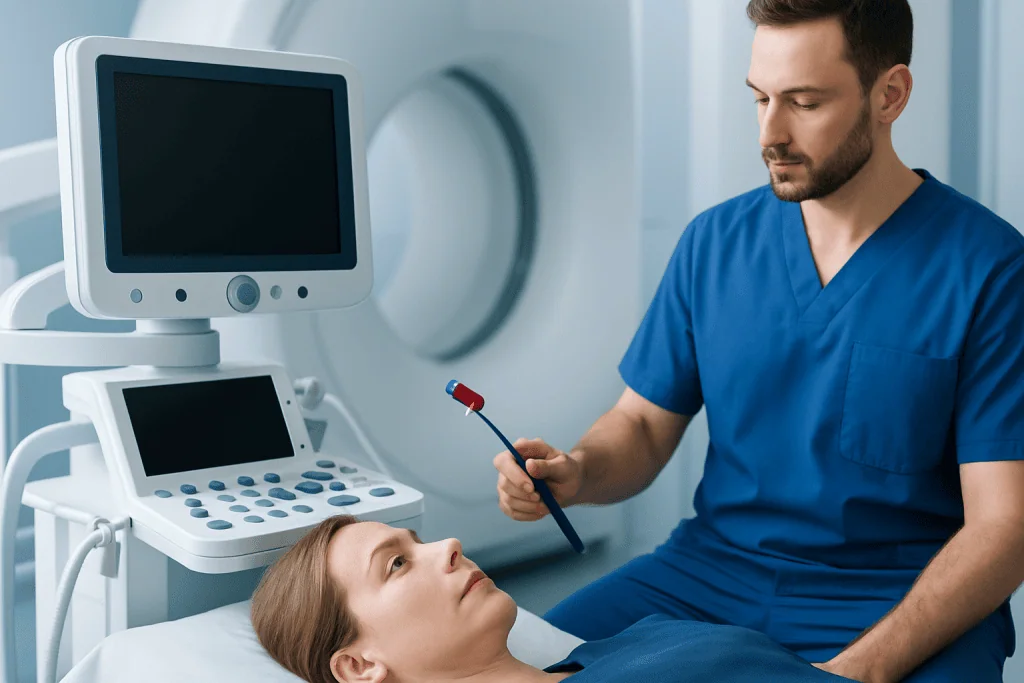
The NIHSS is usually performed at the bedside by a trained doctor, nurse, or other stroke-care professional. It follows a specific sequence so that the exam is done consistently from one clinician to another. This consistency is important because stroke care often moves quickly, and reliable communication can affect treatment decisions.
The examiner asks the patient to answer questions, follow simple commands, look in different directions, name objects, describe images, repeat words or sentences, and move the face, arms, and legs. Sensation, speech clarity, coordination, and awareness of the affected side are also checked. The test is designed to be brief, but it still captures many of the most important neurological signs.
Although the NIHSS is structured, it is not a substitute for a full medical assessment. Brain imaging such as CT or MRI, blood pressure evaluation, blood tests, heart rhythm assessment, and a careful history are all important. In some patients, doctors may combine the neurological exam with urgent imaging and, when appropriate, stroke treatment planning.
What the score can and cannot tell doctors

The total NIHSS score gives a snapshot of stroke-related impairment at a particular time. In general, lower scores suggest milder deficits and higher scores suggest more severe neurological involvement. This can help doctors estimate how much the stroke is affecting daily function and whether the condition appears to be changing.
However, the score has limits. It is not a complete measure of brain injury, and it should not be used alone to determine prognosis. Two patients with the same score may have different symptoms, different brain areas involved, and different recovery paths. Clinical context matters greatly.
The NIHSS can also underestimate some types of stroke. For example, certain strokes affecting the back part of the brain may cause dizziness, imbalance, double vision, or severe nausea while producing a relatively low NIHSS score. For that reason, clinicians do not rely on the number alone; they interpret it together with symptoms, exam findings, and imaging.
The score is best understood as a communication and monitoring tool. It helps answer questions such as: Is the patient getting weaker? Is speech worsening? Did symptoms improve after treatment? Used this way, it supports accurate and timely care rather than replacing clinical judgment.
How NIHSS fits into stroke diagnosis
NIHSS does not diagnose every stroke by itself, but it plays an important role in the diagnostic process. When someone develops sudden weakness, facial droop, speech trouble, vision loss, numbness, severe imbalance, or confusion, emergency teams often perform the scale very early. The findings help prioritize urgent testing and specialist involvement.
Because stroke symptoms can overlap with other conditions, doctors also look for possible stroke mimics. Low blood sugar, seizures, migraines, infections, medication effects, and some brain tumors can sometimes resemble stroke. Imaging is therefore essential to determine whether a blood vessel is blocked, whether there is bleeding, or whether another problem is present.
Clinicians may use the NIHSS alongside brain CT, MRI, vascular imaging, and heart evaluation to define the stroke type and cause. This broader workup helps guide decisions about clot-busting medicines, thrombectomy, blood pressure management, and secondary prevention. In selected cases, assessment may also lead to further evaluation for transient ischemic attack if symptoms have resolved.
Why NIHSS matters in treatment and recovery tracking
One of the main values of the NIHSS is that it creates a shared clinical language. A score documented at arrival can be compared with a score after imaging, after a treatment decision, and again during recovery. This makes it easier for teams across the emergency department, intensive care unit, ward, and rehabilitation services to understand how the patient is doing.
In acute ischemic stroke, the scale may help identify the severity of deficits and support decisions about time-sensitive therapies. It can also help monitor for early complications such as worsening weakness, declining alertness, or expanding neurological deficits. Repeated scoring is especially useful when symptoms fluctuate.
Later, the NIHSS can contribute to discharge planning and rehabilitation discussions, although it is not the only measure used. Recovery also depends on age, stroke location, overall health, how quickly treatment was given, and the support available after hospitalization. Some people with initially high scores improve substantially, while some with low scores may still have important difficulties with speech, coordination, or fatigue.
If ongoing deficits remain, clinicians may recommend therapies focused on mobility, communication, swallowing, or daily activities. Depending on the person’s needs, care may involve physical therapy and rehabilitation as part of a broader stroke recovery plan.
Common misunderstandings about NIHSS
A common myth is that the NIHSS is a simple test where one score gives a full answer about the future. In reality, it is a clinical tool with strengths and limitations. It helps standardize observation, but it cannot capture every symptom equally well, and it cannot replace brain imaging or specialist evaluation.
Another misunderstanding is that a low NIHSS score means there is no emergency. Mild symptoms can still represent a true stroke, and even small deficits may be disabling if they affect speech, hand function, vision, or balance. Any sudden neurological change should be assessed urgently, especially if it started suddenly and without a clear explanation.
Some people also assume that the scale is only relevant in large hospitals or research settings. In fact, it is widely used in stroke systems of care because it supports fast, structured decision-making. Its value lies not in the number alone, but in how the number fits into the overall medical picture.
For international patients needing coordinated neurological evaluation, Acibadem International’s multidisciplinary specialists at JCI-accredited hospitals assess stroke and stroke-like symptoms using established clinical tools, imaging, and individualized treatment planning.
When to seek medical care
Urgent medical care is needed if stroke symptoms begin suddenly, even if they seem mild or improve quickly. Warning signs include facial drooping, arm or leg weakness, numbness on one side, slurred speech, trouble understanding words, sudden vision changes, severe imbalance, or a sudden severe headache with neurological symptoms.
Emergency evaluation is important because some stroke treatments are time-sensitive. A person should not wait for the symptoms to pass or try to drive themselves if significant neurological symptoms are present. Calling emergency services allows faster transport and earlier treatment.
Medical review is also important after transient symptoms that resolve within minutes or hours. These can be warning signs of future stroke risk and should not be ignored. Anyone with concerns about stroke symptoms, especially those with high blood pressure, diabetes, smoking history, irregular heartbeat, or prior vascular disease, should seek professional care promptly.
- Call emergency services for sudden weakness, facial droop, speech trouble, or loss of vision.
- Seek urgent care if symptoms improve but were clearly neurological in nature.
- Arrange follow-up after stroke or TIA to discuss prevention, recovery, and rehabilitation.
Frequently asked questions
What does NIHSS stand for?
NIHSS stands for the National Institutes of Health Stroke Scale. It is a standardized exam used by healthcare professionals to measure neurological problems caused by suspected or confirmed stroke.
What is a normal NIHSS score?
A score of 0 generally means no measurable stroke-related deficit on the scale at the time of testing. However, a person can still have symptoms or a stroke pattern that is not fully captured by the score, so doctors interpret it together with imaging and the overall examination.
Does a higher NIHSS score mean a worse stroke?
In general, higher scores reflect more severe neurological impairment at that moment. Even so, the score is only one part of the picture, and long-term recovery depends on many factors such as stroke location, treatment timing, overall health, and rehabilitation.
Can someone have a stroke with a low NIHSS score?
Yes. Some mild strokes, small strokes in important functional areas, or certain posterior circulation strokes may produce a low NIHSS score while still requiring urgent care. That is why symptoms and imaging remain essential.
Who performs the NIHSS exam?
The exam is performed by trained healthcare professionals, often in the emergency department, stroke unit, or intensive care setting. Doctors, nurses, and stroke specialists may all use it once they are trained in the standardized method.
Is NIHSS used only in the emergency phase?
No. It is often first used during the urgent evaluation of stroke, but it may also be repeated during hospitalization to monitor progress or detect worsening. It can also help document the starting point for recovery and rehabilitation planning.
This article is for general information only and is not a substitute for professional medical advice. Please consult a qualified doctor about your individual situation.
Explore treatments in Turkey — costs, top hospitals & a free quote
JCI-accredited · board-certified surgeons · reply within 24h
Add us as a Preferred Source to see more of our trusted health content across Google Search, AI Overviews and Discover.
Check your numbers in seconds
BMI, calories, due date, blood pressure and 30+ more clinical calculators — free, instant, doctor-reviewed ranges.

More from the Health Library

Inulin Powder: An Evidence-Based Guide for Patients

Nosophobia: Understanding the Fear of Serious Illness
Ethmoid Bone — Explained by Medical Evidence, Not Myths

Citric Acid: An Evidence-Based Guide for Patients

Pneumocystis Pneumonia: A Complete Medical Overview