Photos of Skin Irritations: What Patients Need to Know

Photos of skin irritations may suggest possibilities, but they cannot replace a medical exam. Color, shape, texture, location, itch, pain, and timing all help doctors narrow the cause.
Key Takeaways
- Photos of skin irritations may suggest possibilities, but they cannot replace a medical exam.
- Color, shape, texture, location, itch, pain, and timing all help doctors narrow the cause.
- Many rashes are mild and temporary, but some need prompt evaluation, especially if there is fever, swelling, or rapid spread.
- Skin irritation may result from allergy, infection, chronic inflammation, friction, heat, or medication reactions.
- A dermatologist or primary care doctor can diagnose persistent, painful, or unclear skin changes.
Photos of skin irritations can help patients compare patterns such as redness, bumps, scaling, or blisters, but pictures alone cannot confirm a diagnosis. The most useful approach is to look at what the skin change looks like, where it appears, how it feels, and whether other symptoms are present.
Overview: What photos of skin irritations can and cannot tell patients
Photos of skin irritations can be useful for recognizing broad patterns. For example, some images show dry, scaly patches; others show raised red bumps, hives, blisters, or ring-shaped lesions. These visual clues may help patients understand whether a skin change looks more like irritation, allergy, inflammation, or infection.
However, a photo cannot show the full clinical picture. Two rashes may look similar in an image but have very different causes and treatments. Doctors also consider whether the area is itchy, painful, warm, crusted, spreading, or linked to fever, new products, recent illness, medications, sun exposure, or contact with plants, metals, or chemicals.
Skin tone also matters. Irritation may appear red, pink, purple, gray-brown, or darker than the surrounding skin depending on a person’s natural complexion. Because online images often show limited variation in skin tones, patients may miss important differences or misidentify a rash.
For that reason, image comparison is best used as a starting point rather than a diagnosis. If a skin problem is severe, persistent, worsening, or hard to identify, a qualified doctor should evaluate it directly.
How to interpret common visual patterns
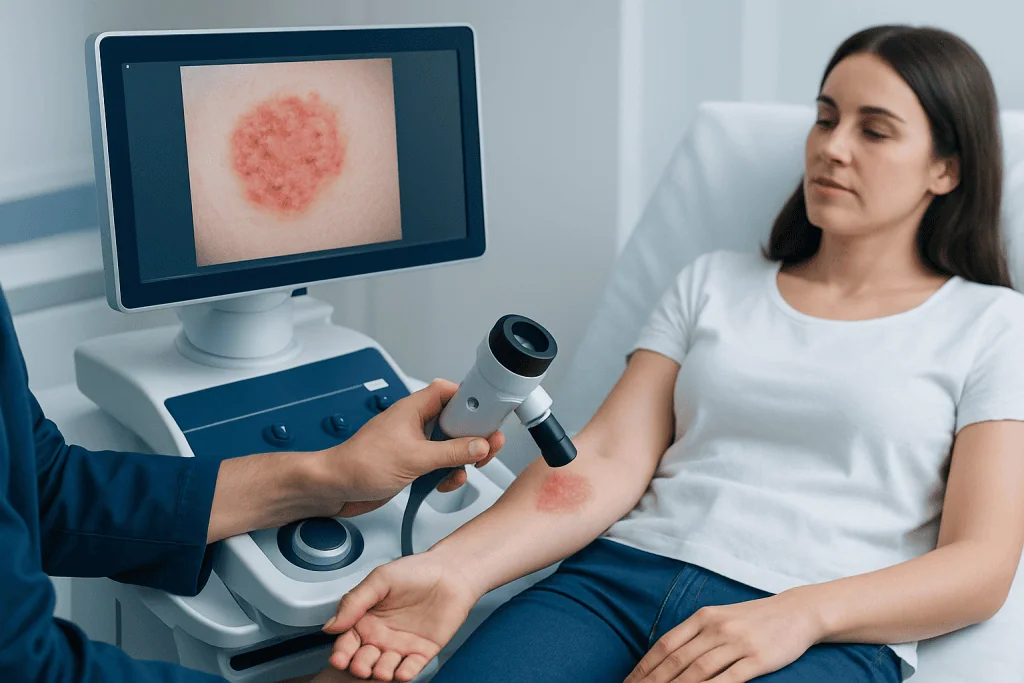
When patients look at photos of skin irritations, it can help to focus on the pattern rather than the label. A flat red area may suggest irritation or inflammation. Tiny bumps may point toward heat rash, follicle irritation, or allergy. Thickened, flaky skin may fit a chronic inflammatory condition. Clear blisters may occur with contact reactions, viral infections, or friction.
The distribution is also important. Skin changes in body folds may be related to moisture, yeast, or friction. Rashes on the hands can be linked to soaps, cleaning products, gloves, or frequent washing. Irritation on the face may be caused by cosmetics, shaving products, sun exposure, or conditions such as eczema or rosacea-like inflammation. A rash limited to one side of the body may raise different questions than a rash that is widespread.
Symptoms that accompany the appearance can be just as informative as the photo itself. Itch often suggests allergy, eczema, dryness, or insect bites. Pain or burning may occur with infections, shingles, or inflamed skin. Oozing, crusting, or pus may indicate a secondary infection or a condition needing prompt treatment.
- Dry and scaly: often seen with eczema, psoriasis, or simple dryness
- Raised and itchy: may occur with hives, bites, or allergic reactions
- Ring-shaped: can suggest fungal infection
- Blistering: may result from irritation, burns, contact allergy, or infection
- Crusted or oozing: can indicate inflamed or infected skin
Common causes patients often compare in skin irritation photos

Several common conditions repeatedly appear in image searches, but they overlap in appearance. Contact dermatitis happens when the skin reacts to something touching it, such as fragrance, detergents, metals, latex, or plants. It usually causes redness, itch, and sometimes swelling or blisters in the area of contact.
Atopic dermatitis, often called eczema, tends to cause dry, itchy, inflamed patches that can come and go. It may affect the hands, face, neck, inside the elbows, or behind the knees. Patients comparing photos may also encounter psoriasis, which often produces thicker, well-defined plaques with scale, commonly on the elbows, knees, or scalp.
Fungal infections are another frequent source of confusion. Ringworm can create a circular, scaly border with clearer skin in the center, but not every ring-shaped rash is fungal. Heat rash may cause clusters of tiny bumps in hot, sweaty areas, while hives tend to appear as raised, itchy welts that can change shape and move from one place to another.
Less commonly, skin irritation-like changes may reflect medication reactions, viral illnesses, bacterial infections, autoimmune disease, or circulation problems. This is one reason self-diagnosis from photos alone can be unreliable, especially if the rash is new, rapidly changing, or accompanied by general symptoms.
Why skin irritations can look different from person to person
A single condition can look quite different between individuals. Age, skin tone, dryness, scratching, prior treatment, and how long the rash has been present can all change its appearance. In early stages, a rash may look faint and patchy; later it may become darker, thicker, cracked, or scabbed.
Images found online often show a classic textbook example, but many real cases are less typical. For instance, mild eczema may appear as only subtle roughness and itch, while severe cases can become red, swollen, and fissured. Psoriasis may present as small spots in one person and larger plaques in another. Even allergic reactions range from slight redness to intense inflammation.
Skin tone deserves particular attention. On lighter skin, inflammation is often visibly pink or red. On medium to dark skin, the same inflammation may look violet, grayish, deep brown, or simply darker than surrounding skin. After the rash heals, temporary light or dark marks may remain even when the active irritation has improved.
Because of these differences, doctors rely not only on appearance but also on history and physical examination. If needed, they may use tests to clarify whether the cause is inflammatory, allergic, fungal, bacterial, or autoimmune.
How doctors diagnose a skin irritation
Diagnosis usually starts with careful questions. A doctor may ask when the rash began, whether it itches or hurts, what products were recently used, whether there was travel or sun exposure, and whether any medicines were started. They also ask whether the rash is recurring and whether there is a personal or family history of allergies, asthma, or chronic skin disease.
Physical examination looks at more than one lesion. The doctor assesses the color, border, scale, moisture, distribution, and whether nails, scalp, or mucous membranes are involved. Photos taken by the patient at home can be helpful if the rash changes quickly or fades before the appointment, but these images are an aid rather than the sole basis for diagnosis.
Some cases need additional testing. A skin scraping may help identify fungal infection. Patch testing may be recommended when allergic contact dermatitis is suspected. A bacterial or viral swab can be useful if there is crusting or blistering. In uncertain or persistent cases, a biopsy may be considered.
If a chronic inflammatory disorder is suspected, the doctor may discuss treatment options such as moisturizers, trigger avoidance, anti-inflammatory medicines, or specialist dermatology care. In some patients, assessment by a dermatologist can help distinguish look-alike conditions and guide long-term management.
Treatment options and practical self-care
Treatment depends on the cause, not just the appearance. Mild irritation from dryness, friction, or over-washing may improve with gentle skin care, fragrance-free moisturizers, lukewarm showers, and avoiding harsh cleansers. If a new cosmetic, detergent, or topical product seems linked to the reaction, stopping it may help. Patients should avoid scratching, which can worsen inflammation and increase the risk of infection.
When the cause is inflammatory, doctors may recommend targeted treatment. Eczema often improves with regular moisturizing and prescription anti-inflammatory therapy when needed. Fungal infections require antifungal treatment rather than steroid creams alone. Hives may respond to antihistamines, while infected skin may require antimicrobial treatment. This is why guessing from photos can delay proper care.
For persistent or recurrent conditions, specialist evaluation may be appropriate. Depending on the diagnosis, a doctor may discuss dermatology care or, for selected inflammatory disorders, therapies used in psoriasis treatment. If skin changes are related to an allergy trigger, evaluation through allergy testing may also be helpful in some cases.
Patients should be cautious about strong over-the-counter or internet-recommended products, especially on the face, around the eyes, or in children. A treatment that helps one rash can worsen another. Gentle cleansing, trigger avoidance, and professional guidance are the safest foundation for care.
When to seek medical care
Many mild skin irritations improve with simple care, but some situations need medical attention. Patients should contact a doctor if a rash lasts more than a couple of weeks, keeps returning, spreads quickly, becomes very painful, or interferes with sleep or daily activities. It is also wise to seek care when the diagnosis is unclear or home measures are not helping.
Prompt assessment is especially important if there is fever, facial swelling, trouble breathing, widespread blistering, skin peeling, or signs of infection such as warmth, pus, or increasing tenderness. A rash involving the eyes, mouth, or genitals should also be evaluated without delay. Infants, older adults, and people with weakened immune systems may need earlier review.
If a skin change follows a new medication, patients should speak with a qualified clinician urgently, particularly if the reaction is widespread or accompanied by general symptoms. Emergency care is needed for severe allergic reactions with swelling of the lips or tongue, breathing difficulty, dizziness, or faintness.
For international patients who need specialist assessment, Acibadem International’s multidisciplinary teams at JCI-accredited hospitals diagnose and treat a wide range of skin conditions, coordinating care when dermatology input is needed.
Using photos of skin irritations wisely
Photos are most helpful when they support observation, not when they replace medical judgment. If patients want to compare their skin changes with images, it helps to note the date, body location, recent exposures, symptoms, and whether the rash changes during the day. Taking clear photos in natural light can also help a doctor track the evolution of a condition over time.
Rather than asking only, “What does this picture look like?” patients may get better answers by asking a broader set of questions: Is the area itchy or painful? Is it dry, scaly, or moist? Is it limited to one area or widespread? Did it begin after a new product, illness, medicine, outdoor activity, or heat exposure? Those details often narrow the possibilities more reliably than appearance alone.
Reliable medical information can help patients understand the difference between irritation, allergy, infection, and chronic inflammatory disease. But no online gallery can account for every variation in skin tone, severity, or associated symptoms. If there is doubt, especially when the rash is persistent or severe, a professional evaluation is the safest next step.
In short, photos of skin irritations can be educational and reassuring when used carefully. They can help patients recognize patterns and prepare for a medical visit, but diagnosis and treatment should be guided by a qualified clinician who can consider the full picture.
Frequently asked questions
Can photos of skin irritations identify a rash accurately?
Photos can suggest general patterns, but they cannot confirm the exact cause. Doctors usually need to know the symptoms, timing, body location, exposures, and medical history before making a diagnosis.
Why does my rash not look like pictures online?
Rashes can look different depending on skin tone, age, scratching, dryness, and how long the condition has been present. Online images often show classic examples, while real cases may appear milder, darker, less defined, or more inflamed.
What skin irritations are commonly confused with each other?
Eczema, contact dermatitis, psoriasis, fungal infections, hives, heat rash, and insect bites can overlap in appearance. That is why itch, pain, scaling, blisters, and location on the body are important diagnostic clues.
Should patients use over-the-counter creams based only on a photo match?
That is not the safest approach. Some products may help one condition but worsen another, especially if the rash is fungal, infected, or located on sensitive skin such as the face or eyelids.
When is a skin irritation more urgent?
Medical care is recommended if the rash is rapidly spreading, very painful, blistering, infected, or associated with fever. Emergency help is needed for trouble breathing, severe swelling, or a serious reaction after taking a new medicine.
What information should a patient record before seeing a doctor?
It helps to note when the rash started, whether it itches or hurts, where it appears, and whether any new products, medicines, foods, or environmental exposures were involved. Photos taken over several days can also help show how the skin change is evolving.
This article is for general information only and is not a substitute for professional medical advice. Please consult a qualified doctor about your individual situation.
Explore treatments in Turkey — costs, top hospitals & a free quote
JCI-accredited · board-certified surgeons · reply within 24h
Add us as a Preferred Source to see more of our trusted health content across Google Search, AI Overviews and Discover.

More from the Health Library

Tibial Nerve: An Evidence-Based Guide for Patients

Mushroom — Explained by Medical Evidence, Not Myths

Quetiapine — Explained by Medical Evidence, Not Myths

Atychiphobia: A Complete Medical Overview

Temporal Artery: A Complete Medical Overview