Pityriasis Rosea: An Evidence-Based Guide for Patients

Pityriasis rosea is a self-limited rash that often clears without scarring. It commonly starts with a “herald patch” before a wider rash appears days to weeks later.
Key Takeaways
- Pityriasis rosea is a self-limited rash that often clears without scarring.
- It commonly starts with a “herald patch” before a wider rash appears days to weeks later.
- Itching can range from mild to bothersome, but supportive treatment often helps.
- Diagnosis is usually clinical, though tests may be needed if the rash is unusual.
- Medical review is important if the rash is severe, painful, involves the face or genitals, or occurs during pregnancy.
Pityriasis rosea is a common, usually harmless skin rash that often begins with a single larger patch and is followed by smaller scaly spots on the trunk. It is not typically serious and often improves on its own, but a doctor can help confirm the diagnosis and ease bothersome symptoms such as itching.
What is pityriasis rosea?
Pityriasis rosea is a common inflammatory skin rash that usually goes away on its own over time. In many people, it begins with one larger oval patch, often called a herald patch, followed days or weeks later by multiple smaller scaly patches on the chest, back, or abdomen. Although the rash can look concerning, it is generally benign and temporary.
This condition is seen most often in children, teenagers, and young adults, but it can affect people of many ages. It is not usually a sign of poor hygiene, an allergy, or a serious internal illness. The main concerns are often discomfort from itching and confusion with other skin conditions that may need different treatment.
Pityriasis rosea can look different depending on skin tone. In lighter skin, patches may appear pink or salmon-colored. In darker skin, they may look gray, violet, or darker brown, and color changes can persist for some time after the rash fades. Because appearance varies, a professional skin assessment can be helpful when the diagnosis is uncertain.
How the rash typically appears and feels
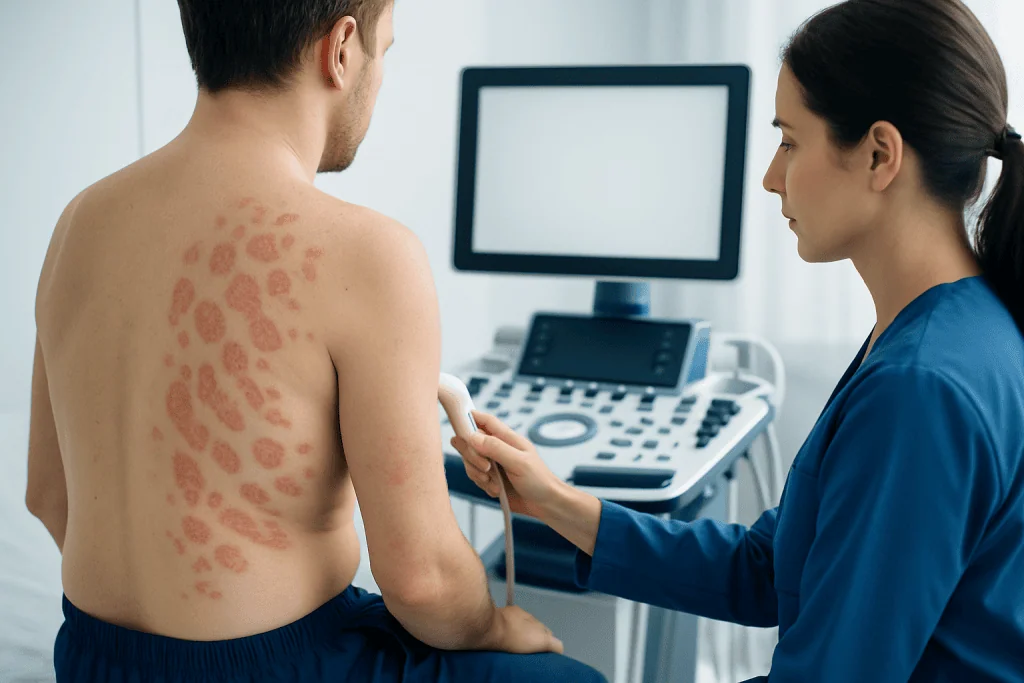
The classic pattern starts with a single larger patch, usually on the chest, back, or abdomen. This herald patch is often oval, slightly raised, and has a fine scale around the edge. After this first lesion appears, a more widespread rash may develop over the trunk and sometimes the upper arms or thighs.
The smaller spots often follow the natural lines of the skin, especially on the back, creating a pattern sometimes described as a “Christmas tree” distribution. The rash usually stays away from the palms of the hands and soles of the feet. Some people have only a few spots, while others develop many.
Itching is common but not universal. For some, the rash is only mildly irritating; for others, itching can interfere with sleep or daily comfort, especially with heat, sweating, or friction from clothing. A few people notice mild fatigue, headache, or cold-like symptoms before the rash begins, though many feel otherwise well.
- Common features include a herald patch, fine scaling, and oval spots on the trunk.
- Itching may be absent, mild, or moderate.
- The rash usually lasts several weeks before gradually fading.
- Temporary skin discoloration may remain for a while after healing, especially in darker skin tones.
Why pityriasis rosea happens

The exact cause of pityriasis rosea is not fully established, but it is thought to be linked in some cases to a viral trigger, particularly reactivation of certain human herpes viruses that are different from the viruses that cause genital herpes. Importantly, pityriasis rosea is generally not considered highly contagious, and it does not usually spread through routine day-to-day contact.
It is not caused by a fungal infection, even though the rash can look scaly. It is also not typically due to food allergy or poor skin care. In some people, pityriasis rosea-like eruptions can be triggered by medications, so a doctor may review recent prescriptions or over-the-counter products if the pattern is unusual.
There are no well-established lifestyle risk factors that clearly prevent or cause pityriasis rosea. It seems to occur sporadically and often without an obvious reason. Because many rashes can look similar, a doctor may consider conditions such as eczema, psoriasis, fungal infection, or skin cancer if there are atypical features or persistent lesions.
How doctors diagnose pityriasis rosea
Diagnosis is often based on the appearance of the rash, the order in which it appeared, and the areas of the body involved. A clinician will usually ask when the herald patch started, whether the rash itches, and whether there have been recent illnesses, new medications, or exposures. In many straightforward cases, no further testing is needed.
However, additional evaluation may be recommended if the rash is unusual, severe, or affecting areas not typical for pityriasis rosea. This is especially important if lesions involve the palms, soles, mouth, or genitals, or if the person has fever, significant pain, or other symptoms suggesting a different condition. Doctors may also consider tests to rule out fungal infection or other illnesses that can mimic pityriasis rosea.
If the diagnosis remains unclear, a dermatologist may perform a skin examination using magnification or occasionally recommend a small skin sample. In some cases, doctors use dermatology evaluation to distinguish pityriasis rosea from other rashes such as drug eruptions, psoriasis, or eczema. The goal is not only to name the rash correctly but also to make sure no treatment-sensitive condition is overlooked.
Treatment options and symptom relief
Because pityriasis rosea usually resolves naturally, treatment focuses mainly on comfort rather than cure. If itching is mild, simple skin care may be enough. Doctors often recommend gentle, fragrance-free moisturizers and avoiding factors that worsen irritation, such as hot showers, heavy sweating, and tight clothing.
For more troublesome itching, clinicians may suggest anti-itch creams, topical corticosteroids, or oral antihistamines, depending on the person’s age, skin findings, and overall health. In selected cases with extensive or very itchy rash, supervised treatment such as light-based therapy may be considered through specialist dermatology care. Stronger treatment is not routinely necessary for most patients.
There is limited evidence that some antiviral approaches may shorten the course in certain severe cases, but they are not standard for everyone. Because pityriasis rosea often improves on its own, treatment decisions should be individualized and made with a qualified doctor. If the rash seems atypical or is getting worse rather than better, reassessment is important.
Self-care, recovery, and practical day-to-day tips
Most people can continue normal daily activities while the rash runs its course. Gentle skin care can make a noticeable difference in comfort. Lukewarm showers, mild soap-free cleansers, soft cotton clothing, and regular moisturizing may reduce dryness and irritation.
Heat can make itching worse, so it may help to avoid long hot baths, saunas, and vigorous exercise if these clearly trigger symptoms. Scratching is best minimized because it can further irritate the skin and increase the chance of marks or temporary post-inflammatory color changes. Keeping nails short and using bland emollients may help.
Recovery is usually gradual. The visible rash often settles over several weeks, but the skin may not look fully back to normal right away. Some people, especially those with darker skin tones, may notice lighter or darker areas for a period after the inflammation is gone. These changes often improve with time. If symptoms are persistent or uncertainty remains, a dermatologist can provide guidance tailored to the individual.
When to seek medical care
Medical review is a good idea whenever a new rash is widespread, unexplained, or causing significant discomfort. A doctor should assess the rash if it is painful rather than itchy, if blisters develop, or if there is fever, mouth sores, or swelling. Evaluation is also important if the rash involves the face, palms, soles, scalp, or genital area, because those patterns may suggest a different diagnosis.
Pregnant patients with a rash that may be pityriasis rosea should seek prompt medical advice. Although most cases are still uncomplicated, a clinician may want closer assessment because management can differ in pregnancy, especially early in gestation. Babies, very young children, and people with weakened immune systems may also benefit from earlier review.
If a person has had recent medication changes, sexually transmitted infection risk, or a rash that is not improving after several weeks, professional evaluation is especially important. Near the end of the care pathway, patients who need specialist assessment may be seen by Acibadem International, where multidisciplinary specialists and JCI-accredited hospitals diagnose and treat skin conditions for international patients.
Frequently asked questions
Is pityriasis rosea contagious?
Pityriasis rosea is generally not considered highly contagious. Most people do not pass it to family members or close contacts through normal daily interaction. Its exact cause is not fully understood, but it does not behave like a typical easily spread infection.
How long does pityriasis rosea last?
In many cases, the rash clears on its own within about 6 to 10 weeks, although some people recover sooner and others take longer. Skin color changes may linger after the rash itself has gone away. If the rash is lasting unusually long or changing in an unexpected way, a doctor should reassess it.
What is a herald patch?
A herald patch is the first, larger spot that often appears before the rest of the rash. It is usually oval, slightly scaly, and found on the trunk. Not every person notices it, but when present it can be a helpful clue to the diagnosis.
Can pityriasis rosea be mistaken for another condition?
Yes. Other rashes, including fungal infection, eczema, psoriasis, drug reactions, and some infections, can sometimes look similar. That is why medical evaluation is useful if the rash is unusual, severe, or not following the expected pattern.
Does pityriasis rosea need treatment?
Many people do not need specific treatment because the condition usually resolves naturally. Treatment is mainly used to reduce itching and improve comfort. A clinician may recommend moisturizers, anti-itch measures, or prescription creams depending on symptoms.
Can adults and children both get pityriasis rosea?
Yes, both adults and children can develop pityriasis rosea, though it is more common in older children, teenagers, and young adults. The general course is often similar across age groups. A healthcare professional should evaluate younger children if the diagnosis is uncertain.
References
- American Academy of Dermatology
- National Health Service
- DermNet
- Mayo Clinic
- MedlinePlus
This article is for general information only and is not a substitute for professional medical advice. Please consult a qualified doctor about your individual situation.
Explore treatments in Turkey — costs, top hospitals & a free quote
JCI-accredited · board-certified surgeons · reply within 24h
Add us as a Preferred Source to see more of our trusted health content across Google Search, AI Overviews and Discover.