Posterior Pelvic Tilt — Explained by Medical Evidence, Not Myths

Posterior pelvic tilt describes the position of the pelvis, not a diagnosis by itself. It may be linked to muscle imbalance, prolonged sitting, deconditioning, pain, or underlying hip and spine conditions.
Key Takeaways
- Posterior pelvic tilt describes the position of the pelvis, not a diagnosis by itself.
- It may be linked to muscle imbalance, prolonged sitting, deconditioning, pain, or underlying hip and spine conditions.
- Many people improve with posture awareness, stretching, strengthening, and physical therapy.
- Persistent pain, weakness, numbness, or walking difficulty should be assessed by a doctor.
- Treatment depends on the cause and may include rehabilitation, pain management, or care for related musculoskeletal conditions.
Posterior pelvic tilt is a postural pattern in which the pelvis rotates backward, often flattening the lower back and changing how the hips, spine, and core work together. It is not always a disease, but when it contributes to pain, stiffness, or movement problems, a medical evaluation can help identify the cause and guide treatment.
Overview: what posterior pelvic tilt means
Posterior pelvic tilt means the pelvis rotates backward relative to the thighs and spine. In simple terms, the front of the pelvis lifts upward and the back of the pelvis drops slightly downward. This often reduces the natural inward curve of the lower back and can make the buttocks appear tucked under.
Medical evidence shows that this posture can be a normal variation in some people and a compensatory pattern in others. It is important not to treat every pelvic position as a problem. The key question is whether the posture is causing symptoms, limiting movement, or reflecting an underlying issue in the hips, spine, muscles, or nerves.
Posterior pelvic tilt is often discussed in fitness and social media content, but many myths oversimplify it. It is not always caused by one “tight” muscle or one “weak” muscle group, and it cannot be judged accurately from a single photo alone. A proper assessment looks at standing posture, walking, spinal alignment, hip motion, pain patterns, strength, flexibility, and daily habits.
How it can affect posture, movement, and comfort
The pelvis is a central link between the upper and lower body. When it tilts backward, the lower back may flatten, the abdominal wall may appear shortened, and the hips may move differently during standing, bending, walking, and exercise. Some people notice stiffness more than pain, while others feel strain in the lower back, hips, buttocks, or hamstrings.
Posterior pelvic tilt can also change how forces are distributed through the body. For example, reduced lumbar curve may alter spinal loading, and limited hip mobility may lead a person to compensate with the knees or upper back. In daily life, this may show up as discomfort after sitting for long periods, difficulty maintaining upright posture, or reduced ease with lifting, squatting, or climbing stairs.
However, posture alone does not predict pain. Some people with a clear posterior tilt have no symptoms, while others with only subtle changes feel significant discomfort. That is why clinicians consider the whole picture rather than assigning symptoms to posture alone.
Symptoms and signs that may be associated with posterior pelvic tilt
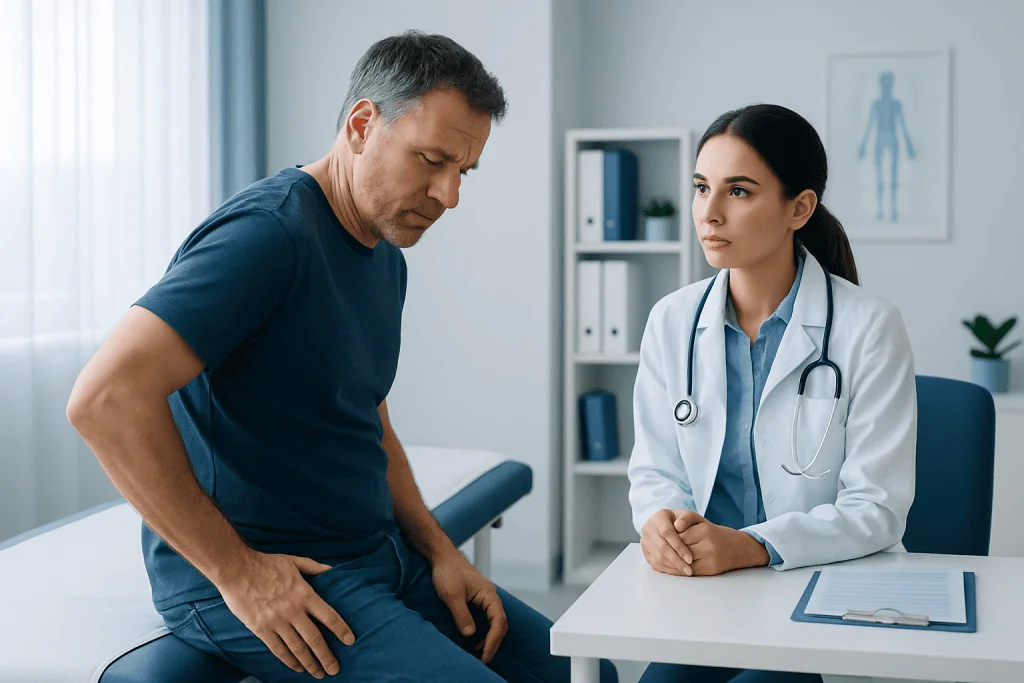
Posterior pelvic tilt itself is a position, so symptoms vary from person to person. Some individuals have no symptoms at all and only notice a change in posture. Others may develop discomfort because the body is moving or loading tissues in a less efficient way.
Commonly reported features include:
- Flattened or reduced natural arch in the lower back
- Tightness in the hamstrings or buttocks
- Hip stiffness, especially with extension
- Lower back discomfort during sitting, standing, or exercise
- A sense of the pelvis being tucked under
- Reduced ease with bending, squatting, or walking briskly
When symptoms are more pronounced, clinicians may also look for related conditions such as muscle strain, hip joint problems, spinal degeneration, or nerve irritation. For example, some people with low back pain may also have a herniated disc or other structural issues, while others may have movement-related pain without a major structural abnormality. A careful examination helps distinguish these possibilities.
Causes and risk factors
There is rarely a single cause of posterior pelvic tilt. In many cases, it develops from a combination of lifestyle, biomechanics, pain adaptation, and age-related change. Prolonged sitting is commonly discussed because it may reduce hip extension, shorten some tissues, and weaken others over time. Still, not everyone who sits for long hours develops this pattern, which highlights the role of individual differences.
Contributors may include deconditioning, reduced core and hip strength, limited hip mobility, hamstring dominance, gluteal weakness, or movement strategies learned after an injury. Pain itself can change posture. A person with back or hip pain may instinctively tuck the pelvis under to avoid positions that feel uncomfortable, even if that strategy creates new strain elsewhere.
Posterior pelvic tilt can also be associated with spinal, hip, or neurological conditions. Degenerative changes, arthritis, previous surgery, muscle imbalance after injury, and some neuromuscular disorders can all influence pelvic alignment. In older adults, posture may shift as the body adapts to changes in the spine, balance, and walking pattern. When symptoms are persistent or progressing, doctors may investigate related problems such as scoliosis or other bone, joint, and spine conditions rather than focusing only on the tilt itself.
How doctors assess and diagnose it
Diagnosis begins with history and physical examination. A doctor or physical therapist usually asks when symptoms started, what activities make them better or worse, whether there is pain, numbness, weakness, or stiffness, and whether there has been a prior injury. The exam may include observing posture from the side, checking spinal curves, testing hip range of motion, assessing muscle strength and flexibility, and watching how the person walks, bends, and stands up from a chair.
There is no single perfect test for posterior pelvic tilt. Assessment is functional and individualized. Clinicians may compare findings in relaxed standing, active movement, and symptom-provoking positions. This is helpful because pelvic alignment can change depending on fatigue, pain, and the task being performed.
Imaging is not always needed. If symptoms suggest a structural problem, the doctor may recommend X-rays, MRI, or other tests to look at the spine, hips, or soft tissues. In selected cases, evaluation may overlap with MRI scanning or specialist review in orthopedics and traumatology to identify conditions that may be contributing to pain or altered posture.
Treatment options supported by clinical practice
Treatment depends on the cause, symptoms, and functional goals. If posterior pelvic tilt is not causing pain or limitation, treatment may not be necessary. When symptoms are present, care often starts conservatively with education, activity modification, and exercise-based rehabilitation. The aim is not simply to force the pelvis into one “ideal” position, but to improve movement quality, reduce pain, and restore strength and mobility.
Physical therapy is often central. A rehabilitation plan may include stretching for muscles that feel shortened, strengthening for the gluteal, hip flexor, spinal, or abdominal muscles depending on the pattern found on exam, and retraining of standing, walking, lifting, and sitting mechanics. Programs are usually personalized rather than based on a one-size-fits-all formula. In some cases, referral for physical therapy and rehabilitation is the most helpful next step.
If an underlying condition is driving symptoms, that condition also needs attention. Management may include pain-relieving measures, treatment for arthritis or disc-related pain, guided exercise progression, or, less commonly, interventional or surgical care when there is significant structural disease. The focus remains on the person’s symptoms and function rather than on posture alone.
Acibadem International’s multidisciplinary specialists and JCI-accredited hospitals evaluate musculoskeletal complaints in international patients, including postural and spine-related concerns, when a more comprehensive assessment is needed.
Self-care, exercise, and prevention
Self-care can be very effective, especially when symptoms are mild and related to daily habits. The goal is to improve mobility and support the body’s ability to move through a comfortable range rather than holding one rigid posture all day. People who sit for long periods often benefit from standing breaks, walking intervals, and changes in workstation setup.
Helpful strategies may include:
- Regular movement breaks during desk work or travel
- Gentle hamstring and gluteal stretching if these areas feel tight
- Hip mobility exercises, especially for extension
- Core and hip strengthening under professional guidance
- Gradual return to exercise after pain or injury
- Attention to lifting and bending technique
Exercises should match the individual pattern. For one person, strengthening the posterior chain may be useful; for another, improving hip flexor activation or spinal mobility may matter more. Pain that worsens with exercise is a sign to stop and seek advice. A physical therapist can help ensure the exercises are appropriate and performed correctly.
When to seek medical care
Medical care is appropriate when posterior pelvic tilt is associated with ongoing pain, worsening stiffness, reduced walking tolerance, repeated injury, or difficulty with work, sport, or daily activities. An evaluation is also important if symptoms do not improve with rest, simple activity changes, and gradual exercise.
People should seek prompt medical attention if posture changes are accompanied by leg weakness, numbness, shooting pain, balance problems, fever, unexplained weight loss, or loss of bladder or bowel control. These features may point to a condition that needs urgent assessment rather than routine posture care.
For children, older adults, or anyone with a history of trauma, osteoporosis, cancer, inflammatory disease, or previous spine surgery, professional evaluation is especially valuable. A doctor can decide whether symptoms reflect a mechanical postural issue, a hip disorder, a spinal condition, or another medical problem that needs targeted treatment.
Frequently asked questions
Is posterior pelvic tilt a medical condition or just a posture?
Posterior pelvic tilt is primarily a description of pelvic position. It becomes medically important when it contributes to pain, stiffness, movement limitation, or reflects an underlying hip, spine, or neurological problem.
Can posterior pelvic tilt cause lower back pain?
It can be associated with lower back pain in some people, especially if it changes how the spine and hips share load during sitting, standing, or exercise. However, back pain is complex, and posture alone is usually not the only cause.
Can exercise fix posterior pelvic tilt?
Many people improve with the right exercise program, especially when symptoms are linked to muscle imbalance, reduced mobility, or deconditioning. The best plan depends on the individual assessment, so exercises should be tailored rather than copied from generic online routines.
Is sitting too much a common cause of posterior pelvic tilt?
Prolonged sitting can contribute by affecting hip mobility, muscle activity, and movement habits over time. Even so, it is usually one factor among several, not the sole explanation in every case.
When should someone worry about posterior pelvic tilt?
Concern is more appropriate when it comes with persistent pain, worsening function, weakness, numbness, or changes in walking and balance. These symptoms deserve medical assessment to rule out a more significant musculoskeletal or neurological issue.
Do all people with posterior pelvic tilt need imaging?
No. Imaging is often unnecessary when the problem appears to be mechanical and responds to conservative care. Doctors usually reserve X-rays or MRI for cases with trauma, nerve symptoms, persistent pain, or suspicion of an underlying structural condition.
This article is for general information only and is not a substitute for professional medical advice. Please consult a qualified doctor about your individual situation.
Joint and spine care in Turkey — expert assessment & treatment
JCI-accredited · board-certified surgeons · reply within 24h
Add us as a Preferred Source to see more of our trusted health content across Google Search, AI Overviews and Discover.

More from the Health Library

Penis Ring — Explained by Medical Evidence, Not Myths

Head Tumors Signs: What Patients Need to Know

Syphilis Test: A Complete Medical Overview

Cerebral Atrophy — Explained by Medical Evidence, Not Myths

Truvada: An Evidence-Based Guide for Patients