

Private mri scan vs Nhs referral: Which Is Right for You?

An MRI scan uses magnetic fields and radio waves rather than ionising radiation to create detailed images. NHS MRI referrals are based on clinical need and local pathways, while private assessment may offer a different route to arranging imaging.
Key Takeaways
- An MRI scan uses magnetic fields and radio waves rather than ionising radiation to create detailed images.
- NHS MRI referrals are based on clinical need and local pathways, while private assessment may offer a different route to arranging imaging.
- A scan result must be interpreted alongside symptoms, examination findings and medical history.
- MRI is not suitable for everyone; implanted devices, metal fragments and severe claustrophobia should be discussed before booking.
- Urgent symptoms such as stroke signs, severe chest pain or sudden weakness need emergency assessment rather than a routine MRI booking.
For private MRI scan vs NHS referral, the right option depends on symptoms, clinical need, local access and whether coordinated follow-up is available. An MRI should be requested when a qualified clinician believes the result is likely to answer a relevant medical question and guide care.
Private MRI Scan vs NHS Referral: The Main Difference
When considering a private MRI scan vs NHS referral, neither option is automatically better for every person. An NHS referral is usually appropriate when a GP, specialist or emergency clinician considers an MRI clinically necessary and requests it through local services. A private route may be considered by people seeking an independent consultation or imaging appointment, but it should still begin with appropriate medical screening and include a clear plan for reviewing the result.
MRI, or magnetic resonance imaging, is a detailed scan that can assess many parts of the body, including the brain, spine, joints, muscles and some internal organs. It does not use X-rays. However, it is not a general health screening test for everyone, and finding an abnormality does not always mean that it explains symptoms or requires treatment.
The most useful comparison is not simply speed. People should consider why the scan is needed, whether symptoms suggest urgent care, who will request and report the examination, and who will explain the findings and arrange treatment if needed. For an overview of the examination itself, see private MRI scan.
How MRI Referral Pathways Work
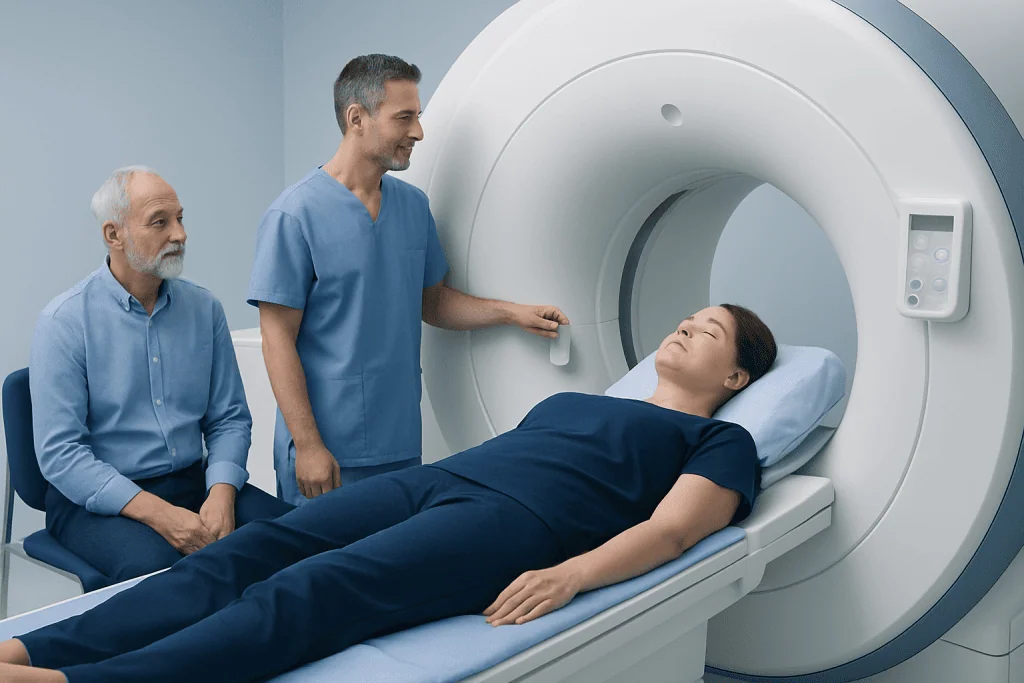
Within the NHS, a person commonly starts with a GP, physiotherapist, hospital clinician or another healthcare professional. The clinician takes a history, performs an examination where appropriate and decides whether imaging is likely to affect management. The referral may be routine, urgent or made through a specialist pathway depending on the concern and local guidance.
A private pathway may begin with a GP, consultant, sports medicine clinician or an imaging provider that arranges clinical review before scanning. In many settings, an MRI examination needs a referral from an appropriately qualified clinician. This helps ensure the requested body area, scan protocol and use of contrast material, if relevant, are suitable for the clinical question.
Both routes should include safety screening, image reporting by an appropriately trained radiologist and access to follow-up. A written report alone can be difficult to interpret without clinical context. Before proceeding, it is sensible to ask how results will be communicated and what happens if the scan identifies a problem needing further care.
Who May Be a Candidate for an MRI?

MRI may be considered for persistent or unexplained symptoms when a clinician needs more detail than can be obtained through examination, blood tests, X-rays or ultrasound. Examples can include certain neurological symptoms, suspected spinal nerve compression, joint or soft-tissue injury, inflammatory conditions and assessment of some organs. The decision depends on the individual presentation rather than symptoms alone.
It is important to tell the healthcare team about any implanted medical device, previous surgery, metal injury, pregnancy, kidney problems, allergies or anxiety in enclosed spaces. Many implants are MRI-compatible under specific conditions, but this must be confirmed before the scan. Metal fragments in or near the eyes require particular attention.
Some MRI examinations use a contrast agent to make particular tissues or blood vessels easier to see. Contrast is not needed for every scan. The clinician and radiology team will consider whether it is useful and whether there are any reasons to avoid or modify its use, including significant kidney disease.
- An MRI may be useful when its result is expected to change diagnosis, treatment or monitoring.
- It may not be the first test when another imaging method better answers the question.
- Symptoms that suggest an emergency should be assessed urgently rather than waiting for an outpatient scan.
What Happens During a Private or NHS MRI Scan?
The scan experience is broadly similar in private and NHS settings. Before the appointment, the patient completes a safety questionnaire and may be asked to remove jewellery, watches, hearing aids and other metal-containing items. Staff confirm the body area to be scanned, explain the procedure and provide ear protection because the MRI machine makes loud tapping and knocking sounds.
During the scan, the patient lies on a movable table that slides into the scanner. They need to keep still while sequences of images are taken. The radiographer can communicate with the patient throughout, and an alarm device is usually available if they need assistance. Depending on the body area and whether contrast is used, the appointment length can vary.
If contrast is needed, it may be given through a small cannula in a vein. After imaging, a radiologist reviews the pictures and prepares a report. The referring clinician should then discuss what the report means in the context of the patient’s symptoms, examination and previous tests. A normal MRI can be reassuring, but it does not rule out every possible cause of pain or other symptoms.
Benefits, Limitations and Possible Risks
A major benefit of MRI is its ability to provide high-resolution images of soft tissues without ionising radiation. It can help clarify a diagnosis, identify injuries or inflammation, guide specialist referral and support treatment planning. In some situations, a timely scan may reduce uncertainty and avoid unnecessary procedures.
However, more imaging is not always better. MRI can detect common age-related or incidental changes that may never cause symptoms. These findings can create worry and may lead to additional appointments or tests. For this reason, the best scan is one requested for a focused clinical reason and reviewed by a clinician who understands the person’s health history.
MRI is generally considered safe when safety checks are followed. Potential difficulties include noise, discomfort from staying still and anxiety in the scanner. Contrast reactions are uncommon but can occur, and contrast needs extra consideration in people with severe kidney impairment. The radiology team should be told immediately about any discomfort, breathing difficulty or unexpected symptoms during the appointment.
Choosing Between an NHS Referral and Private Imaging
An NHS referral may suit people who want their imaging integrated with existing NHS care and specialist pathways. Waiting times and access arrangements vary by location, urgency and service capacity. A clinician can explain whether a scan is indicated, whether another test should come first and whether symptoms meet criteria for an urgent assessment route.
Private imaging may be an option for people who have discussed their symptoms with a clinician and want to explore an alternative appointment pathway. It is particularly important to confirm that the service provides pre-scan safety assessment, radiologist reporting and a route for clinical follow-up. Choosing a scan without a plan for interpreting and acting on the result may not provide the clarity a person expects.
Questions worth asking include: What clinical question will the MRI answer? Is MRI the most appropriate test? Will contrast be required? Who reports the images? Who discusses the result with the patient? How will findings be shared with the person’s usual doctor or specialist? These questions support an informed choice without assuming that one route is right for everyone.
When to Seek Medical Care
People should contact a GP or qualified healthcare professional for symptoms that persist, worsen, interfere with daily activities or raise concern, rather than arranging imaging based only on online information. A clinician can assess whether MRI, another test or conservative care is appropriate. For many musculoskeletal problems, advice on activity, pain management and physiotherapy may be recommended before imaging.
Emergency medical help is needed for symptoms such as sudden weakness or numbness on one side of the body, facial drooping, difficulty speaking, sudden severe headache, loss of consciousness, new seizure, severe chest pain, major trauma, or new loss of bladder or bowel control with back pain. These symptoms require prompt assessment and should not wait for a routine MRI appointment.
People with progressive weakness, unexplained weight loss, fever with severe back pain, a history of cancer, or significant new neurological symptoms should seek timely medical advice. Acibadem International’s multidisciplinary specialists and JCI-accredited hospitals diagnose and treat a wide range of conditions for international patients, with imaging considered as part of an individual clinical assessment.
Frequently asked questions
Can a person get an MRI without an NHS referral?
Private imaging may be available through an appropriate clinician or provider pathway, depending on local rules and the type of examination. A medical assessment is still important to confirm that MRI is suitable, safe and likely to answer a useful clinical question. The patient should also know who will explain the report and manage any follow-up.
Is a private MRI scan more accurate than an NHS MRI scan?
Accuracy depends mainly on the clinical question, scan protocol, image quality and expert interpretation, rather than whether the scan is obtained privately or through the NHS. Both settings can provide high-quality MRI services. A well-targeted referral and appropriate clinical follow-up are essential in either route.
How long does an MRI scan take?
The imaging portion often takes between around 15 and 60 minutes, depending on the body area, number of sequences and whether contrast is used. The full appointment can take longer because of registration, safety checks and preparation. The imaging team can provide a more specific estimate before the appointment.
Does an MRI scan hurt?
MRI does not usually cause pain, although remaining still can be uncomfortable for some people. The machine is noisy, so ear protection is provided. People who feel anxious in enclosed spaces should discuss this before booking, as practical support or alternative arrangements may be possible.
What happens if an MRI finds something abnormal?
An abnormal result does not always mean a serious condition or explain a person’s symptoms. The referring clinician should review the report alongside the medical history, examination and other tests. Further observation, additional tests, specialist advice or treatment may be recommended depending on the finding.
Should someone choose MRI for back pain straight away?
Not always. Many episodes of back pain improve with time and conservative care, and early MRI may show common changes that do not alter treatment. MRI is more likely to be considered when there are persistent symptoms, neurological findings, concern for a serious underlying cause or when results would guide specialist management.
References
- National Health Service
- National Institute for Health and Care Excellence
- Royal College of Radiologists
- RadiologyInfo.org
- U.S. Food and Drug Administration
This article is for general information only and is not a substitute for professional medical advice. Please consult a qualified doctor about your individual situation.
Explore treatments in Turkey — costs, top hospitals & a free quote
JCI-accredited · board-certified surgeons · reply within 24h
Add us as a Preferred Source to see more of our trusted health content across Google Search, AI Overviews and Discover.

More from the Health Library



Related Specialists

Assoc. Prof. Dr. Hasan Üstün
Medical Oncology
Dr. Emel Özveri
General Surgery
Dyt. Pınar Koç
Nutrition & Diet
Dr. Mukhtar Shahgaldıyev
Physical Medicine & Rehabilitation