Procedure Code 92015: An Evidence-Based Patient Guide

CPT code 92015 describes refraction, a test that measures how the eye focuses light to determine a corrective-lens prescription. A refraction is different from a medical eye examination, which evaluates eye health and can identify conditions such as cataracts, glaucoma, or retinal disease.
Key Takeaways
- CPT code 92015 describes refraction, a test that measures how the eye focuses light to determine a corrective-lens prescription.
- A refraction is different from a medical eye examination, which evaluates eye health and can identify conditions such as cataracts, glaucoma, or retinal disease.
- Original Medicare generally does not cover routine refraction because it is considered part of routine vision care rather than medically necessary treatment.
- The test is quick, noninvasive, and painless; dilating drops used during a broader eye examination may temporarily blur vision afterward.
- A person should seek prompt eye care for sudden vision loss, eye pain, flashes, many new floaters, or a curtain-like shadow in vision.
Procedure code 92015 is the CPT code commonly used for refraction, the vision measurement that helps an eye-care professional determine whether glasses or contact lenses could improve clarity. Although it is often performed during a comprehensive eye examination, it is generally billed separately and may not be covered by insurance or Medicare.
Overview: What Procedure Code 92015 Means
Procedure code 92015 is the Current Procedural Terminology (CPT) code used to report a refraction test. Refraction measures how light is focused by the eye and helps determine the lens power needed for glasses or contact lenses. In practical terms, it is the familiar part of an eye visit in which a patient compares choices such as “which is clearer, one or two?”
The procedure code 92015 description is commonly stated as a determination of refractive state. It is not a surgery, scan, or treatment. Instead, it is a clinical measurement that may identify nearsightedness, farsightedness, astigmatism, or age-related difficulty focusing up close, known as presbyopia.
Refraction can be performed by an ophthalmologist, optometrist, or appropriately trained member of the eye-care team under professional supervision, depending on local regulations and the practice setting. It is often completed during a routine eye examination, but it is distinct from the medical assessment of the eyes.
A current prescription can support comfortable, clear vision for daily tasks. However, a refraction result alone does not assess the full health of the eye. Comprehensive eye care may also include evaluation of eye pressure, the cornea, lens, optic nerve, retina, and blood vessels.
How Refraction Works and What It Can Show
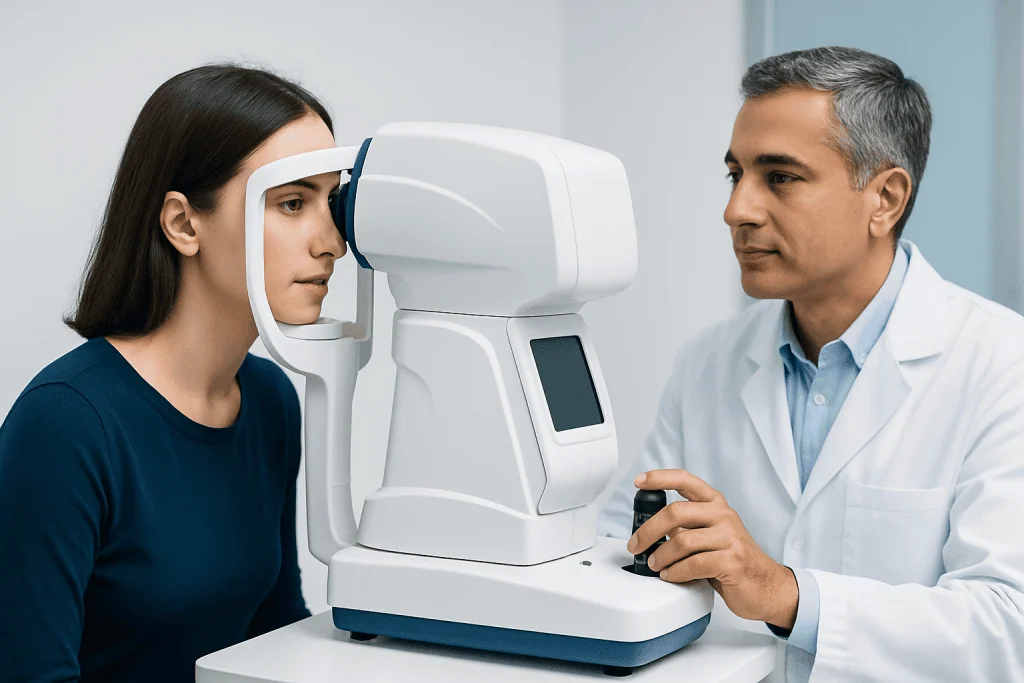
For clear vision, the cornea and lens must bend incoming light so that it focuses precisely on the retina, the light-sensitive tissue at the back of the eye. A refractive error occurs when the eye’s shape or focusing system causes light to focus in front of, behind, or unevenly on the retina. This can produce blurred distance vision, blurred near vision, eyestrain, or headaches associated with visual effort.
During a refraction, the clinician uses an automated instrument, a phoropter containing multiple lenses, or both. The patient looks at letters, symbols, or pictures at a set distance while different lenses are placed in front of each eye. Responses help refine the lens power and, when appropriate, the amount and direction of astigmatism correction.
The result is written as an eyeglass prescription. It may include sphere power for nearsightedness or farsightedness, cylinder and axis for astigmatism, and an “add” power for reading or close work. A prescription can change over time, particularly in childhood, during the years when presbyopia develops, or when eye and general health conditions affect vision.
Blurred vision may also have causes that a refraction cannot correct fully, including cataracts, corneal disease, retinal conditions, optic nerve disorders, or significant dry eye. If vision remains reduced despite an accurate prescription, further medical evaluation is important.
Who May Need Procedure 92015?

Procedure 92015 may be appropriate for people who notice blurred vision at distance or near, difficulty reading, squinting, visual fatigue, or a need to hold reading material farther away. It may also be part of a routine vision assessment when a person needs a new or updated glasses or contact lens prescription.
Children may need refractive assessment when there are concerns about visual development, eye misalignment, frequent rubbing of the eyes, sitting unusually close to screens, or difficulty at school. In young children and in some adults, clinicians may use cycloplegic drops to temporarily relax focusing muscles and obtain a more accurate measurement. This is a clinical decision based on the individual examination.
Adults with diabetes, prior eye surgery, changing vision, or eye symptoms may require more than a refraction. A comprehensive examination is particularly important because changes in vision can sometimes reflect an underlying eye condition rather than a simple need for a new prescription.
A refraction may also be used when considering vision-correction options. Patients interested in reducing dependence on glasses can discuss whether they may be suitable candidates for laser eye surgery, after a detailed assessment of corneal shape, prescription stability, eye health, and visual goals.
Step-by-Step: What Happens During a Refraction?
Before the test, the eye-care professional usually asks about vision concerns, current glasses or contact lenses, work and reading needs, medical conditions, and relevant medications. Visual acuity is often checked first by asking the patient to read letters, numbers, symbols, or images at distance and sometimes near.
An autorefractor may be used as an initial estimate. The patient looks into the device, usually at a target image, while it measures how light reflects from the eye. This measurement is useful, but it is commonly refined with subjective testing because comfort and clarity are individual.
Next, lenses are changed in a phoropter or trial frame while the patient compares image clarity. The clinician adjusts the power gradually and evaluates each eye separately and together. The process commonly takes only a few minutes, although it can take longer when vision is complex, communication is difficult, or additional testing is needed.
At the end, the clinician may provide a prescription and explain whether it is intended for distance, reading, computer use, progressive lenses, or another purpose. If contact lenses are being considered, a separate fitting and eye-surface assessment may be needed because contact lens prescribing requires additional measurements and safety checks.
Benefits, Limits, Risks, and Recovery Timeline
The main benefit of refraction is a tailored measurement that can improve visual clarity and comfort with glasses or contact lenses. Clearer vision may support reading, driving, work, school, and hobbies. It can also help distinguish a correctable refractive error from vision changes that need further medical investigation.
The test itself is noninvasive and painless. It does not involve incisions, radiation, or recovery time. Most people can immediately return to usual activities after a standard refraction. If a new prescription is issued, there can be a short adjustment period while the brain adapts, particularly with stronger prescriptions, astigmatism correction, progressive lenses, or prism lenses.
Some eye appointments include dilating or cycloplegic drops, especially when the clinician needs to examine the retina or improve accuracy in certain patients. These drops may cause temporary light sensitivity and blurred near vision for several hours, sometimes longer. A patient should ask whether driving is advisable after dilation and should bring sunglasses if possible.
A refraction has limitations: it cannot by itself diagnose all eye diseases or guarantee that glasses will restore normal vision. Persistent blur, distortion, double vision, or unexplained vision loss should be assessed through a comprehensive eye examination rather than managed only by changing a prescription.
What Is CPT Code 92015 Billing Guidelines?
CPT code 92015 billing guidelines can vary by insurer, health plan, clinician type, location, and the reason for the visit. In general, 92015 is used to report the refraction component of an eye-care encounter, while the medical or comprehensive eye examination may be reported separately using the code that best reflects the services provided and applicable payer rules.
Patients may encounter procedure code 92014 during an established-patient ophthalmological service. The procedure code 92014 description generally relates to a comprehensive eye examination service for an established patient and is not the same as refraction. Whether 92014 and 92015 can be billed together, and how they are processed, depends on documentation and the individual payer’s policies.
Because coverage rules differ, patients should ask the eye-care practice before the visit whether refraction is included, separately charged, or covered under a vision plan. It is also helpful to ask whether the visit is being scheduled as a routine vision examination, a medical eye examination, or both. The practice’s billing team can explain expected patient responsibility but cannot determine final coverage on behalf of every insurer.
Accurate billing should reflect the services actually performed and documented. Patients who receive an explanation of benefits showing a denial or out-of-pocket balance can contact their insurer and the provider’s billing office to clarify how the claim was submitted and whether a separate vision benefit applies.
Why Does Medicare Not Cover CPT 92015?
Original Medicare generally does not cover CPT 92015 when it is performed as a routine refraction for glasses or contact lenses. Medicare coverage is typically directed toward medically necessary diagnosis and treatment of illness or injury. Routine measurement of refractive error and the routine provision of corrective lenses are usually excluded from Original Medicare benefits.
This does not mean that Medicare never covers eye care. Original Medicare may cover medically necessary eye examinations, testing, and treatment for certain eye diseases or symptoms, subject to its rules and the patient’s coverage. For example, an examination for a medical concern can be covered even if a refraction completed during the same visit is not.
Medicare Advantage plans and other supplemental or vision plans may offer additional routine vision benefits, but benefits, networks, referral requirements, and copayments vary. Patients should review their own plan documents or contact the plan directly before scheduling routine vision services.
The question “Is procedure code 92015 covered by Medicare?” therefore has a practical answer: under Original Medicare, it is usually not covered as a routine refraction. A person should confirm the details with Medicare, their plan, and the eye-care provider because individual circumstances and plan benefits can differ.
Why Is a Refraction Test Not Covered by Insurance?
A refraction test may not be covered by an insurance policy because many medical insurance plans classify it as routine vision care rather than medically necessary care. Medical insurance and vision insurance are often separate benefits. A health plan may cover evaluation and treatment of an eye disease while excluding the measurement needed to prescribe routine glasses.
Coverage may differ when a person has a dedicated vision plan, an employer benefit, or a Medicare Advantage plan that includes routine eye examinations. Even then, limits may apply, such as provider-network requirements, a defined frequency of covered exams, or a separate allowance for eyewear. The exact reason for noncoverage should be explained in the policy or an insurer’s claim decision.
Patients should not postpone assessment of concerning eye symptoms solely because of uncertainty about refraction coverage. Symptoms such as pain, sudden changes in vision, or visual field loss may require a medical eye evaluation rather than a routine vision test and should be discussed promptly with a qualified clinician.
Acibadem International’s multidisciplinary specialists and JCI-accredited hospitals evaluate vision concerns and eye conditions for international patients, with testing selected according to each person’s symptoms and clinical needs.
When to Seek Medical Care
Routine changes in vision can often be assessed at a scheduled eye appointment. However, a person should seek urgent medical attention for sudden loss of vision, severe eye pain, a sudden increase in floaters, flashes of light, a dark curtain or shadow across vision, significant eye injury, or sudden double vision. These symptoms can indicate conditions that require timely evaluation.
A medical eye examination should also be arranged if vision remains blurry despite new glasses, if there is increasing glare or halos, if straight lines appear wavy, or if there is persistent redness, discharge, or light sensitivity. People with diabetes, a family history of glaucoma, prior eye surgery, or known eye disease may need eye assessments at intervals recommended by their clinician.
For gradual visual changes, an eye-care professional can determine whether a refraction is sufficient or whether additional tests are needed. Early assessment supports accurate diagnosis and helps patients understand the most appropriate options for their vision and eye health.
Frequently asked questions
What is procedure code 92015?
Procedure code 92015 is the CPT code for refraction, a test used to measure refractive error and determine a prescription for glasses or contact lenses. It is commonly performed during an eye visit but is separate from the medical examination of the eye.
What is the difference between procedure code 92014 and procedure code 92015?
Procedure code 92014 generally refers to a comprehensive ophthalmological service for an established patient, while 92015 reports refraction. The first code relates to the eye examination service; the second relates specifically to determining refractive state and a corrective-lens prescription.
Is CPT code 92015 covered by Medicare?
Original Medicare generally does not cover 92015 when it is a routine refraction for glasses or contact lenses. Medicare Advantage or separate vision plans may have different benefits, so patients should confirm coverage with their specific plan.
Why might a refraction be charged separately from an eye exam?
A refraction is a distinct service used to determine lens power, whereas an eye examination evaluates eye health and medical concerns. Many insurers treat routine refractive testing as a noncovered vision service, even when they cover medically necessary eye care.
Does a refraction test hurt or require recovery time?
No. Standard refraction is painless, noninvasive, and does not require recovery time. If dilating drops are used as part of a broader examination, near vision may be blurry and light sensitivity may occur temporarily.
Can a refraction detect eye disease?
Refraction can identify whether a refractive error may be contributing to blurred vision, but it cannot fully diagnose eye disease. A comprehensive eye examination is needed to assess conditions affecting the cornea, lens, retina, optic nerve, and eye pressure.
References
- American Academy of Ophthalmology
- Centers for Medicare & Medicaid Services
- American Medical Association
- National Eye Institute
- Medicare.gov
This article is for general information only and is not a substitute for professional medical advice. Please consult a qualified doctor about your individual situation.
Explore treatments in Turkey — costs, top hospitals & a free quote
JCI-accredited · board-certified surgeons · reply within 24h
Add us as a Preferred Source to see more of our trusted health content across Google Search, AI Overviews and Discover.