Pupillary Distance: What Patients Need to Know

Pupillary distance, or PD, is measured in millimeters and helps center lenses correctly in eyeglasses. An accurate PD can improve comfort and reduce eyestrain, especially with stronger prescriptions or progressive lenses.
Key Takeaways
- Pupillary distance, or PD, is measured in millimeters and helps center lenses correctly in eyeglasses.
- An accurate PD can improve comfort and reduce eyestrain, especially with stronger prescriptions or progressive lenses.
- PD is not the same as an eyeglass prescription, but it is often needed when ordering glasses.
- Adults usually have a stable PD, while children’s measurements may change as they grow.
- Eye symptoms such as double vision, sudden vision changes, or eye pain need medical evaluation rather than a glasses adjustment alone.
Pupillary distance is the distance between the centers of the pupils. It is an important optical measurement used to help align eyeglass lenses with the eyes, supporting clearer and more comfortable vision.
Overview: what pupillary distance means
Pupillary distance is the distance between the centers of the pupils, usually measured in millimeters. In practical terms, it tells an optician or optical lab where to place the optical center of each lens so that the lenses line up with the wearer’s eyes. This alignment matters because even a well-written eyeglass prescription may feel uncomfortable if the lenses are not centered correctly.
Patients most often hear about pupillary distance when buying new glasses online or checking a glasses prescription. It is not a disease or a diagnosis. Instead, it is a fitting measurement that works alongside the prescription for nearsightedness, farsightedness, astigmatism, or presbyopia.
Pupillary distance may be written as a single number or as two separate numbers. A single PD measures the total distance from one pupil center to the other. A dual PD gives the distance from the center of the nose to each pupil, which can be helpful when the face is slightly asymmetrical or when lenses need more precise positioning.
Although many people can measure pupillary distance at home, the most reliable method is a professional measurement during an eye exam or optical fitting. This becomes more important for stronger prescriptions, multifocal lenses, and patients who have ongoing visual symptoms.
Why pupillary distance matters for glasses and visual comfort
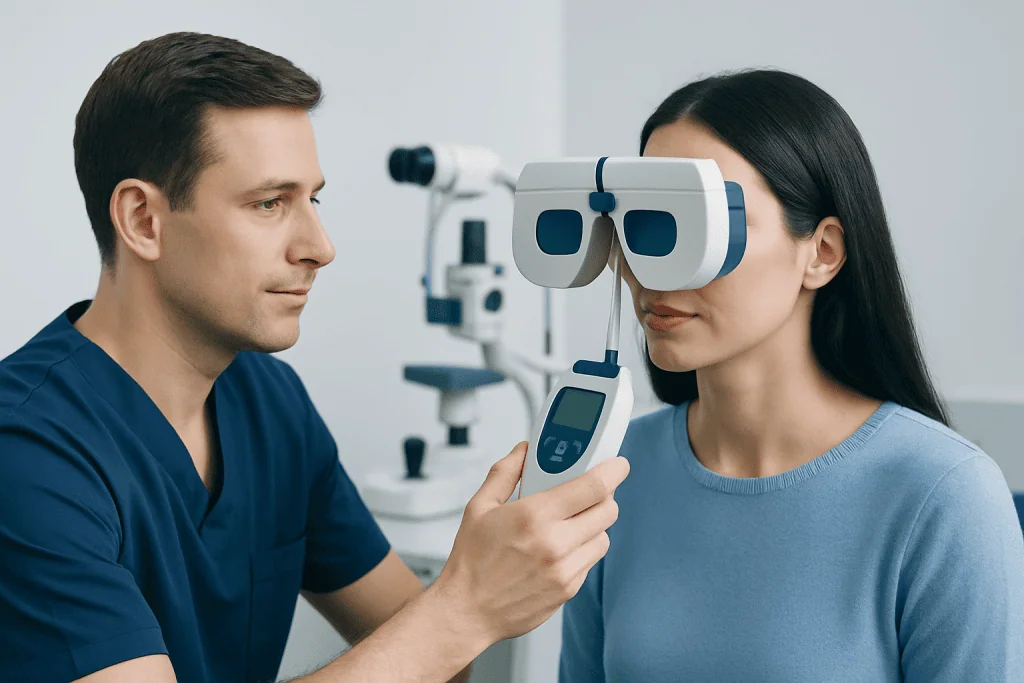
The main reason pupillary distance matters is lens alignment. Eyeglass lenses are designed to direct light through a specific point called the optical center. If that point does not line up well with the pupil, the eyes may need to work harder to focus, which can reduce comfort even if the prescription itself is correct.
An inaccurate PD can contribute to problems such as eyestrain, headaches, blurred vision, or a feeling that the glasses are “off.” Some people notice little difference, especially with simple prescriptions. Others are more sensitive, particularly those with higher prescriptions, progressive lenses, or lenses designed for computer or reading use.
PD can also affect adaptation to new eyewear. When new glasses feel uncomfortable, the cause is not always the prescription power. Frame fit, lens design, and pupillary distance can all play a role. This is one reason a full optical check is useful before assuming that the prescription is wrong.
For contact lenses, pupillary distance is generally less important than it is for eyeglasses because contact lenses move with the eye. However, patients with persistent visual discomfort should still have a full eye assessment to look for other causes, including dry eye or refractive problems such as astigmatism.
Types of PD and how it is measured

Pupillary distance is usually measured as either distance PD or near PD. Distance PD is used for most everyday glasses that help with far vision. Near PD is used for reading or close-up tasks because the eyes naturally turn inward slightly when focusing on nearby objects.
Measurements may also be recorded as single PD or dual PD. A single PD might be written as one number, such as 62 mm. A dual PD might be written as two numbers, such as 31/31 mm or 30.5/31.5 mm, showing the measurement from the bridge of the nose to each pupil. Dual measurements can improve lens centering in some frames and prescriptions.
Eye care professionals may measure PD using a millimeter ruler, a specialized pupillometer, or digital optical systems. The patient is usually asked to look at a target while the measurement is taken. The method is quick, painless, and commonly done during glasses fitting or a comprehensive eye exam.
Some people try to measure PD at home with a ruler, a mirror, or smartphone tools. While these methods can provide a rough estimate, small errors can matter. A professional measurement is usually best if the patient has progressive lenses, prism in the prescription, strong lens powers, or symptoms that suggest more than a simple fitting problem.
What can affect the accuracy of pupillary distance
Several factors can influence whether a pupillary distance measurement is accurate. These include head position, whether the person is looking at a distant or near target, lighting conditions, and the method used to take the measurement. Even a small change in where the eyes are focused can slightly alter the reading.
Age can matter as well. In children, facial growth may change PD over time, so a previous measurement may no longer be correct. In adults, PD is usually stable, but a new frame shape, lens type, or prescription may still call for rechecking the measurement rather than reusing an old value.
Facial asymmetry is another reason a dual PD may be preferred. Many people do not have perfectly symmetrical facial features, and that is normal. Recording separate right and left measurements can help improve how lenses are centered in front of each eye.
Importantly, pupillary distance does not diagnose an eye disorder. If a patient has symptoms such as double vision, a turned eye, repeated headaches with reading, or new trouble focusing, the issue may be more complex than PD alone. In such cases, an ophthalmologist or optometrist may assess for refractive errors, eye alignment problems, or conditions such as strabismus.
When symptoms are not just a fitting issue
Because pupillary distance is closely linked with glasses comfort, patients sometimes assume any visual discomfort must be caused by an incorrect PD. In reality, blurred vision or eye strain can have many causes. A change in prescription, dry eye, lens coating issues, poor frame fit, or an underlying eye condition may all be involved.
For example, people with cataracts, corneal irregularities, or significant astigmatism may still have visual symptoms even when the PD is measured accurately. Others may struggle with progressive lenses because of lens design or adaptation rather than the pupillary distance itself. This is why persistent symptoms deserve a proper eye evaluation.
Symptoms that deserve attention include ongoing headaches with glasses use, double vision, a sensation that the world tilts, nausea when wearing new lenses, or blurred vision that does not improve after an adjustment period. These concerns do not always indicate a serious problem, but they should not be ignored if they continue.
During a full assessment, clinicians may recommend a refraction test, eye alignment testing, slit-lamp examination, or imaging depending on the history and findings. If a refractive procedure is being considered, some patients may also discuss options such as laser eye surgery after a specialist confirms they are suitable candidates.
Diagnosis and related eye examinations
Pupillary distance itself is not something that is “diagnosed.” It is measured. However, the need for a PD check often arises during broader eye care, such as a routine vision test, a glasses fitting, or an evaluation for symptoms like blurred vision or eyestrain.
An eye examination may include visual acuity testing, refraction to determine lens power, checks for eye muscle balance, and an assessment of eye health. If a patient reports discomfort with new glasses, the clinician may compare the prescription, the frame position, the lens centration, and the measured PD to identify the source of the problem.
In some cases, additional testing is recommended to rule out medical causes of visual symptoms. This may include evaluation of the front and back of the eye, tear film testing for dryness, or more specialized exams if there is concern about the cornea, retina, or optic nerve. Patients who have symptoms tied to lens opacity or aging changes may also be assessed for whether cataract surgery is appropriate.
The most helpful approach is to view pupillary distance as one part of a larger visual care picture. Accurate measurements support good optical results, but comfort and clarity depend on the prescription, the lenses, the frames, and the health of the eyes themselves.
Practical self-care and tips for patients ordering glasses
Patients ordering glasses should keep a copy of both their current prescription and their pupillary distance measurement whenever possible. If the PD is not listed, it may still be available from the optical provider that dispensed previous glasses, though policies vary. Rechecking the measurement is often worthwhile before ordering a new frame or lens style.
When glasses arrive, patients should give themselves a short adaptation period, especially with stronger prescriptions or progressive lenses. If symptoms are mild and improving, the eyes may simply be adjusting. If discomfort is significant or persists, the fit and measurements should be reviewed by a professional.
Useful steps for self-care include:
- Use up-to-date eye exams rather than relying on very old prescriptions.
- Ask whether single or dual PD is more suitable for the chosen lenses.
- Have the frame adjusted so it sits evenly on the face.
- Report symptoms clearly, including whether they occur at distance, near, or both.
- Seek a full eye exam if vision changes suddenly or symptoms go beyond glasses discomfort.
Patients considering alternatives to glasses may discuss contact lenses or refractive procedures with an eye specialist. If a broader ophthalmic assessment is needed, multidisciplinary specialists at Acibadem International and its JCI-accredited hospitals evaluate international patients with visual complaints and provide treatments ranging from prescription correction to corneal transplant when medically indicated.
When to seek medical care
A simple glasses fitting issue usually causes mild discomfort, not severe or sudden symptoms. Patients should seek medical care promptly if they develop sudden vision loss, intense eye pain, flashes of light, a curtain-like shadow in vision, double vision, or redness with light sensitivity. These symptoms may point to an eye problem that needs urgent attention.
Medical advice is also appropriate if headaches, dizziness, or blurred vision continue after a new glasses adjustment, or if symptoms affect driving, reading, computer use, or daily activities. Children who hold reading material very close, tilt their head often, or seem to struggle with focusing should also have an eye examination.
Anyone with diabetes, a history of eye surgery, eye injury, or known eye disease should be especially cautious about attributing symptoms only to pupillary distance. A clinician can determine whether the issue is a lens measurement, a prescription change, or a medical condition that needs treatment.
In general, patients can think of pupillary distance as an important detail, but not the whole story. Accurate PD supports better glasses performance, while persistent symptoms deserve a qualified eye professional’s assessment.
Frequently asked questions
What is pupillary distance?
Pupillary distance is the measurement between the centers of the pupils, usually recorded in millimeters. It helps place the optical center of eyeglass lenses in the correct position for clearer and more comfortable vision.
Is pupillary distance included in an eye prescription?
Not always. A glasses prescription lists lens powers, while pupillary distance is a separate fitting measurement that may be recorded by the optical provider or eye care professional.
Can pupillary distance be measured at home?
Yes, it can be estimated at home using a ruler, mirror, or digital tool. However, a professional measurement is usually more reliable, especially for progressive lenses, strong prescriptions, or if the patient has visual symptoms.
What happens if my pupillary distance is wrong on my glasses?
Incorrect PD can make glasses feel uncomfortable and may contribute to eyestrain, headaches, or blurred vision. The effect depends on the prescription and lens type, but persistent discomfort should be checked by an eye care professional.
What is the difference between single PD and dual PD?
Single PD is one number showing the total distance between the pupils. Dual PD gives separate right and left measurements from the center of the nose to each pupil, which can provide more precise lens positioning.
Does pupillary distance change over time?
In adults, pupillary distance is usually stable. In children, it can change as the face grows, which is one reason regular eye and glasses checks are useful.
This article is for general information only and is not a substitute for professional medical advice. Please consult a qualified doctor about your individual situation.
Explore treatments in Turkey — costs, top hospitals & a free quote
JCI-accredited · board-certified surgeons · reply within 24h
Add us as a Preferred Source to see more of our trusted health content across Google Search, AI Overviews and Discover.

More from the Health Library

Anastrozole: A Complete Medical Overview

Mastopexy: A Complete Medical Overview
Deep Breathing Diaphragmatic Breathing — Explained by Medical Evidence, Not Myths

Skin Peeling in Tongue — Explained by Medical Evidence, Not Myths

Trichiasis — Explained by Medical Evidence, Not Myths