Resistance Bands for Shoulder Exercises: An Evidence-Based Guide for Patients

Resistance bands can support shoulder strength, joint control, and gradual rehabilitation. The best exercises depend on the cause of symptoms, such as weakness, stiffness, tendon irritation, or post-injury recovery.
Key Takeaways
- Resistance bands can support shoulder strength, joint control, and gradual rehabilitation.
- The best exercises depend on the cause of symptoms, such as weakness, stiffness, tendon irritation, or post-injury recovery.
- Technique, pain monitoring, and gradual progression matter more than using a stronger band early.
- Exercises should usually feel challenging but not sharply painful during or after the session.
- Persistent pain, limited motion, night pain, or weakness after injury should be assessed by a qualified clinician.
Resistance bands for shoulder exercises can be a safe, effective way to improve shoulder strength, stability, and mobility when the movements match the person’s condition and are performed with good form. For patients with pain, weakness, stiffness, or recovery after injury, bands are often useful as part of a clinician-guided exercise plan rather than a one-size-fits-all routine.
Overview: Are resistance bands good for the shoulder?
Resistance bands for shoulder exercises are often a practical and evidence-informed option for improving shoulder function. They allow gentle, progressive loading of the muscles that support the shoulder blade and rotator cuff, which can help with strength, movement control, and confidence in daily activities. Because bands provide adjustable resistance and do not require heavy equipment, they are commonly used in home exercise programs and rehabilitation settings.
The shoulder is a highly mobile joint, and that mobility depends on coordinated work between the rotator cuff, shoulder blade muscles, upper back, and surrounding soft tissues. A band program can target these areas with relatively low joint stress when the exercises are chosen carefully. This can be helpful for some people with mild pain, deconditioning, postural strain, or recovery after certain injuries.
However, not every painful shoulder should be exercised in the same way. Conditions such as rotator cuff tears, frozen shoulder, tendon irritation, instability, or arthritis may require different movement choices, ranges, and pacing. For that reason, patients usually benefit most when a doctor or physiotherapist helps match the exercise plan to the underlying problem rather than simply copying a general routine from the internet.
How resistance bands help shoulder function
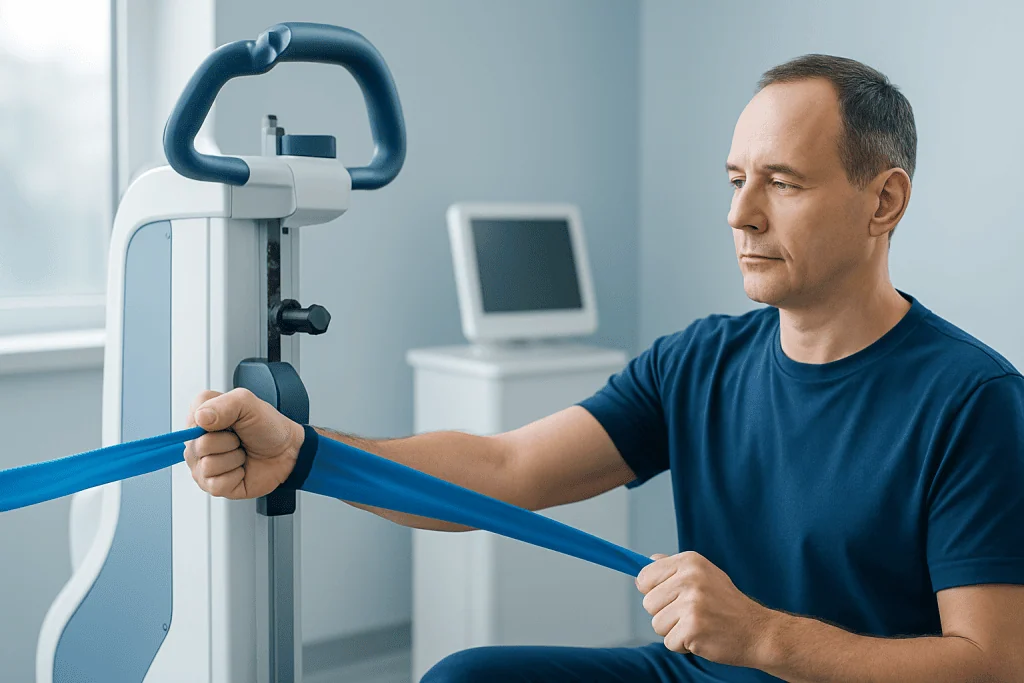
Resistance bands can be useful because they support gradual, controlled strengthening. In many shoulder problems, the goal is not only to make the muscles stronger but also to improve how they work together. Better muscle coordination may reduce strain on irritated tissues and improve the mechanics of reaching, lifting, dressing, and overhead tasks.
Bands can also help patients start with lower loads than traditional weights. This is important when the shoulder is painful, weak, or recovering after inactivity. A light band may be enough at first to retrain movement quality without provoking symptoms. As the shoulder tolerates more, resistance, repetitions, or range of motion can be increased step by step.
Another advantage is versatility. Band exercises can target external rotation, internal rotation, rowing motions, scapular retraction, and controlled reaching patterns. They may be prescribed as part of a broader rehabilitation plan that can also include stretching, posture work, manual therapy, and in some cases physical therapy and rehabilitation.
- Low-cost and portable for home use
- Easy to progress gradually
- Useful for strengthening and motor control
- Can be adapted for many fitness levels
- Best used with proper technique and symptom monitoring
Who may benefit, and who should be cautious

Many adults can benefit from resistance bands for shoulder exercises, especially those with mild weakness, reduced conditioning, office-related postural strain, or non-severe shoulder discomfort. They are also commonly used during recovery from some overuse conditions or after a clinician has assessed a shoulder injury. In older adults, gentle band work may support maintenance of function for daily activities such as grooming, reaching shelves, and carrying light objects.
At the same time, caution is important when symptoms are significant or unexplained. A recent fall, sudden loss of strength, visible deformity, marked swelling, numbness, tingling, fever, or inability to raise the arm may suggest a problem that needs medical assessment before exercise. People with significant pain at night, pain that steadily worsens, or a history of repeated shoulder dislocation should not assume a band program alone will solve the issue.
Patients with known tendon tears, inflammatory joint disease, severe arthritis, or recovery after surgery may still use bands, but the plan should be individualized. In these situations, a supervised program is often safer than self-directed exercise. If needed, doctors may combine rehabilitation with further evaluation for conditions such as shoulder impingement or specialist orthopedic care.
Key safety principles before starting
Before starting resistance bands for shoulder exercises, patients should choose a light band and a stable setup. The band should be free of damage, anchored securely if needed, and used in a clutter-free area to reduce the risk of snapping or loss of balance. Movements should be slow and controlled rather than forceful or jerky.
Pain monitoring is especially important. Mild muscle effort, fatigue, or slight discomfort can be acceptable during rehabilitation, but sharp pain, catching, worsening pain afterward, or symptoms that last into the next day usually mean the exercise is too much or not appropriate. In general, the shoulder should feel no worse overall as the program continues.
Posture also matters. Many patients compensate by shrugging the shoulder, arching the low back, or pushing through painful ranges. A better approach is to keep the neck relaxed, shoulder blade gently controlled, and range of motion within comfort. If symptoms are ongoing, assessment may include clinical examination and sometimes orthopedic rehabilitation to build a safer plan.
Examples of patient-friendly band exercises
The most suitable exercises depend on the person’s diagnosis and stage of recovery, but several band movements are commonly used in shoulder programs. These usually begin with a light band and modest repetition ranges, focusing first on quality of movement. Breathing normally and avoiding painful compensation are more important than doing many repetitions.
Examples may include:
- External rotation: elbow bent and kept close to the side while the forearm rotates outward. This often targets the rotator cuff.
- Internal rotation: elbow bent at the side while the forearm moves inward across the body.
- Rows: pulling the band back with elbows close to the body to train the upper back and shoulder blade muscles.
- Scapular retraction: gentle squeezing of the shoulder blades with band tension, without shrugging.
- Band-assisted flexion or reaching: guided forward arm raise within a comfortable range, when appropriate.
These exercises are not ideal for everyone. For example, some painful shoulders become more irritated with repeated overhead work or exercises done too far from the body. Others need mobility-focused treatment before strengthening. Patients recovering from injury may benefit from evaluation by orthopedics if symptoms do not improve as expected.
Progression is usually gradual. A clinician may first increase control and repetitions, then add resistance, then expand range or functional tasks. Starting too aggressively often leads to flare-ups, which can reduce confidence and delay recovery.
Common mistakes that can make shoulder pain worse
One common mistake is using a band that is too strong too soon. This often leads to poor form, excess upper trapezius activation, and strain rather than useful strengthening. A lighter band that allows smooth, precise movement is often more effective than a heavy band that causes compensations.
Another mistake is exercising into significant pain. Some patients assume that more discomfort means faster progress, but this is not usually true for shoulder rehabilitation. Repeatedly provoking pain can increase guarding and sensitivity, especially in irritated tendons or stiff joints.
Patients also sometimes focus only on the shoulder itself and ignore the role of the shoulder blade, chest, upper back, and overall posture. Because the shoulder works as part of a kinetic chain, a complete plan may include upper back mobility, thoracic posture work, and gradual return to daily tasks. If symptoms are long-standing or recurrent, clinicians may assess for related conditions such as frozen shoulder or other structural causes.
How often to do them and what progress should feel like
There is no single routine that suits every patient. In general, shoulder band exercises are often performed several times per week rather than intensely every day, allowing tissues time to adapt. The exact frequency depends on the diagnosis, pain level, recent activity, age, and whether the exercises are part of formal rehabilitation.
Progress should usually feel gradual rather than dramatic. Over time, patients may notice easier reaching, better endurance, less stiffness, or improved confidence with daily movement. Temporary mild soreness in the muscles can occur, especially when beginning, but symptoms should settle rather than accumulate.
If the shoulder becomes more painful, more restricted, weaker, or increasingly disturbed at night, the program may need adjustment. Some patients need a different exercise selection, a slower pace, or additional medical evaluation. In more complex cases, a team approach can be helpful; Acibadem International’s multidisciplinary specialists in JCI-accredited hospitals evaluate and treat shoulder conditions for international patients when advanced assessment or rehabilitation is needed.
When to seek medical care
Patients should seek medical care if shoulder pain begins after a fall, collision, sudden pulling injury, or heavy lift and is followed by weakness, loss of motion, or visible deformity. Medical attention is also important if there is numbness, tingling, significant swelling, redness, fever, or pain that is severe or rapidly worsening.
Even without a major injury, an appointment is sensible if shoulder symptoms last more than a few weeks, disturb sleep, limit everyday activities, or do not improve with rest and careful exercise. A clinician can help identify whether the issue is more likely related to tendon irritation, stiffness, instability, arthritis, or another cause.
Diagnosis may include a physical examination and, when appropriate, imaging or referral to specialists. Early evaluation can help patients avoid exercises that are not suited to their condition and start a more targeted recovery plan.
Frequently asked questions
Are resistance bands effective for shoulder rehabilitation?
They can be effective for many patients because they allow gradual strengthening and movement control with relatively low load. Their benefit is greatest when the exercises match the underlying condition and are progressed appropriately under professional guidance when needed.
Can resistance bands help rotator cuff problems?
They are often used in programs for some rotator cuff-related symptoms, especially to strengthen external rotators and shoulder blade muscles. However, a full-thickness tear, major weakness, or pain after injury should be medically evaluated before starting or intensifying exercise.
Should shoulder band exercises hurt?
They may feel challenging and can cause mild muscle fatigue, but they should not cause sharp pain or clearly worsen symptoms afterward. If pain increases during the movement or remains worse the next day, the exercise may need to be modified or stopped.
How long does it take to notice improvement?
Some patients feel better control or less stiffness within a few weeks, while strength gains usually take longer. Recovery speed depends on the diagnosis, severity of symptoms, consistency, and whether other treatment such as physiotherapy is also needed.
Which color resistance band should a beginner use for shoulder exercises?
Band colors are not standardized across brands, so color alone is not a reliable guide. Most beginners should start with the lightest or one of the lightest options that allows smooth movement without compensation or increased pain.
Can older adults use resistance bands for shoulder exercises safely?
Yes, many older adults can use them safely when the resistance is appropriate and the exercises are tailored to balance, mobility, and pain level. It is especially important to begin gradually and seek professional advice if there is significant weakness, arthritis, or a recent injury.
References
- American Academy of Orthopaedic Surgeons
- American Physical Therapy Association
- National Institute of Arthritis and Musculoskeletal and Skin Diseases
- Mayo Clinic
- National Health Service
This article is for general information only and is not a substitute for professional medical advice. Please consult a qualified doctor about your individual situation.
Joint and spine care in Turkey — expert assessment & treatment
JCI-accredited · board-certified surgeons · reply within 24h
Add us as a Preferred Source to see more of our trusted health content across Google Search, AI Overviews and Discover.

More from the Health Library

Cheiloplasty: Procedure, Recovery and Results

Child Development: An Evidence-Based Guide for Patients

Flu Shot: An Evidence-Based Guide for Patients

Bay Leaf Benefits — Explained by Medical Evidence, Not Myths

Bubble guts: Symptoms, Causes, and Treatment — Complete Patient Guide

Bulgur: A Complete Medical Overview
Related Specialists

Fzt. Fırat Çenberci
Physical Medicine & Rehabilitation
Dr. Beyza Çitçi
Neurology
Dr. Muhammet Mustafa Yıldız
Emergency Service
Dr. Mehmet Severcan
Aesthetic Plastic & Reconstructive Surgery