

Romanian Deadlift: What Patients Need to Know

The romanian deadlift is different from a conventional deadlift because it starts from standing and focuses more on hip hinging than knee bending. Good form usually includes a neutral spine, controlled lowering, the weight kept close to the legs, and movement driven from the hips.
Key Takeaways
- The romanian deadlift is different from a conventional deadlift because it starts from standing and focuses more on hip hinging than knee bending.
- Good form usually includes a neutral spine, controlled lowering, the weight kept close to the legs, and movement driven from the hips.
- The exercise can help build posterior-chain strength, but poor technique or excessive load may strain the lower back, hamstrings, or grip.
- People with back pain, recent injury, osteoporosis, or balance problems should seek individualized advice before starting or progressing.
- Pain during the lift is not normal and should prompt stopping the exercise and assessing technique or possible injury.
The romanian deadlift is a strength-training exercise that emphasizes the hip hinge and mainly works the hamstrings, glutes, and lower back stabilizers. For most healthy adults, it can be safe and effective when technique, mobility, and load are matched to the person’s ability and any existing medical issues are taken into account.
Overview: what the Romanian deadlift is
The romanian deadlift is a resistance exercise built around a movement pattern called the hip hinge. In simple terms, the person pushes the hips backward while keeping the spine in a stable, neutral position, then returns to standing. This movement places the greatest training emphasis on the hamstrings and gluteal muscles, while the trunk and upper back work to keep the body steady.
Unlike the conventional deadlift, which commonly begins with the weight on the floor, the romanian deadlift usually starts from standing. The knees stay slightly bent but do not squat deeply, and the weight is lowered along the thighs and shins only as far as flexibility and spinal control allow. Because of this, the exercise is often used for strengthening rather than maximal lifting.
From a health perspective, the exercise is not a medical treatment in itself, but it can be part of a broader plan to improve strength, posture, movement efficiency, and resilience in daily life or sport. As with any loaded exercise, the benefits depend on proper technique, appropriate programming, and the person’s individual musculoskeletal health.
How the movement works and which muscles it trains
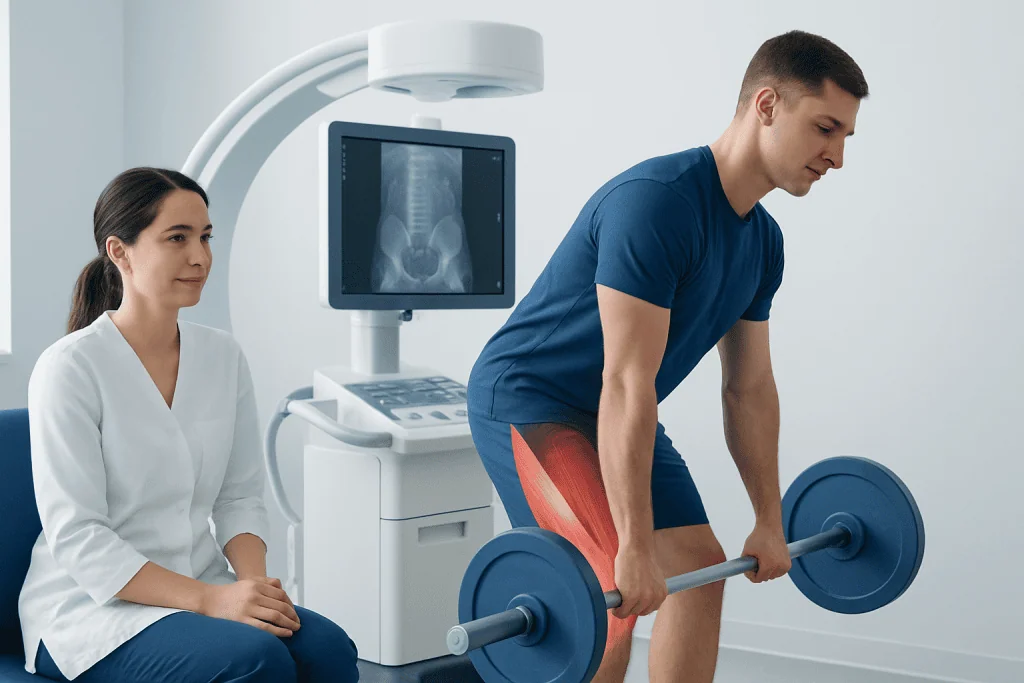
The main muscles worked in a romanian deadlift are the hamstrings and gluteus maximus. These muscles help extend the hips, which is the primary action that brings the body back to upright. The exercise also challenges the spinal erectors, deep core muscles, upper-back muscles, and forearm grip, although these muscles act more as stabilizers than prime movers.
The movement is best understood as a controlled backward shift of the hips rather than a forward bend from the waist. During the lowering phase, the hips move back, the torso inclines forward, and the knees remain softly bent. The weight stays close to the body to reduce unnecessary strain on the lower back.
This pattern matters because many everyday activities depend on safe hip hinging, including lifting objects, reaching toward the floor, or rising from a bent position. For some people, learning the romanian deadlift with coaching can improve body awareness and help them distinguish hip movement from spinal rounding, which may be useful in injury prevention programs and rehabilitation settings.
- Primary muscles: hamstrings, gluteus maximus
- Important stabilizers: spinal erectors, abdominal wall, lats, upper back, forearms
- Main movement pattern: hip hinge with controlled eccentric lowering
Potential benefits and common mistakes

When performed correctly, the romanian deadlift can help increase posterior-chain strength, improve control during bending and lifting, and support athletic tasks such as running, jumping, and changing direction. It can also complement rehabilitation and conditioning programs designed to address weakness in the hips or hamstrings, provided a clinician or qualified exercise professional agrees it is appropriate.
One reason the exercise is popular is that it can be adapted. It may be performed with dumbbells, a barbell, kettlebells, or even a light training stick while learning the pattern. This makes it accessible across a wide range of experience levels, from beginners working on movement quality to experienced lifters using it to build strength.
Common mistakes include rounding the back, letting the weight drift far from the legs, lowering farther than mobility allows, locking the knees stiffly, or trying to lift too much weight too soon. These errors can reduce the training effect on the hips and increase strain on the back or hamstrings. If movement is limited by pain, weakness, or poor balance, an assessment may be more helpful than continuing to practice through discomfort.
Safety, risks, and who should be cautious
For most adults without major musculoskeletal problems, the romanian deadlift can be safe when introduced gradually and taught well. The greatest risks usually come from technical breakdown, fatigue, and mismatched loading. A safe plan starts with mastering the hinge pattern, using a light load, and progressing only when the same technique can be repeated consistently.
Possible problems include low-back strain, hamstring strain, aggravation of existing hip discomfort, and less commonly issues related to balance or grip. People who already have back pain may find that hinging movements are comfortable, uncomfortable, or only tolerable within a modified range. Pain should not be dismissed as simply part of training, especially if it is sharp, radiates down the leg, or persists after exercise. Some back symptoms may overlap with a herniated disc or other spinal conditions and deserve medical review.
Extra caution is sensible for people with osteoporosis, a recent fracture, recent surgery, uncontrolled dizziness, severe arthritis, or a history of hamstring tears. Pregnant individuals, older adults, and people returning after injury may also need exercise modifications. If there is uncertainty about whether the movement is suitable, evaluation by a physician, sports medicine specialist, orthopedist, or physiotherapist is a reasonable next step.
Form basics: what good technique usually includes
Good romanian deadlift form begins with standing tall, feet about hip-width apart, and the load held close to the thighs. The chest stays open, the shoulders remain packed rather than shrugged, and the spine stays neutral. The person then sends the hips backward while maintaining a slight knee bend, allowing the torso to lean forward as one unit rather than curling through the spine.
The lowering phase ends when the hamstrings feel tension and the person can no longer move deeper without losing spinal position or letting the weight drift away. For some people this is just below the knees; for others it may be mid-shin. Range of motion is individual and depends on flexibility, limb proportions, and control, not on reaching a fixed depth.
To stand back up, the person presses the feet into the floor and drives the hips forward, finishing in a tall posture without leaning backward excessively. Breathing, tempo, and bracing also matter. Many people benefit from learning the movement with supervised physical therapy and rehabilitation or exercise instruction if they have pain, poor balance, or difficulty understanding the hinge pattern.
- Keep the load close to the legs
- Move from the hips, not by rounding the lower back
- Use a controlled pace rather than dropping quickly
- Stop the descent when form changes or pain begins
Diagnosis of exercise-related pain and treatment options
If the romanian deadlift causes pain, the first step is to clarify whether the problem is delayed muscle soreness, a technique issue, or an actual injury. Mild muscle soreness in the hamstrings or glutes can be normal after a new exercise, especially 24 to 72 hours later. In contrast, sharp pain, sudden pulling sensations, swelling, weakness, numbness, or pain that alters walking may suggest injury.
Medical evaluation may include a physical examination, assessment of posture and movement, and a review of training habits such as load, repetition volume, and recovery. In selected cases, imaging studies may be needed if there is suspicion of a structural problem involving the spine, tendons, or joints. Persistent back pain, recurrent hamstring injuries, or symptoms into the leg may also require further work-up, and some patients may be evaluated in orthopedics and traumatology clinics.
Treatment depends on the cause. It may include temporary activity modification, guided rehabilitation, mobility and strengthening exercises, and a gradual return to lifting. If the exercise has exposed underlying symptoms linked with lumbar disc herniation or another spine condition, management should be individualized. In some cases, patients may also be referred for spine surgery assessment, though most exercise-related pain is treated without surgery.
Prevention and self-care for safer training
Injury prevention starts before the first repetition. A sensible warm-up, attention to mobility, and realistic load selection all help. Many people do best by first learning a bodyweight hinge, then progressing to light dumbbells or kettlebells before heavier barbell work. Building tolerance gradually gives the muscles and connective tissues time to adapt.
Recovery matters as much as technique. Muscles need time between hard sessions, and fatigue can lead to poor control. Adequate sleep, general conditioning, and balanced programming that includes core, hip, and upper-back strength may lower the chance of overuse problems. It is also helpful to vary training intensity rather than lifting heavily every session.
At home, self-care for mild post-exercise soreness usually includes relative rest, gentle walking or mobility work, hydration, and avoiding the aggravating movement for a short period. Self-care is not a substitute for assessment when pain is significant or prolonged. Near the end of a care pathway, some patients may seek coordinated input from specialists; Acibadem International’s multidisciplinary teams in JCI-accredited hospitals diagnose and treat musculoskeletal conditions for international patients.
When to seek medical care
Medical advice is appropriate if pain begins suddenly during a romanian deadlift and is severe, if there is a popping sensation followed by weakness, or if pain does not improve after a few days of reduced activity. Care is also important if symptoms repeatedly return whenever lifting is resumed, as this may suggest an unresolved technique issue or an underlying condition.
Urgent evaluation is needed for red-flag symptoms such as numbness, tingling, pain traveling below the knee, loss of strength, difficulty walking, loss of bladder or bowel control, fever, or significant trauma. These symptoms are not typical of simple training soreness and should not be ignored.
People with existing back disorders, osteoporosis, prior major orthopedic surgery, or uncertain fitness to exercise should consider speaking with a qualified doctor or physiotherapist before starting heavier resistance training. Early guidance can often keep a manageable problem from becoming a longer interruption to activity.
Frequently asked questions
Is the romanian deadlift safe for beginners?
It can be safe for beginners when it is taught as a movement pattern first and loaded gradually. Many people benefit from starting with a light implement and focusing on hip hinging, balance, and spinal control before using heavier weights.
What is the difference between a romanian deadlift and a conventional deadlift?
A romanian deadlift usually starts from standing and emphasizes a hip hinge with only a slight knee bend. A conventional deadlift commonly starts from the floor and uses more knee bend, making it a different setup and loading pattern.
Which muscles does the romanian deadlift work most?
The exercise mainly trains the hamstrings and gluteal muscles. The lower back, abdominal muscles, upper back, and forearms also work to stabilize the body and control the weight.
Should a person feel the romanian deadlift in the lower back?
Some muscular effort in the lower back can be normal because the back muscles help stabilize the spine. Sharp pain, pinching, or pain that lingers or radiates is not expected and should prompt stopping the exercise and seeking assessment if symptoms continue.
Can the romanian deadlift help with back pain?
For some people, strengthening the hips and learning to hinge well may support back health as part of a broader rehabilitation plan. However, back pain has many causes, so the exercise should not be treated as a universal solution and may need to be modified or avoided in certain conditions.
How low should the weight go in a romanian deadlift?
The weight should only lower as far as the person can maintain a neutral spine and good control. For some that may be just below the knees, while for others it may be lower, depending on flexibility, limb length, and comfort.
References
- American College of Sports Medicine
- National Institute of Arthritis and Musculoskeletal and Skin Diseases
- National Health Service
- American Academy of Orthopaedic Surgeons
- MedlinePlus
This article is for general information only and is not a substitute for professional medical advice. Please consult a qualified doctor about your individual situation.
Joint and spine care in Turkey — expert assessment & treatment
JCI-accredited · board-certified surgeons · reply within 24h
Add us as a Preferred Source to see more of our trusted health content across Google Search, AI Overviews and Discover.

More from the Health Library



Related Specialists

Dr. Shabnam Islamova
Emergency Service
Assoc. Prof. Dr. Yetkin Zeki Yılmaz
Otorhinolaryngology
Dr. Hakan Özbay
Orthopedic Surgery & Traumatology
Dr. Duygu Gür Ünal
Pediatrics