Rotator Cuff Rehab Exercises: An Evidence-Based Patient Guide
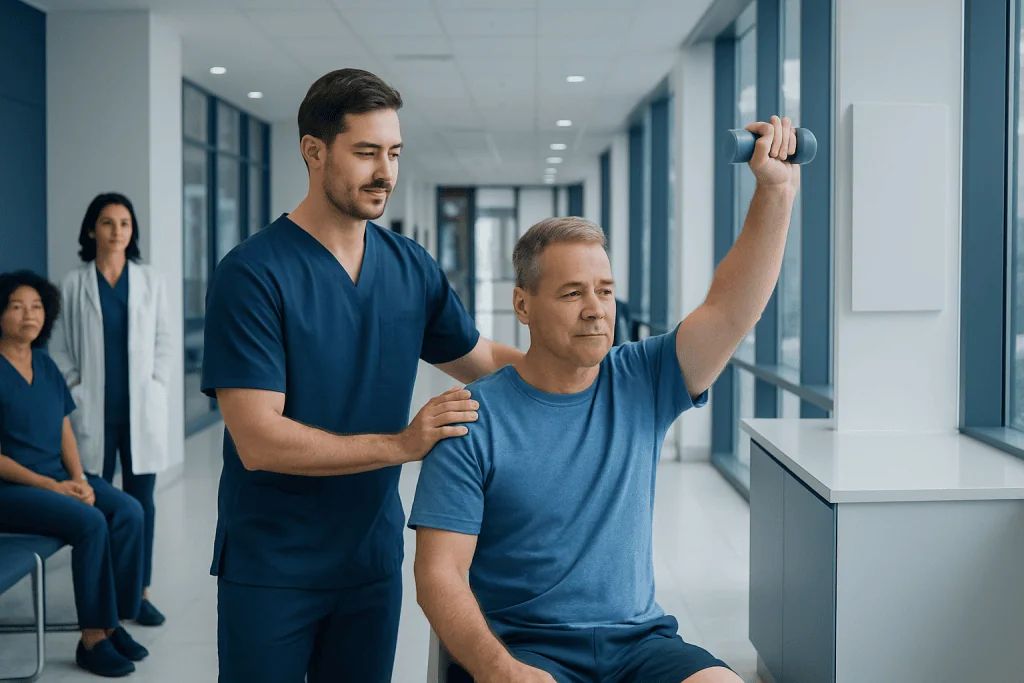
Early rehabilitation usually prioritizes gentle movement and shoulder-blade control before strengthening. The best exercise depends on the injury, symptoms, examination findings, and whether surgery has been performed.
Key Takeaways
- Early rehabilitation usually prioritizes gentle movement and shoulder-blade control before strengthening.
- The best exercise depends on the injury, symptoms, examination findings, and whether surgery has been performed.
- Mild effort-related discomfort can be acceptable in some plans, but sharp pain, worsening night pain, or loss of function should be discussed with a clinician.
- After rotator cuff repair, rehabilitation restrictions protect the healing tendon and must follow the surgeon’s protocol.
- Age alone does not determine whether rotator cuff surgery is appropriate; health, function, tear characteristics, and personal goals matter.
Rotator cuff rehab exercises help rebuild comfortable shoulder motion, shoulder-blade control, and tendon-loading tolerance after irritation, injury, or surgery. The safest plan is gradual and individualized: painful exercises, sudden progression, and heavy lifting too early may delay recovery.
Overview: how rotator cuff rehabilitation works
Rotator cuff rehab exercises are a progressive set of movements designed to improve shoulder comfort, motion, strength, and day-to-day function. The rotator cuff is a group of four muscles and tendons that helps center the upper arm bone in the shoulder socket while the arm lifts, reaches, and rotates. Rehabilitation does not simply “strengthen the shoulder”; it gradually restores coordination among the rotator cuff, shoulder blade muscles, upper back, and trunk.
A programme commonly begins with symptom control and comfortable range-of-motion work. It then moves toward low-load muscle activation, resistance exercises, and task-specific training for work, sport, or household activities. Progression should be based on the person’s pain response, movement quality, strength, and recovery after activity rather than a fixed schedule alone.
Rotator cuff symptoms can occur with tendinopathy, partial or full-thickness tears, shoulder impingement-type pain, stiffness, or following repair surgery. A clinician can distinguish these possibilities and also consider related conditions, such as shoulder pain, that may need a different approach.
What are the best exercises for rehabbing a rotator cuff injury?
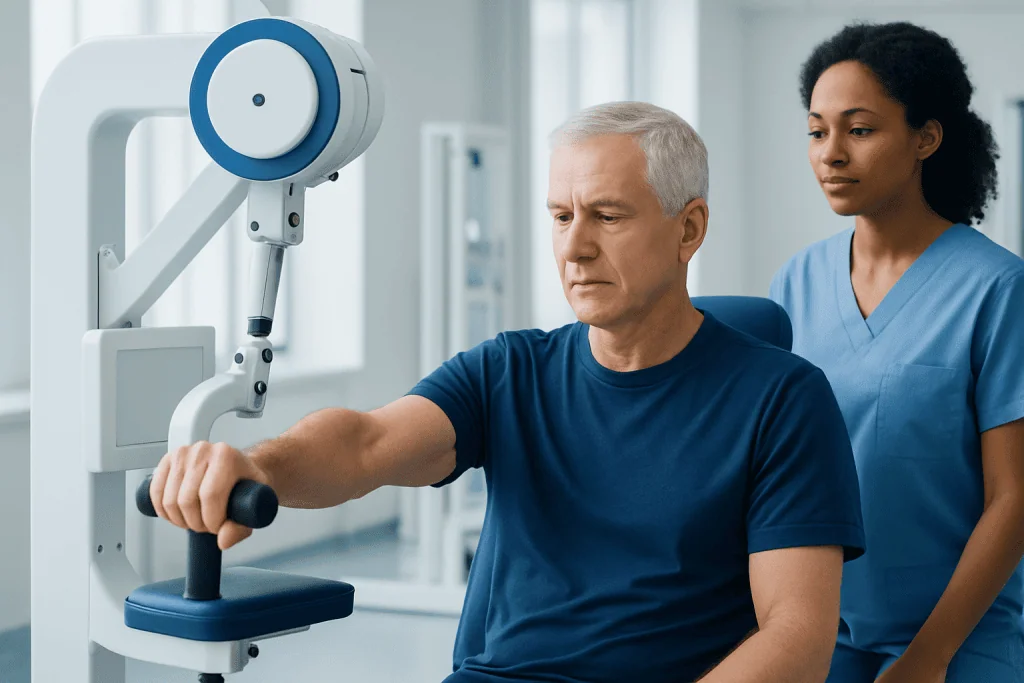
The best exercises are the ones that match the stage of recovery and can be performed with good control without a significant symptom flare. In the early stage, a physiotherapist may recommend pendulum movements, supported forward elevation, gentle assisted external rotation, and shoulder-blade setting. These exercises can maintain movement while limiting strain on sensitive tissues.
When pain and movement are improving, exercises often include isometric external and internal rotation, where the person presses gently into a wall or stable surface without moving the shoulder. Later, resistance-band or light-weight exercises may train external rotation, internal rotation, rowing, and shoulder-blade muscles. A controlled wall slide or supported arm raise may help rebuild overhead tolerance.
- Pendulum: Lean forward with the unaffected hand supported, let the affected arm relax, and make small gentle circles.
- Scapular setting: Sit or stand tall and gently draw the shoulder blades back and down without shrugging.
- External rotation with a band: Keep the elbow near the side and rotate the forearm outward slowly against light resistance.
- Supported rows: Pull the elbows back with a resistance band while avoiding neck tension and shoulder shrugging.
Exercises should not produce sharp pain, catching, or a clear worsening that persists into the next day. A physiotherapist can determine the appropriate range, resistance, frequency, and progression, particularly after a traumatic injury or when weakness is pronounced.
Who may benefit, and when exercise needs modification

Non-surgical rehabilitation is commonly appropriate for many people with rotator cuff-related shoulder pain, tendinopathy, small or degenerative tears, or reduced shoulder strength. It may also be used before surgery to improve movement and after surgery to support a safe return of function. The person’s goals matter: lifting a child, sleeping comfortably, returning to manual work, and playing a throwing sport place different demands on the shoulder.
Exercise needs modification for people with severe stiffness, arthritis, neck-related symptoms, recent dislocation, inflammatory disease, or a substantial rotator cuff tear. Individuals who have had a rotator cuff repair must follow their surgeon’s instructions because the repaired tendon needs time to heal to bone. Active lifting and resisted rotation may be restricted early in recovery.
A thorough assessment generally considers how the symptoms began, pain at rest or at night, range of motion, strength, work and sport demands, and medical history. Imaging is not always required at the start, but ultrasound or MRI may be useful when a significant tear is suspected or symptoms do not improve with appropriate care.
A practical step-by-step rehabilitation pathway
Stage 1: settle symptoms and preserve movement. The aim is to remain gently active while avoiding activities that repeatedly aggravate the shoulder, such as heavy overhead lifting. Comfortable assisted movements, pendulums, posture awareness, and light shoulder-blade work may be used. Cold or heat may offer short-term comfort for some people, but neither replaces a tailored exercise plan.
Stage 2: restore control and tolerance. As symptoms settle, the programme typically introduces controlled isometric work and active range-of-motion exercises. The focus is smooth movement without substituting a shoulder shrug or arching the lower back. Progress may be slower if night pain, stiffness, or weakness remains substantial.
Stage 3: build strength and function. Resistance is gradually added through bands, cables, or light weights. Exercises may include external and internal rotation, rows, arm raises within a comfortable range, and closed-chain exercises such as wall weight shifts. Load is increased gradually when the shoulder is recovering well and daily activities are becoming easier.
Stage 4: return to specific activities. The final stage prepares the shoulder for individual tasks, including lifting, pushing, reaching, swimming, racquet sports, or physical work. Higher-demand activities require adequate range, strength, endurance, and confidence. A clinician can help establish practical return-to-activity criteria rather than relying on time alone.
Can you provide me with a PDF of rotator cuff rehab exercises?
A general PDF can be a useful reminder of exercises, but it cannot safely replace an individualized assessment and programme. The same exercise may be helpful for one person and unsuitable for another, particularly after surgery, following an acute tear, or when shoulder stiffness is prominent. For this reason, the most appropriate PDF is usually one supplied or approved by the treating surgeon or physiotherapist.
Patients can ask their healthcare team for a written or digital home-exercise plan that includes clear instructions, pictures, the planned frequency, and signs that an exercise should be stopped or adjusted. It should state whether the arm may be actively lifted, whether resistance is permitted, and any lifting or range-of-motion restrictions.
When using any generic exercise handout, people should start gently, prioritize controlled form over repetitions, and avoid adding resistance independently. New numbness, marked weakness, increasing swelling, or pain that remains worse after exercise warrants professional advice.
What is the 7 Minute Rotator Cuff Solution and what exercises are included?
The “7 Minute Rotator Cuff Solution” is not a single standardized medical rehabilitation protocol. It is a name used for short exercise routines promoted online, and the exact exercises can vary by source. Such routines often combine shoulder-blade positioning, mobility work, band rotations, rows, and light arm-raising exercises.
A brief routine may be convenient for general shoulder conditioning, but seven minutes is not a universal solution for rotator cuff injury. Effective rehabilitation depends on correct diagnosis, appropriate loading, exercise quality, and gradual progression over time. Some people need a shorter programme at first, while others need more targeted work for stiffness, strength deficits, or return to sport.
People should be cautious with any programme that encourages exercising through significant pain or promises rapid recovery. A qualified physiotherapist can adapt an efficient home routine to the person’s symptoms and goals while protecting a healing shoulder.
Recovery timeline, benefits, and possible risks
Recovery timelines vary considerably. Mild rotator cuff-related pain may begin to improve over several weeks with activity modification and consistent exercise, while tendon-related symptoms and strength changes may require several months of progressive rehabilitation. Recovery after a surgical repair is longer because the repaired tendon must heal before strengthening and demanding activities are introduced.
The potential benefits of rehabilitation include less pain, improved shoulder movement, better sleep, increased strength, and a more confident return to valued activities. Rehabilitation can also help people understand how to manage flare-ups and adjust workload. Improvement is usually gradual rather than linear, and occasional mild symptom fluctuations can occur as activity increases.
The main risk is overloading the shoulder too soon or using poor technique, which can aggravate symptoms. Conversely, avoiding all shoulder movement for too long may contribute to stiffness and weakness. A measured programme supervised by a clinician can balance these risks, especially for people with a known tear or after surgery.
Should a 70 year old have rotator cuff surgery?
A 70-year-old may be a suitable candidate for rotator cuff surgery, but age alone should not determine the decision. The choice depends on the type and size of the tear, whether it followed an injury, the degree of weakness and functional limitation, response to non-surgical treatment, overall health, and the person’s priorities. Some older adults achieve good function with rehabilitation and do not need surgery.
Surgery may be considered when there is a traumatic full-thickness tear, persistent weakness, substantial pain or functional limitation despite appropriate non-surgical care, or a tear likely to progress in a person with meaningful activity demands. The surgeon will discuss whether repair is technically feasible and whether the expected benefits justify the recovery commitment.
When repair is recommended, it is often performed using arthroscopic shoulder surgery. The procedure generally uses small incisions and a camera to assess and treat structures inside the shoulder. Rehabilitation afterward is essential and commonly includes an initial protection period, followed by guided movement and later strengthening.
At Acibadem International, multidisciplinary specialists in JCI-accredited hospitals can assess shoulder conditions and coordinate diagnosis, treatment, and rehabilitation for international patients.
When to seek medical care
Medical assessment is advisable for shoulder pain that began after a fall, a lifting injury, or a sudden pulling event, especially if the person cannot raise the arm or has clear new weakness. Prompt evaluation is also appropriate for symptoms that do not improve after several weeks of sensible activity modification and rehabilitation, or when pain regularly disrupts sleep and daily activities.
Urgent medical care is needed for a visibly deformed shoulder, severe swelling after an injury, fever or a hot red joint, loss of sensation, a cold or pale arm, or severe pain that is rapidly worsening. These signs can indicate problems that require timely assessment and should not be managed with home exercises alone.
A shoulder specialist or physiotherapist can determine whether conservative care, imaging, injection-based treatment in selected circumstances, or a surgical opinion is appropriate. For people considering surgery, discussing rotator cuff repair can clarify the likely rehabilitation pathway, expected restrictions, and individual goals.
Frequently asked questions
How often should rotator cuff rehab exercises be done?
The recommended frequency depends on the exercise type, symptom level, and stage of rehabilitation. Gentle mobility work may be prescribed more often than strengthening exercises, which need recovery time. A physiotherapist should provide an individualized schedule, especially after surgery.
Should rotator cuff exercises hurt?
Exercises should generally feel manageable and controlled. Mild muscular effort or brief low-level discomfort may be acceptable in some rehabilitation plans, but sharp pain, catching, or symptoms that are clearly worse afterward should be reviewed. Patients should not force painful movement.
Can a rotator cuff tear heal with exercise?
Exercise can improve pain, strength, shoulder control, and function, even when a tendon tear remains present. However, a full-thickness tear does not usually reattach itself through exercise alone. A clinician can explain whether non-surgical treatment is reasonable for the specific tear and symptoms.
How long does rotator cuff rehabilitation take?
Some people notice early improvement within weeks, but meaningful strength and function gains often take several months. Recovery after rotator cuff repair is usually longer because the tendon needs protected healing before progressive strengthening. The timeline depends on the injury, treatment, health factors, and activity goals.
Can I lift weights with a rotator cuff injury?
Heavy or overhead lifting may aggravate a painful rotator cuff injury, particularly early in recovery. Later, carefully selected resistance exercises are often an important part of rehabilitation. The amount of weight and the type of exercise should be progressed based on symptoms and professional guidance.
Do I need an MRI before starting rotator cuff exercises?
Not always. Many people can begin a clinically guided rehabilitation programme after a history and physical examination. MRI or ultrasound may be recommended when there is major weakness, a traumatic injury, suspicion of a significant tear, or symptoms that do not improve as expected.
References
- American Academy of Orthopaedic Surgeons
- American Physical Therapy Association
- National Institute of Arthritis and Musculoskeletal and Skin Diseases
- OrthoInfo
This article is for general information only and is not a substitute for professional medical advice. Please consult a qualified doctor about your individual situation.
Rotator Cuff in Turkey — costs, top hospitals & a free quote
JCI-accredited · board-certified surgeons · reply within 24h
Add us as a Preferred Source to see more of our trusted health content across Google Search, AI Overviews and Discover.