Scabies: What Patients Need to Know

Scabies is caused by microscopic mites, not poor hygiene. The main symptoms are intense itching, often worse at night, and a rash with small bumps or burrow-like lines.
Key Takeaways
- Scabies is caused by microscopic mites, not poor hygiene.
- The main symptoms are intense itching, often worse at night, and a rash with small bumps or burrow-like lines.
- Treatment usually includes prescription anti-scabies medication for the patient and close contacts.
- Itching can continue for a few weeks after treatment even when the mites are gone.
- Washing or isolating clothing, bedding, and towels helps reduce the chance of re-infestation.
Scabies is a contagious skin infestation caused by tiny mites that burrow into the skin, leading to intense itching and a rash. It is treatable, but successful care usually involves treating close contacts and cleaning shared items to prevent re-infestation.
Overview: what scabies is and why it matters
Scabies is a common skin infestation caused by a tiny mite called Sarcoptes scabiei. The mite burrows into the outer layer of skin, where it triggers an immune reaction that causes itching and a rash. Although the condition can feel distressing, it is treatable and does not mean a person is unclean.
Scabies spreads mainly through prolonged skin-to-skin contact. It can affect people of any age and background, including children, adults, and older adults. Because the itching may begin weeks after the mites first spread, people can pass scabies to others before they realize they have it.
Early recognition is helpful because treatment can relieve symptoms and reduce spread within households, care facilities, schools, and other close-contact settings. In some situations, a doctor may also consider other itchy skin conditions such as eczema or allergic rashes before confirming the diagnosis.
Symptoms and what scabies can look like
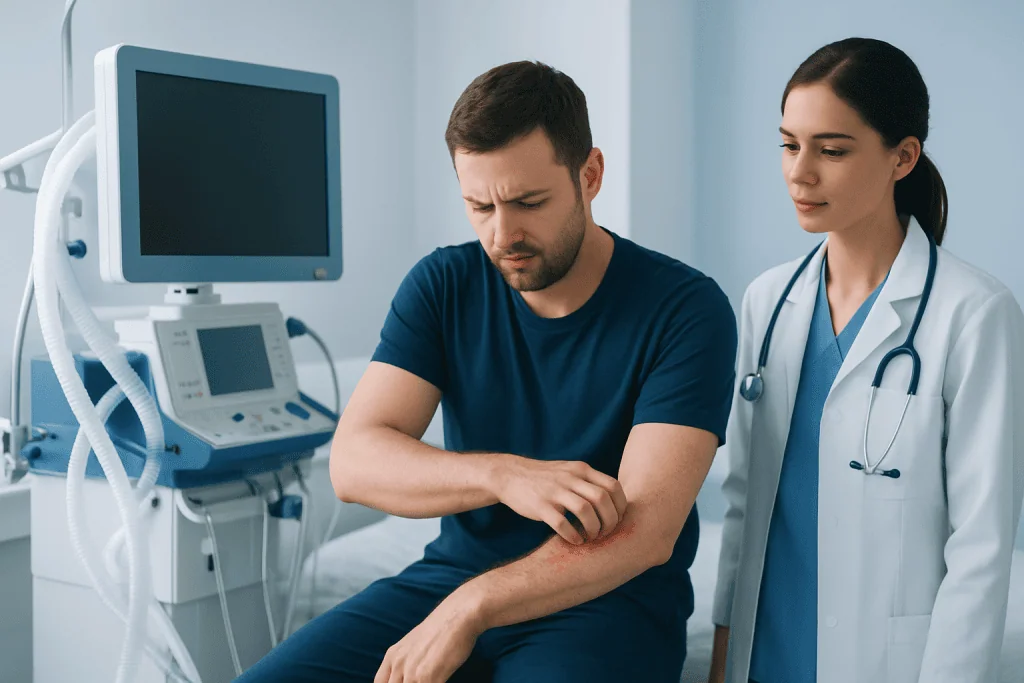
The hallmark symptom of scabies is intense itching that is often worse at night. Many people also develop a rash with small red bumps, tiny blisters, or thin, wavy, thread-like lines called burrows. The rash is caused both by the mites and by the body’s reaction to them.
Common sites include the wrists, finger webs, elbows, armpits, waistline, buttocks, nipples, and genitals. In infants, young children, older adults, and people with weakened immune systems, the scalp, face, palms, and soles may also be affected. Scratching can break the skin and increase the risk of a secondary bacterial skin infection.
Symptoms can vary. A person who has had scabies before may start itching within a few days of re-exposure, while someone with a first infestation may not notice symptoms for several weeks. This delay is one reason scabies can spread before it is recognized.
- Intense itching, especially at night
- Small bumps, blisters, or scaly patches
- Burrow-like lines in the skin
- Sores from scratching
- Worsening itch among several household members at the same time
How scabies spreads, causes, and risk factors

Scabies is caused by direct infestation with the human itch mite. It usually spreads through close, prolonged skin contact, such as living in the same household, caring for a family member, or sexual contact. Brief casual contact, such as a quick handshake, is less likely to spread typical scabies.
Less commonly, mites may spread through shared bedding, towels, or clothing, especially in cases of crusted scabies. Crusted scabies is a more severe form in which very large numbers of mites are present. It can occur in people with weakened immune systems, neurologic conditions, or difficulty sensing or responding to itching.
Risk rises in places where people live or spend time in close quarters. This includes households, dormitories, nursing homes, and long-term care settings. Scabies is not a sign of poor hygiene, and it can affect anyone regardless of income, cleanliness, or lifestyle.
Diagnosis: how doctors confirm scabies
Doctors often diagnose scabies by asking about symptoms, recent close contact with an itchy person, and the pattern of the rash. A skin examination is central to diagnosis. The distribution of itching and rash, together with similar symptoms in household members, can strongly suggest scabies.
Sometimes the diagnosis is confirmed by identifying mites, eggs, or mite droppings from a skin scraping or by examining the skin with dermoscopy, a magnifying device used in dermatology. These tests can support the diagnosis, although scabies may still be treated based on the history and exam even when mites are not easily found.
Because many skin problems can cause itching and rash, a dermatologist or other qualified clinician may consider other conditions. Depending on the appearance of the skin, they may also evaluate for problems such as psoriasis or contact dermatitis. If the diagnosis is uncertain, a referral for specialist assessment can help guide treatment.
Treatment options and what to expect
Scabies treatment aims to kill the mites and prevent them from spreading again. Standard treatment usually involves a prescription topical medication applied to the skin. In selected cases, doctors may recommend an oral anti-parasitic medicine, especially when treatment has failed, when outbreaks occur in institutions, or when crusted scabies is present.
Close contacts often need treatment at the same time, even if they do not yet have symptoms. This step is important because itching can take weeks to appear after exposure. At the same time, clothing, bedding, and towels used recently should be washed in hot water and dried thoroughly, or sealed aside for the period advised by a clinician.
It is common for itching to continue for two to four weeks after successful treatment because the skin may still be reacting to dead mites and their debris. Doctors may suggest soothing skin care, anti-itch medicines, or evaluation for dermatology care if symptoms are severe, prolonged, or complicated by infection. If scratching has led to signs of bacterial infection, additional treatment may be needed.
People should follow the treatment instructions exactly and avoid repeating or changing medicines without medical advice. A specialist may be helpful when there is persistent itching, uncertain diagnosis, treatment resistance, or widespread skin involvement that could benefit from infectious diseases evaluation.
Prevention, home measures, and protecting others
Preventing re-infestation is an important part of scabies care. Household members, sexual partners, and other close contacts identified by a doctor usually need evaluation and often treatment at the same time. This reduces the chance that mites will pass back and forth between people.
At home, recently used clothing, bed linens, and towels should be washed and dried according to medical advice. Items that cannot be washed may be sealed in a plastic bag for the recommended period so mites can no longer survive. Regular household cleaning is sensible, but extreme disinfection is usually not necessary for typical scabies.
It can also help to keep fingernails short and avoid scratching as much as possible to reduce skin damage. Gentle moisturizers, fragrance-free skin care, and cool compresses may ease discomfort while the skin heals. If symptoms persist or spread despite these steps, further medical review is appropriate.
When to seek medical care
A person should seek medical care if they have intense itching with a new rash, especially if symptoms are worse at night or if other household members are also itchy. Prompt evaluation is also important when symptoms affect a baby, an older adult, a pregnant person, or someone with a weakened immune system.
Medical advice is especially important if there are signs of infection, such as increasing redness, warmth, swelling, pus, or fever. People should also contact a doctor if itching continues for more than a few weeks after treatment, if the rash is widespread, or if they are unsure whether treatment was applied correctly.
In complex or recurrent cases, specialist assessment may be helpful. Acibadem International’s multidisciplinary specialists in JCI-accredited hospitals diagnose and treat scabies and other skin conditions for international patients, including access to specialist dermatology evaluation when needed.
Frequently asked questions
Is scabies caused by poor hygiene?
No. Scabies is caused by microscopic mites that spread mainly through prolonged skin-to-skin contact. It can affect anyone, regardless of cleanliness or living habits.
How long does scabies itching last after treatment?
Itching can continue for two to four weeks after successful treatment. This does not always mean the treatment failed, because the skin may still be reacting to the mites and their remains. If symptoms keep worsening or new burrows appear, a doctor should reassess the situation.
Does everyone in the household need treatment?
Often, yes. Close household members and intimate partners are commonly treated at the same time, even if they do not have symptoms yet. This helps prevent the infestation from passing back and forth.
Can scabies spread through clothes or bedding?
Typical scabies spreads mainly through close skin contact, but clothing, bedding, and towels can sometimes play a role. This is more important in crusted scabies, where many more mites are present. Cleaning recently used items as advised by a doctor is part of good prevention.
What is crusted scabies?
Crusted scabies is a more severe form of scabies in which very large numbers of mites build up in thick, crusted areas of skin. It is more likely in people with weakened immune systems or certain neurologic or physical limitations. It usually needs prompt medical attention and a more intensive treatment plan.
Can scabies come back after treatment?
Yes. Re-infestation can happen if close contacts are not treated or if exposure occurs again before the outbreak is fully controlled. Sometimes persistent itching is mistaken for recurrence, so follow-up with a doctor can help clarify whether more treatment is needed.
References
- World Health Organization
- Centers for Disease Control and Prevention
- American Academy of Dermatology
- National Health Service
- DermNet
This article is for general information only and is not a substitute for professional medical advice. Please consult a qualified doctor about your individual situation.
Explore treatments in Turkey — costs, top hospitals & a free quote
JCI-accredited · board-certified surgeons · reply within 24h
Add us as a Preferred Source to see more of our trusted health content across Google Search, AI Overviews and Discover.

More from the Health Library



Related Specialists

Assoc. Prof. Dr. Umut Dişel
Internal Medicine
Prof. Dr. Mehdi S.Öğüt
Ophthalmology
Prof. Dr. Gül Sağın Saylam
Pediatric Cardiology
Prof. Dr. Elif Eroğlu Büyüköner
Cardiology