Sinus Cancer Treatment: How It Works, Results and What to Expect

Sinus cancers are uncommon and require assessment by an experienced head and neck cancer team. Surgery and radiation therapy are common main treatments, often used together for locally advanced disease.
Key Takeaways
- Sinus cancers are uncommon and require assessment by an experienced head and neck cancer team.
- Surgery and radiation therapy are common main treatments, often used together for locally advanced disease.
- Some tumors can be removed through the nose using endoscopic techniques, while others need open surgery.
- Outlook varies widely by tumor type, stage, location and whether complete treatment is possible.
- New or persistent one-sided nasal symptoms, facial swelling, vision changes or unexplained nosebleeds should be medically assessed.
Sinus cancer treatment is individualized and may include surgery, radiation therapy, chemotherapy, targeted therapy or immunotherapy. The care plan depends on the precise cancer type, its location in the nasal cavity or sinuses, whether it has spread, and the person’s overall health and treatment goals.
Overview: How sinus cancer treatment works
Sinus cancer treatment aims to remove or control cancer while preserving breathing, vision, facial appearance, speech and swallowing as much as possible. In many cases, treatment involves surgery to remove the tumor followed by radiation therapy to reduce the chance of cancer returning. Chemotherapy, targeted medicines or immunotherapy may also be used in selected situations.
“Sinus cancer” commonly refers to cancers arising in the nasal cavity or paranasal sinuses, including the maxillary, ethmoid, frontal and sphenoid sinuses. These tumors are not all the same: squamous cell carcinoma is one type, while others include adenocarcinoma, melanoma, olfactory neuroblastoma and salivary-gland-type tumors. Because treatment is guided by the pathology result, a biopsy and expert review are important before planning care.
Care is usually coordinated through a multidisciplinary team that may include ear, nose and throat surgeons, skull-base surgeons, medical oncologists, radiation oncologists, radiologists, pathologists, eye specialists, dentists, reconstructive surgeons, speech and swallowing therapists and supportive-care professionals. The team considers both cancer control and quality of life at every stage.
Who may be a candidate for sinus cancer treatment?
Most people with confirmed sinus cancer are candidates for some form of treatment. The recommended approach depends on the tumor’s site, size, growth pattern, cell type and stage. Doctors also assess whether the tumor involves nearby structures such as the eye socket, skull base, brain covering, facial bones, nerves, lymph nodes or more distant organs.
Overall health matters as well. Before treatment, clinicians review heart and lung health, nutrition, current medicines, hearing, dental health and the ability to recover from surgery or radiation. These assessments help the team tailor treatment safely and may identify supportive care that should begin before cancer therapy.
For an early, localized tumor, surgery or radiation alone may sometimes be appropriate. For larger tumors or tumors close to important structures, combined treatment is often recommended. When cancer cannot be fully removed safely, radiation with chemotherapy, systemic therapy, or symptom-focused care may be considered according to the individual situation.
A second pathology review or consultation with a specialist center can be valuable for rare tumor types. It helps confirm the diagnosis and ensures that the proposed treatment accounts for the distinctive behavior of the specific cancer.
Step by step: diagnosis and treatment planning
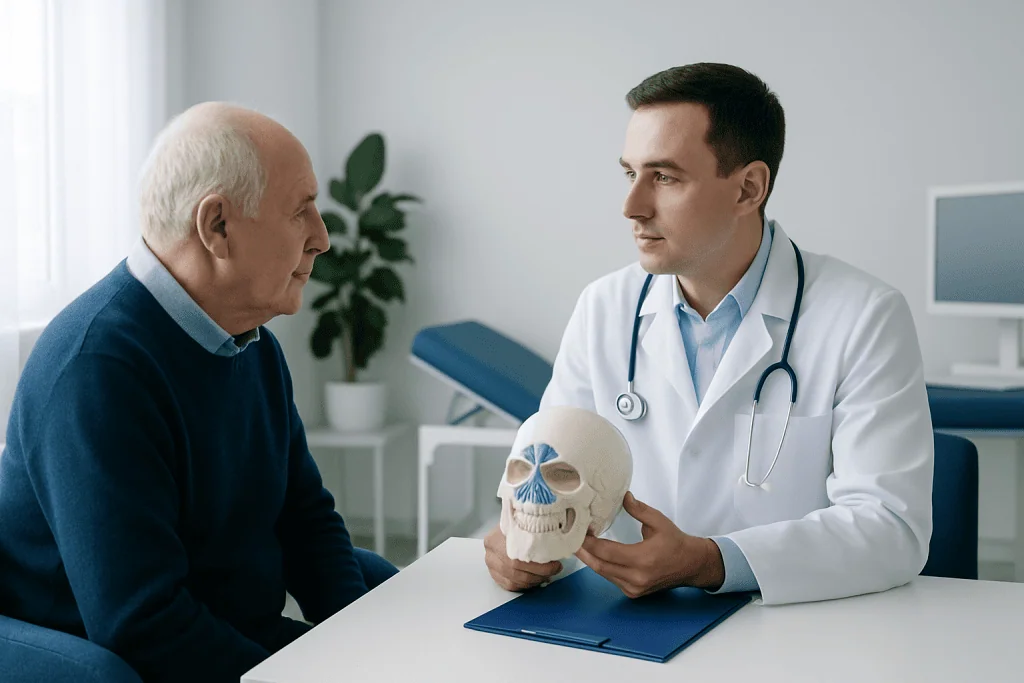
The first step is confirming the diagnosis with a biopsy. This may be performed in the clinic or operating room, often using a small endoscope passed through the nostril. A pathologist examines the sample to identify the exact cancer type and may perform additional laboratory tests that help guide treatment.
Imaging is used to define the tumor’s extent. CT scans show bone involvement particularly well, while MRI provides detailed information about soft tissues, the eye socket, nerves and skull base. PET-CT or other tests may be used when doctors need to check for lymph-node involvement or spread elsewhere in the body.
After staging is complete, the multidisciplinary team discusses the findings and develops a treatment plan. Patients are informed about the expected benefits, possible side effects, alternatives and likely impact on everyday functions. Dental assessment, nutrition support and consultation with rehabilitation services may be arranged before treatment begins.
When surgery is planned, doctors may use image guidance and detailed imaging maps to improve precision. For tumors near the eye or brain, care may be coordinated with ophthalmology and neurosurgery teams. The final plan should reflect the person’s diagnosis, preferences and practical support needs.
Sinus cancer treatment options
Surgery is a main treatment for many resectable sinus cancers. Some tumors can be removed endoscopically through the nostrils, avoiding an external incision. This approach uses a camera and specialized instruments to reach the nasal cavity and sinuses. Other tumors require an open approach through the face, mouth or scalp, especially when they extend into areas that cannot be safely reached endoscopically.
Surgeons aim to remove the cancer with a margin of healthy tissue where feasible. Reconstruction may be performed during the same operation or later to restore separation between the nose, mouth, eye socket or skull base, and to support facial function and appearance. The type of surgery depends greatly on the tumor’s exact location.
Radiation therapy uses high-energy beams to destroy cancer cells. It is often given after surgery when there is a meaningful risk of microscopic cancer cells remaining. It may also be the primary treatment when surgery is not appropriate. Modern techniques, such as intensity-modulated radiation therapy, are designed to target the tumor area while limiting dose to nearby healthy tissues.
Chemotherapy and other systemic treatments may be combined with radiation for certain advanced tumors, used before surgery in selected cases, or offered when cancer has returned or spread. Depending on the tumor type and molecular findings, treatment may include chemotherapy, targeted therapy or immunotherapy. These choices require careful discussion with a medical oncologist because benefits and side effects differ between treatments.
Patients seeking specialist assessment can discuss sinus cancer treatment options with a team experienced in head and neck oncology. Related evaluation may also address nasal cavity cancer, as nasal cavity and sinus tumors can require similar diagnostic and treatment expertise.
Recovery timeline, benefits and possible risks
Recovery varies according to the treatment used and the extent of disease. After endoscopic surgery, some people go home within a few days, although nasal congestion, crusting, fatigue and temporary changes in smell are common. Follow-up visits may include gentle cleaning inside the nose, and saline rinses are often recommended by the surgical team.
Recovery after open surgery or reconstructive surgery can take longer. Swelling, discomfort, numbness and changes in chewing, speech, facial movement or appearance may improve gradually over weeks to months. If surgery affects the eye socket, teeth, palate or jaw, additional rehabilitation and specialist follow-up may be needed.
Radiation therapy is commonly delivered over several weeks. During treatment, fatigue, skin irritation, dry mouth, nasal dryness, thick mucus, mouth soreness, taste changes and swallowing discomfort can occur. Some effects improve after treatment ends, but dry mouth, dental problems, changes in smell or taste, and tissue stiffness can sometimes persist. Long-term follow-up helps identify and manage these concerns early.
The potential benefit of treatment is improved cancer control and, when possible, cure. Risks depend on the treatment area and may include bleeding, infection, cerebrospinal fluid leakage after skull-base surgery, changes in vision, tearing problems, nerve injury, hearing changes and effects on swallowing. The treatment team explains the risks that are most relevant to the individual before treatment begins.
Supportive care is an important part of recovery. Nutrition professionals, dentists, pain specialists, physiotherapists and speech and swallowing therapists can help patients maintain strength, comfort and daily function during and after treatment.
How quickly does sinus cancer spread?
Sinus cancer does not have one predictable rate of spread. Growth depends on the specific tumor type, grade and location. Some tumors grow slowly, while others are more aggressive and may extend into nearby structures such as the eye socket, skull base or facial bones before they cause obvious symptoms.
Because the sinuses are enclosed spaces near important structures, even a tumor that has not spread to distant organs can become locally advanced. This is why persistent one-sided symptoms should be evaluated rather than assumed to be routine sinusitis. Imaging and biopsy, not symptoms alone, determine how far a cancer has progressed.
Doctors use staging tests to look for local extension, lymph-node involvement and distant spread. Once the tumor characteristics are known, the oncology team can explain the likely behavior of that particular cancer and how promptly treatment should begin.
How serious is sinus cancer?
Sinus cancer is a serious diagnosis because it can occur close to the eyes, brain, major nerves and blood vessels. It is also often identified after symptoms have been present for some time, as early symptoms may resemble common nasal or sinus conditions.
However, seriousness does not mean that treatment is ineffective. Many tumors can be treated, and some can be cured, particularly when they are localized and can be fully treated with surgery, radiation or both. Even for more advanced disease, modern multidisciplinary care can help control cancer and manage symptoms.
The most useful way to understand an individual situation is to discuss the pathology type and stage with the treating team. They can explain whether the goal is cure, long-term control or relief of symptoms, and what treatment options are appropriate.
What is the survival rate for people with sinus cancer?
There is no single survival rate that accurately describes every person with sinus cancer. Outcomes differ substantially according to the cancer type, stage at diagnosis, location, whether it has reached lymph nodes or distant sites, and whether complete local treatment is possible.
Published survival estimates are based on groups of patients treated in earlier periods and cannot predict an individual outcome. They may not reflect newer surgical methods, radiation planning, pathology testing or systemic therapies. Different countries and cancer registries also report outcomes in different ways.
A treating specialist can provide a more meaningful discussion after reviewing the biopsy, scans and treatment plan. Patients may wish to ask about the stage, treatment intent, factors that influence prognosis and how response will be monitored over time.
How treatable is sinus cancer?
Sinus cancer is often treatable, especially when it is localized and can be addressed with surgery, radiation therapy or a combination of treatments. The chance of long-term control depends on the tumor’s characteristics and how extensively it involves surrounding areas at the time of diagnosis.
Some advanced cancers are still managed with curative intent through carefully planned combined therapy. In other situations, systemic treatments can shrink or slow cancer, and supportive treatments can improve symptoms and quality of life. Clinical trials may be an option for selected patients, particularly for rare tumors or cancer that has returned.
Regular surveillance after treatment is essential because recurrence can occur. Follow-up may include nasal endoscopy, imaging and examinations of the neck, teeth, eyes and swallowing function. Reporting new symptoms promptly supports early assessment and management.
When to seek medical care
A person should arrange a medical assessment for nasal or sinus symptoms that persist, are one-sided or do not improve as expected with usual treatment. Examples include ongoing nasal blockage on one side, repeated unexplained nosebleeds, blood-stained nasal discharge, facial pain or swelling, numbness, loose upper teeth, reduced smell, a persistent lump in the neck, or changes around the eye.
Urgent assessment is appropriate for new double vision, loss of vision, marked eye swelling, severe headache with neurological symptoms, or significant bleeding. These symptoms have many possible causes, but prompt evaluation is important to identify the cause safely.
People already diagnosed with sinus cancer should contact their care team for worsening symptoms, fever after surgery, persistent vomiting, uncontrolled pain, dehydration, breathing difficulty or any treatment side effect that feels difficult to manage. Acibadem International’s multidisciplinary specialists and JCI-accredited hospitals provide diagnostic evaluation and treatment planning for international patients with sinus cancer.
Frequently asked questions
What is usually the first treatment for sinus cancer?
Surgery is often the first treatment when the tumor can be safely removed. Radiation therapy is commonly used after surgery for higher-risk disease, while some tumors are treated primarily with radiation, chemotherapy or a combination of approaches.
Can sinus cancer be removed through the nose?
Some sinus cancers can be removed with endoscopic surgery through the nostrils. Whether this is suitable depends on the tumor’s size, location and involvement of nearby structures such as the eye socket or skull base.
Will sinus cancer treatment affect vision?
Vision may be affected when the tumor or treatment is close to the eye socket, optic nerve or eye muscles. The care team uses detailed imaging and careful planning to protect vision whenever possible, but the individual risk depends on the tumor’s location.
Is chemotherapy always needed for sinus cancer?
No. Chemotherapy is not needed for every sinus cancer. It may be used with radiation, before surgery, for certain tumor types, or when cancer has recurred or spread.
Can sinus cancer come back after treatment?
Yes, recurrence is possible, particularly with some tumor types or more advanced disease. Regular follow-up examinations, endoscopy and imaging help doctors monitor for recurrence and manage treatment effects.
Are persistent sinus symptoms usually cancer?
No. Persistent nasal congestion, sinus pressure and discharge are much more commonly caused by inflammation, allergy or infection. However, one-sided or unusual symptoms that continue, worsen or include bleeding, facial numbness or eye changes should be assessed by a clinician.
References
- National Cancer Institute
- American Cancer Society
- European Society for Medical Oncology
- National Comprehensive Cancer Network
- American Society of Clinical Oncology
This article is for general information only and is not a substitute for professional medical advice. Please consult a qualified doctor about your individual situation.
Oncology care in Turkey — second opinion and treatment plan
JCI-accredited · board-certified surgeons · reply within 24h
Add us as a Preferred Source to see more of our trusted health content across Google Search, AI Overviews and Discover.