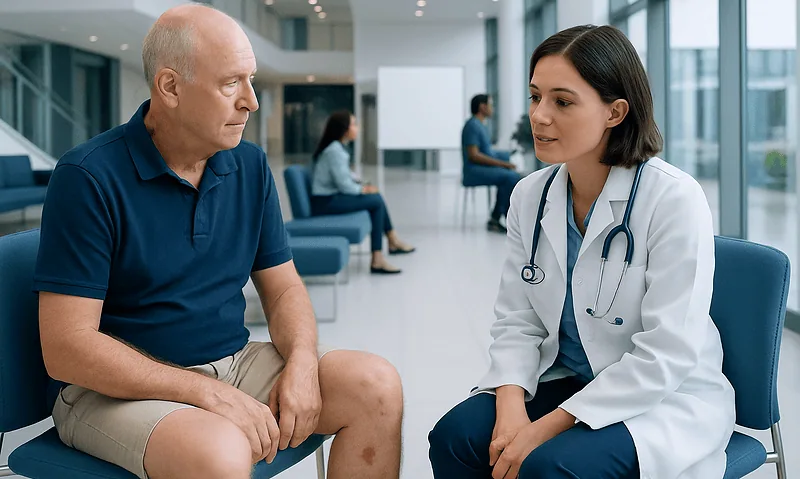
Skin Cancer Warning Signs: What It Can Look Like
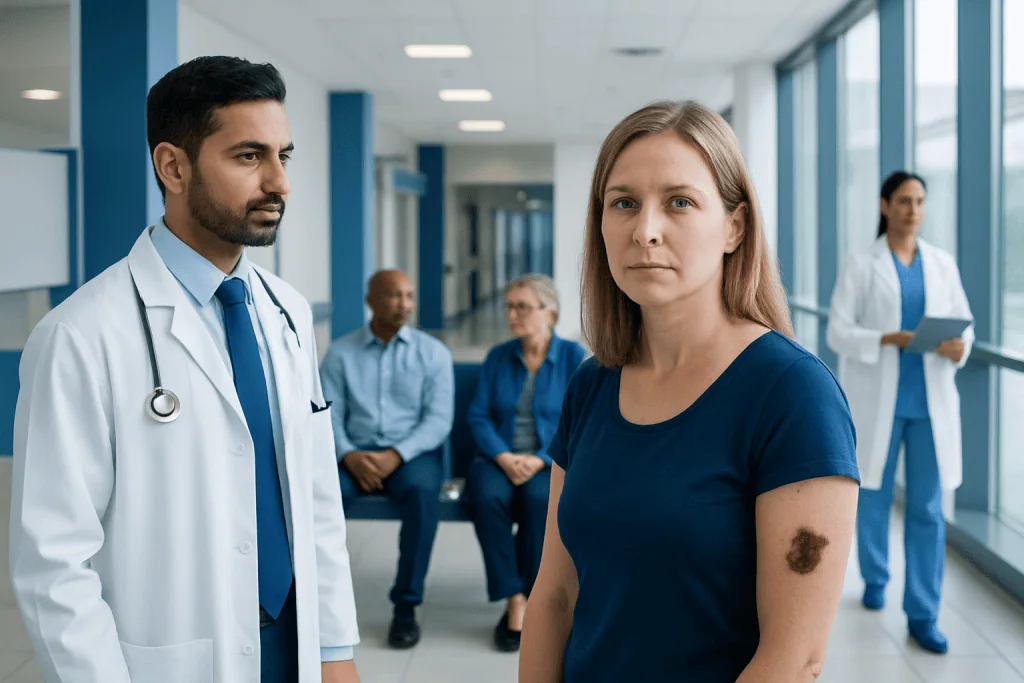
Skin cancer may look like a new spot, a changing mole, or a sore that does not heal. The ABCDE rule can help identify suspicious pigmented lesions.
Key Takeaways
- Skin cancer may look like a new spot, a changing mole, or a sore that does not heal.
- The ABCDE rule can help identify suspicious pigmented lesions.
- Not all skin cancers are dark; some are pink, red, pearly, scaly, or flesh-colored.
- People should pay attention to bleeding, crusting, itching, tenderness, or rapid growth in a skin lesion.
- A dermatologist can diagnose suspicious spots with a skin exam and, if needed, a biopsy.
Skin cancer can appear in different ways, from a changing mole to a sore that does not heal. Knowing the common warning signs can help a person seek medical advice early and get the right treatment if needed.
Overview: What skin cancer can look like
Skin cancer warning signs are not always obvious. Some skin cancers begin as a dark mole that changes over time, while others appear as a pink bump, a scaly patch, or a sore that repeatedly crusts and returns. Because appearance can vary widely, it is helpful to notice any spot on the skin that looks different from the rest or behaves differently over time.
The three main types are basal cell carcinoma, squamous cell carcinoma, and melanoma. Basal cell carcinoma often appears as a pearly bump, a shiny patch, or a sore that does not fully heal. Squamous cell carcinoma may look like a rough, scaly, thickened, or crusted area, sometimes with tenderness. Melanoma often develops as a new pigmented spot or a change in an existing mole, but it can also be pink, red, or skin-colored.
Skin cancer can develop anywhere on the body. It is common on sun-exposed areas such as the face, scalp, ears, neck, chest, hands, arms, and legs, but it can also occur on the soles of the feet, under the nails, on the genitals, or in areas that receive little sun. That is why full-body skin awareness is important, not just checking the face or arms.
Many harmless skin changes occur with age, sun exposure, or irritation. Even so, a new or changing lesion should not be ignored. A doctor can assess whether a spot is likely benign or whether it needs closer examination for skin cancer.
Common warning signs and symptoms
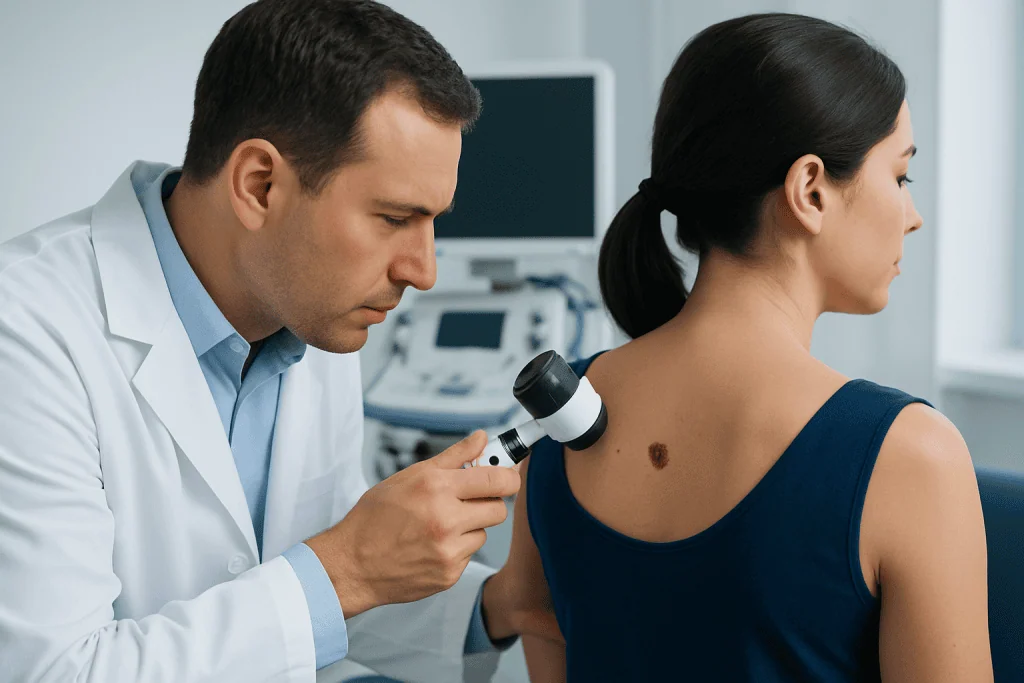
A useful general rule is to look for a spot that is new, changing, or not healing. This may include a mole that becomes larger, darker, uneven, or raised, or a patch of skin that begins to bleed, crust, itch, sting, or feel sore. Changes may happen gradually over weeks to months.
Melanoma is often described using the ABCDE rule:
- A – Asymmetry: one half does not match the other.
- B – Border: edges are irregular, blurred, or ragged.
- C – Color: the lesion has multiple colors or uneven coloring.
- D – Diameter: it is larger than about 6 mm, although smaller melanomas can occur.
- E – Evolving: the spot changes in size, shape, color, or symptoms.
Another important clue is the “ugly duckling” sign. This means one mole or spot looks noticeably different from the others on the same person’s skin. A lesion that stands out by color, size, shape, or behavior may deserve medical evaluation even if it does not fully match the ABCDE pattern.
Non-melanoma skin cancers can be more subtle. Warning signs may include a shiny or translucent bump, a flat scar-like area, a persistent red scaly patch, a wart-like growth, or a tender crusted sore. These lesions can be mistaken for eczema, a pimple, or a small injury, especially if they improve briefly and then return.
How different types of skin cancer may appear
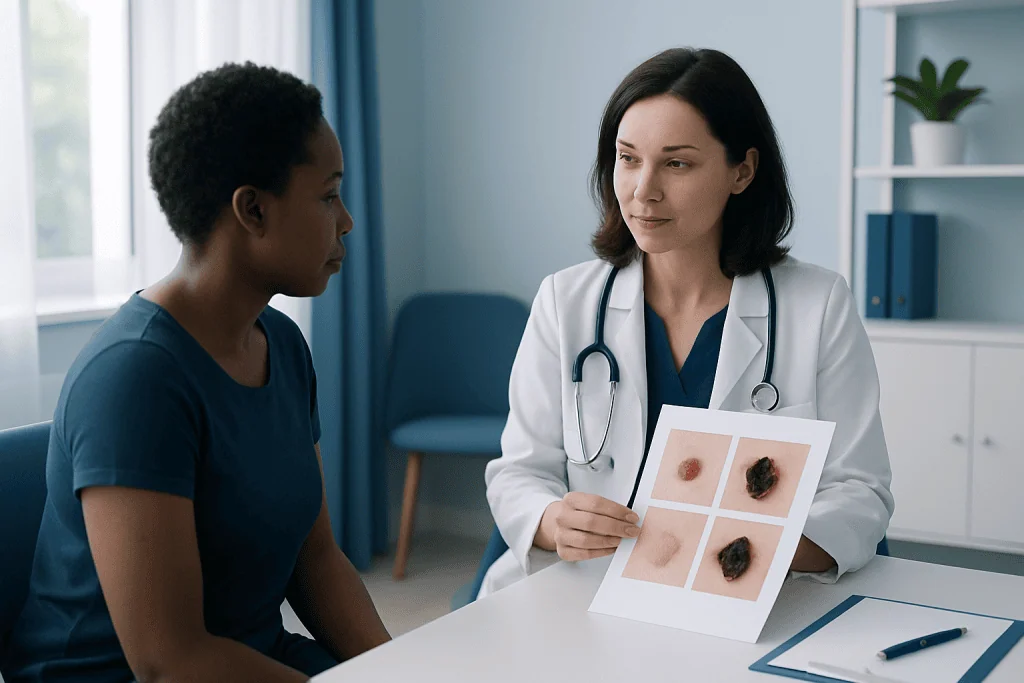
Basal cell carcinoma is the most common skin cancer. It often appears as a pearly or waxy bump, a small pink growth with slightly raised edges, or a flat patch that looks pale, shiny, or scar-like. Tiny visible blood vessels may be seen on the surface. It may bleed easily after minor rubbing or shaving and then seem to heal before bleeding again.
Squamous cell carcinoma often develops as a rough, thickened, scaly patch or plaque. It may look red, inflamed, crusted, or ulcerated. Some lesions become firm bumps, while others resemble a persistent wart or a sore that stays open. These cancers may arise on the lips, ears, scalp, face, hands, and other sun-exposed areas, but they can also occur in scars or chronically irritated skin.
Melanoma can be brown, black, tan, blue, red, pink, white, or a mixture of shades. Some melanomas spread across the skin surface, while others grow more quickly downward. A melanoma may start in a mole or appear as an entirely new spot. On darker skin tones, melanoma can occur on the palms, soles, or beneath a nail, where it may look like a dark streak or a slowly widening band.
Because different lesions can overlap in appearance, it is not always possible to tell by sight alone whether a spot is harmless or concerning. When there is uncertainty, a specialist may recommend dermoscopic examination and, if needed, a biopsy. In patients with a suspicious pigmented lesion, further assessment may focus on ruling out melanoma.
Causes and risk factors
The main cause of most skin cancers is damage to skin cells from ultraviolet radiation. This damage can come from sunlight or from artificial tanning devices. UV exposure accumulates over time, so repeated sunburns, long-term outdoor work, and regular tanning can all increase risk. Skin cancer can still affect people who are careful in the sun, but the risk tends to be higher with greater lifetime exposure.
Some people have a naturally higher risk because of their skin type or medical history. Risk factors include fair skin, light eyes, blond or red hair, a tendency to burn easily, many moles, unusual moles, or a personal or family history of skin cancer. A weakened immune system also increases risk, as can older age, though skin cancer can occur in younger adults as well.
Certain areas and situations deserve added attention. Previous radiation treatment, chronic wounds, burn scars, and actinic damage from years of sun exposure can raise the risk of particular skin cancers. Melanoma risk may also be higher in people with a strong family history or inherited genetic susceptibility.
Having risk factors does not mean a person will definitely develop skin cancer, and some people with skin cancer have few clear risk factors. For this reason, regular skin awareness matters for everyone. Looking for changes and protecting the skin from further UV damage are both important parts of prevention.
How doctors diagnose suspicious skin changes
Diagnosis usually begins with a clinical skin examination. The doctor asks when the spot first appeared, whether it has changed, and whether it causes symptoms such as bleeding, itching, pain, or crusting. A full skin check may be recommended because a person can have more than one suspicious lesion, and some concerning spots are in places they have not noticed.
Dermatologists often use a handheld tool called a dermatoscope to examine the lesion more closely. This can reveal structures and color patterns that are not visible to the naked eye. Dermoscopy helps guide decision-making, but it does not replace tissue diagnosis when a lesion is suspicious.
The most reliable way to confirm skin cancer is a biopsy. In a biopsy, all or part of the lesion is removed and examined under a microscope. If cancer is diagnosed, the pathology report helps determine the exact type and features, which guide treatment. In some cases, especially for melanoma or more advanced disease, further imaging or lymph node evaluation may be needed.
When a lesion is confirmed, treatment planning depends on the cancer type, size, location, depth, and whether it has spread. Some patients may also need coordination with specialists in medical oncology or radiation oncology if the disease is more complex.
Treatment options
Treatment depends on the type of skin cancer and how early it is found. Many basal cell and squamous cell carcinomas can be treated successfully when diagnosed early. The most common approach is surgical removal, which aims to remove the cancer completely while preserving as much healthy skin as possible.
For some small or superficial lesions, options may include scraping and cautery, cryotherapy, topical treatments, light-based therapies, or close specialist monitoring in selected cases. Certain skin cancers in delicate areas, such as the face, may require specialized surgical techniques to preserve appearance and function. A dermatologist or surgical specialist can explain which option is most appropriate.
Melanoma usually requires prompt surgical excision with an appropriate margin of normal skin. Depending on the depth and stage, additional procedures or treatments may be recommended. More advanced disease may be treated with therapies such as immunotherapy, targeted therapy, radiation therapy, or other cancer-directed care. In selected situations, doctors may discuss immunotherapy as part of a broader treatment plan.
Follow-up care is important after treatment because some patients develop a new skin cancer later or need monitoring for recurrence. Near the end of the care pathway, patients may benefit from support in dermatology for ongoing skin checks and management of sun-related skin changes. Acibadem International’s multidisciplinary specialists and JCI-accredited hospitals diagnose and treat skin cancer for international patients.
Prevention and self-care
The most effective prevention step is protecting the skin from ultraviolet radiation. This includes seeking shade when the sun is strongest, wearing protective clothing, using a broad-spectrum sunscreen, and reapplying it as directed, especially after swimming or sweating. Avoiding tanning beds is also important because artificial UV radiation can damage the skin in the same way as sunlight.
Regular self-examination can help people notice skin cancer warning signs earlier. A monthly skin check in good lighting is a practical habit. It helps to use a mirror for hard-to-see areas and to ask a partner or family member to check the back, scalp, or other difficult places. Taking photos of moles or spots may make changes easier to track over time.
People with many moles, a previous skin cancer, or a strong family history may benefit from scheduled professional skin examinations. A doctor may recommend how often these should take place based on personal risk. Children and adults alike should be encouraged to practice sun safety, since skin protection across the lifespan matters.
Self-care also means not trying to diagnose a suspicious spot alone. Picking at a lesion, repeatedly treating it as a rash without medical advice, or delaying evaluation can make diagnosis harder. If a lesion is changing, bleeding, or not healing, it is best to arrange a medical assessment.
When to see a doctor
A person should see a doctor if they notice a new mole or skin lesion that looks unusual, a spot that changes in size or color, or a sore that does not heal within a few weeks. Bleeding, crusting, persistent scaling, pain, itching, or a lesion that repeatedly disappears and returns are also reasons to seek medical advice.
Prompt evaluation is especially important for lesions that match the ABCDE features or show the ugly duckling pattern. Nail streaks that change, dark patches on the palms or soles, and growths on the lips, ears, or scalp should not be overlooked. These areas can sometimes be harder for a person to monitor on their own.
Most skin changes are not cancer, and many will turn out to be benign growths, inflammatory conditions, or harmless age-related changes. Even so, it is reassuring and safer to have a suspicious lesion checked by a qualified clinician. Early diagnosis often allows simpler treatment and may improve outcomes.
If there is concern about a rapidly changing spot, especially one that bleeds or appears clearly different from other moles, an appointment should be arranged sooner rather than later. A dermatologist, primary care doctor, or cancer specialist can advise on the next steps and whether a biopsy is needed.
Frequently asked questions
What are the first warning signs of skin cancer?
Early warning signs often include a new spot on the skin, a mole that changes, or a sore that does not heal. Other clues include bleeding, crusting, itching, or a lesion that looks different from nearby spots.
Does skin cancer always look dark or black?
No. Skin cancer can be brown or black, but it may also be pink, red, pearly, flesh-colored, scaly, or translucent. That is why any new or changing lesion deserves attention, even if it is not dark.
Can a harmless-looking pimple or sore be skin cancer?
Sometimes it can. Certain skin cancers resemble a pimple, a small wound, eczema, or a rough patch, especially if they heal partially and then return. A persistent or recurring lesion should be checked by a doctor.
How can someone check their skin at home?
A monthly self-exam in good lighting can help. It is useful to check the entire body, including the scalp, back, soles of the feet, and under the nails, and to compare spots over time using mirrors or photos.
Who is most at risk for skin cancer?
Risk is higher in people with significant sun exposure, a history of sunburns, fair skin, many moles, or a personal or family history of skin cancer. However, skin cancer can affect people of all skin tones and ages.
When should a mole be evaluated by a doctor?
A mole should be evaluated if it changes in shape, size, color, or symptoms, or if it becomes asymmetric or develops irregular borders. It is also wise to seek care for any mole that stands out from the others.
References
- World Health Organization
- American Academy of Dermatology
- National Cancer Institute
- American Cancer Society
- National Health Service
This article is for general information only and is not a substitute for professional medical advice. Please consult a qualified doctor about your individual situation.
Skin Cancer in Turkey — costs, top hospitals & a free quote
JCI-accredited · board-certified surgeons · reply within 24h
Add us as a Preferred Source to see more of our trusted health content across Google Search, AI Overviews and Discover.