Skull Nerve: A Complete Medical Overview

The term skull nerve usually refers to the cranial nerves. Cranial nerves help control smell, vision, eye movement, facial sensation, hearing, balance, swallowing, and tongue movement.
Key Takeaways
- The term skull nerve usually refers to the cranial nerves.
- Cranial nerves help control smell, vision, eye movement, facial sensation, hearing, balance, swallowing, and tongue movement.
- Symptoms depend on which nerve is affected and may range from mild numbness to facial paralysis or double vision.
- Diagnosis often involves a neurological examination and may include imaging, hearing tests, or blood tests.
- Treatment focuses on the cause and can include medication, rehabilitation, or specialized procedures.
Skull nerve is a common way people refer to the cranial nerves, the 12 pairs of nerves that arise from the brain and pass through the skull to control important functions in the head, neck, and some internal organs. When one of these nerves is irritated, compressed, inflamed, or injured, symptoms can include facial weakness, numbness, vision changes, hearing problems, dizziness, or trouble swallowing.
What does “skull nerve” mean?
The term skull nerve is not a formal medical name, but many people use it to mean the cranial nerves. These are 12 pairs of nerves that connect directly to the brain and travel through openings in the skull. They carry signals that support essential tasks such as seeing, smelling, chewing, blinking, hearing, balancing, swallowing, speaking, and moving the tongue and shoulders.
Unlike spinal nerves, which branch from the spinal cord and mainly serve the body below the head, cranial nerves mostly serve the head and neck. A few also affect the chest and abdomen, especially the vagus nerve, which helps regulate heart rate, digestion, and other automatic functions.
Because each cranial nerve has a specific role, symptoms can offer clues about which nerve may be affected. For example, facial drooping can suggest a facial nerve problem, while double vision may point to a nerve that controls eye movement. Understanding this anatomy helps explain why doctors ask detailed questions about vision, hearing, balance, taste, swallowing, and facial sensation during an evaluation.
The 12 cranial nerves and what they do
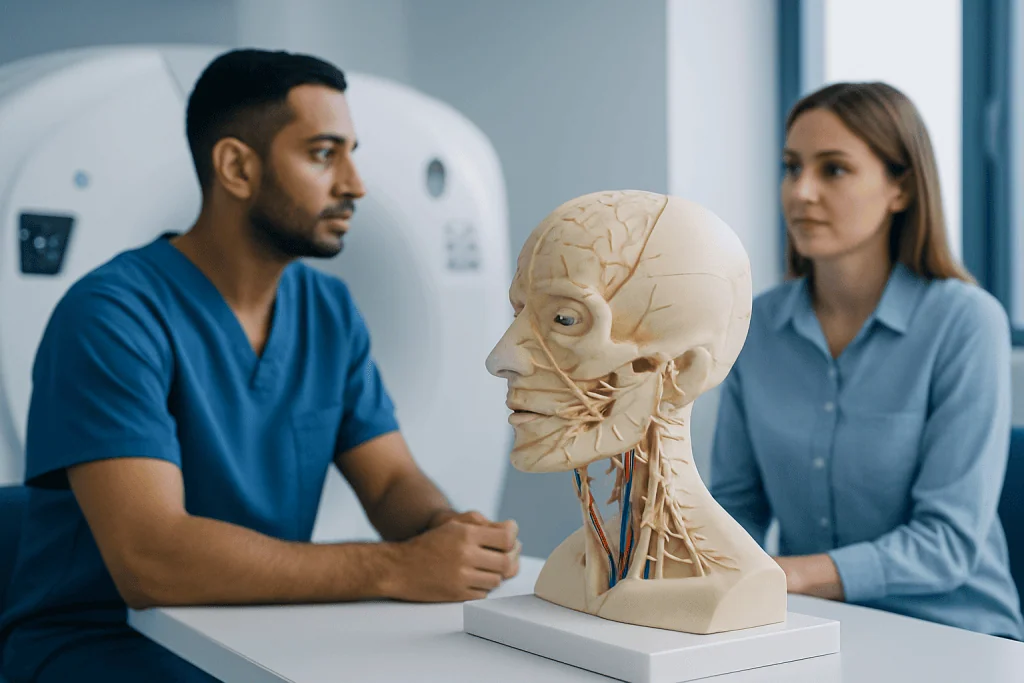
Each cranial nerve has a number and a function. Some carry sensation to the brain, some control muscles, and some do both. A simple overview can make the topic easier to understand:
- I Olfactory: smell
- II Optic: vision
- III Oculomotor: most eye movements, eyelid lifting, and pupil constriction
- IV Trochlear: one eye muscle that helps look downward and inward
- V Trigeminal: facial sensation and chewing
- VI Abducens: outward movement of the eye
- VII Facial: facial expression, part of taste, and tear and saliva production
- VIII Vestibulocochlear: hearing and balance
- IX Glossopharyngeal: part of taste and swallowing
- X Vagus: swallowing, voice, and automatic body functions
- XI Accessory: shoulder and neck movement
- XII Hypoglossal: tongue movement
These nerves work together constantly. Speaking clearly, for instance, relies on coordinated movement of the tongue, throat, vocal cords, and facial muscles. Eating and drinking safely also depend on several cranial nerves acting in sequence.
When a single skull nerve is affected, symptoms may be quite specific. When several are involved, the pattern can suggest a broader condition affecting the brainstem, skull base, or nearby blood vessels and tissues.
Symptoms of a skull nerve problem

Symptoms vary depending on which cranial nerve is involved. Some people notice changes suddenly, while others develop symptoms gradually over days, weeks, or months. Problems can affect sensation, movement, coordination, or automatic functions.
Possible symptoms include facial numbness, tingling, or pain; weakness on one side of the face; drooping of the eyelid or mouth; double vision; blurred vision; hearing loss; ringing in the ears; dizziness or vertigo; changes in taste or smell; difficulty chewing; hoarseness; trouble swallowing; or tongue weakness. Some people also experience imbalance, dry eye, or reduced tear production.
In certain conditions, pain is the main feature. For example, severe brief facial pain can occur with trigeminal neuralgia, a disorder involving the trigeminal nerve. In other cases, weakness is more obvious, such as in Bell’s palsy, which affects the facial nerve and can cause sudden one-sided facial drooping.
Symptoms that involve more than one function, such as hearing changes plus facial weakness or swallowing difficulty plus hoarseness, often need prompt medical evaluation. A careful examination helps determine whether the problem is related to a cranial nerve, the brain, the ear, the muscles, or another structure.
Causes and risk factors
There are many possible causes of cranial nerve problems. A skull nerve may be affected by inflammation, infection, trauma, blood vessel compression, diabetes-related nerve injury, autoimmune disease, stroke, tumor, or increased pressure within the skull. Sometimes the cause is temporary and treatable; in other cases, it may require longer-term monitoring or care.
Common examples include viral inflammation of the facial nerve, compression of a nerve by a nearby artery, sinus or ear infections spreading to nearby tissues, head injury, and complications from chronic conditions such as diabetes or high blood pressure. Less commonly, nerve symptoms may result from multiple sclerosis, skull base disorders, or growths near the nerve pathway. A doctor may also consider acoustic neuroma when hearing loss, tinnitus, and balance problems develop together.
Risk factors depend on the underlying condition but may include older age, vascular risk factors, infections, immune system disorders, previous head trauma, and smoking. However, some people develop cranial nerve symptoms without any clear risk factor.
It is important not to assume that all facial pain, dizziness, or vision changes come from a skull nerve problem. These symptoms can overlap with eye disease, inner ear disorders, migraine, muscle conditions, or central nervous system conditions. That is why diagnosis is based on the whole clinical picture rather than symptoms alone.
How doctors diagnose skull nerve disorders
Diagnosis begins with a detailed medical history and a focused neurological examination. The doctor will ask when symptoms started, whether they came on suddenly or gradually, and whether there are associated issues such as headache, fever, rash, weakness, hearing changes, or difficulty swallowing. During the exam, they may test eye movements, facial sensation, facial expression, hearing, balance, speech, gag reflex, and tongue strength.
Further testing depends on the suspected cause. Imaging studies such as MRI or CT can help identify inflammation, stroke, bleeding, structural abnormalities, or masses affecting the nerve pathway. Hearing tests, balance tests, blood tests, and eye examinations may also be useful. In selected cases, electrical studies or lumbar puncture may be considered.
The goal is not only to confirm that a cranial nerve is involved, but also to find the reason. This matters because treatment differs greatly between infection, nerve compression, stroke, autoimmune disease, or tumor. If surgery is being considered, advanced imaging helps map the nerve and nearby blood vessels or structures.
When symptoms suggest a structural problem, doctors may recommend specialist evaluation in neurology, ENT, ophthalmology, or neurosurgery. For some patients, this may include Gamma Knife radiosurgery or brain tumor surgery if a lesion is found and treatment is appropriate.
Treatment options for skull nerve conditions
Treatment depends on the cause, the nerve involved, and how severe the symptoms are. Some conditions improve with medication and time, while others need rehabilitation, procedures, or surgery. The main aim is to relieve symptoms, protect nerve function, and address the underlying problem.
Medications may be used to reduce inflammation, control infection, ease nerve pain, or manage associated conditions such as vertigo or dry eye. Eye protection is especially important if eyelid closure is weak, because the cornea can become irritated. Speech and swallowing therapy may help when the throat or tongue muscles are affected, and vestibular rehabilitation can support recovery from balance-related symptoms.
When a nerve is compressed by a blood vessel or a mass, interventional treatment may be needed. For example, severe nerve pain or compression syndromes may sometimes be treated with microvascular decompression. Tumors or other lesions may require surgery, focused radiosurgery, or careful follow-up depending on their size and behavior.
Care is often multidisciplinary. Neurologists, neurosurgeons, ENT specialists, ophthalmologists, radiologists, and rehabilitation professionals may all contribute to diagnosis and treatment. Near the end of the care pathway, international patients may also seek evaluation at Acibadem International, where multidisciplinary specialists in JCI-accredited hospitals diagnose and treat complex cranial nerve conditions.
Self-care and daily management
Self-care does not replace medical treatment, but it can support comfort and safety while recovery is underway. The most useful steps depend on symptoms. People with facial weakness may need eye drops, ointment, or protective taping at night if recommended by a clinician. Those with swallowing issues may benefit from texture changes and supervised swallowing strategies guided by a speech therapist.
If dizziness or imbalance is present, practical steps such as moving slowly, using handrails, keeping floors clear, and avoiding driving until assessed can reduce the risk of falls. For facial pain, triggers such as very cold wind, chewing hard foods, or touching sensitive areas may worsen discomfort in some people.
Managing overall health can also help. Good control of blood sugar, blood pressure, and cholesterol may reduce the chance of nerve-related complications in some cases. Adequate rest, hydration, and follow-up appointments are important, especially when symptoms are changing.
People should avoid self-diagnosing persistent neurological symptoms. Because the same symptom can have several causes, a professional assessment is the safest way to decide whether observation, medication, therapy, or a procedure is needed.
When to seek medical care
Medical care is recommended for any new facial weakness, double vision, sudden hearing loss, severe facial pain, trouble swallowing, persistent dizziness, or unexplained numbness in the face. These symptoms do not always signal an emergency, but they should be evaluated because early diagnosis can guide timely treatment.
Emergency care is especially important if cranial nerve symptoms come with sudden severe headache, confusion, weakness in an arm or leg, trouble speaking, loss of consciousness, or new imbalance severe enough to prevent walking. These features can point to stroke or another urgent neurological problem.
Children, older adults, and people with cancer, diabetes, immune suppression, or recent head trauma should be assessed promptly if skull nerve symptoms appear. Even when symptoms seem mild, a clinician can help determine whether watchful waiting is appropriate or whether imaging and specialist input are needed.
Regular follow-up is also important if symptoms persist, worsen, or return. Tracking changes over time helps doctors adjust treatment and monitor recovery or progression.
Frequently asked questions
Is a skull nerve the same as a cranial nerve?
In everyday language, yes. People often use the term skull nerve to refer to the cranial nerves, which arise from the brain and pass through the skull. In medical settings, the usual term is cranial nerve.
How many skull nerves are there?
There are 12 pairs of cranial nerves. Each pair has a specific role, such as controlling eye movement, facial sensation, hearing, balance, swallowing, or tongue movement.
Can skull nerve damage heal?
Some cranial nerve problems improve partially or fully, especially when caused by temporary inflammation or mild injury. Recovery depends on the cause, the severity of damage, and how quickly treatment begins. In other cases, symptoms may persist and need ongoing management.
What doctor treats skull nerve problems?
A neurologist often leads the evaluation, but treatment may involve other specialists depending on the nerve and the cause. These can include ENT specialists, ophthalmologists, neurosurgeons, and rehabilitation professionals.
Is facial pain always caused by a skull nerve disorder?
No. Facial pain can also come from dental problems, sinus disease, migraine, jaw disorders, or other conditions. A doctor considers the pain pattern, examination findings, and sometimes imaging before making a diagnosis.
Are skull nerve symptoms ever an emergency?
Yes. Sudden facial weakness, double vision, trouble swallowing, severe dizziness, or symptoms accompanied by limb weakness, confusion, or speech changes should be assessed urgently. These signs can sometimes indicate stroke or another serious neurological condition.
This article is for general information only and is not a substitute for professional medical advice. Please consult a qualified doctor about your individual situation.
Explore treatments in Turkey — costs, top hospitals & a free quote
JCI-accredited · board-certified surgeons · reply within 24h
Add us as a Preferred Source to see more of our trusted health content across Google Search, AI Overviews and Discover.
Check your numbers in seconds
BMI, calories, due date, blood pressure and 30+ more clinical calculators — free, instant, doctor-reviewed ranges.

More from the Health Library

Peristalsis: What Patients Need to Know

Gorilla Brand Super Glue: An Evidence-Based Guide for Patients

Reddish Colour Stool: An Evidence-Based Guide for Patients

Herpes on Penis — Explained by Medical Evidence, Not Myths

Tortuous Colon: What Patients Need to Know