Timed Get Up and Go: A Complete Medical Overview

The Timed Up and Go test measures everyday movements used for safe independent mobility. It is commonly used in older adults, but may also support assessment after illness, injury or neurological conditions.
Key Takeaways
- The Timed Up and Go test measures everyday movements used for safe independent mobility.
- It is commonly used in older adults, but may also support assessment after illness, injury or neurological conditions.
- A slower time does not diagnose a specific condition; results must be considered alongside the person’s health, function and test setting.
- Use of a walking aid during testing should be documented, and the person should use their usual aid unless told otherwise.
- New difficulty walking, repeated falls or sudden balance changes should be medically assessed.
The timed get up and go, often called the Timed Up and Go (TUG) test, is a simple clinical assessment of functional mobility. It measures how safely and efficiently a person can stand, walk, turn and sit, helping clinicians identify mobility concerns and plan further evaluation or support.
What is the timed get up and go test?
The timed get up and go is a short, standardized test of functional mobility. Functional mobility means the ability to perform movements needed in daily life, such as rising from a chair, walking a short distance, turning around and sitting down again. The test is widely known as the Timed Up and Go, or TUG, test.
During the test, a clinician measures the time needed for a person to stand from a chair, walk three meters (about 10 feet), turn, return to the chair and sit down. It is not a test of athletic performance. Instead, it provides one practical snapshot of walking speed, balance, lower-limb strength, coordination and confidence while moving.
Health professionals may use the TUG test in outpatient clinics, rehabilitation settings, hospitals and community care. It can be useful when reviewing falls, reduced independence, recovery after surgery or illness, and symptoms that affect movement. The result is one part of a broader assessment rather than a stand-alone diagnosis.
What happens during a TUG assessment?
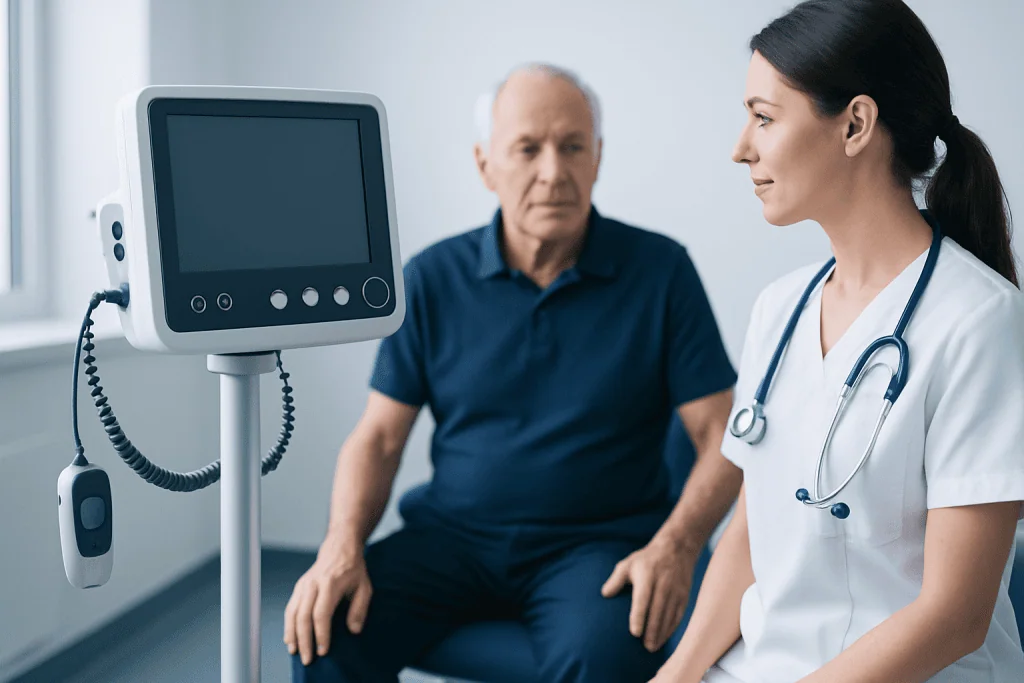
A standard TUG assessment is usually completed in a clear, well-lit space with a firm chair, a marked three-meter walking distance and a timing device. The person generally wears their usual footwear and may use their normal walking aid, such as a cane or walker, if they routinely rely on one. This is recorded because it affects how the result is interpreted.
The clinician gives simple instructions: stand up from the chair, walk at a comfortable and safe pace to the marked point, turn around, walk back and sit down. Timing begins when the person starts to rise and ends when they are seated again. Some clinicians allow a practice attempt, particularly if the person is unfamiliar with the task.
The number of seconds is important, but observation is equally valuable. A clinician may note whether the person needs their hands to push up from the chair, shuffles, loses balance, takes many small steps while turning, hesitates, grabs for support or appears short of breath. These details can guide decisions about further assessment, exercise, equipment or rehabilitation.
- Wear secure, familiar shoes whenever possible.
- Use the usual mobility aid unless the clinician advises otherwise.
- Tell the clinician about pain, dizziness, breathlessness or fear of falling before starting.
- Do not attempt an unsupervised test if standing or walking is currently unsafe.
How are timed get up and go scores interpreted?

In many clinical settings, completing the TUG test in around 10 seconds or less suggests relatively independent mobility for a healthy adult. Times longer than this can be associated with reduced mobility, though there is no single cut-off that applies accurately to every person. Age, physical activity level, height, health conditions, use of a mobility aid and the exact testing method can all influence the result.
A time of 12 seconds or more is often used as a signal that an older adult may need a more detailed falls and mobility assessment. However, it should not be interpreted as proof that a fall will occur. Some people take longer because of arthritis, pain, recent surgery, fatigue or caution, while others may complete the task quickly but still have unsafe movement patterns.
For this reason, clinicians commonly compare a result with the person’s usual ability, previous test results and other measures. These may include a falls history, medication review, blood pressure assessment, vision screening, muscle strength testing, cognitive screening and examination of the feet and footwear. Repeating the test under similar conditions can help show whether mobility is improving, stable or declining.
The most meaningful question is often not whether a score is “good” or “bad,” but whether it represents a change for that individual. A noticeable slowing over weeks or months, especially with new falls or reduced daily independence, deserves discussion with a qualified healthcare professional.
What can a slower TUG result indicate?
A slower result can reflect difficulty in one or more parts of the movement sequence. For example, rising from a chair may be affected by leg weakness, hip or knee pain, reduced joint movement or poor balance. Turning can be challenging when there is dizziness, impaired coordination, neurological symptoms or concern about falling. Walking pace may also slow because of heart or lung symptoms, fatigue, vision changes or medication effects.
Common contributors include deconditioning after bed rest or illness, osteoarthritis, osteoporosis-related pain, peripheral neuropathy, problems with vision or inner-ear balance, and side effects from medicines that cause drowsiness or low blood pressure. Neurological conditions, including Parkinson’s disease and stroke, may also affect walking and turning. A slow test result alone cannot determine the cause.
In some situations, a clinician may investigate symptoms related to Parkinson’s disease or arrange assessment after a stroke, depending on the person’s history and examination. The appropriate evaluation is individualized and may involve primary care, geriatric medicine, neurology, orthopedics, rehabilitation or physiotherapy.
Fear of falling also matters. A person may move unusually slowly because they are worried about losing balance, even when muscle strength is reasonably preserved. Addressing confidence, home hazards, vision, footwear and appropriate exercise can be as important as treating an underlying medical problem.
How clinicians use the test in care planning
The TUG test is most useful when it supports a practical care plan. For someone recovering from an illness, injury or operation, it may help a rehabilitation team set realistic mobility goals and monitor progress. For an older adult with recent falls, it can prompt a fuller assessment of fall-related risk factors and day-to-day safety.
Depending on the findings, a clinician may recommend strength and balance exercises, gait training, review of mobility equipment, pain management, vision care or review of medicines. A supervised physical therapy program may focus on safer transfers, walking endurance, turning, leg strength and confidence in daily activities.
People with persistent joint pain or stiffness may benefit from an assessment of musculoskeletal causes, while people with tingling, numbness or weakness may need neurological evaluation. The goal is to preserve independence and reduce avoidable risks, not simply to improve a number on a stopwatch.
For people who travel for care, Acibadem International’s multidisciplinary specialists and JCI-accredited hospitals can assess mobility concerns and coordinate appropriate diagnostic and rehabilitation care for international patients.
Supporting mobility and reducing fall risk
Regular, appropriately tailored activity is one of the most effective ways to support mobility. Exercises that build leg strength, balance and walking endurance can be helpful, particularly when selected with guidance from a physiotherapist or clinician. People with a history of falls, severe pain, significant weakness or dizziness should seek advice before beginning a new exercise routine.
A safer home environment can also make a meaningful difference. Clear walkways, adequate lighting, handrails on stairs, secure rugs, accessible frequently used items and non-slip footwear can reduce common hazards. An eye examination and review of hearing may be appropriate when sensory changes are affecting confidence or balance.
Medicines should not be stopped without medical advice. However, anyone who feels dizzy, excessively sleepy or unsteady after starting or changing a medicine should tell the prescribing clinician. A review can identify treatments that may contribute to low blood pressure, sedation or impaired coordination.
Nutrition, hydration and management of chronic conditions also support physical resilience. If movement is limited by pain, weakness or poor balance, individualized rehabilitation can help identify safe strategies for returning to valued daily activities.
When to seek medical care
Medical advice is appropriate for repeated falls, a new fear of walking, increasing difficulty getting out of a chair, new reliance on furniture for support, or a clear decline in walking speed or endurance. A doctor should also assess persistent dizziness, fainting, numbness, weakness, severe joint pain or breathlessness that limits normal movement.
Urgent medical care is needed for sudden weakness or numbness on one side of the body, facial drooping, new speech difficulty, sudden severe dizziness with loss of coordination, chest pain, fainting, or a fall with possible serious injury. These symptoms may require prompt emergency assessment.
A TUG test can be safely repeated as part of a care plan, but it should not replace professional assessment when symptoms are new, worsening or unsafe. A clinician can determine whether further tests, specialist referral, falls prevention measures or a structured mobility program are needed.
Frequently asked questions
What does the timed get up and go test measure?
The timed get up and go test measures functional mobility: standing from a chair, walking, turning and sitting down. It gives clinicians information about balance, gait, leg strength and the ability to perform routine movements safely.
What is a normal timed get up and go score?
Many healthy adults complete the test in about 10 seconds or less. However, there is no single normal score for everyone, because age, health conditions, mobility aids and testing conditions affect the result. Clinicians interpret the score in the context of the individual person.
Does a high TUG score mean someone will fall?
No. A slower TUG time can indicate that further falls and mobility assessment may be useful, but it does not predict falls with certainty. Past falls, medications, vision, home safety, strength and specific health conditions also matter.
Can the Timed Up and Go test be done at home?
It may be possible to practice similar movements at home, but formal testing is best performed or supervised by a trained healthcare professional. This is particularly important for anyone who feels unsteady, has recently fallen or uses a mobility aid.
Should a person use a cane or walker during the TUG test?
Usually, a person should use their usual walking aid during the test. The clinician records this information so the result can be interpreted correctly and compared fairly with future assessments.
How can someone improve a timed get up and go result?
Improvement depends on the cause of slower mobility. Strength and balance training, treatment of pain or dizziness, medication review, appropriate footwear and physiotherapy may help. A healthcare professional can recommend the safest approach for the person’s needs.
This article is for general information only and is not a substitute for professional medical advice. Please consult a qualified doctor about your individual situation.
Explore treatments in Turkey — costs, top hospitals & a free quote
JCI-accredited · board-certified surgeons · reply within 24h
Add us as a Preferred Source to see more of our trusted health content across Google Search, AI Overviews and Discover.
Check your numbers in seconds
BMI, calories, due date, blood pressure and 30+ more clinical calculators — free, instant, doctor-reviewed ranges.

More from the Health Library

Mastic Gum Benefits: An Evidence-Based Guide for Patients

Pap Smear — Explained by Medical Evidence, Not Myths

Erythrophobia — Explained by Medical Evidence, Not Myths

Casodex — Explained by Medical Evidence, Not Myths

Creatine Water Retention: A Complete Medical Overview