Tinea Versicolor Photos: An Evidence-Based Guide for Patients

Tinea versicolor commonly appears as flat discolored patches with very fine scale. Photos can suggest the condition, but they cannot confirm the diagnosis on their own.
Key Takeaways
- Tinea versicolor commonly appears as flat discolored patches with very fine scale.
- Photos can suggest the condition, but they cannot confirm the diagnosis on their own.
- The rash often becomes more noticeable after sun exposure because affected skin tans differently.
- Treatment usually involves antifungal shampoos, creams, or sometimes prescription tablets.
- Recurrence is common, but long-term skin damage is not typical.
- Medical review is important if the rash is spreading, unclear, or not improving with treatment.
Tinea versicolor photos usually show flat patches that are lighter, darker, or pinker than the surrounding skin, often on the chest, back, shoulders, or upper arms. Pictures can help patients recognize the pattern, but a clinician is often needed to confirm the diagnosis because several other skin conditions can look similar.
Overview: what tinea versicolor photos usually show
Tinea versicolor photos most often show small, flat patches of skin that look lighter, darker, or slightly pink compared with nearby skin. These patches may join together into larger areas and are commonly seen on the chest, upper back, shoulders, neck, and upper arms. A very fine, dry scale may be visible, especially when the skin is gently scratched.
This condition is caused by an overgrowth of a normal yeast that lives on the skin. It is also called pityriasis versicolor and is not usually dangerous. It is not a sign of poor hygiene, and it is not typically considered highly contagious in the way many infections are.
Photos can be helpful because they show the common distribution and color changes, but appearance varies with skin tone, lighting, and recent sun exposure. On lighter skin, patches may look tan, pink, or brown. On darker skin, they are often more noticeable as lighter areas.
Many people search for images because they want to know whether a new rash is likely to be tinea versicolor. That is a reasonable starting point, but pictures alone cannot distinguish it from every similar-looking rash. A dermatologist or other qualified doctor can confirm whether these marks are a dermatologic condition such as tinea versicolor or another cause of skin color change.
How the rash can look on different skin tones
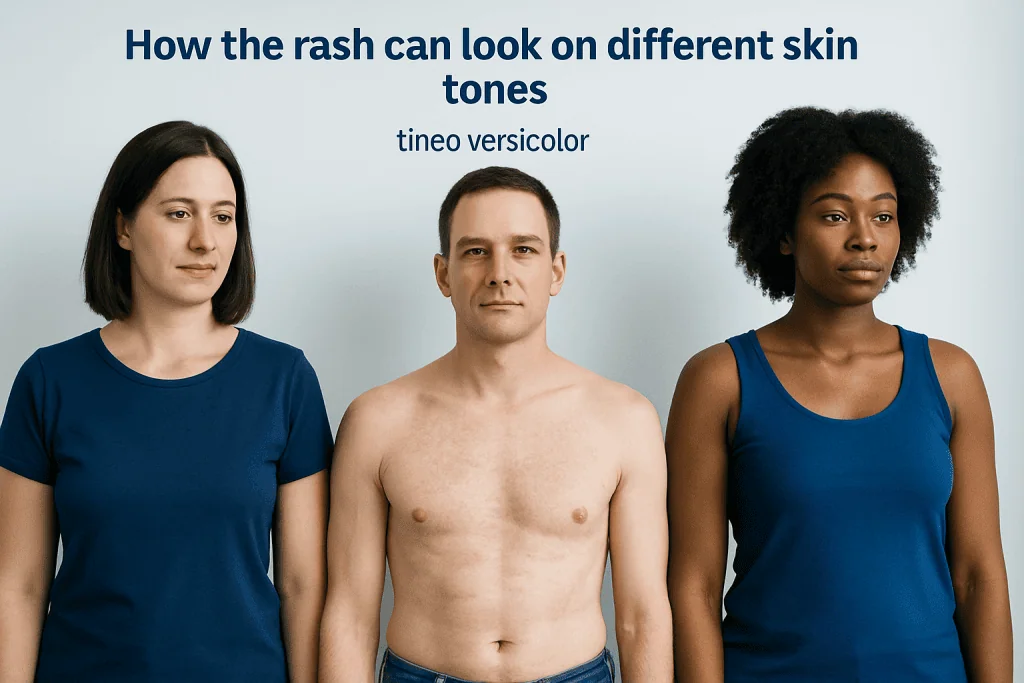
One reason online image searches can be confusing is that tinea versicolor does not look exactly the same in every person. The yeast affects pigment in the skin, so the main clue is often color contrast rather than a bright, raised rash. In some people the patches are pale or white, while in others they are brown, salmon-colored, or slightly red.
On darker skin tones, the condition often stands out as lighter patches that do not tan normally. On lighter skin tones, it may appear darker than the surrounding skin, especially after time in the sun. In both cases, the edges are often soft rather than sharply outlined.
The texture can offer another clue. Unlike conditions that create thick plaques or moist irritation, tinea versicolor usually has a subtle, powdery scale. The surface may feel dry, but it is often not very inflamed. Mild itching can occur, especially in warm weather or after sweating, but some people have no symptoms beyond the change in color.
Photos taken at home can miss this fine scale because phone cameras tend to flatten texture. For that reason, a rash that looks smooth in a photo may still be consistent with tinea versicolor in person. If the appearance remains unclear, a skin specialist may assess it more accurately during an examination.
Common symptoms and where it appears

The most common sign is discolored patches on the upper body. These patches may start small and then merge into wider areas. They are usually found in places with more oil-producing skin, including the upper chest, upper back, shoulders, and sometimes the neck or upper arms.
Most cases cause few physical symptoms. Some people notice mild itch, especially when they are hot or sweaty. Others only become aware of it after sun exposure, when unaffected skin tans but the involved patches remain lighter or become more obvious.
Typical features include:
- Flat spots or patches rather than swollen bumps
- Color that is lighter, darker, pink, or tan compared with surrounding skin
- Fine, dry scaling on the surface
- Patchy distribution on the trunk and shoulders
- More noticeable contrast in summer or humid climates
Symptoms that are less typical include significant pain, marked swelling, crusting, oozing, or sores. When those features are present, another diagnosis may need to be considered. Conditions such as eczema, vitiligo, seborrheic dermatitis, or psoriasis can sometimes resemble it at first glance.
Causes, triggers, and risk factors
Tinea versicolor develops when Malassezia yeast, which normally lives on human skin, grows more actively than usual. This change can interfere with the skin’s normal pigmentation and lead to visible patches. It is best thought of as an overgrowth of a common organism rather than a classic infection picked up from another person.
Warmth, humidity, and sweating can make the condition more likely. It is seen more often in hot climates and during summer months. Oily skin, hormonal shifts, and a personal tendency to recurrence may also play a role.
Risk factors can include:
- Living in a warm or humid environment
- Heavy sweating or frequent exercise in heat
- Oily skin
- Adolescence and young adulthood
- A weakened immune system in some cases
Tinea versicolor is common and usually benign, but it can be frustrating because it often returns. The color change may remain for weeks or months even after the yeast has been treated, which can make people think therapy has failed when the infection itself has already improved.
How doctors diagnose tinea versicolor
Doctors usually diagnose tinea versicolor by examining the skin and asking about symptoms, climate, sweating, and prior episodes. The pattern and distribution often provide strong clues. A clinician may gently scrape the skin to look for fine scale that is not easy to see at first.
If the diagnosis is uncertain, additional office-based tests may help. A sample of scale can be examined under a microscope with potassium hydroxide, which may show yeast elements consistent with tinea versicolor. In some cases, a Wood’s lamp exam may reveal a characteristic color change, although findings vary.
The main reason diagnosis matters is that many conditions can mimic the look of tinea versicolor in photos. Vitiligo causes lighter patches but usually without scale. Post-inflammatory pigment change can happen after acne, eczema, or minor skin injury. Fungal ringworm on the body can also be confused with it, but ringworm often has a more defined border.
When the rash is widespread, recurrent, or difficult to classify, a dermatologist may recommend a full dermatology consultation. This can help distinguish common pigment changes from inflammatory skin disease or less typical causes.
Treatment options and what to expect
Treatment aims to reduce the yeast overgrowth and prevent relapse. For many patients, first-line care includes antifungal products applied to the skin, such as medicated shampoos, washes, or creams. These are often used on the affected areas and sometimes on a broader area of the trunk because the yeast may be present beyond the visible patches.
If the rash is extensive, keeps returning, or does not respond to topical treatment, a doctor may prescribe oral antifungal medicine. The right approach depends on the severity, how often the condition recurs, and the person’s general health. Self-treating repeatedly without confirmation can be unhelpful if the rash is actually another condition.
It is important to know that color recovery is slow. Even after successful treatment, the skin may not return to its usual shade right away. The scale generally improves first, while the pigment difference can take weeks to months to fade.
Some patients benefit from specialist-led skin care planning, especially if episodes are frequent in warm seasons. In broader skin medicine programs, clinicians may also evaluate related concerns such as persistent rashes or unusual pigmentation changes through services connected with dermatology treatment.
Prevention, self-care, and recurrence
Because recurrence is common, prevention is an important part of care. People who tend to get tinea versicolor repeatedly may be advised by their doctor to use an antifungal wash periodically during hot or humid months. This should be based on individual medical guidance rather than long-term self-treatment without review.
Simple self-care steps can also help reduce flare-ups. Showering after heavy sweating, changing out of damp clothes, and choosing breathable fabrics may make the skin less favorable for yeast overgrowth. Using non-greasy skin products can also be useful for some people.
Helpful habits may include:
- Keeping the skin as cool and dry as practical
- Washing after exercise or heavy perspiration
- Wearing loose, breathable clothing
- Following treatment instructions for the full recommended duration
- Seeking review if the rash keeps returning or changes in appearance
Sun protection can also make the condition less visually prominent while the skin recovers. Since affected areas tan differently, broad-spectrum sunscreen may reduce contrast between normal and previously affected skin. If there is uncertainty about recurrence or lingering discoloration, a doctor may check whether another diagnosis is present.
When to seek medical care
Medical care is appropriate if a rash looks like tinea versicolor but the diagnosis is not clear, especially when online photos are the main comparison. A doctor should also review skin changes that are rapidly spreading, painful, very itchy, inflamed, or not improving after appropriate over-the-counter antifungal treatment.
It is also sensible to seek care if the discoloration involves the face, if there are repeated recurrences, or if there are medical conditions that affect immunity. Pregnant patients, children, and people taking multiple medicines should ask a clinician before starting new treatments, particularly oral antifungal drugs.
Specialist assessment may be helpful when pigment changes cause ongoing concern or affect quality of life. At Acibadem International, multidisciplinary specialists in JCI-accredited hospitals evaluate and treat skin conditions for international patients, including recurrent or uncertain cases that may need coordinated care.
Finally, skin changes that do not fit the usual pattern of tinea versicolor may need a different work-up. If another cause is suspected, clinicians may recommend evaluation through a skin check-up or referral for targeted testing and treatment.
Frequently asked questions
What do tinea versicolor photos usually look like?
They usually show flat patches that are lighter, darker, pink, or tan compared with nearby skin. The patches often appear on the chest, back, shoulders, or upper arms and may have a very fine dry scale.
Can tinea versicolor be diagnosed from photos alone?
Photos can raise suspicion, but they cannot confirm the diagnosis reliably. Several other conditions can look similar, so an in-person exam or simple office test may be needed.
Why does the rash look more obvious after sun exposure?
Affected skin often does not tan in the usual way, so contrast becomes more noticeable after surrounding skin darkens. This is one reason many people first notice the condition in summer.
Is tinea versicolor contagious?
It is generally not considered highly contagious. The yeast involved normally lives on the skin of many healthy people, and the problem usually comes from overgrowth rather than catching it from someone else.
How long does it take for skin color to return to normal?
The yeast may respond to treatment before the color change fades. Pigment recovery often takes weeks to months, even when the condition has been treated successfully.
What is the difference between tinea versicolor and vitiligo?
Tinea versicolor usually causes patchy color change with fine scale, often on the trunk, and may itch mildly. Vitiligo typically causes more clearly defined pale patches without scale and is not caused by yeast overgrowth.
This article is for general information only and is not a substitute for professional medical advice. Please consult a qualified doctor about your individual situation.
Joint and spine care in Turkey — expert assessment & treatment
JCI-accredited · board-certified surgeons · reply within 24h
Add us as a Preferred Source to see more of our trusted health content across Google Search, AI Overviews and Discover.

More from the Health Library

Oatmeal Bath — Explained by Medical Evidence, Not Myths

Cherry Pits — Explained by Medical Evidence, Not Myths

Endocrine: What Patients Need to Know

Adiponectin: What Patients Need to Know

Heart Monitor: A Complete Medical Overview