Wet Amd — Explained by Medical Evidence, Not Myths

Wet AMD affects the macula, the part of the retina responsible for sharp central vision. Common symptoms include blurred central vision, wavy lines, dark spots, and difficulty reading or recognizing faces.
Key Takeaways
- Wet AMD affects the macula, the part of the retina responsible for sharp central vision.
- Common symptoms include blurred central vision, wavy lines, dark spots, and difficulty reading or recognizing faces.
- Risk increases with age, smoking, family history, and cardiovascular risk factors.
- Eye specialists diagnose wet AMD with a dilated eye exam and retinal imaging tests.
- Treatment often involves anti-VEGF eye injections, and prompt care offers the best chance to protect vision.
Wet AMD is an advanced form of age-related macular degeneration in which abnormal blood vessels grow under the retina and leak fluid or blood. It can affect central vision quickly, but early diagnosis and treatment can help slow damage and preserve sight.
Overview: what wet AMD means
Wet AMD, short for wet age-related macular degeneration, is a chronic eye disease that damages the macula, the central part of the retina needed for detailed vision. The condition develops when abnormal blood vessels grow beneath the macula and leak fluid or blood. This leakage can disturb the retinal layers and lead to rapid changes in central vision.
Unlike dry AMD, which usually progresses more slowly, wet AMD may cause noticeable vision changes over days or weeks. It does not usually affect side, or peripheral, vision in the early stages, but it can make everyday tasks such as reading, driving, and recognizing faces more difficult. Because vision changes can happen quickly, wet AMD is considered a condition that needs prompt ophthalmic evaluation.
Wet AMD most often occurs in older adults and may develop in one eye first, although the other eye can also become affected over time. Some people with wet AMD previously had dry AMD, while others first notice problems when the wet form appears. Understanding the condition early can help people seek care without delay and make informed decisions about treatment.
Symptoms and how vision may change
The hallmark of wet AMD is a change in central vision. Straight lines may start to look bent, wavy, or distorted. Printed words can seem blurry or missing in the middle, and colors may appear less vivid. Some people notice a dark, gray, or empty spot in the center of what they are looking at.
Symptoms may start suddenly or seem to worsen over a short period. A person may find that faces are harder to recognize, fine detail is difficult to see, or one eye seems weaker than the other. In the early stage, changes may be subtle, especially if the unaffected eye compensates.
Common symptoms of wet AMD include:
- Blurred or distorted central vision
- Straight lines appearing wavy
- A dark or blank area in the center of vision
- Trouble reading or seeing fine detail
- Difficulty recognizing faces
- Reduced contrast or color brightness
Any new distortion, sudden blur, or central blind spot should be assessed by an eye doctor as soon as possible. Wet AMD symptoms can overlap with other eye conditions, so proper diagnosis is important.
Why wet AMD happens: causes and risk factors

Wet AMD develops when fragile, abnormal blood vessels grow from deeper layers beneath the retina into the area under the macula. This process is called choroidal neovascularization. These vessels are prone to leaking fluid, fats, or blood, which can scar the macula and interfere with the retina’s ability to process detailed central vision.
The exact reason this vessel growth begins is not always clear, but age-related changes in the retina play a major role. Chronic inflammation, oxidative stress, and changes in the retinal support tissues are thought to contribute. Wet AMD is closely related to macular degeneration overall, but not everyone with dry AMD will go on to develop the wet form.
Several factors can raise the risk of wet AMD:
- Older age
- Smoking or a history of smoking
- Family history of AMD
- High blood pressure or other cardiovascular risk factors
- High cholesterol
- Obesity and low physical activity
- Previous dry AMD
- Light skin or light-colored eyes, in some populations
While some risk factors cannot be changed, others can. Not smoking, controlling blood pressure, and staying engaged in routine eye care may help lower the chance of disease progression or support overall eye health.
How wet AMD is diagnosed
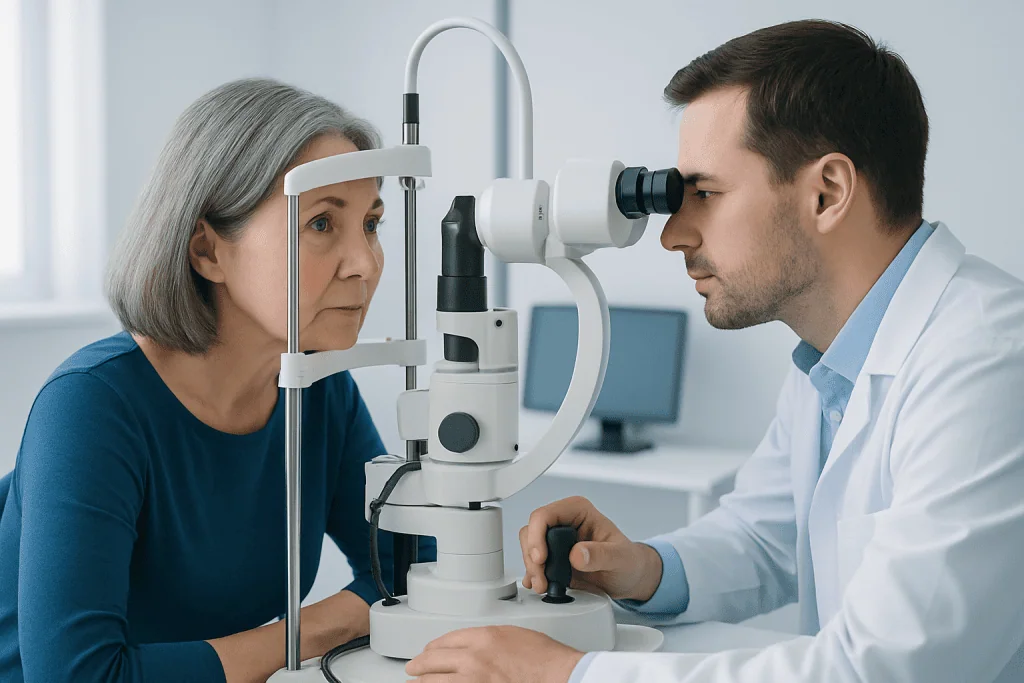
Diagnosis usually begins with a discussion of symptoms and a complete eye examination by an ophthalmologist, often a retina specialist. The doctor checks visual acuity, looks at the back of the eye through a dilated pupil, and examines the macula for signs of swelling, bleeding, or abnormal vessels.
Retinal imaging is central to confirming wet AMD. Optical coherence tomography, often called OCT, creates detailed cross-sectional images of the retina and can show fluid or thickening in the macula. Another test, fluorescein angiography, uses a dye and photographs to show leakage from abnormal blood vessels. In some cases, OCT angiography may also help visualize blood flow without dye.
An Amsler grid may be used in the clinic or at home to detect distortion in central vision, but it does not replace a full medical evaluation. Because other retinal disorders can mimic wet AMD, such as diabetic eye disease or retinal vein problems, specialists may recommend a comprehensive eye examination and targeted retinal imaging to confirm the cause.
Early diagnosis matters because treatment is generally more effective before significant scarring has formed. Even if symptoms affect only one eye, both eyes should be monitored carefully over time.
Treatment options and what to expect
The main treatment for wet AMD is medication injected into the eye to block vascular endothelial growth factor, or VEGF. These medicines, often called anti-VEGF therapy, help reduce leakage, slow abnormal vessel growth, and in many cases stabilize vision. Some people also notice improvement in vision after treatment, although results vary depending on how advanced the condition is when therapy begins.
Treatment is usually given as a series of injections over time rather than a one-time procedure. Follow-up visits are important because wet AMD can remain active or return, and doctors adjust the treatment schedule based on examination findings and OCT imaging. For many patients, intraocular injection therapy is the cornerstone of care.
Less commonly, other approaches may be considered in selected situations. These can include laser-based therapies for certain patterns of abnormal vessel growth, although they are used much less often than anti-VEGF medicines today. Low-vision rehabilitation can also be valuable for people whose central vision remains impaired despite treatment, helping them use magnifiers, lighting strategies, and adaptive tools more effectively.
If another retinal problem is present or diagnosis is uncertain, the specialist may investigate related conditions such as retinal diseases before finalizing a treatment plan. Near the end of the care pathway, some patients also benefit from broader ophthalmology evaluation and follow-up to monitor both eyes and overall visual function.
Living with wet AMD: self-care and prevention
Wet AMD requires medical treatment, but daily habits still matter. Protecting general vascular health may support the eyes as well. People are often advised to stop smoking, keep blood pressure and cholesterol under control, stay physically active within their ability, and attend regular eye follow-up appointments.
For people who have AMD in one or both eyes, monitoring vision at home can be helpful. Using an Amsler grid, checking each eye separately, and noting new distortion or blurred areas may help identify changes that need urgent review. Good lighting, larger print, and contrast-enhancing tools can also make reading and other close work easier.
A balanced diet that includes leafy green vegetables, fruits, and sources of omega-3 fats can support general eye health. Some people with age-related macular degeneration may be advised by their doctor to take specific nutritional supplements, but these are not appropriate for everyone and do not replace treatment for wet AMD. It is safest to ask an eye specialist before starting supplements.
Emotional adjustment is also important. Changes in vision can affect confidence and independence, but vision rehabilitation services and practical home adaptations often help people continue daily routines safely and comfortably.
When to seek medical care
A person should seek prompt medical care if they notice sudden blurred central vision, straight lines becoming wavy, a new dark spot in the center of sight, or rapid difficulty reading or recognizing faces. These symptoms do not always mean wet AMD, but they should be assessed urgently because several retinal problems can threaten vision if treatment is delayed.
People already diagnosed with dry AMD should be especially alert to new changes, even if they seem mild or affect only one eye. Covering one eye at a time can reveal differences that may otherwise go unnoticed. If symptoms appear outside normal clinic hours, it is still sensible to contact urgent eye care services for advice.
Regular follow-up is important even when vision feels stable. Ongoing monitoring helps detect recurrent leakage, treatment response, and changes in the other eye. Acibadem International’s multidisciplinary eye specialists in JCI-accredited hospitals diagnose and treat retinal conditions for international patients, with care plans guided by clinical evaluation and imaging findings.
Frequently asked questions
Is wet AMD the same as dry AMD?
No. Both are forms of age-related macular degeneration, but wet AMD involves abnormal blood vessel growth and leakage under the macula. Dry AMD usually progresses more slowly, while wet AMD can cause faster central vision changes and often needs prompt treatment.
Can wet AMD cause complete blindness?
Wet AMD usually affects central vision rather than total vision. This means many people keep some side vision, but central detail needed for reading or recognizing faces can become severely impaired if the condition progresses. Early treatment can help reduce the risk of major vision loss.
Is wet AMD an emergency?
New symptoms of wet AMD should be treated as urgent, even if they are not always a medical emergency in the same sense as trauma. Sudden distortion, central blur, or a dark spot in vision should be evaluated quickly by an eye doctor. Early assessment gives the best chance to preserve vision.
Can wet AMD be cured?
There is no guaranteed cure for wet AMD, but modern treatment can often control the disease. Anti-VEGF injections may reduce fluid leakage, slow progression, and sometimes improve vision. Ongoing monitoring is usually needed because the condition can remain active or return.
How often are injections needed for wet AMD?
The treatment schedule varies from person to person. Some patients need injections monthly at first, while others may move to a less frequent plan depending on how the eye responds. The retina specialist decides the schedule based on symptoms, examination, and retinal imaging.
What should a person avoid if they have wet AMD?
Smoking is one of the most important avoidable risks and should be stopped if possible. It is also wise to avoid skipping follow-up appointments or ignoring new visual symptoms. A doctor may also advise better control of blood pressure and other cardiovascular risk factors to support overall eye health.
References
- American Academy of Ophthalmology
- National Eye Institute
- National Health Service
- Mayo Clinic
This article is for general information only and is not a substitute for professional medical advice. Please consult a qualified doctor about your individual situation.
Explore treatments in Turkey — costs, top hospitals & a free quote
JCI-accredited · board-certified surgeons · reply within 24h
Add us as a Preferred Source to see more of our trusted health content across Google Search, AI Overviews and Discover.
Check your numbers in seconds
BMI, calories, due date, blood pressure and 30+ more clinical calculators — free, instant, doctor-reviewed ranges.